From the hearing organ to sensitivity, attention, and familiar expressions.
Sound and a listener
Hearing creates a connection with sound
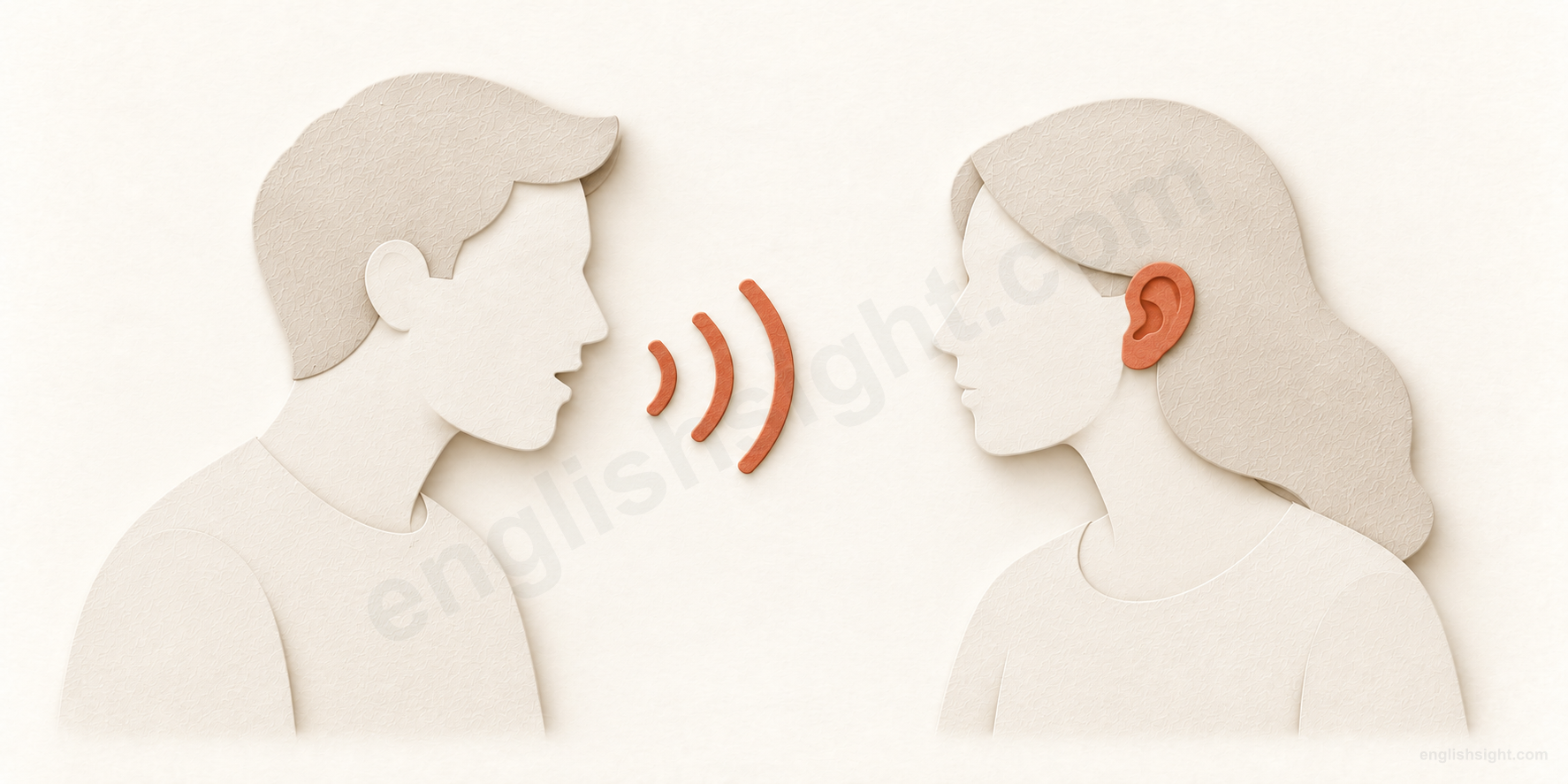
The person on the left speaks.
ear
The highlighted ear marks where the listener receives sound.
Three curved sound lines extend toward the person on the right.
The ear connects a listener with sound; hearing alone does not mean understanding.
An ear is the organ through which a person or animal hears; in many expressions it also represents sensitivity to sound or attention to a speaker.
The sound-and-listener relationship is a teaching model. Hearing, understanding, remembering, and choosing to listen are different things. The grain meaning and several fixed idioms need their own explanations.
Your ears let you hear. English also uses ear for skill with sound and for the attention you give another person. These connections help organize many everyday expressions.
Some expressions are fixed idioms, and an ear of corn is a separate plant meaning. One picture cannot predict every use; the constructions below show where each meaning belongs.
01
The body and close speech
Start with a countable body part, then notice how ordinary speech links the ear with receiving sound.
01
an / the / possessive + ear; plural ears; ear + noun
an ear / ears
the body part used for hearing
Situation
A person is standing beside a loud machine.
Meaning in context
They cover both ears.
Ear can name the visible outer part or the hearing organ more broadly.
Use a countable noun for the body part: one ear, two ears, my left ear. Animals can have large, pointed, or floppy ears. Cover your ears describes a physical action, not necessarily a refusal to listen.
Ear is a noun; hear is a verb. I heard a noise tells what happened, while My ears hurt describes the body. In an ear infection and ear protection, singular ear modifies another noun.
The inner ear also helps with balance. This lesson explains ordinary vocabulary rather than detailed anatomy. Long-eared is an adjective meaning having long ears; it does not make ear itself a verb.
In a sentence
I covered my ears when the alarm started.
Watch the difference Say My ear hurts or My ears hurt, matching the number; not My ear hear a noise.
02
ears + ring / pop; sound / words + ring in someone’s ears
my ears are ringing
describe a sound sensation or a sound that stays in the mind
Situation
A loud sound has ended.
Meaning in context
A ringing sensation remains.
The same sound vocabulary can describe a bodily sensation or a vivid memory.
My ears are ringing describes a ringing sound you experience, often in a context of noise. My ears popped describes a pressure-related sensation, for example during a flight. An ear infection names a condition; earache names pain.
His words are still ringing in my ears usually means that you remember the words vividly. The words, rather than your ears, are the subject. No real ringing sound needs to be present now.
In a sentence
The coach’s last words were still ringing in my ears on the way home.
Watch the difference Context decides whether ringing describes a physical sensation or a remembered sound; it does not always mean someone is speaking about you.
03
whisper + something + in someone’s ear; have a word in someone’s ear
whisper in someone’s ear
speak quietly and closely to a particular person
Situation
A room is noisy or a message is private.
Meaning in context
One person receives a quiet remark.
In someone’s ear identifies the close listener, not a destination for a physical object.
Whisper something in someone’s ear means speak very close to that person so they can hear a quiet voice. The ear connects the body part with receiving speech.
Have a word in someone’s ear, especially in British English, means speak privately, often to advise or warn. A whisper is not required. Walls have ears is a warning that others may overhear; walls do not literally hear.
In a sentence
Maya whispered the answer in my ear.
Watch the difference Have a word in your ear is a private conversation, not a promise to say exactly one word.
02
Hearing and sensitivity to sound
Ear can refer to judgment of sound, the method of playing music, or the pleasure of listening.
04
have + an / a good / a keen + ear for + noun
have an ear for music / languages
notice and judge differences in sound well
Situation
Two speakers use slightly different accents.
Meaning in context
A listener notices the difference.
Ear can represent sensitivity to sound rather than the size or health of an organ.
Have an ear for something describes an ability to recognize sound patterns, such as tunes, accents, rhythm, or natural dialogue. For introduces the area of ability. A good or keen ear emphasizes skill. A trained ear has developed this sensitivity through experience.
A tin ear, especially for music, expresses poor sensitivity. To my ear or to my ears introduces how something sounds to me: To my ears, that line sounds too formal. This is a viewpoint, not a measurement of hearing.
A good ear does not by itself mean that someone can read music or speak every language. The expression concerns sound judgment; other skills need separate learning.
In a sentence
Nora has a good ear for accents and notices tiny changes in pronunciation.
Watch the difference Use an ear for music, not an ear of music. Good hearing and an ear for music are related but different abilities.
05
play + (music / an instrument) + by ear
play a tune by ear
perform music from hearing and memory
Situation
You have heard a tune but have no written score.
Meaning in context
You find and play its notes.
By ear identifies the way the musician works.
Play by ear means rely on how the music sounds, including memory of what you have heard, rather than on reading the notes. You can play a tune, a song, or an instrument by ear.
By is a preposition of method here. Ear stays singular without an article: by ear. This expression does not mean that the ear physically plays the instrument.
In a sentence
I cannot read music, but I can play that tune by ear.
Watch the difference Play a tune by ear concerns music. Play it by ear can instead mean adapt a plan as events develop.
06
be / sound + easy on the ear
easy on the ear
pleasant to listen to
Situation
A recording begins.
Meaning in context
Its sound is comfortable and pleasing.
The expression evaluates the sound itself.
A voice or melody that is easy on the ear is pleasant to hear. On the ear belongs to this established informal expression; on does not describe physical contact.
This differs from music to my ears, which often celebrates the content of welcome news. A calm voice can be easy on the ear even when it brings disappointing news.
In a sentence
The singer’s gentle voice is easy on the ear.
Watch the difference Easy on the ear does not mean easy to understand; a pleasant voice may still use unfamiliar words.
03
Attention, information, and listening
These expressions distinguish being eager to listen, being distracted, gaining influence, and ignoring a message.
07
be + all ears
be all ears
be keen and ready to listen
Situation
A friend offers to explain a surprise.
Meaning in context
You invite the whole story.
The listener signals full interest.
I’m all ears is an informal way to invite someone to continue. All exaggerates your attention: it is as if listening were your whole activity.
Use be with the expression: We were all ears when she began. It describes interest and readiness, not a guarantee that every detail will be understood.
In a sentence
You have an idea for the trip? I’m all ears.
Watch the difference Keep plural ears even with I: I’m all ears, not I’m all ear.
08
lend + an / a sympathetic + ear + (to someone / something)
lend an ear / a sympathetic ear
offer patient attention and support
Situation
A colleague needs to talk about a difficult day.
Meaning in context
Someone listens with care.
Ear stands for the attention offered by a listener.
Lend an ear to someone or their problems means listen attentively and kindly. Lend a sympathetic ear makes the supportive attitude explicit. No body part changes owner.
She offered a sympathetic ear similarly means she was available to listen. A receptive ear emphasizes willingness to consider what is said; a friendly ear can mean a friendly person who will listen. Give ear to is a more formal or literary way to say listen to or heed; it is less usual in casual conversation.
In a sentence
I cannot solve the problem, but I can lend a sympathetic ear.
Watch the difference Listening sympathetically does not necessarily mean agreeing or giving advice.
09
listen + with half an ear + (to someone / something)
listen with half an ear
give only part of your attention
Situation
Someone speaks while you finish a message.
Meaning in context
You catch only part of what they say.
Half measures attention figuratively, not a body part.
With half an ear describes divided or weak attention. You are hearing something, but another activity occupies much of your mind.
Compare be all ears, which presents eager attention, and lend an ear, which presents willing listening. Half an ear does not normally mean that only one of your two ears works.
In a sentence
I listened with half an ear while I finished the email.
Watch the difference Say half an ear, not half of ear; this is an idiom about attention.
10
have + someone’s ear; have the ear of + person
have someone’s ear
be able to get an influential person to listen
Situation
You need a decision-maker to consider a proposal.
Meaning in context
A trusted adviser can put the proposal to them.
Possessing an ear figuratively means having access to attention and influence.
Someone who has the manager’s ear can get the manager to listen and take their views seriously. The phrase often suggests trust and influence, rather than a single accidental hearing.
Have the ear of the manager is the same pattern with an of-phrase. Get someone’s ear can describe gaining their attention. Compare have an ear for music, which describes the listener’s ability, not access to another person.
In a sentence
Ravi has the director’s ear, so ask him to explain our proposal.
Watch the difference Change the possessive with the listener: her ear means her attention, not her skill at music.
11
bend + someone’s ear + (about something)
bend someone’s ear about something
talk to someone at length about a subject
Situation
You start describing a problem.
Meaning in context
The listener hears a long account.
The speaker occupies the listener’s attention for some time.
Bend someone’s ear is informal and often suggests that the listener finds the talk excessive or tiresome. It can also appear in a light request: Can I bend your ear for a minute?
About introduces the topic. The speaker bends the listener’s ear; this reverses the viewpoint of lend an ear, where the listener offers attention. No physical bending is involved.
In a sentence
Leo bent my ear about the parking rules all the way home.
Watch the difference This can sound critical of the speaker. Use talk to someone for a neutral description.
Keep your ears open for an announcement means stay alert so that you notice it when it happens. For names the sound, information, or person you are listening out for.
You can also strain your ears to hear something faint: that emphasizes effort to hear now. Keep your ears open emphasizes continuing readiness, not physical effort.
In a sentence
Keep your ears open for the announcement about our platform.
Watch the difference Open is figurative here; people do not open their ears like doors.
13
keep / have + your / an + ear to the ground
keep your ear to the ground
stay informed about recent developments
Situation
You want to know when a local job becomes available.
Meaning in context
You pay attention to news and what people say.
Listening represents active awareness of a situation.
Keep or have your ear to the ground means stay informed through what you notice and hear. It often concerns opportunities, changes, or local opinion, not a particular sound.
My ear, your ear, and an ear are possible. The full ground expression is established; its meaning cannot be predicted simply by changing ground to any other surface.
In a sentence
I’ll keep my ear to the ground and tell you if a studio becomes available.
Watch the difference No one needs to put an ear on the floor. The expression means stay informed.
An animal may literally prick up its ears by raising them. For a person, My ears pricked up means I became interested and listened closely. I pricked up my ears gives the person as subject.
A sound caught my ear means it attracted my attention. Compare catch my eye for something noticed visually. Cock an ear, a less everyday alternative, means turn attention toward a sound.
In a sentence
My ears pricked up when I heard the name of my old school.
Watch the difference A person’s ears need not visibly move. Caught my ear means attracted attention, not understood everything.
15
message + fall on deaf ears; person + turn a deaf ear to + message
fall on deaf ears / turn a deaf ear
receive no attention or refuse to listen
Situation
Residents ask for a safer crossing.
Meaning in context
The people responsible take no notice.
The two constructions give different subjects to an ignored message.
A warning, request, or appeal falls on deaf ears when others ignore it. The message is the subject: Our appeal fell on deaf ears.
A person turns a deaf ear to a warning when they ignore it. Close or shut your ears to something also means refuse to listen. These are established figurative expressions, not descriptions of someone’s hearing ability.
In a sentence
The committee turned a deaf ear to our request for more lights.
Watch the difference Use plural ears after fall on, but a singular ear after turn a. A request falls on deaf ears; it does not turn a deaf ear.
16
words / information + go in one ear and out the other
go in one ear and out the other
be heard but not retained or acted on
Situation
You explain where to put the keys.
Meaning in context
The listener immediately forgets.
Hearing does not ensure that information stays with the listener.
The full expression presents words as entering and immediately leaving, a teaching metaphor for little lasting attention or memory. It is informal and can sound annoyed.
The subject is normally what is said: The instructions went in one ear and out the other. Unlike a technical account of hearing, the idiom says nothing about an actual route through the head.
In a sentence
The directions went in one ear and out the other, and I had to ask again.
Watch the difference Use go, with past went; do not treat in one ear as a separate phrasal verb that always means forget.
17
news / a report + reach someone’s ears; come to someone’s ears
reach someone’s ears
become known to someone through what they hear
Situation
A piece of news spreads.
Meaning in context
Another person hears about it.
The news is the subject; the person is its eventual recipient.
News reached my ears means I heard about it, often through other people rather than directly from the original source. Come to someone’s ears has a similar meaning.
This wording is more colorful than I heard that…. The phrase does not by itself prove that the news is accurate or that it was secret.
In a sentence
News of the cancelled concert finally reached my ears on Friday.
Watch the difference Reach takes the recipient directly: reached my ears, not reached to my ears.
04
Reactions and feelings
Some expressions concern welcome news, surprise, or a happy face. Read the whole expression rather than predicting from ear alone.
18
news / words + be + music to someone’s ears
music to my ears
information that makes you very pleased
Situation
You are worried about the repair cost.
Meaning in context
You hear that the repair is free.
The pleasure comes from what the message means.
That is music to my ears means I am delighted to hear it. The subject can be a promise, an offer, or any welcome information; it need not be actual music.
Use the possessive of the pleased listener: music to her ears. Compare easy on the ear, which describes a pleasing sound even when the message itself is unwelcome.
In a sentence
“The repair is free.” Those words were music to my ears.
Watch the difference Music is uncountable here: music to my ears, not a music to my ears.
19
cannot / could not + believe + possessive + ears
cannot believe your ears
be very surprised by what you hear
Situation
A quiet colleague announces an unexpected career change.
Meaning in context
You react with amazement.
Disbelief emphasizes surprise rather than necessarily rejecting the facts.
I couldn’t believe my ears is a familiar reaction to something remarkable, shocking, or unexpected. It often exaggerates astonishment; the speaker may accept that the words were really said.
Compare I couldn’t hear her, which reports difficulty hearing. Can’t believe my ears says that what I heard was surprising, not that the sound was too quiet.
In a sentence
I couldn’t believe my ears when Sam said he was moving to Iceland.
Watch the difference Use my ears for my reaction; your ears would describe the other person’s reaction.
20
possessive + ears + be + burning
your ears are burning
jokingly sense that others are talking about you
Situation
Friends have just mentioned you.
Meaning in context
You arrive and joke that you somehow knew.
A bodily feeling becomes an established joke about being discussed.
Were your ears burning? can be said to someone you have just been talking about. I thought my ears were burning is a playful response. The expression can suggest unkind talk, but the joke need not accuse anyone of hostility.
Literal burning ears are a bodily sensation. The idiom does not provide evidence that someone was talking about you, and it differs from a sound still ringing in your ears.
In a sentence
“We were just talking about you.” “I thought my ears were burning!”
Watch the difference This is a conversational joke, not a reliable way to know what others are saying.
21
grin / smile / beam + from ear to ear
grin from ear to ear
smile very broadly with happiness
Situation
You open a long-awaited acceptance message.
Meaning in context
Your face shows a huge smile.
The ears mark the imagined width of the smile.
Grin, smile, or beam from ear to ear describes a very wide, happy smile. The expression concerns the face, not hearing or attentive listening.
From…to… supplies two exaggerated endpoints. The mouth does not literally need to reach the ears, and the phrase does not mean the smile passes from one person to another.
In a sentence
Aisha was grinning from ear to ear after she passed the test.
Watch the difference Keep both prepositions: from ear to ear, not between ear and ear.
05
Flexible plans and fixed idioms
These established expressions move beyond literal hearing. Their grammar and tone matter as much as their memorable images.
22
play it by ear
play it by ear
decide what to do as the situation develops
Situation
The weather and the group’s energy are uncertain.
Meaning in context
You leave the next activity flexible.
A familiar musical expression extends to responding without a fixed plan.
We’ll play it by ear means we will decide according to what happens. This is informal and does not require a musical activity. The whole expression carries the meaning of flexible decision-making.
It refers generally to the situation or arrangement. Compare play this song by ear, which ordinarily means perform the music from its sound rather than a written score.
In a sentence
We have no booking for dinner; we’ll play it by ear after the walk.
Watch the difference The ordinary planning idiom keeps it: We’ll play it by ear. Ear alone does not mean improvise.
23
be + up to + possessive + ears + in + noun
be up to your ears in work
have a great deal to deal with
Situation
Several deadlines arrive together.
Meaning in context
Work occupies almost all your attention.
An imagined high level expresses being deeply occupied or involved.
Up to my ears in work is an informal way to say I have far too much work. Debt or problems can also fill the position after in. The expression presents involvement as if you were nearly submerged.
It does not describe listening to work. The height image belongs to the whole construction, and the thing after in explains what occupies or burdens the person.
In a sentence
I’m up to my ears in paperwork this week.
Watch the difference Use in for the workload: up to my ears in reports, not up to my ears of reports.
24
have + something + coming out of + possessive + ears
have something coming out of your ears
have far more of something than you need
Situation
Your garden produces an enormous crop.
Meaning in context
You have a surplus to give away.
The idiom exaggerates quantity rather than describing listening.
Have something coming out of your ears informally emphasizes abundance or excess. Here the thing is what you have too much of, not something being heard.
Compare be up to your ears in work, which stresses being busy or burdened. Something coming out of your ears stresses a surplus, though the context can also make that surplus a problem.
In a sentence
We have tomatoes coming out of our ears, so please take a bag.
Watch the difference Do not interpret the image literally or use it as a medical description.
25
be + (still) + wet behind the ears
wet behind the ears
inexperienced or naive
Situation
Someone has only recently entered a profession.
Meaning in context
They still lack practical experience.
This is a fixed judgment of experience, not a listening instruction.
Still wet behind the ears informally describes someone as inexperienced, often young or new to a role. It can be dismissive, so new to the job is a more neutral description.
The meaning belongs to wet behind the ears as a whole. Neither wet nor behind independently turns ear into a word meaning beginner.
In a sentence
I was still wet behind the ears when I started my first job.
Watch the difference Calling a colleague wet behind the ears may sound patronizing; use it with care.
26
make + a pig’s ear + of + something
make a pig’s ear of something
do a task badly and make a mess of it
Situation
You try to assemble a small shelf.
Meaning in context
The result is badly put together.
The whole informal idiom evaluates a poor result.
Make a pig’s ear of something is especially British English. The object of of is the task or thing handled badly: a repair, a form, or an explanation.
This is a fixed expression, not a predictable extension of hearing. It is informal criticism and can be used about your own mistakes. The related proverb about a silk purse and a sow’s ear is outside the main lesson.
In a sentence
I made a pig’s ear of the form and had to start again.
Watch the difference Keep the possessive pig’s and the preposition of; do not substitute any animal at random.
27
be / find yourself + out on + possessive + ear
be out on your ear
be made to leave abruptly
Situation
Someone repeatedly breaks the rules at work.
Meaning in context
They face being thrown out or dismissed.
The expression presents an unwanted, abrupt departure.
Be out on your ear is an informal expression for being forced to leave, such as losing a job or being expelled from a place. It can sound harsh or threatening.
The person forced to leave supplies the possessive: He was out on his ear. The phrase does not mean that someone is standing outside to listen.
In a sentence
He knew that one more serious mistake could leave him out on his ear.
Watch the difference Use singular ear in this idiom, unlike plural ears in up to your ears.
06
A separate food and plant meaning
The grain-bearing ear is an independent branch with the same spelling and pronunciation.
28
an ear of + corn / wheat; plural ears of + grain noun
an ear of corn / wheat
a grain-bearing part of a cereal plant
Situation
A cereal plant grows.
Meaning in context
A seed-bearing head develops.
This ear is a separate plant noun, not a hearing metaphor.
An ear of wheat is the part that carries the grains. An ear of corn, especially in American food contexts, is a cob with its kernels. Count the ears: two ears of corn, not two corns when you mean two cobs.
Dictionaries separate the historical plant word from the hearing word. Learn this common food and farming use as its own branch instead of forcing it into the listening picture.
The agricultural verb ear, meaning form ears, exists, but is outside this beginner noun lesson. Everyday instructions normally use grow or develop ears instead.
In a sentence
We grilled four ears of corn for lunch.
Watch the difference Ear counts the grain-bearing unit, not an individual kernel and not the whole plant.
Keep the organ, attention, and idiom apart
A noun with a regular plural
Ear and ears are the ordinary noun forms. Use possessives or articles as the expression requires: my ear, an ear for music, by ear, all ears. Most entries here are noun phrases or idioms, not phrasal verbs. Passive and causative verb families are not applicable to this noun lesson.
Hearing is not the same as listening
Hear describes receiving sound; listen describes directing attention. A person may hear a message yet ignore or forget it. An ear for music adds sensitivity and judgment; it does not simply mean an undamaged ear.
Learn fixed wording and tone
An idiom’s number and preposition matter: all ears, a deaf ear to, by ear, up to my ears in. Expressions such as bend someone’s ear, wet behind the ears, and out on your ear can sound critical. Their meanings are conventional, not rules for inventing new combinations.
Coverage boundary
The lesson covers the ordinary body noun, sound ability, attention, a selection of established conversational idioms, and the food and plant noun. Specialized technical ear-shaped projections and newspaper layout terms are outside scope. Old-fashioned punishment expressions and less common regional idioms are noted in the research inventory rather than taught as beginner targets.
Choose the intended meaning
Use the situation and the whole expression to decide.
1. A learner can tell accents apart very accurately. Which expression describes that skill?
2. You will choose what to do after seeing the weather. Which sentence fits?
3. Nobody paid attention to the warning. Which sentence gives the warning as its subject?
4. You buy three cobs of corn with their kernels. Which phrase counts them?
5. A message says your lost bag has been found. You feel relieved. Which expression celebrates the news?
Sources and teaching notes
The sources below were read to check meanings, patterns, and usage labels. The explanations, examples, and teaching diagram are original to this lesson.
This diagram presents a useful connection, not a shared mental picture of every English speaker.