Early places something near a beginning or before a usual, planned, or suitable time.
Time needs a reference
Time needs a reference
A period or an expected time supplies the reference.
early
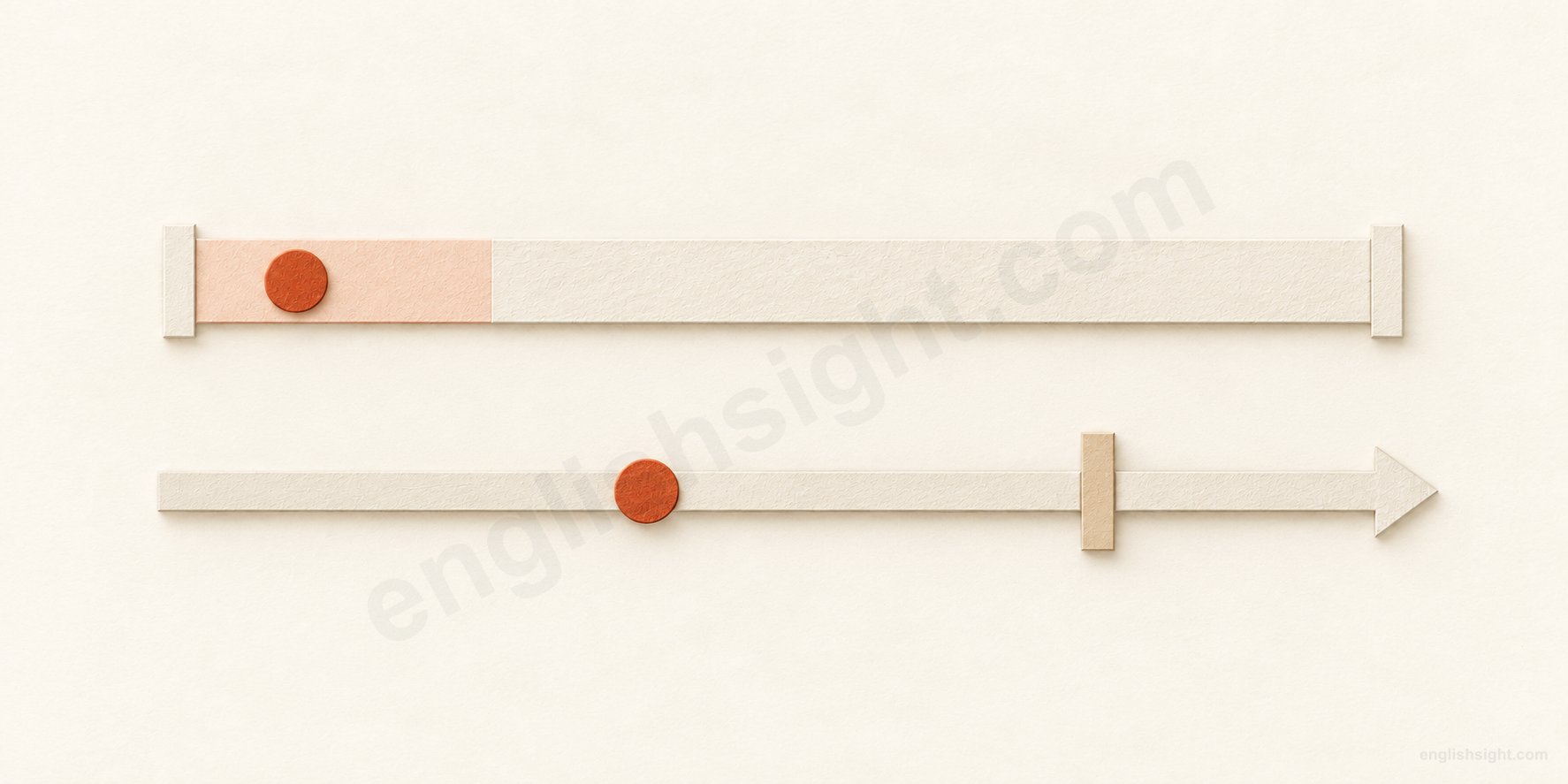
Above: near the beginning. Below: before the expected time.
Read each row from left to right and locate the orange event marker.
Near the beginning, or before the expected time.
Early places an event near the beginning of a relevant span, or before a usual or expected time.
The upper line shows a beginning region; the lower line compares an event with an expected point. Neither line means fast, and neither says whether the timing is good or bad.
An early chapter belongs near the start of a book. An early arrival happens before the time people expected. Ask what period or reference time the speaker has in mind.
The two relations are connected by time, but they are not identical: a train can arrive early at eleven at night. The diagram is a teaching model, not a claim that all English speakers share one mental image.
01
Near the beginning of a period
A day, a decade, a life, or a project supplies the time span. Early places something toward its beginning; the length of that beginning depends on context.
01
early in + period; in early + month / season; early this / next + period
early in June / in early June
locate something near the start of a named period
Reference / situation
June runs from its first day to its last.
Time relation
The visit falls near the beginning of June.
The month supplies a range, not an appointment to beat.
Early in June is an adverbial time phrase. In early June uses early as an adjective within a time expression. Both can locate a visit in the first part of that month.
Use early next week or early this year without in before next or this. Compare in the early 2000s, where the decade expression takes in.
There is no universal cutoff: early June does not promise one exact date. Ask for a date when precision matters.
In a sentence
We plan to visit the island in early June.
Watch the difference Say early next week, not in early next week.
02
early in the morning; an early-morning + noun
early in the morning
during the first part of the morning
Reference / situation
The morning has just begun.
Time relation
Most of that morning is still ahead.
Early refers to a part of the day, not to speed.
We left early in the morning locates the departure within the morning. We left early can instead mean before our usual or planned departure time; context supplies the reference.
An early-morning walk uses a compound modifier before walk. Compare We walked early in the morning, where the time phrase follows the verb.
In a sentence
The streets are quiet early in the morning.
Watch the difference A car can travel slowly early in the morning. Early does not mean fast.
03
the early stages of + noun; early + work / chapters / history
the early stages / early work
the beginning part of a process or body of work
Reference / situation
A project or career has a longer development ahead.
Time relation
You discuss its first phase or first works.
The reference can be a sequence, not a clock.
In the early stages of a project, the project is only beginning to develop. An artist’s early work belongs toward the beginning of that artist’s career, even if it was made centuries ago.
The same relation applies to early chapters, early history, and early modern art. Historical period names have their own established boundaries; early alone does not specify a century.
Early does not necessarily mean first. Several early chapters can follow chapter one. Nor does early work necessarily mean poor work.
In a sentence
The project is still in its early stages, so the design may change.
Watch the difference Do not replace early with first if you mean a whole beginning phase rather than the first item.
04
at / from an early age; in + possessive + early teens / twenties / thirties
at an early age / in her early twenties
refer to youth or the first years of an age range
Reference / situation
A person’s life or age range supplies the scale.
Time relation
The event belongs toward the beginning of that scale.
An early age and early twenties use different reference ranges.
At an early age means when someone was young, often younger than is usual for the activity. It does not specify a number.
In her early twenties places her age in the first part of the twenties. Her late twenties points toward the other end. These are approximate descriptions, not exact ages.
From an early age marks when a continuing activity began: She has enjoyed drawing from an early age. My earliest memories uses the superlative for memories reaching furthest back in my life.
In a sentence
Maya learned to swim at an early age.
Watch the difference Say in her early twenties, not at her early twenties.
05
early + reports / signs / indications
early reports / early signs
information or signs available at a beginning stage
Reference / situation
Only the first information has arrived.
Time relation
You describe what it suggests so far.
Early information is preliminary; early does not certify it.
Early reports are reports from the first stage of an unfolding situation. Early signs or indications are things noticed near the beginning that may suggest what will follow. This use is especially characteristic of news and formal reporting.
The noun determines whether you mean a report, evidence, or a warning. An early report need not be inaccurate, but later information may change the picture.
In a sentence
Early reports suggest that the bridge will reopen tomorrow.
Watch the difference Early signs of recovery are not the same as proof that recovery is complete.
02
Before the usual or expected time
Find the reference time: an appointment, a routine, a season, or the point when an action becomes suitable. Being early can be helpful, inconvenient, or simply factual.
06
arrive / be + (duration) + early; early for + event
arrive early / be ten minutes early
arrive before a planned or expected time
Reference / situation
The lesson is due to start at nine.
Time relation
You arrive at ten to nine.
The scheduled time is the reference, regardless of the time of day.
Arrive early uses an adverb to describe when you arrive. You are early uses an adjective after be and often describes your arrival in the situation.
A duration before early measures the gap: ten minutes early means ten minutes before the relevant time. Early for a meeting names the event whose timing matters.
You can arrive early for an evening concert. On time means at the appointed time; early means before it. In time means before it is too late for a purpose, so it can overlap with early.
In a sentence
I was ten minutes early for my piano lesson.
Watch the difference Do not use ten minutes early to mean in ten minutes. The first measures a gap before a reference time.
07
verb + early; an early + noun; take early retirement
get up early / make an early start
do something before a usual or relatively late time
Reference / situation
A routine or planned day supplies the comparison.
Time relation
The activity starts sooner in that schedule.
Early modifies timing; it does not describe how quickly the action is performed.
Get up early and leave work early put the activity before a usual or expected time. With no explicit comparison, morning routines often suggest a relatively early clock time. An early riser is someone who regularly gets up early.
Make an early start means begin early. Take early retirement means retire before the usual retirement point, not retire in the morning.
Early is both an adjective and an adverb despite ending in -ly: an early breakfast, eat early. There is no ordinary adverb earlyly.
In a sentence
We made an early start to avoid the traffic.
Watch the difference Soon means after a short wait from now or another reference point; early compares with a beginning or expected time.
08
early + plant / crop noun; early-flowering + plants
early flowers / early potatoes
flower or produce a crop before or at the start of the main season
Reference / situation
Most varieties will be ready later.
Time relation
This variety flowers or produces a crop sooner.
The comparison is with the plant’s normal seasonal cycle.
Early flowers can be flowers that appear before others or at the start of the main season. Early potatoes are types ready to harvest relatively early. The adjective does not mean the plants move or grow at a fast speed at every moment.
In early-flowering plants, early modifies flowering. The hyphen helps join the modifier before plants. This is a seasonal use of the same timing relation, not a separate action verb.
In a sentence
We grow early potatoes so that we can harvest some before the main crop.
Watch the difference The noun use earlies for early crops is a specialist gardening term; use early potatoes in general conversation.
09
early enough + to-infinitive; not early enough for + noun
early enough to…
at a time that leaves sufficient time for a purpose
Reference / situation
You need time to park before the show.
Time relation
Your arrival leaves that time available.
Enough evaluates whether the timing meets a practical need.
Arrive early enough to park means arrive at a sufficiently early time for parking. The to-infinitive names the purpose made possible by the timing.
Not early enough means the timing fails that need. It may describe an arrival that is before the official start but still leaves too little preparation time.
Compare We arrived early to park: that gives a purpose. Adding enough explicitly says the arrival time was sufficient for it.
In a sentence
We arrived early enough to park and find our seats.
Watch the difference Put enough after early: early enough, not enough early.
10
it is too early + to-infinitive; too early for + noun / person + to-infinitive
too early to tell / too early for…
before a suitable or sufficiently informed time
Reference / situation
There is not yet enough evidence or readiness.
Time relation
You delay the action or judgment.
Too adds a problem relative to the purpose; early alone does not.
It is too early to tell means the present stage does not yet allow a reliable judgment. It does not have to refer to the morning.
It is too early for lunch can mean the meal is not yet appropriate. It is too early for us to decide names the people whose decision is premature.
Very early merely emphasizes an early time. Too early says it is earlier than is suitable for something. A very early arrival can still be useful.
In a sentence
It is too early to tell whether the new timetable is working.
Watch the difference Do not interpret too early as always meaning extremely early in the morning.
03
Earlier, earliest, and time limits
Comparison changes the reference point. Read than, a duration, as…as, or at the earliest carefully: these patterns do different jobs.
11
earlier than + noun / clause / expected; duration + earlier; earlier and earlier
earlier than expected
compare two times and place one before the other
Reference / situation
You expected the delivery on Friday.
Time relation
It arrives on Wednesday instead.
Earlier is comparative, even when neither time is early in the day.
Use earlier for both the adjective and the adverb: an earlier train, arrive earlier. Than introduces the comparison: earlier than expected, earlier than usual, earlier than we planned.
A duration measures the difference: two days earlier than expected. Much, a little, and even can modify earlier; very normally modifies early instead.
Earlier and earlier describes a continuing movement toward earlier times: The children wake up earlier and earlier in summer.
In a sentence
The parcel arrived two days earlier than expected.
Watch the difference Use earlier, not more early, in ordinary comparison; say much earlier rather than very earlier.
12
earlier today / this week; earlier in + period; duration + earlier; an earlier + noun
earlier today / a week earlier
before now or before a mentioned time
Reference / situation
The conversation has a present or past reference point.
Time relation
You refer back to a preceding event or version.
Earlier can mean previously without implying ahead of schedule.
I called earlier today means I called at a time before now within today. It does not mean I called too soon or before an appointment.
In a past story, a week earlier looks back from the time being discussed: He moved in June; a week earlier, he had sold his car. A week ago normally looks back from now.
An earlier version or an earlier decision similarly means a previous one. It need not belong to the beginning of the day or be the first version ever made.
In a sentence
I checked the address earlier today, but I have forgotten it.
Watch the difference Earlier and ago can use different reference points; choose according to whether you are looking back from now or from a past event.
13
the earliest + noun; verb + earliest; the earliest possible + time noun
the earliest train / arrive earliest
identify the first time among alternatives
Reference / situation
Several departures or arrivals can be compared.
Time relation
One comes before all the others in that set.
Earliest ranks times; it does not necessarily imply a morning event.
The earliest train is the one that leaves first among the trains under discussion. It may be an evening train if all the choices are in the evening.
Who arrived earliest? uses earliest as an adverb. The earliest possible date adds a limit imposed by what can be arranged.
Compare the first train, which identifies the first item in the sequence, and an early train, which can be one of several relatively early departures.
In a sentence
The earliest train we can catch leaves at six this evening.
Watch the difference Use earliest, not most early, for ordinary superlatives.
14
time / date + at the earliest
Friday at the earliest
give the first possible time, allowing a later one
Reference / situation
The repairs cannot finish before Friday.
Time relation
Friday remains possible, but so does a later date.
This expression sets a lower time limit, not a deadline.
Friday at the earliest rules out Thursday and earlier dates. It does not guarantee Friday.
Compare by Friday, which presents Friday as the latest allowed or expected completion point. At the latest reverses the boundary set by at the earliest.
In a sentence
The repairs will be finished on Friday at the earliest.
Watch the difference Do not treat at the earliest as meaning no later than. It means no earlier than.
15
as early as + time / date; as early as possible
as early as…
emphasize a surprisingly early time or an early possibility
Reference / situation
The suggested time is earlier than someone might expect.
Time relation
You draw attention to that early timing.
The emphasis is on how early the stated time is.
The museum could reopen as early as March presents March as an unusually early possibility. Could still marks possibility; as early as does not turn it into a promise.
People were using the route as early as 1800 emphasizes how far back that evidence goes. It does not by itself prove that nobody used the route before 1800.
Compare Come as early as possible: that asks for the earliest feasible arrival, rather than expressing surprise at a stated date.
In a sentence
The museum could reopen as early as March.
Watch the difference A surprisingly early possibility is not necessarily the actual or guaranteed time.
04
Familiar expressions and practical intentions
These phrases describe beginnings, habits, warnings, and requests. Learn the whole expression and its tone rather than inventing its meaning from a picture.
16
early on; early on in + situation
early on
at a beginning stage of a situation
Reference / situation
A course or relationship has begun.
Time relation
Something happens near that beginning.
On is part of an established time expression, not a direction of movement.
Early on locates something near the start of the situation already being discussed. Early on in the course makes that situation explicit.
Compare earlier on, which can look back to a preceding stage or time. Neither expression must refer to the morning, and early on is not a phrasal verb.
In a sentence
Early on in the course, we learned how to ask for help.
Watch the difference Do not confuse early on with on time: the first means at a beginning stage, the second means at the appointed time.
17
it is (still) early days (yet)
it’s still early days
say that a situation is too new for firm conclusions
Reference / situation
A new plan has had only a short trial.
Time relation
You reserve judgment about its future.
Days points to a beginning phase, not a precise number of days.
This British expression often answers optimism or worry with caution: we need more time before deciding how things will turn out. Yet can be added: It’s early days yet.
Compare in the early days of the company, which simply locates something in the company’s beginning period. It’s early days adds the practical message that a judgment is premature.
In a sentence
The new plan looks promising, but it is still early days.
Watch the difference Keep the fixed plural days even with singular it: It’s early days.
18
in / into the early hours; the early hours of + day
the early hours
the time soon after midnight
Reference / situation
One calendar day has just started.
Time relation
The event falls in the hours following midnight.
This fixed phrase can refer to nighttime, before dawn.
In the early hours of Sunday locates an event soon after midnight at the start of Sunday. Into the early hours means an activity continued into that part of the night.
The small hours is another expression for this period. Unlike an early breakfast, the early hours does not primarily compare an event with its usual scheduled time.
In a sentence
The party continued into the early hours of Sunday.
Watch the difference The early hours of Sunday follow Saturday night; they do not mean Sunday evening.
19
verb + bright and early
bright and early
very early in the morning
Reference / situation
You want to begin near the start of the day.
Time relation
You stress an early morning start.
The whole phrase emphasizes morning timing.
Bright and early is a lively, often cheerful way to describe a very early morning start. You can use it for a plan or a report of what happened.
Bright does not require sunshine or prove that the person feels cheerful. The expression works even on a dark winter morning.
In a sentence
We will set off bright and early to catch the ferry.
Watch the difference Do not use bright and early simply for a slightly early arrival at a late-night appointment.
20
be an early bird; the early bird catches the worm
an early bird / the early bird catches the worm
describe an early riser or praise acting before others
Reference / situation
Some people rise or take opportunities before others.
Time relation
You describe the habit or suggest an advantage.
The bird is a conventional metaphor, not a literal participant.
An early bird is a person who gets up or arrives very early, often said humorously. She’s an early bird describes the person, not a species.
The early bird catches the worm is a saying that encourages taking an opportunity before other people do. It offers advice, not a rule that every early action succeeds.
Contrast a night owl, someone who tends to stay awake late. A person can sometimes act early without having an early-rising habit.
In a sentence
You are an early bird today—the rest of us are still asleep.
Watch the difference Do not read the proverb as a guarantee or as a definition of early in every context.
21
have / get an early night
have / get an early night
go to bed earlier than usual
Reference / situation
You are tired and want more rest.
Time relation
You choose an earlier bedtime.
The phrase describes bedtime, not sunset.
Have an early night and get an early night are familiar ways to say that you go to bed relatively early. The relevant comparison is with a usual or relatively late bedtime.
Compare early in the night, which locates an event in the first part of a night. Having an early night is a decision about sleep.
In a sentence
I am exhausted, so I am going to have an early night.
Watch the difference An early night does not mean that darkness starts early.
22
please + verb + at your earliest convenience
at your earliest convenience
request action as soon as reasonably convenient
Reference / situation
A formal message asks someone to respond or act.
Time relation
You ask them to choose the first convenient opportunity.
The wording balances promptness with the recipient’s availability.
This is a conventional business phrase. It requests prompt action while referring to what is convenient for the other person.
It can sound formal or pressing despite its polite wording. In an ordinary message, When you have a moment may feel more relaxed.
If a deadline matters, state it directly. At your earliest convenience leaves the actual time unspecified.
In a sentence
Please send the signed form at your earliest convenience.
Watch the difference Do not use this phrase when you need to communicate an exact deadline.
23
an early + reply / decision
an early reply / an early decision
a reply or decision soon after the present request
Reference / situation
You are waiting for a response.
Time relation
You hope not to wait long.
In this formal use, early can look forward from now.
In formal correspondence, an early reply means a prompt reply in the near future. It need not mean a reply before an agreed deadline or before breakfast.
The request and context supply the starting point. Compare an earlier reply, which can mean a previous reply, and an early report, which may mean preliminary information.
We would appreciate a prompt reply is a clear alternative. Please reply by Thursday gives an actual deadline.
In a sentence
We would appreciate an early reply so that we can confirm the booking.
Watch the difference This formal use can mean soon, but early and soon are not freely interchangeable in every sentence.
24
an early warning of + danger; an early-warning system
early warning of…
advance notice of a serious problem or danger
Reference / situation
A danger may develop later.
Time relation
A signal gives time to prepare or respond.
Early relates the warning to the problem it precedes.
An early warning gives notice before a danger or serious problem develops or becomes more severe. Of introduces what the warning concerns.
An early-warning system is designed to provide that advance notice. Early does not mean that the warning itself is a minor or harmless problem.
Compare early signs of recovery: signs can suggest a welcome development, while warning points toward a problem or danger.
In a sentence
The sensor gives an early warning of a possible leak.
Watch the difference Warning identifies danger; that negative meaning comes from warning, not from early alone.
Keep the reference point in view
Early, soon, and fast answer different questions
Early places an event relative to a beginning or expected time. Soon describes a short wait from a reference point. Fast describes speed. Leaving early does not mean driving fast, and I will leave soon does not say whether I will be ahead of schedule.
Early is an adjective and an adverb
Use an early train and arrive early. The comparative and superlative are earlier and earliest in both roles. Adjective early can follow be when describing an arrival: You are early. Early is not an everyday verb, so passive, causative, and phrasal-verb inventories do not apply.
The word does not judge the outcome
Early action can be useful; an early arrival can inconvenience a host. Too early adds unsuitability, and early enough adds sufficiency for a purpose. Those judgments come from the full construction and context.
Scope of this lesson
This lesson covers modern adjective and adverb uses and selected familiar expressions. Early doors is British informal speech for an early stage, especially in sport. Specialist earlies, historical names, and compounds such as early music are not expanded into separate lessons here.
Choose the right time relation
Find the time span, comparison, or limit before you choose.
1. A concert begins at 9 p.m. You arrive at 8:40 p.m. Which statement fits?
2. A technician says, “Friday at the earliest.” What can you conclude?
3. “I spoke to her earlier today.” Does this say the call happened before an agreed time?
4. A project has just begun, and its results are unclear. Which response reserves judgment?
5. You arrived before the show began, but there was not enough time to park. Which sentence fits?
Sources and teaching notes
The sources below support the uses and expressions. The explanations and examples are original; the timeline model is a teaching interpretation of the verified time relations.
The diagram illustrates time relations; it does not describe a mental picture shared by every native speaker.