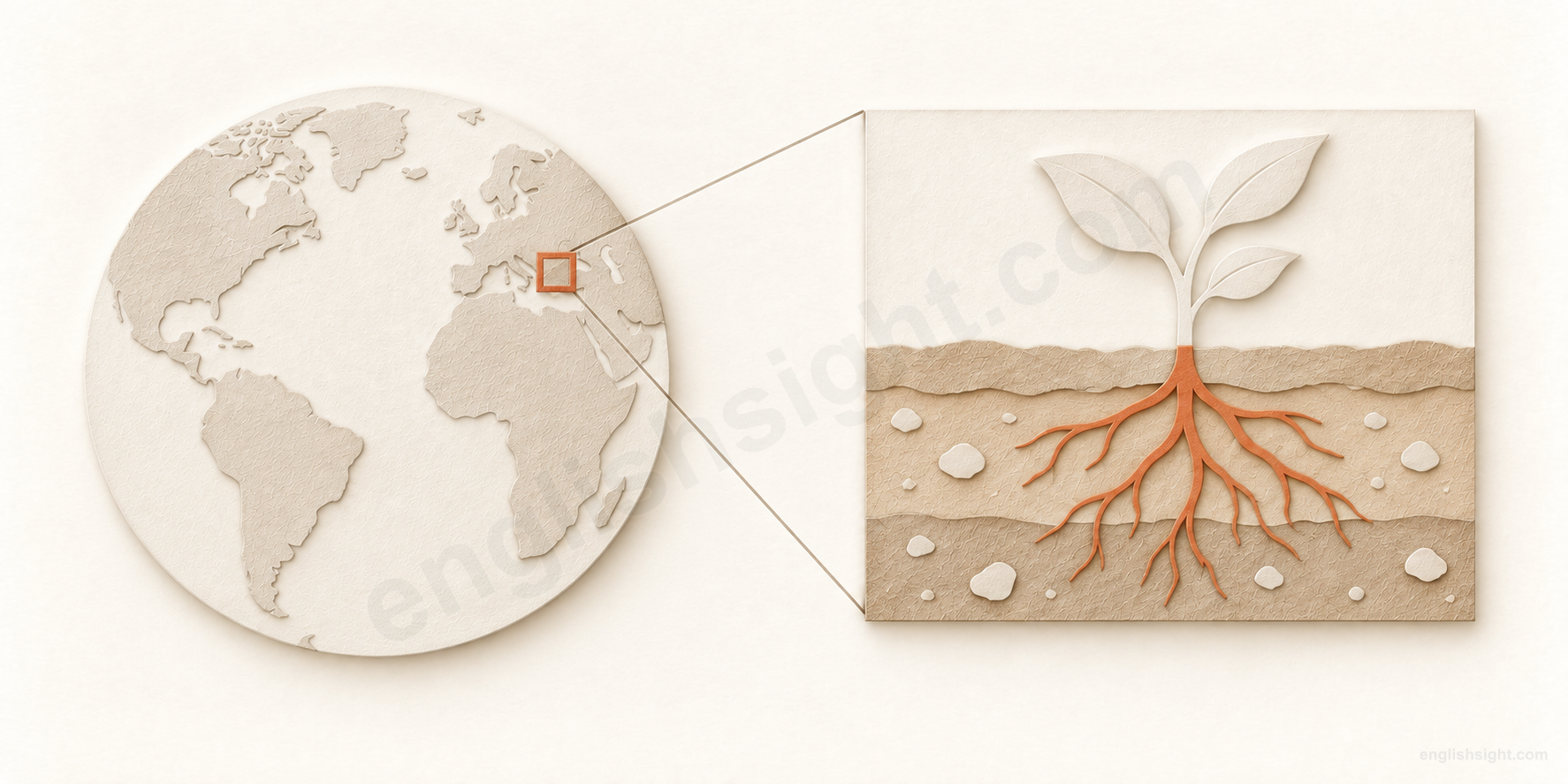
Use earth at different scales, then learn what its familiar expressions add.
From the whole planet to a patch of soil
One planet, a local surface, and its material
The whole planet
earth
The ground surface and soil around roots
Look more closely at the marked patch of land.
Earth can name the planet, the ground, or the soil; this view changes scale, not time.
Earth can name our planet as a whole, its solid ground, or the soil at that ground’s surface.
The sketch changes scale, not time: the enlarged soil section belongs to the highlighted land area on the globe. It is a teaching connection, not a model that predicts every idiom.
Earth can name our planet, the ground beneath us, or the soil around roots. These connected uses differ in scale and in grammar.
Everyday expressions also use earth for emphasis, practical reality, and imagined limits. Learn the whole pattern rather than translating each word separately.
01
The planet, its surface, and its soil
Start with scale: the whole planet, the ground in one place, or the material around a plant’s roots. The surrounding words show which you mean.
01
Earth; the earth / the Earth; planet Earth; Earth’s + noun
Earth / the earth
the planet where we live
Situation / starting point
A camera views our planet from space.
Meaning in context
You identify the whole planet, including its oceans.
Earth names the whole planet; it does not mean only dry land.
Use Earth as a planet name: Earth has one moon. The earth and the Earth are also established ways of referring to our planet. Capitalization varies by context and editorial style; this lesson uses Earth when presenting the name.
Compare Earth with the world. They can refer to the same planet, but world also covers human affairs or a particular sphere of activity: the business world is not a different planet.
In a sentence
From space, Earth looks mostly blue.
Watch the difference Do not use an earth for our one planet in ordinary factual description.
02
on / under / beneath the earth; the earth + shake
the earth beneath our feet
the solid ground rather than the sky or sea
Situation / starting point
You feel a tremor while standing outside.
Meaning in context
You describe the ground moving.
The earth can mean the surface supporting us.
The earth shook refers to ground movement, not necessarily a change in the planet’s orbit. Beneath the earth and under the earth locate something below the surface.
Ground is the usual everyday choice for an outdoor surface: put the bag on the ground. Floor names the walking surface inside a room or vehicle. Land is useful when contrasting a place with the sea.
In a sentence
We felt the earth tremble beneath our feet.
Watch the difference A kitchen floor is not normally called the earth.
03
some + earth; a handful / bag / mound of earth
some earth / a handful of earth
loose soil as material
Situation / starting point
A plant needs more material around its roots.
Meaning in context
You add loose soil to its pot.
Earth as soil is normally uncountable; a handful measures an amount.
Some earth, damp earth, and a bag of earth describe material. Say two bags of earth to count containers; do not turn the soil itself into two earths.
Soil is the neutral gardening word, earth often suggests loose material, and dirt is also used this way especially in North American English. Mud emphasizes wet, sticky soil; dust emphasizes fine dry particles. They are not interchangeable in every description.
In a sentence
I added a handful of earth around the seedling.
Watch the difference For ordinary soil, use much earth or some earth, not many earths.
02
Gardening, animals, and electrical language
Some uses concern actual soil or a connection to the ground. Learn their grammar and regional limits rather than treating every use as the name of the planet.
04
earth up + plants; earth + plants / them + up
earth up potatoes
pile soil around growing plants
Situation / starting point
Potato plants are growing in a row.
Meaning in context
More soil surrounds their lower stems.
Up belongs to a gardening action, not travel away from Earth.
To earth up plants is to draw soil around their bases. The verb has an object: earth up the potatoes or earth the potatoes up. With a pronoun, use earth them up.
This is a gardening use to recognize alongside the material noun. Earthing up names the activity: We spent the morning earthing up potatoes. It is separate from electrical earthing.
In a sentence
We earthed up the potatoes after breakfast.
Watch the difference Earth them up has the natural pronoun position; avoid earth up them.
05
an earth; a fox’s earth; fox earths
a fox’s earth
a fox’s underground home
Situation / starting point
A fox disappears into a hillside.
Meaning in context
You identify its underground home.
This animal-home sense is countable, unlike soil.
An earth can be the hole where a burrowing animal, especially a fox, lives. A fox’s earth and two fox earths count homes, not planets or handfuls of soil.
Burrow is the more broadly useful word for an animal’s underground home. Learn earth here mainly for reading nature descriptions; it is not the normal word for any hole dug by a person.
In a sentence
The cubs waited near the entrance to the fox’s earth.
Watch the difference The article an marks a countable animal home; some earth means soil.
06
an earth; the earth wire; an earth connection
an earth / an earth wire
an electrical connection to the ground, or its wire
Situation / starting point
An electrician inspects a metal appliance.
Meaning in context
The inspection includes its protective ground connection.
British earth corresponds to North American ground in electrical language.
In British electrical usage, an earth is a connection or wire linking equipment to the ground. Earth wire uses the noun before another noun to identify its function.
This branch relates to physical ground, but the phrase concerns an electrical system rather than garden soil. In North American English, ground and ground wire are the corresponding terms.
In a sentence
The electrician checked the earth wire before testing the appliance.
Watch the difference Keep the regional meaning in view: an earth here is not an animal home.
07
earth + equipment; equipment + be + earthed
be earthed
be connected to an electrical earth
Situation / starting point
A report describes an appliance’s electrical connection.
Meaning in context
It says the appliance is connected to earth.
The passive makes the appliance the subject of the connection.
British English uses earth something for connecting electrical equipment to the ground; North American English uses ground something. The passive is especially familiar: the appliance is earthed.
The forms are earth, earths, earthed, and earthing. An electrician earthed the unit is active; The unit was earthed is passive. Earthing here names an electrical process, not a claim about a health treatment.
In a sentence
The report confirms that the metal casing is earthed.
Watch the difference Earthed is a past participle here; Earth’s with an apostrophe expresses possession.
03
Surprise and the widest possible scope
On earth can locate life on our planet, but in questions and strong statements it also adds emphasis. These patterns do different jobs.
08
life / people + on earth; on Earth
life on earth
life existing on our planet
Situation / starting point
You discuss where life exists.
Meaning in context
You restrict the discussion to our planet.
On earth can express location without surprise or anger.
Life on earth refers to living things on this planet. There is normally no the in the familiar phrase on earth. Life on Earth is also possible when Earth is treated as the planet’s name.
Compare earth in a pot, where the noun means soil. The preposition and the larger topic help select the sense; on does not always signal an idiom.
In a sentence
We are studying the history of life on earth.
Watch the difference In this use, on earth does not mean in soil; birds and sea life are included.
09
what / why / how / where / who + on earth + question
what / why / how on earth…?
make a question sound strongly surprised, puzzled, or annoyed
Situation / starting point
A locked room contains a wet umbrella.
Meaning in context
You ask how it got there with strong puzzlement.
After a question word, on earth strengthens the question.
How on earth did it get here? asks the same basic question as How did it get here? but adds a strong reaction. Tone and context determine whether the speaker sounds amused, puzzled, or angry.
Put on earth after the question word or phrase: Where on earth is it? It does not ask for a geographic location on the planet unless the context makes that literal.
In a sentence
How on earth did this umbrella get into the locked room?
Watch the difference This emphasis can sound confrontational; a plain question is gentler.
10
nothing / nobody / no + noun + on earth
nothing / no reason on earth
emphasize that no possible thing or reason qualifies
Situation / starting point
Someone asks if you will sell a treasured photograph.
Meaning in context
You strongly rule out every possible offer.
On earth widens the imagined range of a negative statement.
Nothing on earth would make me sell it means there is absolutely nothing that could persuade me. No reason on earth similarly rejects any possible justification.
The negative comes from nothing or no, not from earth. Keep the normal sentence grammar: There is no reason on earth to hurry. This is an emphatic judgment, not a literal search of the planet.
In a sentence
Nothing on earth would make me sell that photograph.
Watch the difference On earth by itself does not make a positive sentence negative.
11
the + superlative + noun + on earth
the happiest person on earth
extend a superlative to the widest imaginable comparison
Situation / starting point
A friend receives wonderful news.
Meaning in context
She describes herself with an enthusiastic superlative.
The superlative supplies the ranking; on earth expands its scope.
The happiest person on earth compares someone with people everywhere, often as an emotional exaggeration. The best place on earth works the same way for a place.
Compare life on earth, which simply locates life. Here the phrase follows a noun with a superlative, so its communicative effect is stronger. It is not scientific proof of a worldwide ranking.
In a sentence
After that phone call, I felt like the happiest person on earth.
Watch the difference Keep the superlative: happiest, not the happy person on earth for this meaning.
04
Practical thinking and a return to reality
Ground-level reality provides a useful memory link for these expressions. Their familiar meanings come from the complete phrase.
12
a down-to-earth + noun; be down to earth
a down-to-earth person / approach
practical, sensible, and easy to relate to
Situation / starting point
You need advice you can actually use.
Meaning in context
A colleague offers clear, realistic help.
The adjective describes a practical manner, not a downward journey.
A down-to-earth person deals with ordinary realities in a sensible, approachable way. A down-to-earth approach is realistic and usable. The description is generally approving.
Use hyphens in a down-to-earth answer. After be, dictionaries and styles may show down to earth or down-to-earth. Do not interpret the adjective as a claim that the person is poor or uneducated.
In a sentence
Her down-to-earth advice helped us plan a realistic budget.
Watch the difference Down-to-earth describes a quality; come down to earth describes a return to reality.
13
come back / down to earth; come down to earth with a bump
come back / down to earth
return to ordinary reality after excitement or unrealistic hopes
Situation / starting point
A holiday has felt wonderfully carefree.
Meaning in context
The next morning brings bills and chores.
Returning to earth is a figurative return to everyday demands.
Come back to earth and come down to earth describe leaving an excited or unrealistic state. With a bump or with a bang adds that the adjustment is sudden or unpleasant.
An astronaut can also come back to Earth literally. A sentence about bills, work, or unrealistic expectations usually signals the figurative meaning. The person experiences the change; no outside cause is required by this pattern.
In a sentence
After the festival, Monday’s unpaid bills brought a shock, and we came down to earth with a bump.
Watch the difference Use no article in the idiom: come down to earth, not to the earth.
14
bring + someone + (back) down to earth
bring someone back / down to earth
make someone face ordinary facts or limits
Situation / starting point
A team imagines an expensive launch.
Meaning in context
A cost estimate makes the team rethink.
Bring introduces the cause that makes another person become realistic.
The estimate brought us down to earth makes the estimate the cause and us the affected people. We came down to earth describes the change from our side.
You can bring someone back down to earth with a bump when reality is a sharp disappointment. This is an idiomatic pattern with a person as object, not a general rule that bring means disappoint.
In a sentence
The builder’s estimate brought us back down to earth.
Watch the difference Do not omit the object when naming the cause: the estimate brought us down to earth.
05
Money, effort, character, and disappearance
Learn these established expressions with their verbs and articles. A globe or a handful of soil cannot predict their full meanings.
15
something costs the earth; pay the earth for something; charge the earth
cost / pay / charge the earth
involve a very large amount of money
Situation / starting point
You compare two repair prices.
Meaning in context
One price seems far too high.
The earth is an exaggerated amount of money in this British informal idiom.
The repair costs the earth makes the repair the subject. We paid the earth makes the buyer the subject. They charge the earth makes the seller the subject. The verbs determine who pays and who sets the price.
It doesn’t cost the earth is a familiar way to say something is affordable. Keep the article the. The expression does not name a fixed sum or literally price the planet.
In a sentence
A good desk chair doesn’t have to cost the earth.
Watch the difference Pay the earth for the repair differs from the repair costs the earth in subject and structure.
16
promise + (someone) + the earth
promise someone the earth
make extravagantly unrealistic promises
Situation / starting point
An advertisement offers impossible results.
Meaning in context
You warn that its promises cannot be trusted.
The earth represents an impossibly generous offer, not actual ownership.
Promise someone the earth criticizes a promise as too grand to be deliverable. The recipient can be omitted: The advertisement promises the earth.
Promise the moon and promise the world are related established alternatives. This expression is usually skeptical; it does not simply mean promise something valuable and then provide it.
In a sentence
The advertisement promises customers the earth for a tiny monthly fee.
Watch the difference Keep the recipient before the promised thing: promises customers the earth.
17
move heaven and earth + to-infinitive
move heaven and earth
make every possible effort to achieve something
Situation / starting point
A family urgently needs to reach a wedding.
Meaning in context
They try every available way of getting there.
The complete idiom expresses effort, without guaranteeing success.
Move heaven and earth to do something means use every possible effort or resource. The to-infinitive identifies the goal; nothing is literally moved in space.
The idiom can describe determination or effort that ultimately fails. We moved heaven and earth, but still missed the ceremony is coherent. Keep heaven and earth together, without the.
In a sentence
We moved heaven and earth to get everyone to the wedding.
Watch the difference Effort is not the same as a successful result.
18
go to the ends of the earth + to-infinitive / for someone
go to the ends of the earth
be willing to make extraordinary efforts for a goal
Situation / starting point
Someone is searching for a missing family photograph.
Meaning in context
They express willingness to do whatever it takes.
The ends of the earth suggests the furthest imaginable limits.
I’d go to the ends of the earth to find it expresses exceptional determination. The expression often involves willingness rather than a report that the person has traveled anywhere.
Unlike a literal description of a long journey, the idiom can cover contacting people, searching archives, or other efforts. The usual phrase has plural ends and the earth.
In a sentence
I’d go to the ends of the earth to find that photograph.
Watch the difference The phrase does not claim that the planet has a physical edge.
19
disappear / vanish off the face of the earth
vanish off the face of the earth
disappear completely or become impossible to find
Situation / starting point
A file was here yesterday.
Meaning in context
Nobody can find any trace of it today.
The phrase intensifies disappearance rather than naming a route.
Vanish or disappear off the face of the earth says that someone or something seems to have disappeared completely. It is often hyperbole when a missing object must still exist somewhere.
The subject disappears; the sentence does not name someone who destroys it. Compare wipe something off the face of the earth, where an agent causes removal or destruction.
In a sentence
The signed form seems to have vanished off the face of the earth.
Watch the difference This idiom does not necessarily mean death or destruction.
20
wipe + someone / something + off the face of the earth
wipe something off the face of the earth
destroy or remove something completely
Situation / starting point
A report describes the destruction caused by a flood.
Meaning in context
It stresses that nothing of a village remained.
Wipe names a cause of total removal; vanish does not.
The flood wiped the village off the face of the earth presents the flood as the cause and the village as what was destroyed. This is strong language for complete devastation.
The related expression wipe something off the map also stresses total destruction or removal. The phrase is not a neutral substitute for move something to another place.
In a sentence
The flood almost wiped the village off the face of the earth.
Watch the difference Almost matters: it stops the sentence from asserting complete destruction.
21
someone + be + the salt of the earth
the salt of the earth
a thoroughly decent, honest, dependable person or group
Situation / starting point
Neighbors help one another without expecting payment.
Meaning in context
You praise their character warmly.
The whole expression praises people; it does not describe their appearance.
They’re the salt of the earth praises people for dependable goodness. It can describe a single person too: My neighbor is the salt of the earth.
The wording is traditional and can sound socially patronizing in some contexts, particularly when praising a group from a position of privilege. Use it with attention to tone rather than as a neutral job or class label.
In a sentence
Our neighbors are the salt of the earth; they always help when someone is ill.
Watch the difference Keep the full phrase, including both instances of the.
22
be hell on earth; a hell on earth
hell on earth
an experience or situation of extreme misery
Situation / starting point
People are trapped in unbearable heat.
Meaning in context
They describe the experience in very strong terms.
Hell contributes the suffering; on earth places that imagined misery in real life.
It was hell on earth describes extreme suffering or an exceptionally unpleasant experience. Hell on earth and a hell on earth both occur.
This phrase is emotionally strong. A speaker may exaggerate a bad journey, but a serious account may refer to actual hardship. Earth alone does not carry the meaning of misery.
In a sentence
With no water or shade, those hours felt like hell on earth.
Watch the difference The phrase is much stronger than inconvenient or uncomfortable.
23
look / feel / taste + like nothing on earth
look / feel like nothing on earth
look or feel extremely bad
Situation / starting point
Someone sees their exhausted reflection after a sleepless night.
Meaning in context
They describe their appearance with comic exaggeration.
This fixed comparison is different from nothing on earth followed by a verb.
I look like nothing on earth is an informal way to say I look dreadful. Feel, taste, and similar verbs can occur in the same expression.
Compare Nothing on earth would persuade me, where nothing is the subject and means no possible thing. In like nothing on earth, the comparison is a conventional judgment that something is very bad.
In a sentence
After the overnight bus ride, I looked like nothing on earth.
Watch the difference Do not interpret this as a literal claim that you resemble no known species.
24
go to earth; run + someone / something + to earth
go to earth
go into hiding, especially to avoid someone
Situation / starting point
A witness fears being found by pursuers.
Meaning in context
The witness hides rather than answering the door.
This mainly British expression concerns concealment, not returning from space.
Go to earth means hide from someone or something. Its link with an animal going into a burrow can help memory, but people need not hide underground.
Go to ground is an established alternative. Contrast go to earth with run someone to earth: in the latter, the subject searches successfully and the object is the person found. For example, We finally ran the missing expert to earth at her workshop.
In a sentence
When reporters arrived, the owner went to earth.
Watch the difference Run someone to earth means find them after a difficult search, not make them hide.
Choose the sense and keep the whole expression
Scale, articles, and countability
Earth / the earth can refer to the planet. The earth often means the ground, while some earth means soil. An earth can be an animal home or, in British electrical language, a ground connection. The surrounding words select the meaning.
Related words are not automatic substitutes
Use ground for an ordinary outdoor surface, floor inside a building, and soil for gardening material. World also describes human affairs. Do not replace these words with earth simply because a translation uses the same word.
Grammar and scope
Earth is primarily a noun in this lesson. The electrical verb is transitive and often passive; earth up is a gardening particle construction. The noun idioms are not all phrasal verbs. Earth’s is possessive; earths can be a plural count noun or a present-tense verb. Chemistry, astrology, historical senses, and most derived compounds are outside this lesson.
The diagram’s boundary
The globe and soil section explain connected physical meanings. They do not establish an etymology for every expression or a mental picture shared by all speakers. No movement or before-and-after event is implied by the enlargement.
Choose the meaning that fits
Look at the situation, the article, and the whole expression.
1. You need more loose soil for a plant pot. Which request fits?
2. You cannot understand how a locked window opened. Which question adds strong puzzlement?
3. A high price makes your team reconsider its unrealistic plan. Which sentence identifies the price as the cause?
4. A British report says that an appliance is earthed. What does this describe?
5. A friend says the repair costs the earth. What is the friend saying?
6. After a long search, you ran a missing expert to earth at her workshop. What happened?
Sources and teaching notes
Dictionary entries support the uses and regional labels below. Explanations and examples are original; the change-of-scale sketch is a teaching aid.
The diagram illustrates a teaching connection, not an image shared by every speaker.