Find the boundary, then explore sharpness, advantage, tension, and gradual movement.
A surface has a limit
A surface has a limit
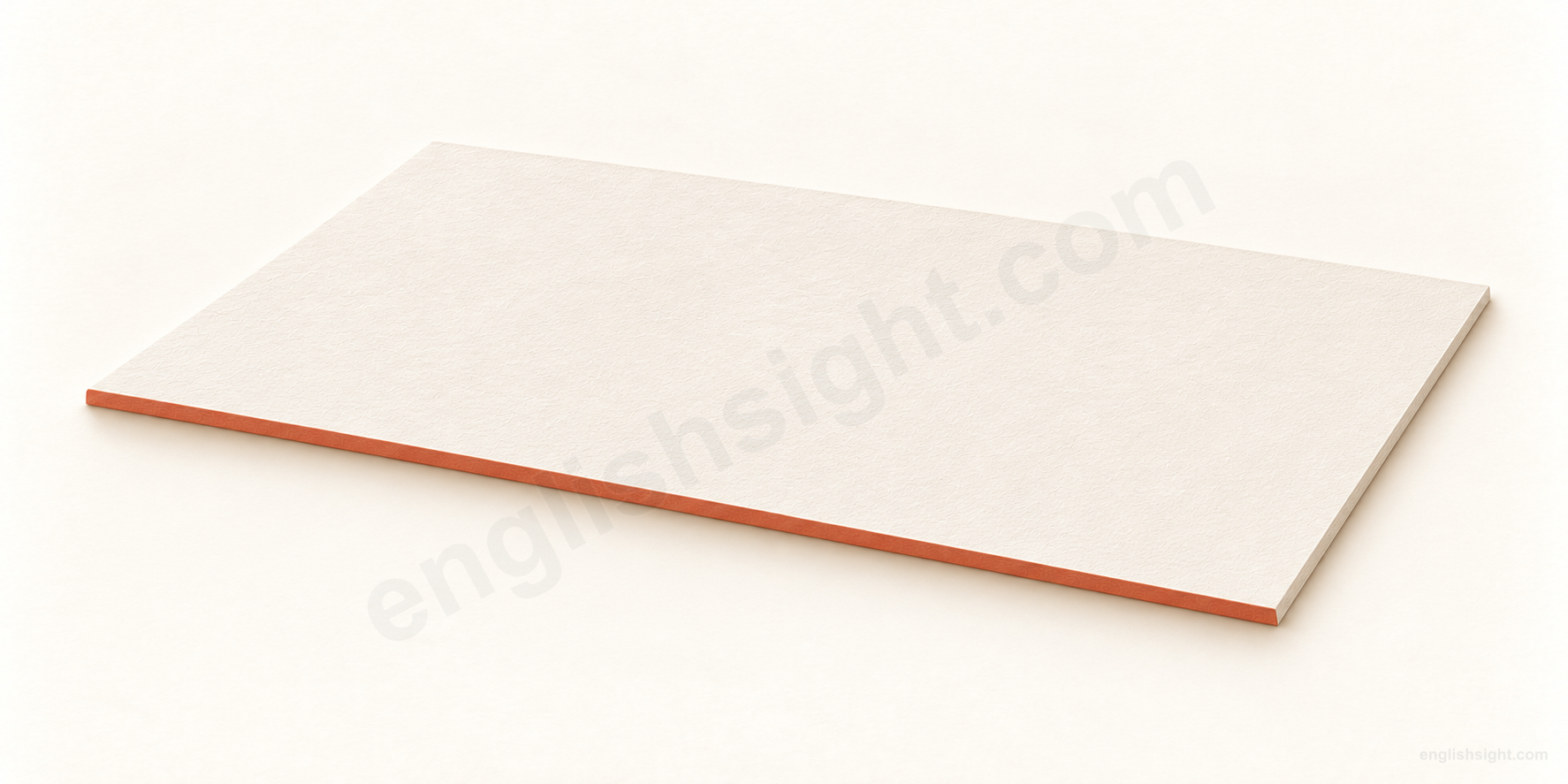
A sheet of card has a broad surface.
edge
Beyond this boundary, the card ends.
The surface reaches the highlighted outer boundary.
The highlighted edge marks where the card ends. Its other sides also have edges; an edge need not be sharp.
An edge is the outer limit or narrow boundary of something, where its main surface or extent ends.
The sketch isolates a physical boundary. It shows a relationship, not an event: nothing needs to move or fall. Abstract uses and idioms require their own explanations.
Put a finger near the end of a sheet of card: the card is still there on one side, and beyond its edge the card stops. Edge names that outer limit or the narrow part beside it.
This gives us a useful starting point for limits and thresholds. A blade supplies another useful connection: sharpness can describe a voice or a strong effect. Learn advantage, gradual movement, and fixed expressions in their own constructions; the drawing cannot predict them all.
01
Surfaces, narrow sides, and borders
Locate an edge, distinguish it from a corner or a face, and describe a cutting edge or a border added to an object.
01
the edge of + noun; at / on / near / along the edge
the edge of a table / town
the outer limit, or the part next to it
Situation / starting point
A notebook rests near the end of a tabletop.
Location / interpretation
Very little tabletop remains beyond the notebook.
Edge locates an object relative to the whole surface or area.
Of names the whole: the edge of the table, the forest, or the page. Top, bottom, and outer can specify which edge. At or on the edge of town both locate something near the town’s limit; on does not mean it is resting on top of the town.
Along an edge follows its line; over the edge goes beyond it. Compare a border between countries and a page margin: border often concerns a division or surrounding strip, while margin usually names space left beside the main content.
English example
Move the notebook away from the edge of the table.
Watch the difference A corner is where sides meet; an edge can extend between corners or run around a curve. Use of, not the edge from the table.
02
stand / balance something on its edge
stand a coin on its edge
balance a flat object on its narrow side
Situation / starting point
A coin is lying flat.
Location / interpretation
Its broad faces are upright and its narrow rim touches the table.
The edge can be a narrow surface rather than a mathematical line.
On its edge contrasts with flat on one face. A coin has a curved edge; an edge does not have to be straight. The possessive its identifies the coin’s own narrow side.
For a solid shape, edge also names a line where faces meet. A cube has twelve edges and eight corners: faces, edges, and corners name different features.
English example
For the photograph, we balanced the coin on its edge.
Watch the difference On edge without a possessive is also a feeling idiom. The coin’s physical position does not mean it is nervous.
03
the edge of a blade; a sharp edge; lose its edge
a sharp edge / lose its edge
the cutting part of a blade, or its sharpness
Situation / starting point
A kitchen knife no longer cuts easily.
Location / interpretation
Its cutting side needs sharpening.
A blade’s edge is a particular working boundary.
A sharp or serrated edge describes the part that cuts. The handle, point, and edge are different parts: a pointed tool is not necessarily sharp along its sides.
A knife that has lost its edge has become less sharp. The same words can describe a person or team losing effectiveness; use the subject and context to decide whether any actual blade is involved.
English example
This old knife has lost its edge and crushes the tomatoes.
Watch the difference An ordinary table edge need not cut. Do not add the meaning sharp to every use of edge.
04
edge something with something; be edged with / in something; trees / shrubs edge a place
be edged with / in
have a material or line around the outside
Situation / starting point
A plain curtain needs a contrasting border.
Location / interpretation
Blue ribbon runs along its outside.
Here edge is a verb whose object receives a border.
Edge the curtain with ribbon makes the curtain the object and ribbon the bordering material. The passive is especially useful: The curtain is edged with blue ribbon. In can introduce a border’s material or colour too.
Edge a lawn means trim its boundary neatly. The object determines the practical action: trimming grass and adding ribbon are not the same job, although both concern an outer boundary. In a lace-edged cloth, -edged forms part of a compound adjective.
The bordering things can themselves be the subject: Small shrubs edge the path means they grow along its sides. This describes an arrangement; it does not say that the shrubs are moving or that someone is adding them now.
English example
The white curtains are edged with blue ribbon.
Watch the difference In this sense edged does not mean moved slowly. A with-phrase often identifies the added border.
02
Advantage, tone, and force
Here edge describes a relative benefit or a noticeable quality. The sentence around it tells you which.
05
have an / the edge over / on somebody; give somebody an edge
have / give / gain an edge over
have a benefit that helps in comparison with others
Situation / starting point
Two applicants have similar experience.
Location / interpretation
One also speaks the language needed for the job.
The comparison concerns a helpful difference, not a physical boundary.
Have an edge over or on someone means have an advantage. Give someone an edge names what supplies it; gain, keep, and lose an edge describe changes in that advantage. Competitive edge is useful in work and sport.
An edge can be slight or substantial; it is not a promise of victory. Say an edge when introducing one advantage, and the edge when treating it as the relevant advantage in a comparison.
English example
Her experience with children gave her an edge over the other applicants.
Watch the difference Use an edge over them, not an edge than them. Edge here does not mean they have already been defeated.
06
an edge to / in somebody’s voice; an edge of + feeling
an edge to someone’s voice
a noticeably sharp or tense quality in speech
Situation / starting point
The words are polite.
Location / interpretation
The speaker’s tone nevertheless sounds irritated.
The sharpness is heard in the delivery.
There was an edge to her voice points to tension, anger, bitterness, or another sharp emotional quality. A nervous edge names the particular feeling. The noun does not refer to the physical limit of the sound.
Listen to both words and tone: a mild sentence can be delivered with an edge. This sharpness connection is helpful for memory, but it does not make every use of edge angry.
English example
“We agreed on ten o’clock,” she said, with an edge to her voice.
Watch the difference Compare on edge: that describes the person’s tense state, while an edge to the voice describes a quality of the speech.
07
give something an edge; have a + adjective + edge
give something an edge
add a striking quality or a distinct character
Situation / starting point
A familiar song sounds predictable.
Location / interpretation
An unusual arrangement makes it more striking.
A creative edge need not be an advantage over a named competitor.
A performance, story, or design can have an edge: something about it feels forceful, daring, or arresting. An adjective or of-phrase can name that quality, such as a satirical edge. A musical style can also supply a distinct flavour: The song has a bluesy edge means that blues influences its sound; it need not sound aggressive.
This use evaluates the effect on an audience. Compare give the band an edge over its rivals, which makes a competitive comparison explicit. The same noun can therefore focus on style or on advantage.
English example
The unexpected ending gives the comedy a darker edge.
Watch the difference An edge does not automatically mean better, dangerous, or rude. The adjective and context specify the effect.
03
Thresholds, feelings, and risk
Read the whole expression: being on edge, being on the edge of something, and being on the edge of your seat do different jobs.
08
be on the edge of + noun; bring / drive something to the edge of + noun
on the edge of tears / disaster
very close to entering a state or situation
Situation / starting point
A speaker is struggling to stay composed.
Location / interpretation
Crying may start at any moment.
A physical limit becomes a threshold between states.
On the edge of tears means almost crying, not already crying. On the edge of disaster similarly puts a situation close to a bad outcome. Of names what may begin; nouns such as tears, collapse, and extinction are familiar here.
To the edge of disaster describes being brought to that threshold; over the edge can describe passing a limit. Fixed expressions can overlap: push someone to the edge can also mean make them lose control. Teeter on the edge of something stresses a precarious situation that may deteriorate. Read the whole expression rather than treating the preposition as a precise measurement.
English example
After the long argument, Ben was on the edge of tears.
Watch the difference Keep the and of: on the edge of tears. On edge alone describes tension and does not name a particular approaching event.
09
push / send somebody over the edge; push somebody to the edge
push someone over the edge
cause someone to lose emotional or behavioural control
Situation / starting point
Someone is already under severe strain.
Location / interpretation
One more event makes them unable to cope.
The edge represents an emotional limit in this expression.
Push or send someone over the edge presents a final pressure as more than the person can manage. The subject is a cause; the object is the person affected. The event may be one of a series.
This is stronger than annoy someone. The expression does not diagnose a medical condition, and it does not mean someone has literally pushed a body over a ledge. Use the context to separate the figurative and physical readings.
English example
After weeks of stress, the extra demand nearly pushed her over the edge.
Watch the difference Over makes the crossing image explicit. Push someone to the edge can also mean cause a loss of control in this established idiom, so do not assume to always means the person still copes. Nearly makes the example describe an almost-reached result.
10
be / feel on edge; keep somebody on edge
be / feel on edge
be tense and find it hard to relax
Situation / starting point
A message is expected but has not arrived.
Location / interpretation
Every notification makes the waiting person jump.
The whole phrase describes a state of tension.
I’m on edge can describe anxiety, nervous excitement, or irritability. It does not specify what you are close to doing. Feel, seem, and keep someone on edge fit this state expression too.
Compare on the edge of the bed, a literal location, and on the edge of tears, an approaching state. In the feeling idiom there is no the and no required of-phrase. Remember the complete form rather than translating edge alone.
English example
The unexplained delay kept everyone on edge.
Watch the difference I feel on the edge can suggest being near a limit, but it is not the standard form of this tense-state idiom. Use I feel on edge.
11
be on the edge of one’s seat; keep somebody on the edge of their seat
on the edge of your seat
fully absorbed and excited about what happens next
Situation / starting point
A film has reached a crucial scene.
Location / interpretation
The audience follows every detail with suspense.
The expression concerns attention and anticipation.
The story kept me on the edge of my seat means I was eager to find out what would happen. It can be praise for a thriller, match, or performance; the viewer need not actually be sitting forward.
Change the possessive with the person: I was on the edge of my seat; they were on the edge of their seats. Unlike on edge, this often highlights enjoyable excitement and absorption.
English example
The final round kept us on the edge of our seats.
Watch the difference On edge and on the edge of your seat are not interchangeable. General nervousness does not necessarily mean fascination.
12
live (life) on the edge; be on a knife-edge / the razor’s edge
live on the edge / on a knife-edge
take risks, or be in a precariously balanced situation
Situation / starting point
A business has almost no room for another setback.
Location / interpretation
One small change could determine whether it survives.
These expressions use a narrow limit to describe risk.
Live on the edge often describes a life involving danger or repeated risk. It does not merely mean live on the outskirts of a town. The surrounding sentence can make the attitude admiring, critical, or neutral.
On a knife-edge describes an outcome delicately balanced between success and failure. Of a person, it can mean anxiously waiting for a result. On the razor’s edge similarly emphasizes danger. These blade expressions are stronger and more specific than simply near.
English example
The company’s future is on a knife-edge until the vote.
Watch the difference Being on a knife-edge does not require an actual knife. For an ordinary address, say at or on the edge of town instead.
04
Intensity, imperfections, and familiar compounds
These expressions have established meanings. Some connect clearly with a boundary or blade; others need to be learned as a unit.
13
take the edge off + noun; take the edge off
take the edge off
reduce the strength or intensity of something
Situation / starting point
You are hungry but dinner is not ready.
Location / interpretation
A small snack makes the hunger less intense.
The expression weakens an effect without necessarily removing it.
Take the edge off hunger, pain, or tension means make it less intense. The image of blunting a sharp effect can help you remember the expression, but the thing affected need not have a physical edge.
It can also weaken something welcome: bad news might take the edge off someone’s enjoyment. When the context supplies the feeling, take the edge off can stand without an expressed object. The article the belongs to the expression.
English example
A few crackers took the edge off my hunger while I cooked.
Watch the difference This need not mean eliminate completely or improve in every respect. The object determines whether a reduced effect is welcome.
14
something sets somebody’s teeth on edge
set someone’s teeth on edge
cause a strongly unpleasant or irritating reaction
Situation / starting point
A metal chair scrapes across the floor.
Location / interpretation
A listener finds the sound almost unbearable.
The whole idiom expresses a reaction, not a dental procedure.
A harsh noise, an unpleasant taste, or even someone’s manner can set your teeth on edge. The thing causing the reaction is the subject; the possessive identifies the person affected.
The expression may evoke physical discomfort, but it can also express strong irritation. Compare keep me on edge, which means keep me tense; it does not necessarily mean that a sound or manner grates on me.
English example
The squeak of that chair sets my teeth on edge.
Watch the difference Say sets my teeth on edge, not sets my teeth on the edge. Learn the complete idiom.
15
have rough edges; be rough around the edges; smooth out the rough edges
rough edges / rough around the edges
small faults or a lack of polish
Situation / starting point
A new presentation is useful but not fully polished.
Location / interpretation
Some transitions and details still need work.
The surface metaphor evaluates finishing rather than a literal outline.
A person, performance, or product with rough edges has aspects that could be improved. Rough around the edges can describe unpolished behaviour or an unfinished feel without saying the whole thing is bad.
Smooth out or knock off the rough edges means improve those details. Compare literal rough edges on a piece of wood, which may need sanding. The object and situation tell you whether the finishing is physical or figurative.
English example
The presentation is still rough around the edges, but the main argument is clear.
Watch the difference This is not the same as completely broken or useless. When describing a person, it can sound critical even if you intend affection.
16
something frays / is fraying at / around the edges
fray at / around the edges
begin to lose coherence or effectiveness
Situation / starting point
A once-united group is under pressure.
Location / interpretation
Small disagreements start to weaken its unity.
Fraying extends the image of a fabric beginning to come apart.
A plan, organization, or relationship that is fraying at the edges is showing signs of deterioration. Fray supplies the coming-apart meaning; edge helps locate the early signs at the limits of the whole.
Unlike rough edges, this phrase suggests a process of decline rather than simply a few unfinished details. Fray at the seams is a related expression. A jacket can also literally fray around its edges.
English example
Their cooperation began to fray at the edges after the budget cuts.
Watch the difference Do not infer that everything has already collapsed. The phrase often points to developing weaknesses.
17
at / on the cutting edge of + field; cutting-edge + noun
at the cutting edge / cutting-edge
among the most advanced developments in a field
Situation / starting point
A laboratory develops a new research method.
Location / interpretation
Its work is among the field’s latest advances.
The established compound concerns the forefront of development.
At or on the cutting edge of a field describes an advanced position. Before a noun, use the adjective cutting-edge: cutting-edge equipment. Leading edge and leading-edge similarly describe an advanced position or technology.
The cutting edge of a knife is literal. In a competition, give the team a cutting edge can instead mean give it an advantage; this does not by itself say its equipment is new. The phrase and context select the reading.
English example
The laboratory works at the cutting edge of battery research.
Watch the difference Use the hyphen in an adjective before a noun: cutting-edge research. Keep the noun phrase separate: at the cutting edge.
18
something is a double-edged sword; double-edged + noun
a double-edged sword
something with both helpful and harmful effects
Situation / starting point
Remote work makes commuting unnecessary.
Location / interpretation
It can also make social contact harder.
The whole idiom balances an advantage against a disadvantage.
A double-edged blade literally has two cutting edges. A double-edged sword figuratively can help and hurt: the same arrangement brings a benefit and a cost.
The adjective double-edged can more generally describe contrasting effects, or a remark with two possible meanings. In the sword idiom, explain the actual trade-off rather than assuming two equal or opposite results.
English example
Working from home is a double-edged sword: I save time, but I miss daily conversation.
Watch the difference This does not mean simply twice as effective. Two advantages alone do not supply the usual contrast in the idiom.
19
an edge case; handle / test edge cases
an edge case
an unusual situation outside the typical cases being considered
Situation / starting point
A form works with ordinary names.
Location / interpretation
A name with an unusual format needs separate attention.
This technical compound concerns exceptions to the usual situation.
In technology, an edge case is an unusual or unexpected case that may need special handling. It can be worth testing even when it affects few users.
The boundary connection is a memory aid: imagine testing away from the ordinary centre of the examples. An edge case need not involve a physical boundary or necessarily be a software bug.
English example
A name containing only one letter is an edge case we should test.
Watch the difference This is a compound noun, not a phrasal verb. Unusual does not automatically mean invalid.
05
Small movements, small changes, and competition
As a verb, edge often describes cautious or gradual progress. Direction words and objects distinguish moving, changing, winning, and displacing.
20
edge + direction; edge one’s way + through / towards + place
edge closer / away / past
move in small, often cautious steps
Situation / starting point
A sleeping dog blocks most of a passage.
Location / interpretation
A visitor moves slowly through the space beside it.
The verb supplies gradual movement; the following phrase supplies direction.
Edge closer, edge away, and edge past describe different paths. The moving person is the subject. In I edged past the dog, edge has no direct object; the dog belongs to the preposition past. Edge your way through a crowd makes the gradual progress explicit.
You do not have to be beside an actual edge. Closer, away, past, towards, along, and through describe the route. These open direction combinations are not all separate idiomatic phrasal verbs.
English example
I edged past the sleeping dog without waking it.
Watch the difference Edge does not itself mean move left, move sideways, or move out. Read the direction phrase.
21
edge + object + direction; be edged + direction
edge something forward / closer
move an object slowly or by small amounts
Situation / starting point
A chair is a little too far from the desk.
Location / interpretation
Its user moves it forward a small distance.
A transitive pattern adds the thing that is moved.
In edge your chair forward, you cause the chair to move gradually. The chair is the object; forward gives its direction. Contrast The chair edged forward, where the chair itself is the grammatical subject.
A passive is possible when the object’s movement matters: The chair was edged closer to the desk. This is different from was edged with ribbon, which describes a border. Look at what follows edged.
English example
She edged her chair closer to the desk so she could reach the keyboard.
Watch the difference Use an object when you mean move something: she edged the chair closer. She edged closer normally describes her own movement.
22
a value edges up / down / higher / lower; edge ahead of somebody
prices edge up / down
increase or decrease slightly or gradually
Situation / starting point
A figure changes by a small amount.
Location / interpretation
The new value is a little higher or lower.
No object needs to travel through space.
Prices edge up and prices edge down describe small changes. Up or higher gives an increase; down or lower gives a decrease. Edge towards a target presents gradual progress towards a value or goal.
A runner or candidate can edge ahead of a rival, gaining a small lead. This does not mean the competition has finished. Compare edge out, which can report actually beating someone.
English example
Ticket prices edged up slightly this spring.
Watch the difference Edge suggests a small or gradual change; it does not naturally emphasize a sudden huge jump. Ahead describes a lead, not a guaranteed win.
23
edge somebody out; edge out somebody; edge somebody (by a small margin)
edge someone out
beat a competitor by a small margin
Situation / starting point
Two swimmers finish almost together.
Location / interpretation
One wins by a fraction of a second.
This established competition use reports a narrow victory.
Edge out a rival and edge a rival out both work. With a personal pronoun, put it between the verb and particle: edge them out. By can introduce the winning margin.
Sports reports also use edge without out for a narrow win. Compare edge ahead of a rival during the race: that describes taking a lead and does not necessarily report the final result.
English example
Maya edged her rival out by a tenth of a second.
Watch the difference With a pronoun say edged her out, not edged out her. A narrow win is not the same as gradually forcing someone out of a job.
24
edge somebody / something out (of something); be edged out
edge someone out of a role
gradually remove or replace someone in a position
Situation / starting point
A team leader has substantial responsibilities.
Location / interpretation
Others take those responsibilities until the leader no longer has the role.
This use concerns displacement, not necessarily a scored contest.
Edge someone out of a role can describe a gradual, indirect removal. The affected person may not immediately recognize what is happening. The passive is natural when discussing that person: She was edged out of the team.
The noun after of names the position or organization lost. In a market, one product can edge another out by gradually replacing it. Context distinguishes displacement from the narrow-win meaning of edge out.
English example
He was gradually edged out of the leadership team as his duties went to others.
Watch the difference Use edged him out, not edged out him. Out of introduces the lost position; it need not describe a literal exit from a room.
Read the boundary, the grammar, and the whole expression
One starting picture, several branches
The physical boundary model helps with outer limits and thresholds. Sharpness helps connect blades with force or tone. Advantage, small movements, and fixed idioms still need their own usage patterns; this is a teaching connection, not a claim about a single picture in every speaker’s mind.
Articles can change the expression
On edge is a tense state. On the edge of something names a literal or figurative limit. On its edge describes a flat object standing on its narrow side. Do not drop or add the, of, or the possessive without checking the intended meaning.
Forms and grammar
The noun is countable for physical edges: an edge, two edges. Advantage, tone, and force commonly use a singular edge. Verb forms are edge, edges, edged, edging: drop the final e before -ing. Edge is /edʒ/, edges /ˈedʒɪz/, and edged /edʒd/. Progressive forms are natural for movement and change. Transitive uses allow passives; there is no ordinary edge someone to do something pattern.
Scope and register
The lesson covers ordinary nouns, useful verb patterns, and familiar figurative expressions, with edge case marked as a technology extension. Specialized cricket, skiing, graph theory, hair styling, engineering, dialect place-name uses, and a full catalogue of compounds are outside this lesson. Basic solid-shape edges are included. No frequency percentage or claim of exhaustive coverage is intended.
Choose the meaning that fits
Use the situation, the article, and the words after edge.
1. You feel tense while waiting for an unexplained call. Which sentence directly describes that state?
2. Ben is on the edge of tears. What does the sentence itself tell you?
3. Training gives a team an edge over its rivals. What follows?
4. Replace the rival with them: Maya edged the rival out.
5. A manager was edged out of the department over several months. Which reading fits?
6. A snack took the edge off your hunger. Which interpretation is justified?
7. The curtain was edged with ribbon. What happened?
8. A runner edged ahead halfway through the race. What can you conclude?
Sources and teaching notes
The sources below were read to check senses, patterns, and idioms. Explanations, examples, and the boundary sketch are original teaching material. The visual links are memory aids, not dictionary claims about what every speaker imagines.
The boundary sketch is a teaching aid; it does not explain every idiom by itself.