A shell, its contents, and meanings beyond breakfast.
Use egg for food and new life, then learn the full expressions that carry other meanings.
The whole egg and what is inside
The whole egg and what is inside
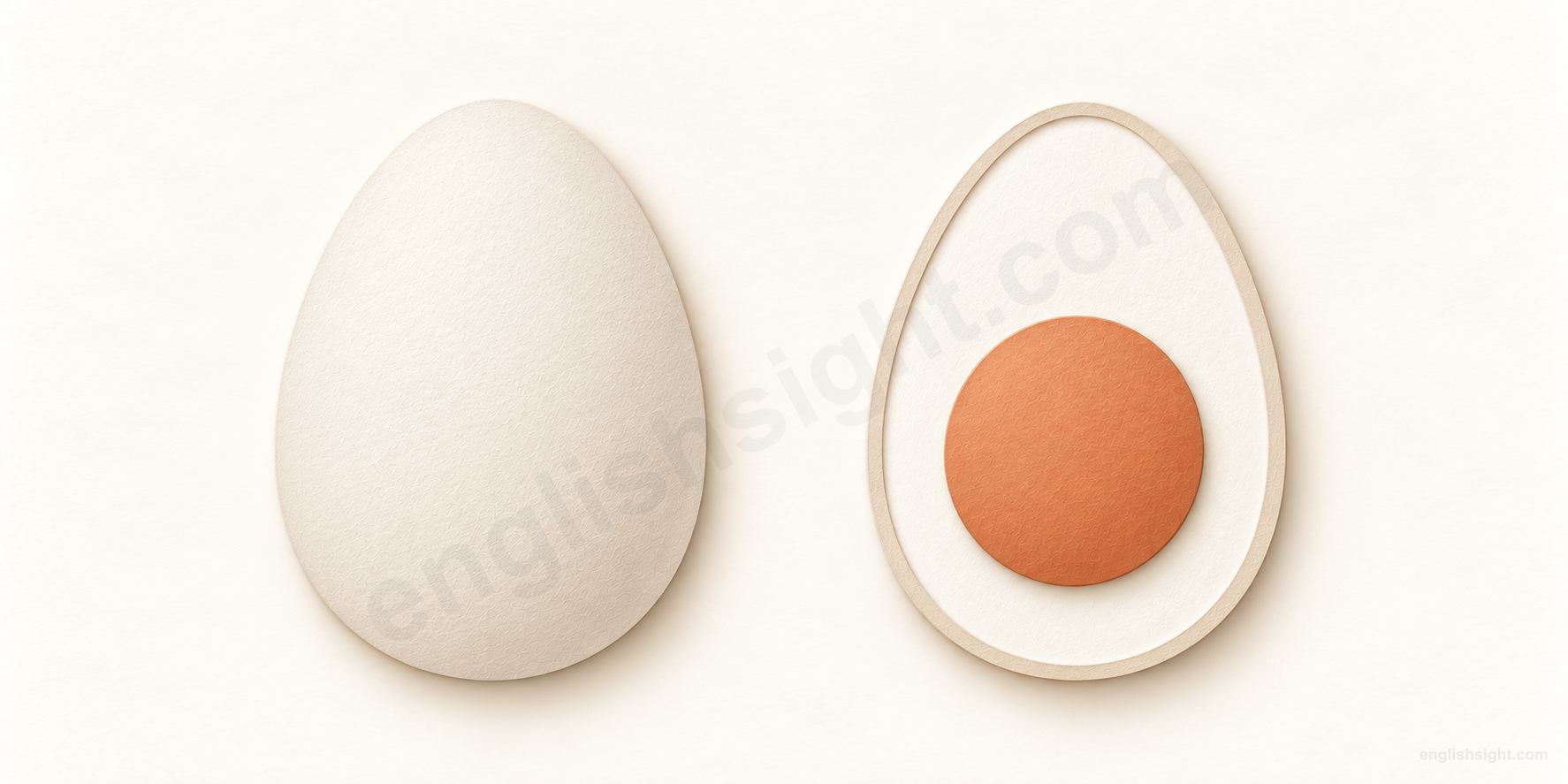
A whole bird’s egg with its shell intact.
egg
The shell surrounds the white, which surrounds the yolk.
Compare the outside with a cutaway view of the contents.
The shell encloses white and yolk. These are outside and cutaway views, not a hatching sequence.
A bird’s egg encloses contents inside a shell; in everyday food talk, egg can name either the whole item or its edible contents.
This bird’s-egg model helps with food, parts, and shape. It does not describe every biological egg or predict fixed idioms and the separate verb egg on.
At breakfast, an egg usually means a hen’s egg. In a nature lesson, eggs may belong to birds, fish, insects, or other animals. In biology, an egg can also be a reproductive cell, without a bird’s hard shell.
The whole object, its contents, and its familiar shape provide useful connections. Several expressions, however, have meanings you must learn as complete phrases. Egg somebody on is a separate verb use, not a story about an egg becoming something else.
The diagram offers a teaching comparison, not a claim about a picture shared by all English speakers.
01
Buying, preparing, and eating eggs
Distinguish separate eggs from egg as an ingredient, and choose words for the parts and preparation.
01
an egg; number + eggs; a carton of eggs
an egg / two eggs
individual eggs that you can count
Situation / starting point
You need ingredients for breakfast.
Meaning / result
You ask for a number of whole eggs.
One egg is one item; eggs is the regular plural.
Use an egg for one and eggs for more than one: an egg, three eggs, a dozen eggs. In ordinary food shopping, the context usually makes chicken eggs the default; say duck eggs or quail eggs when the kind matters.
A carton of eggs names the package, while half a dozen eggs means six eggs. A fried egg can still be counted as one prepared item, even though its shell has been removed.
In a sentence
Could you buy half a dozen eggs on your way home?
Watch the difference Say an egg, not a egg: the first sound is a vowel.
02
some / a little + egg; contain + egg
some egg / contains egg
egg treated as food material rather than separate items
Situation / starting point
You are checking what a food is made with.
Meaning / result
Egg is identified as an ingredient.
Uncountable egg refers to the edible substance.
Use some egg, a little egg, or beaten egg when the amount of egg material matters. There is egg on your sleeve means some of that substance is on it, not necessarily a whole egg.
Contains egg describes an ingredient. Contains eggs is possible too, but focuses more on eggs as ingredients or items. Compare two eggs in the recipe with a little beaten egg brushed onto the pastry.
In a sentence
This sauce contains egg, so I’ll choose a different one.
Watch the difference Do not force a plural when talking about material: a little egg is natural; a little eggs is not.
03
egg white / yolk; the white / yolk of an egg; separate an egg
egg white / egg yolk / eggshell
the different parts of an egg
Situation / starting point
A recipe needs the white but not the yolk.
Meaning / result
You separate the edible parts and remove the shell.
The white surrounds the yolk; the shell is the outside.
The white of an egg is the clear part when raw, which normally turns white when cooked. The yolk is the yellow or orange central part. The eggshell, or egg shell, is the outer covering.
To separate an egg in a recipe is to separate its white and yolk. Two egg whites means the whites from two eggs. In egg whites and egg yolks, egg stays singular as a noun modifier.
In a sentence
Separate the eggs and put the yolks in a small bowl.
Watch the difference Separate the eggs usually means separate whites from yolks, not put each whole egg in a different place.
04
a boiled / fried / poached egg; scrambled eggs; crack / beat an egg
boiled / fried / poached / scrambled eggs
eggs described by the way they are cooked
Situation / starting point
Someone is ordering breakfast.
Meaning / result
The cooking word specifies the kind of egg dish.
The preparation word supplies the cooking method.
A boiled egg cooks in its shell in water; a soft-boiled or hard-boiled egg differs in how firmly the contents have set. A fried egg cooks out of its shell in a pan. A poached egg cooks out of its shell in gently hot water.
Scrambled eggs are stirred during cooking so the mixture forms soft pieces. The dish is normally named in the plural. Raw egg is uncooked; beaten egg has been mixed, usually with a fork or whisk, but need not have been cooked.
Crack an egg into a bowl means break the shell and let the contents fall into it. Beat the eggs concerns mixing the contents. Egg itself does not specify any of these actions.
In a sentence
I’d like a poached egg on toast and some tea.
Watch the difference Beaten and scrambled are different: beating is preparation; scrambling is a way of cooking.
02
Eggs in nature and biology
The animal lays an egg; an egg may hatch. A reproductive egg cell is related but is not a tiny shelled breakfast egg.
05
animal + lay / lays / laid + eggs
lay eggs
produce eggs from the body
Situation / starting point
A female bird or another egg-laying animal reproduces.
Meaning / result
Eggs are deposited outside its body.
The animal is the subject; eggs is the object of lay.
A hen lays an egg. Other animals can lay eggs too, so fish eggs and insect eggs are ordinary descriptions, even when those eggs do not have a hard bird’s-egg shell.
The past is laid: The hen laid an egg. Lie means rest or be in a position; it does not take egg as its object. Not every egg is fertilized or will develop into a young animal.
In a sentence
The turtle laid its eggs in the sand.
Watch the difference For producing an egg, use lay / laid, not lie / lay.
06
egg + hatch; young animal + hatch from + egg; hatch / incubate eggs
an egg hatches / hatch from an egg
a young animal emerges from an egg
Situation / starting point
A young animal has developed inside a suitable egg.
Meaning / result
It breaks out of the egg.
Hatching is emergence, not the earlier laying of the egg.
An egg hatches describes what happens to the egg; a chick hatches or hatches from an egg describes the young animal coming out. The subject changes, but the event is closely related.
A bird can hatch its eggs by keeping them in conditions that allow the young to develop and emerge. Incubate eggs focuses on maintaining those conditions before hatching. Do not infer from the noun egg alone that hatching must happen.
In a sentence
We watched a chick hatch from an egg.
Watch the difference Lay an egg is producing it; hatch from an egg is coming out later.
07
fertilize an egg; an egg cell; an egg donor
an egg / an egg cell
a female reproductive cell
Situation / starting point
A biology text discusses reproduction.
Meaning / result
Egg refers to a cell involved in fertilization.
A biological egg cell need not have a hard shell.
An egg cell is also called an ovum; ova is the plural of ovum, while eggs is the everyday plural of egg. In this sense, a sperm fertilizes an egg.
Terms such as donor egg and egg donor use this cell meaning. They do not refer to a hen’s egg given away as food. The shared reproductive connection helps explain the relation, but the objects are not identical in size or structure.
In a sentence
The diagram shows a sperm next to an egg cell.
Watch the difference Do not picture a shelled kitchen egg when egg refers to a human reproductive cell.
03
Shape, celebrations, and hidden extras
Some names follow the familiar shape. Others belong to established cultural or regional expressions.
08
a chocolate egg; an Easter egg; an Easter egg hunt
a chocolate egg / an Easter egg
an egg-shaped sweet or a decorated egg for Easter
Situation / starting point
A family prepares an Easter celebration.
Meaning / result
Egg may name a real decorated egg or an egg-shaped sweet.
Shape can carry the name even when the material is chocolate.
A chocolate egg is made of chocolate in an egg-like shape; it is not a biological egg. At Easter, Easter egg can mean this kind of chocolate gift or a real egg whose shell has been decorated.
An Easter egg hunt is a game in which people look for hidden eggs. Context tells you whether the objects are decorated eggs, chocolate, or other play versions. This is a use of the whole cultural name, not a change in the meaning of Easter alone.
In a sentence
The children painted Easter eggs at the kitchen table.
Watch the difference A chocolate egg names the material and shape; it does not promise that egg is an ingredient.
09
find / discover + an Easter egg + in a game / film
an Easter egg in a game or film
a hidden extra included for people to discover
Situation / starting point
Someone notices an unexpected detail in a game.
Meaning / result
They recognize an intentionally hidden bonus or reference.
The full expression Easter egg can refer to hidden entertainment.
This Easter egg might be a secret screen, a joke, or a reference to another story. It need not look like an egg or appear at Easter.
The connection with looking for hidden celebration eggs is a useful memory aid. In actual use, learn Easter egg as the name of the extra; egg alone is not a general word for every hidden feature.
In a sentence
Players found an Easter egg behind the game’s final door.
Watch the difference A software bug is an unintended problem; an Easter egg is a deliberately included surprise.
10
a goose egg on the scoreboard
a goose egg
a score of zero, in informal North American usage
Situation / starting point
A team finishes a game without scoring.
Meaning / result
A speaker refers to its zero score.
The egg-shaped zero motivates this regional expression.
In North American informal sports talk, a goose egg can mean zero on the scoreboard. The whole compound supplies that meaning.
A goose egg in a farm story can simply be an egg laid by a goose. Ordinary zero is clearer across regions and outside sports.
In a sentence
After the final whistle, our team still had a goose egg on the scoreboard.
Watch the difference Do not use egg alone as the ordinary English name of the number zero.
04
Two different verb uses
Egg somebody on means urge them to act. Egg a building means throw eggs at it. Read the object and the particle.
11
egg somebody on; egg somebody on to + verb; be egged on by somebody
egg somebody on
urge someone to do or continue something
Situation / starting point
A person hesitates about a risky action.
Meaning / result
Other people encourage them to go ahead.
The person being urged is the object; on belongs to the verb expression.
To egg someone on is to encourage action, especially something foolish or unwise. The urging may be verbal or come from a crowd’s reaction. It is informal and often suggests pressure rather than careful support.
Use egg him on with a pronoun between the verb and on. With a full noun phrase, egg the crowd on and egg on the crowd are both possible. Add to + verb to name the action: They egged him on to interrupt.
The passive is natural: He was egged on by his friends. Forms are eggs, egged, and egging. This verb has a different historical origin from the noun, so the shell-and-contents model does not explain it.
In a sentence
His friends egged him on to tell another rude joke.
Watch the difference Say egg him on, not egg on him. Encourage is a broader, more neutral alternative.
12
egg + target; target + be egged
egg a house / a car
throw eggs at a target
Situation / starting point
Someone uses eggs to damage or dirty property.
Meaning / result
The target is hit with eggs.
The object is the target, not the person being urged.
In this informal transitive verb use, egg a car means throw eggs at the car. The passive is possible: The car was egged overnight.
Compare They egged him on, which describes encouragement and needs no real eggs. The noun-related verb can also mean coat food with egg in cooking; ordinary recipe instructions often make the action clearer by saying dip in beaten egg.
In a sentence
Someone egged the shop window during the night.
Watch the difference An egged window has been pelted; an egged-on person has been urged to act.
05
Plans, reactions, and relationships
Learn these expressions as wholes. Some invite a useful comparison with an egg; their precise meanings belong to the phrase.
13
put all + possessive + eggs in one basket
put all your eggs in one basket
make success depend on just one option
Situation / starting point
You can rely on one application or try several.
Meaning / result
You avoid making everything depend on a single chance.
The expression concerns concentrated risk, not literal storage.
If all the eggs are in one basket, one mishap can affect them all. That comparison helps you remember the established advice: keep more than one possibility open.
Your eggs stand for the things or hopes at risk, and the basket stands for one plan or opportunity. The phrase is often negative advice, but it can also describe what someone did: We put all our eggs in one basket.
In a sentence
I applied to several colleges because I didn’t want to put all my eggs in one basket.
Watch the difference The whole phrase means depend on one option; basket alone does not mean a risky plan.
14
have / be left with / end up with + egg on + possessive + face
have egg on your face
look foolish because events expose a mistake
Situation / starting point
You confidently announce a result.
Meaning / result
The result proves you wrong in front of others.
The embarrassment comes from being shown to be mistaken.
Have egg on your face, be left with egg on your face, and end up with egg on your face describe an embarrassing loss of credibility. The food need not be present.
The expression is informal. Compare literal egg on your face after eating: the same words can describe food there, so the context must supply the figurative reading.
In a sentence
I said the shop was closed, then ended up with egg on my face when everyone walked in.
Watch the difference Egg is uncountable here; the familiar idiom uses egg on your face, not an egg on your face.
15
save / build up + a nest egg; a nest egg for + purpose
a nest egg
money set aside for future use
Situation / starting point
You save a little money over time.
Meaning / result
You have a reserve for a later need.
A nest egg is the saved sum, not an egg or a place to live.
Build up a nest egg describes accumulating savings. For retirement or for a first home can specify the later purpose. The expression is informal and does not name a particular account type.
Treat the reserve as one countable noun phrase: a small nest egg, our nest egg. The phrase does not guarantee that the money will grow or be enough.
In a sentence
She is building up a small nest egg for her first home.
Watch the difference Do not translate the two nouns separately when the context is money.
16
a chicken-and-egg + problem / situation / question
a chicken-and-egg problem
a problem of which of two linked things must come first
Situation / starting point
Work experience helps you get a job, but a job gives you experience.
Meaning / result
Each seems to require the other first.
The expression highlights a circular order or causal difficulty.
You can call this a chicken-and-egg situation, question, or problem. The familiar question about which came first supplies a comparison for two things that appear to depend on each other.
It may concern uncertain cause and effect or a practical starting problem. It does not mean simply that a decision is difficult: the question must concern which linked thing comes first, causes the other, or depends on the other. Actual two-way dependence is not required in every use.
In a sentence
Getting experience without a job is a chicken-and-egg problem for many graduates.
Watch the difference In this adjective-like position, write chicken-and-egg before the noun.
17
be + a good / bad egg
a good egg / a bad egg
a person judged as decent or badly behaved
Situation / starting point
Someone’s behavior shows what they are like.
Meaning / result
You informally judge their character.
Egg refers to a person only in the established expression.
Calling someone a good egg can warmly suggest that they are kind, dependable, or decent. A bad egg is someone seen as dishonest or troublesome. These labels sound old-fashioned and informal.
The literal contrast is a good egg you can eat versus a bad or rotten egg that has spoiled. When speaking of a person, the phrase is a character judgment, not a comment about their shape.
In a sentence
Marta is a good egg; she stayed late to help us pack.
Watch the difference A fresh egg is natural for food; a fresh egg is not the matching idiom for a decent person.
18
walk on eggshells around + person
walk on eggshells
act with extreme care to avoid upsetting someone
Situation / starting point
A person reacts badly to small comments.
Meaning / result
People around them become unusually cautious.
The fragile shell is a memory aid for careful behavior.
Walk on eggshells often describes choosing every word carefully because someone may become angry or upset. It can describe a tense relationship rather than actual walking.
The variant walk on eggs also exists. Learn the plural expression as a whole; it does not mean that all ordinary careful behavior must involve fear.
In a sentence
We feel as if we’re walking on eggshells around the new manager.
Watch the difference The eggshells are figurative; the key meaning is extreme caution, often about another person’s reaction.
19
can’t make an omelette / omelet without breaking eggs
you can’t make an omelette without breaking eggs
a saying about accepting some difficulty or unwanted effects to achieve something
Situation / starting point
A useful change will also cause inconvenience.
Meaning / result
A speaker presents some disruption as unavoidable.
The cooking fact provides a comparison, not proof that a particular cost is justified.
An omelette needs broken eggs; the saying compares that necessary step with problems involved in reaching a larger goal. Omelet is an American spelling of omelette.
Use it to explain someone’s attitude toward a trade-off. It can sound dismissive when the “eggs” stand for other people’s losses, so it is not neutral reassurance in every situation.
In a sentence
When the repairs disrupted the office, he said, “You can’t make an omelette without breaking eggs.”
Watch the difference The saying expresses a viewpoint; it does not establish that every harmful action is necessary.
20
kill the goose that lays the golden egg / eggs
kill the goose that lays the golden eggs
destroy a source of continuing benefit
Situation / starting point
Something produces repeated value.
Meaning / result
A short-sighted action destroys that source.
The goose is the continuing source; the eggs are the repeated benefits.
The expression warns against damaging what keeps producing success or income. Its meaning comes from the traditional story of a goose that lays valuable eggs, not from biological egg production alone.
Both golden egg and golden eggs occur in the saying. In a business discussion, the goose might be a trusted product or loyal customers, while the eggs are the benefits they keep bringing.
In a sentence
Charging loyal users for every small feature could kill the goose that lays the golden eggs.
Watch the difference The warning concerns losing an ongoing source, not just missing one chance.
21
person / performance / joke + lay an egg
lay an egg
fail badly, especially before an audience
Situation / starting point
A joke or performance is expected to work.
Meaning / result
The joke or performance fails to get the intended response.
This is an informal, mainly North American idiom.
A comedian can lay an egg, and a joke, show, or advertisement can lay an egg too. In this use, nobody produces a real egg; the expression describes a flop.
Compare the literal sentence The hen laid an egg. The subject and setting determine the reading. Fail or flop is a clearer choice when the regional idiom may be unfamiliar.
In a sentence
My opening joke laid an egg, so I moved straight to the main topic.
Watch the difference Do not interpret a person laying an egg literally in a performance review.
Keep the object, the grammar, and the whole phrase distinct
Count items; measure material
Use an egg or several eggs for separate items, and some egg for an amount of the food substance. Egg in egg white or egg donor is a singular noun modifier, not automatically an adjective meaning egg-shaped.
The biology connection has limits
Birds, fish, and insects can produce eggs with different coverings. A human egg cell does not have a bird’s hard shell, and a food egg need not contain a developing chick. This lesson teaches vocabulary, not medical instructions.
Two verbs with different objects
Egg someone on means urge them to act; egg a wall means throw eggs at it. Both have forms egg, eggs, egged, egging. He was egged on is a passive encouragement pattern; The wall was egged is a passive target pattern.
Useful connections are not an all-purpose rule
Fragility, contents, and shape help you remember selected expressions. Exact idiomatic meanings are conventional. Do not guess nest egg or egg on from the diagram, and do not treat these selections as a frequency ranking.
Choose by context
Read the complete expression and decide what egg refers to.
1. A cook needs a small amount to brush onto pastry, not another whole item. Which phrase fits?
2. A chick breaks out after developing inside its egg. Which sentence describes that event?
3. Friends encourage a hesitant person to do something foolish. Which form fits?
4. You apply to several jobs instead of depending on one. Which sentence explains your reason?
5. Someone is building up a nest egg for later life. What are they doing?
6. A game review says a developer included an Easter egg. What can this mean?
Sources and teaching notes
The sources below were read to check meanings, forms, and usage labels. The explanations and examples are original. The whole-and-contents diagram is a teaching comparison; it does not derive every expression.
The diagram compares two views of a bird’s egg; it is not a mental picture shared by every speaker.