Follow elastic from a material’s property to useful objects and adaptable arrangements.
Stretch and recovery
Change under force, recover after release
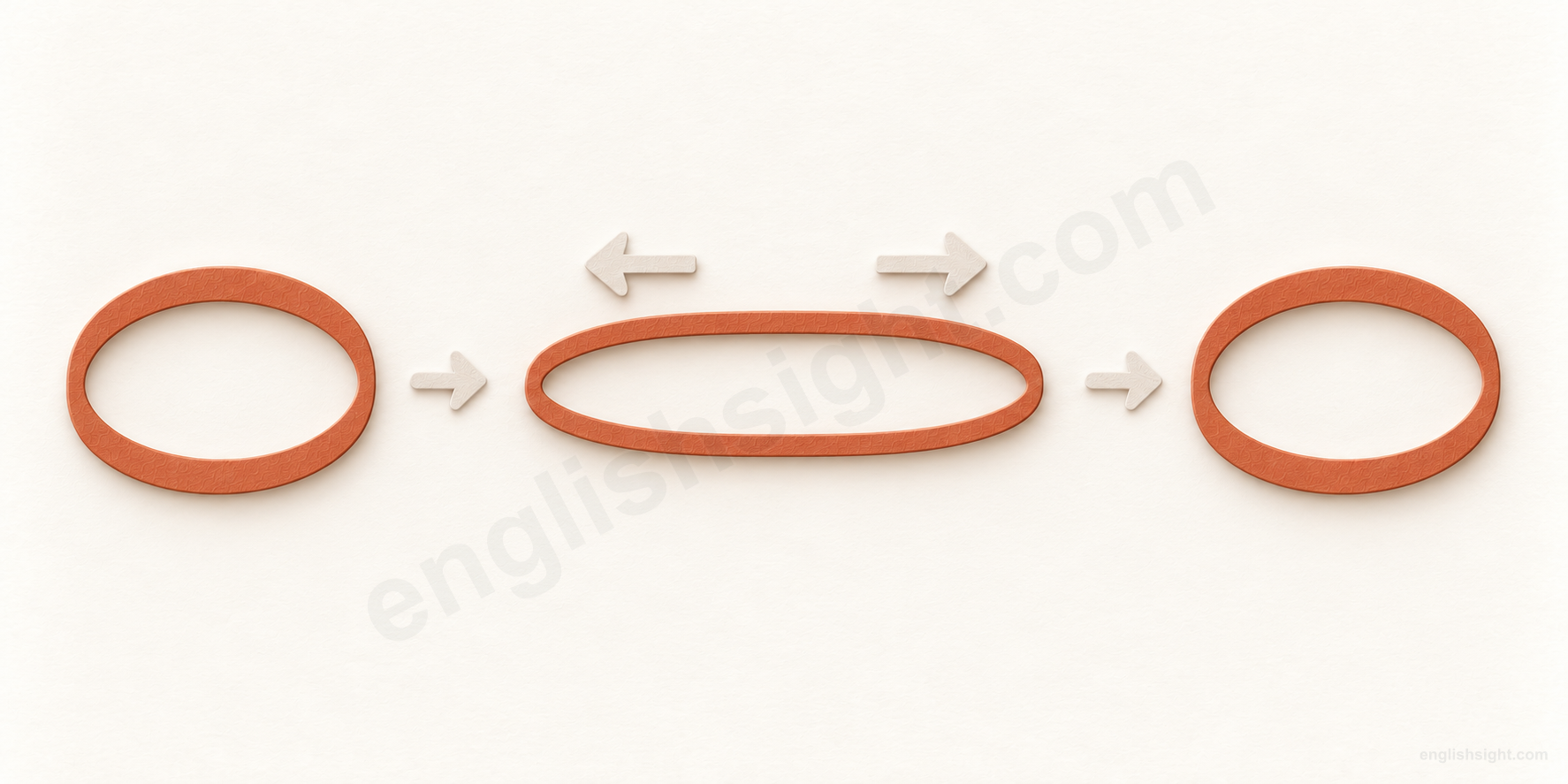
The band is at rest.
elastic
After release, the band returns to its resting shape.
Opposing pulls stretch the band.
An elastic band stretches under a pull and recovers after release.
An elastic material can change shape under force and recover when that force is removed.
This is a model of physical elasticity within a material’s limits. Plans and interpretations can adapt without returning to their original form; economics uses elastic for responsiveness.
Pull a suitable band and it lengthens; release it and it draws back. Elastic names that capacity, and it also names the stretchy material used in clothing and small loops.
Abstract uses keep the idea of giving or adjusting, but they do not always include a literal return. This lesson connects the uses without treating one picture as a rule for every expression.
01
A material changes shape and recovers
Elastic can name a property, describe something made with a stretchy material, or name the material itself. These are related uses with different grammar.
01
elastic + noun; noun + be / become + elastic
elastic material
able to change shape under force and recover when the force is removed
Starting situation
A band has its resting shape.
Result or use
After you stretch and release it, it returns toward its original shape.
Recovery distinguishes elasticity from merely becoming longer or bending.
Elastic is an adjective in This material is elastic and an elastic cord. In ordinary descriptions, it often means the material stretches and then returns when released. In broader physical usage, the change can also involve compression or bending.
Rubber is a material; elastic describes a property. Not every elastic object is a rubber band. Dough can be elastic too: it gives when pulled and tends to pull back. This is the same physical family, not a separate idiom.
The three-state sketch follows one band through resting, stretching, and release. It is an idealized teaching model within the material’s limits, not a promise that any amount of stretching leaves it undamaged.
In a sentence
This cord is elastic: it stretches when pulled and returns when released.
Watch the difference Flexible means able to bend without breaking; it does not by itself promise a return to the original shape. Stretchy emphasizes ease of stretching.
02
an elastic + clothing noun
an elastic waistband
a clothing part that stretches to fit and then draws in again
Starting situation
You pull a waistband wide enough to put the trousers on.
Result or use
It draws inward around your waist.
Elastic before the clothing noun describes its material or stretchy construction.
An elastic waistband or elastic headband is made with elastic material, so it can expand and fit snugly. The noun tells you which clothing part or accessory has that property; elastic does not mean the whole garment is rubber.
Compare an elastic waistband with the elastic in the waistband. In the first, elastic is an adjective describing the waistband. In the second, it is a noun naming the material inside it. Elasticated waistband is another clothing description, especially in British English.
In a sentence
These shorts have an elastic waistband, so they are easy to pull on.
Watch the difference An elastic waist refers to the stretchy waist part of clothing, not to the person’s body becoming elastic.
03
some elastic; a piece / length of elastic; made of elastic
a piece of elastic
some stretchy material used as a cord, strip, or fabric
Starting situation
You need material to repair a loose waistband.
Result or use
You measure and cut the amount required.
Elastic names a material and is normally uncountable in this use.
Use some elastic, a piece of elastic, or a length of elastic when talking about material for sewing or making things. A metre of elastic measures it; it does not turn the material noun into a countable item.
The noun often refers to a manufactured strip, cord, or fabric that contains rubber or a similar stretchy substance. Made of elastic names the material; made elastic describes giving something an elastic property.
In a sentence
I bought a metre of elastic to repair the waistband.
Watch the difference For material, say I need some elastic, not I need an elastic. An elastic can name an individual band in some varieties of English.
02
Bands, hair ties, and worn material
Choose a countable name for an individual object. When elastic wears out, it can remain stretched instead of recovering.
04
an elastic band; a rubber band; an elastic / elastics; a hair elastic
an elastic band / a hair elastic
an individual stretchy loop used to hold things together or tie hair
Starting situation
Loose cards need to stay together, or long hair needs to be tied back.
Result or use
A stretched loop draws inward and holds them.
The individual object is countable, unlike the material noun.
An elastic band is a thin rubber loop for holding things together. Oxford labels elastic band British English; rubber band is used in both British and North American English. The compound names an object rather than any band that happens to stretch.
An elastic, plural elastics, also means a rubber band in some usage; Collins marks that use mainly US, with US and Canadian marking in its larger dictionary. These labels describe variation, not a rule that every American uses the shorter noun.
A hair elastic is a stretchy loop for tying hair; hair tie is another useful name. The noun after hair identifies a purpose-made object. Ask for a rubber band for cards or a hair tie for hair when you want the purpose to be clear.
In a sentence
She used a hair elastic to tie her hair back before cooking.
Watch the difference An elastic band is not a music group. A hair elastic and an ordinary rubber band may differ in construction and intended use.
05
the elastic + has gone / has worn out
the elastic has gone
the elastic no longer stretches and recovers properly
Starting situation
The waistband used to grip comfortably.
Result or use
The material stays loose, and the garment slips.
In this clothing context, gone describes loss of function rather than disappearance.
The elastic has gone is a familiar way, especially in British English, to say that it has lost its useful springiness. The strip may still be inside the garment; the problem is that it no longer draws back properly.
You can also say The elastic has worn out or The elastic has lost its stretch. Loose elastic describes the resulting fit. Broken or snapped elastic is a different physical failure: it has actually split.
In a sentence
The elastic in these socks has gone, so they keep sliding down.
Watch the difference Do not assume gone always means missing. The surrounding description tells you whether something disappeared or stopped working.
03
Plans, interpretations, and price response
Abstract uses transfer the idea of giving or changing under pressure. Read the noun and context: literal recovery is not part of every extension.
06
elastic + plan / schedule; plans + be + elastic
elastic plans
plans that can be adjusted as circumstances change
Starting situation
You have an outline for the weekend.
Result or use
You can change the timing if something else comes up.
The plan can give rather than remain rigid.
Elastic plans or an elastic schedule allow changes in timing or arrangement. The material image offers a useful comparison: the arrangement can stretch to accommodate something new. It need not return to its earlier form afterward.
Flexible plans is a more straightforward everyday alternative. Elastic can draw attention to how far an arrangement can expand or adapt; it does not mean the plan is automatically unlimited or unreliable.
In a sentence
Our weekend plans are elastic, so we can stay an extra night if necessary.
Watch the difference Elastic does not simply mean long-lasting or well organized. It concerns room for adjustment.
07
an elastic interpretation / definition / concept; an elastic interpretation of + noun
an elastic interpretation
an interpretation that allows the meaning or application of a rule to change or widen
Starting situation
A rule has a relatively narrow reading.
Result or use
Someone applies a broader or more adaptable reading.
It is the interpretation or concept that stretches, not a physical rulebook.
An elastic interpretation of a rule gives it room to cover different circumstances. An elastic definition or concept likewise has boundaries that can be adjusted. This is an adjective with an abstract noun, not a phrasal verb.
The expression can be approving if adaptability is useful, or critical if a person seems to stretch a rule too far. Elastic alone does not assert dishonesty. The evaluation comes from context and the speaker’s attitude.
In a sentence
That is a rather elastic interpretation of the parking rules.
Watch the difference Do not infer that every elastic interpretation breaks a rule; the phrase may question how freely it is being applied.
demand that responds strongly to a change in price
Starting situation
A seller changes the price.
Result or use
The quantity people want to buy changes substantially.
In economics, elastic describes responsiveness rather than the flexibility of a physical object.
Elastic demand is a specialized economics use worth recognizing in news or study. When the context is price, it concerns how much the quantity demanded responds to a price change. Elastic supply applies the response idea to the quantity sellers offer.
This use does not predict that demand must return to its starting point. The band picture is only a memory link for responsiveness. Exact measurements and distinctions such as unit elasticity belong in an economics lesson.
In a sentence
Demand for these optional extras is elastic: a small price rise leads many customers to stop buying them.
Watch the difference Elastic demand does not mean that demand is simply high or that the product itself stretches.
Keep the property, material, and object apart
Elastic is not a verb
Use stretch the elastic, replace the elastic, or make the material more elastic. This lesson covers an adjective and a noun, so passive verb forms, causative verb patterns, and particle verbs are not applicable.
Material versus one object
Some elastic is material; a piece of elastic measures a portion. An elastic band or, in some usage, an elastic names one object. The plural elastics belongs to countable objects, not to an ordinary quantity of sewing material.
Nearby words
Elastic emphasizes shape recovery in physical uses; flexible allows bending or adjustment without necessarily recovering; stretchy emphasizes stretching; resilient often emphasizes recovery after pressure or difficulty. Elasticity is the related noun for the property, not the usual name for a strip used in sewing.
Less everyday branches
Elastic step and elastic spirits describe springiness or quick recovery in more literary descriptions; elastic mind can mean adaptable thinking. Technical uses include elastic collisions in physics. They are acknowledged here but are not the focus of the everyday examples.
Choose the intended meaning
Identify whether the sentence describes a property, material, an object, or an abstract response.
1. A strip lengthens when pulled and returns after release. Which description identifies both parts?
2. You need a measured amount of stretchy material for a sewing repair. Which request fits?
3. The elastic is still inside the sock, but the sock keeps sliding down. What does “the elastic has gone” mean here?
4. “Our plans are elastic.” What can you reasonably infer?
5. A report says demand is elastic in response to price. Which explanation fits?
Sources and teaching notes
Dictionary sources support the meanings and usage below. The explanations, examples, and principle sketch are original teaching material; the visual connection is a teaching model.
The sketch is a teaching aid, not a claim that every native speaker shares one mental picture.