Read the noun to distinguish an electric device, a physical effect, and an exciting impression.
Electricity as the source of power
Electricity supplies the power
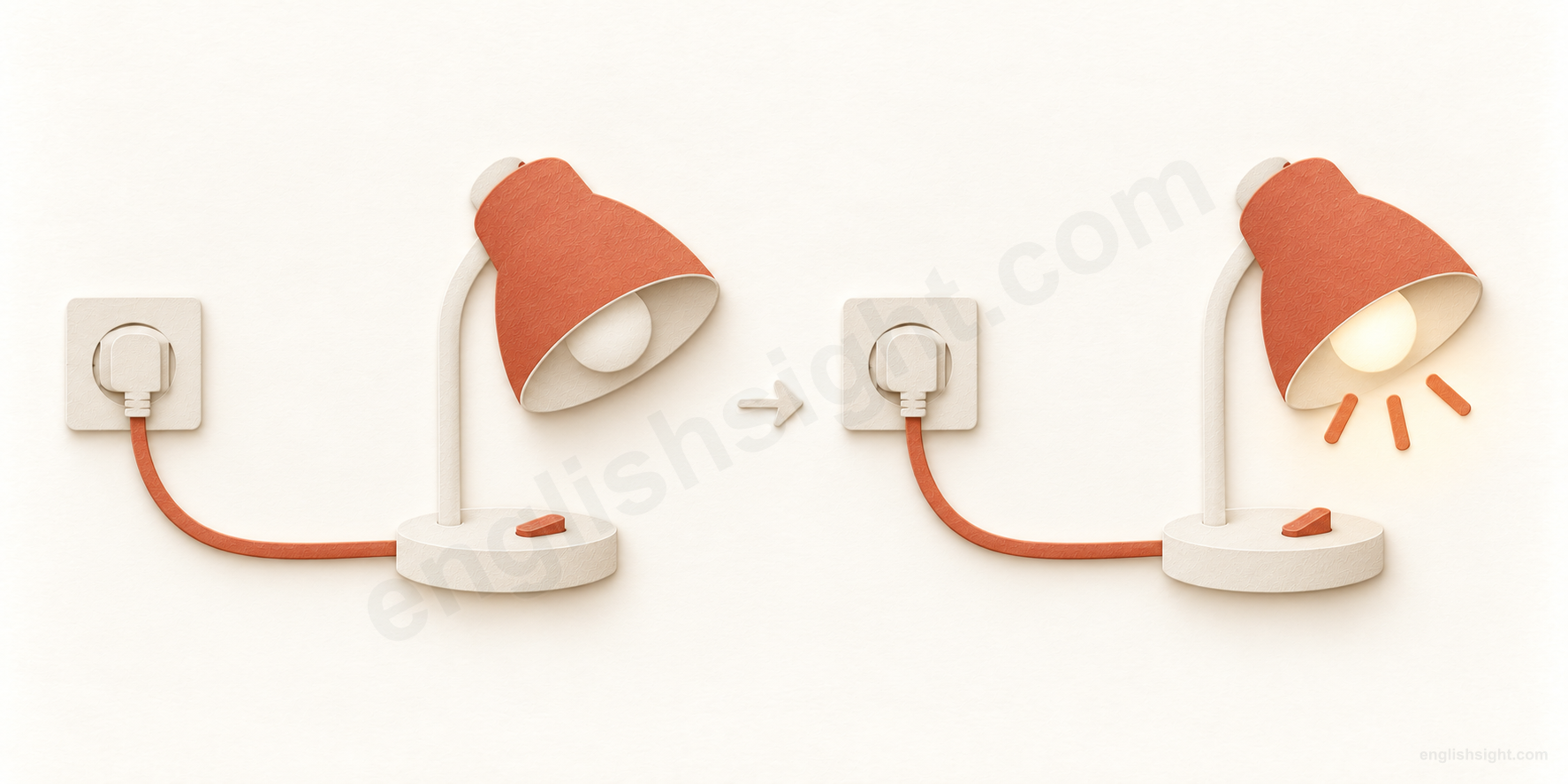
The electric lamp is connected but switched off.
electric
The same lamp gives light.
Switching it on lets electrical power operate the lamp.
Electric identifies the lamp’s power source. It remains an electric lamp while switched off.
In the central device use, electric identifies electricity as what powers the thing; other literal uses name connections, phenomena, or effects involving electricity.
The lamp illustrates a power relationship. It remains an electric lamp when off. Excitement and bright colour are established extensions, and the picture does not mechanically predict them.
Electric usually describes a relationship with electricity: something uses it, produces it, carries it, or results from it. The noun supplies the precise role, so an electric heater, an electric generator, an electric wire, and an electric shock are not the same kind of thing.
Other established uses express emotional or visual intensity. Learn these alongside the literal meanings, without assuming that every expression refers to a hidden electrical current.
01
Things that use electricity
Choose electric to identify a source of power or a familiar type of instrument. The noun tells you what the device does.
01
electric + device noun; device + be + electric
an electric kettle / heater / toothbrush
a device that uses electricity to do its work
Situation
You are choosing between a kettle for a stove and one with a power base.
What is meant
You identify the kind that uses electrical power.
Electric names the power source, not whether the device is switched on.
In an electric kettle, electric describes the kettle; kettle supplies the purpose. Apply the same pattern to an electric light, fan, oven, blanket, razor, or toothbrush. A battery-powered toothbrush is electric even though it has no cable during use.
The kettle is electric works too when you contrast it with another kind. You can say The electric kettle is switched off: electric does not mean currently operating. In British English, an electric fire is a heater; fire here does not require burning fuel.
In a sentence
Our electric kettle is off, but the water is still hot.
Watch the difference Use electric to describe the device and electricity for the energy: It uses electricity, not It uses electric in neutral international English.
02
electric + vehicle noun; a fully electric car
an electric car / bike / train
transport powered by electricity
Situation
Two cars use different sources of power.
What is meant
You distinguish the car powered by an electric motor.
The adjective identifies propulsion; it does not promise a particular range or charging method.
Electric car, electric bus, and electric scooter tell the listener what powers the vehicle. The noun changes the vehicle, not the basic contribution of electric. An electric bike may assist the rider rather than replace all pedalling.
A train can receive electricity from outside rather than carry a battery. Do not infer battery-powered from electric alone. In everyday car comparisons, a fully electric car is distinguished from a hybrid, which also has a combustion engine.
In a sentence
We took an electric train to the coast.
Watch the difference Electric does not by itself mean self-driving, battery-only, or free to operate.
03
electric + musical instrument
an electric guitar
an instrument designed for an electrical sound system
Situation
A guitarist prepares to play through an amplifier.
What is meant
The instrument supplies a signal that the amplifier makes audible at higher volume.
Here the electrical system concerns sound, not a motor moving the strings.
An electric guitar uses an electrical signal and amplification as a central part of its sound. The player still plucks or strums the strings. The contrast with an acoustic guitar concerns how the sound is produced and projected, not whether a person plays it.
Electric bass and electric piano are also established instrument names. Learn the instrument name as a unit: electric piano and electronic keyboard can describe different kinds of equipment, even though both use electricity.
In a sentence
Maya plays an electric guitar through a small amplifier.
Watch the difference Do not read electric guitar as a guitar that plays itself.
02
Electricity, its effects, and its supply
Electric also describes current, charge, connections, and electricity services. These are related uses, but a wire, a shock, and a bill play different roles.
04
electric + current / charge / field / power
electric current / charge / field
a physical phenomenon involving electricity
Situation
A lesson distinguishes flowing charge from charge on an object.
What is meant
Current and charge are named separately.
Electric links the noun to electricity; the noun determines the physical idea.
Electric current concerns the flow of charge. Electric charge is a property an object or particle can have; charge can be present without a continuous current. Electric field names the field associated with electric charge. These are conventional scientific noun phrases, not three kinds of appliance.
The lamp sketch illustrates one use of current, but it does not explain all electrical phenomena. Static charge, for example, need not involve a lamp, a plug, or a household supply. You may also meet electric power and electrical energy.
The relationship can also be production: an electric generator produces electricity, whereas an electric heater uses it. Do not assume that every machine described as electric must take electricity as its input.
In a sentence
The teacher compared electric current with electric charge.
Watch the difference Do not use electric as a noun for current: say an electric current, not an electric, when discussing the phenomenon.
05
electric / electrical + connection or conductor noun
an electric socket / plug / cable
a connection or conductor used for electricity
Situation
A lamp needs a connection to its power supply.
What is meant
Its plug and cable provide that connection.
These parts carry or connect the supply; they are not all power-consuming machines.
Electric socket, electric plug, and electric wire describe parts of an electricity system. In American English, outlet is a familiar alternative to socket. In a clear household context, the shorter words plug, socket, and cable often need no adjective.
Electrical socket, electrical plug, and electrical cable are possible too. The overlap is real; do not invent a rule that electrical parts cannot carry current. Learn common combinations rather than replacing electric with electrical everywhere.
In a sentence
The lamp’s cable reaches the electric socket beside the desk.
Watch the difference A socket supplies a connection; it is not an electric appliance simply because its name contains electric.
06
get / receive an electric shock
get / receive an electric shock
experience the effect of electricity passing through the body
Situation
Someone touches an object with a static charge.
What is meant
They feel a brief shock.
Electric specifies the cause of the shock; get or receive describes the experience.
An electric shock is a physical electrical event, not merely surprise. Get an electric shock is ordinary conversational wording; receive an electric shock is also used. The verb carries the experience, while electric identifies the kind of shock.
Compare I got a shock when I saw the price: without electric, shock can describe an emotional surprise. A small static shock and a serious electrical injury both fall under electric shock; the phrase alone does not state severity.
In a sentence
I got a small electric shock when I touched the metal handle.
Watch the difference An electric shock is not just a very surprising piece of news.
07
electric + bill / company / meter
an electric bill / the electric company
the charge or organisation connected with an electricity supply
Situation
A household receives its monthly energy statement.
What is meant
The bill records the electricity service and use.
Electric identifies the service, not the material that a bill is made from.
Electric bill is an established everyday expression, especially familiar in American English. It is informal everyday wording rather than a technical term. Electricity bill is another clear choice. The bill is an account to pay; it is not a piece of paper operated by electricity.
The electric company supplies electricity, and an electric meter measures its use. These combinations extend the electricity relationship to the service and its management. They do not mean that every object with electric before it is an appliance.
In a sentence
Our electric bill was lower this month.
Watch the difference An electronic bill is delivered or handled electronically; that does not tell you whether it is for electricity.
03
Excitement and striking colour
In these established extensions, electric evokes intensity. Read the noun and the situation: no literal current is required.
08
an electric atmosphere; atmosphere / room + be + electric (with + emotion)
an electric atmosphere
an atmosphere full of strong shared excitement or tension
Situation
A crowd waits for a major announcement.
What is meant
The room feels intensely alert and emotionally charged.
The intensity is figurative, not a measurement of electricity in the air.
An electric atmosphere describes how strongly people feel the moment. The atmosphere was electric uses electric after was; the atmosphere is the subject, and electric describes it. Electric with excitement or electric with tension can specify the feeling.
This use can evoke the sudden force of a shock or a charged state, but that is a teaching connection, not a literal physical explanation. The noun atmosphere supplies the shared social setting. Electrical atmosphere would normally suggest a physical or technical subject instead.
In a sentence
The atmosphere was electric as the finalists walked onto the stage.
Watch the difference Electric need not mean pleasant: a tense room can also feel electric.
09
electric + performance / personality
an electric performance
a performance that creates intense excitement
Situation
An audience watches a performer.
What is meant
The performance energises and grips the audience.
Electric evaluates the impact rather than identifying the equipment.
An electric performance praises the exciting effect of a performance. It can describe an acoustic musician, a dancer, or an actor. In an electric guitar, by contrast, electric classifies equipment.
An electric personality similarly presents someone as exciting and full of energy. This is an expressive description, not the usual neutral way to say someone is awake or active. Use energetic for a straightforward description of high energy.
In a sentence
The actor gave an electric performance in the final scene.
Watch the difference A performance can be electric without using any electric instrument.
10
electric blue; an electric-blue + noun
electric blue
a vivid, striking shade of blue
Situation
You want to distinguish a bright colour from a muted blue.
What is meant
You choose a colour description that suggests visual intensity.
Electric modifies the colour; it does not mean that the object lights up.
Electric blue is an established colour expression. You can say an electric-blue jacket or The jacket is electric blue. The hyphen can join the colour words before a noun; both spellings occur.
Electric also occurs with other vivid colours, such as electric orange. Blue is a useful expression to learn as a whole. Colour names do not guarantee an exact scientific specification, and electric does not simply combine naturally with every colour word.
In a sentence
She chose an electric-blue jacket for the concert.
Watch the difference An electric-blue jacket need not contain lights, wires, or a battery.
04
Changing technology and choosing a word
Learn the go + adjective pattern, the overlap with electrical, and the limited informal noun use.
11
go + electric; be + electric
go electric
change to using electrical power or electric equipment
Situation
A household cooks with gas.
What is meant
It changes to electric cooking equipment.
Go supplies the idea of change; electric names the new type.
In go electric, go is followed by an adjective describing the resulting arrangement. A household may go electric for cooking, a driver may go electric by choosing an electric car, and a band may go electric by using amplified instruments. Context tells you what changes.
This is not a particle verb: electric is an adjective, not a preposition or adverb. Compare The cooker is electric, which describes its type without saying that anyone has made a change.
In a sentence
We decided to go electric when we replaced the gas cooker.
Watch the difference Going electric does not mean that the people themselves become electrically charged.
12
electric + device; electrical + system / field; electronic + technology / activity
electric / electrical / electronic
choose between power, a general electrical connection, and electronic technology
Situation
You describe a heater, a wiring fault, and a payment system.
What is meant
You choose the conventional adjective for each purpose.
The words overlap in some contexts but are not interchangeable everywhere.
Electric is a useful choice for specific powered things: an electric heater. Electrical often describes a wider field, system, or category: electrical engineering, an electrical fault, electrical equipment. Electrical appliances is natural too; this is a tendency in collocation, not a strict device-versus-system law.
Electronic concerns technology that controls currents or signals using components such as chips, and activities carried out through such systems: electronic equipment, electronic payments. An appliance can be electric in its power source and electronically controlled in its operation. Use electric, rather than electrical, for the figurative excitement in an electric atmosphere.
In a sentence
The electric heater has an electronic timer, but the fault is in the electrical wiring.
Watch the difference Do not call an email an electric message merely because electricity is involved.
13
the electric + singular verb; electrics (informal British noun)
the electric
electricity as a supply, in informal British usage
Situation
Someone is talking informally about the home’s power supply.
What is meant
The electric refers to that supply.
This is a regional noun use; the adjective remains the main learning target.
In informal British English, the electric can mean the electricity supply: The electric is off. Here electric is a noun, not an adjective waiting for a missing noun. For a broad international audience, The electricity is off or The power is off is clearer.
Dictionaries also record an electric for a vehicle or other thing powered by electricity. That use depends on context; an electric car is a clearer starting point. British informal electrics can mean wiring or electrical equipment: the house’s electrics. It is not the normal plural of electricity.
In a sentence
“The electric is off,” Sam said, pointing to the dark kitchen.
Watch the difference Keep the regional label: use electricity for the general uncountable noun, not an electric or electrics.
Keep the meaning and the grammar separate
Adjective first
Electric is mainly an adjective, pronounced /ɪˈlektrɪk/, with stress on the second syllable. It does not change for plural nouns: electric cars. It works before nouns and after be where the context supports the description.
Type versus degree
A car is electric as a type, so more electric is not the normal way to say more powerful. Figurative excitement can be graded: the atmosphere became even more electric. Very electric is possible for an exciting performance, but very electric kettle does not describe the appliance’s type naturally.
Related forms
Electricity is the usual uncountable noun for the energy or supply. Electrically is an adverb: electrically powered. Electrify is a separate verb. Electric is not itself an ordinary verb, so it has no active/passive or separable particle-verb family.
The picture has a boundary
Electric can involve static charge, natural phenomena, or supply services as well as powered machines. The connected lamp is one teaching example, not a claim that every electric thing plugs into a wall.
Choose what electric contributes
Look at the noun and the situation before choosing.
1. A kettle uses electricity, but its switch is off. Which sentence is natural?
2. A paper statement tells you how much you owe for electricity. Which description fits?
3. A singer performs without amplified instruments and thrills the audience. Can the performance be electric?
4. A shop describes a jacket as electric blue. What does this normally tell you?
5. After years of cooking with gas, a family chooses an electric cooker. What does We went electric communicate?
Sources and teaching notes
The dictionary sources below support the senses and usage distinctions. Explanations, examples, and the visual teaching model were created for this lesson.
The diagram is a teaching model, not a picture shared by every English speaker.