Use end for an outer part, a final point, a result, or a purpose—and learn what the full expression adds.
The limit of extent or continuation
The limit of extent or continuation
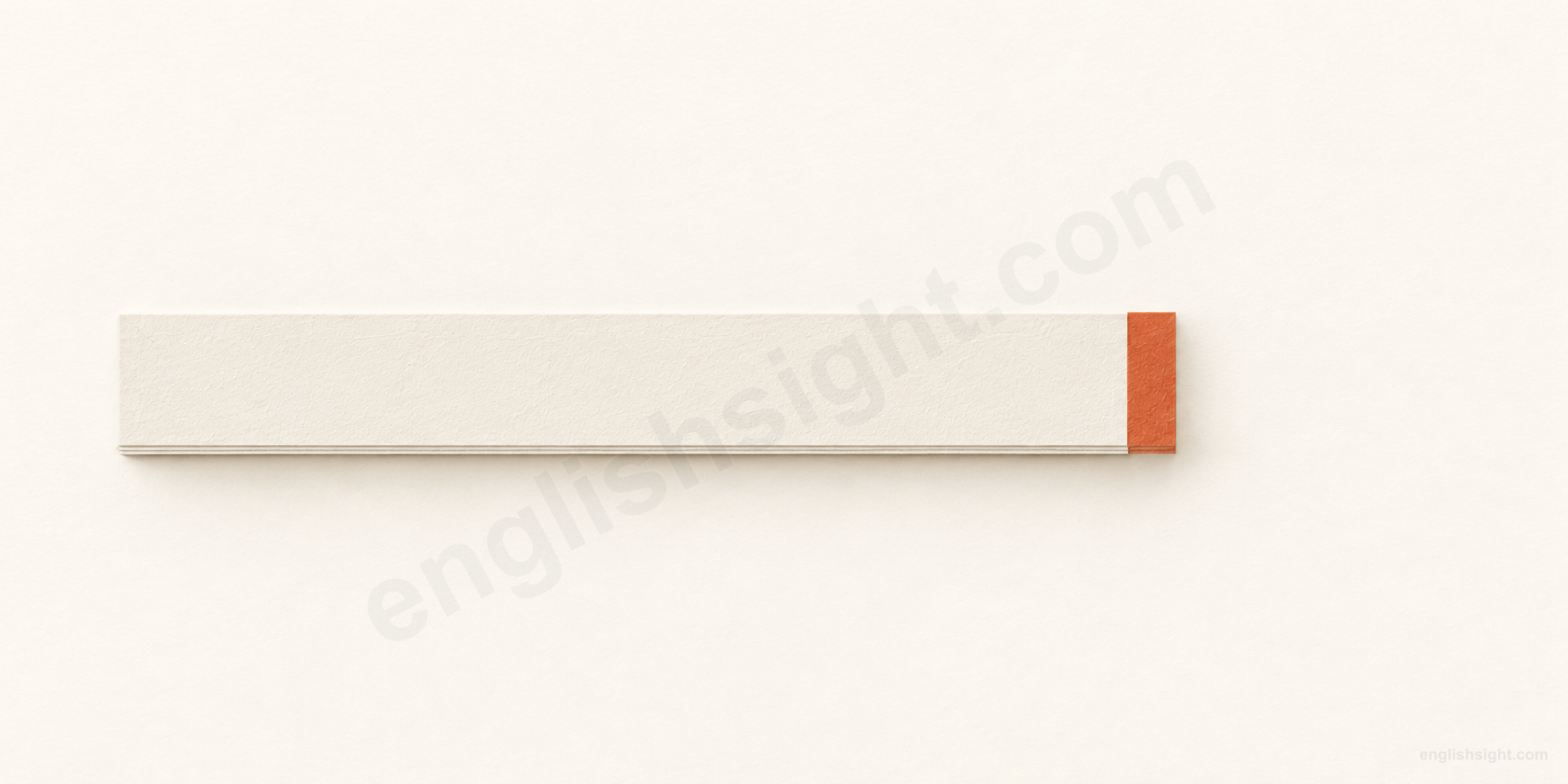
The paper strip extends horizontally.
end
The strip does not continue beyond this edge.
Its right end is highlighted in orange.
An end marks a limit of extent or continuation.
An end is a limit of something’s extent or continuation; to end is to reach or bring about that limit.
The strip makes one physical boundary visible. A time period can have a comparable final point, while goals and idioms require the additional patterns explained below.
A rope has two ends; a meeting has an end in time. End can name a boundary or the final part near it. As a verb, it can say that something stops, or that someone causes it to stop.
This lesson uses a boundary as a teaching connection. Purpose, responsibility, and fixed idioms need their own explanations; no single sketch predicts every use or represents every English speaker’s private mental picture.
01
Ends in space and on a scale
An object can have two ends. Context identifies which outer part is relevant; it need not be a destination or an ending in time.
01
the / one / either + end of + noun; both ends of + noun
the end of a rope / road / range
the outermost part or limit of an extent
Situation or intention
You follow a rope, corridor, or price scale.
Result or interpretation
You identify one of its outer parts.
An end is measured against the extent of a particular thing.
The end of a rope is a physical extremity; the far end of a corridor is the part away from your current position. At the other end identifies the contrasting side. A rope has two ends, so end does not always mean the last thing in a sequence.
At the expensive end of the market applies the same idea to a scale. Both ends of the political spectrum means its opposing extremes. The object after of tells you what extent is being considered.
In sport, teams change ends when they exchange the sides they defend. In a queue, the end normally means the back where a new arrival joins; follow the local context rather than assuming end means front.
In a sentence
Hold one end of the rope while I tie the other to the post.
Watch the difference Use the end of the road for its terminal part; the side of the road is a different location.
02
arrange + objects + end to end; from end to end
end to end / from end to end
touching at their ends, or across the whole length
Situation or intention
Two tables are separate; a hall has a measurable length.
Result or interpretation
The tables touch, or the entire hall is measured.
Small changes in the phrase distinguish arrangement from full extent.
Put two tables end to end means join the short ends to make a longer line. It does not mean put the long sides together. End is singular in this fixed arrangement phrase.
From end to end describes the whole length: We measured the hall from end to end. The repeated noun marks the two limits of the same extent, rather than a final moment.
In a sentence
We placed the two tables end to end to seat everyone.
Watch the difference In the table example, end to end describes joined placement; from end to end explicitly describes the full length of one extent.
03
stand / set + object + on end
stand something on end
place an object upright on one of its ends
Situation or intention
A long box lies flat.
Result or interpretation
It stands with one short face supporting it.
On end can describe orientation rather than time.
Stand the box on end places it vertically, using an end as its base. The box does not disappear or finish; end remains a physical part.
Compare hours on end, a separate fixed time expression. The noun before on end and the verb stand make the intended reading clear.
In a sentence
Stand the narrow box on end so it takes up less floor space.
Watch the difference On end is not at the end: one gives orientation, the other identifies a location.
04
some / a few + odds and ends
odds and ends
small miscellaneous things or minor jobs
Situation or intention
A drawer contains unrelated small items.
Result or interpretation
You refer to them together without listing each one.
This fixed plural expression groups miscellaneous items.
Odds and ends can include spare buttons, keys, or pieces of string. They need not all be broken or literal end pieces. This is an informal expression for assorted small things.
It can also describe minor tasks: I have a few odds and ends to finish before leaving. Separately, a cigarette end is the remaining used piece, especially in British English; that literal remnant use does not explain every item called odds and ends.
In a sentence
I keep spare buttons and other odds and ends in this tin.
Watch the difference Use the fixed plural ends; an odd and end is not the singular form.
02
Final parts, deadlines, and stopping
Separate the final part of a period from a deadline, continued duration, an eventual result, and the act of stopping something.
05
at / near / towards + the end of + period or event
at the end of…
in the final part or at the final point
Situation or intention
A lesson or a film is progressing.
Result or interpretation
You locate something in its closing part.
At the end places an event relative to a named whole.
At the end of the film tells you when something happens within that film. At the end can stand alone when everyone knows which event is meant. Towards the end means in the later part, without necessarily reaching the last moment.
From beginning to end covers the whole event or text. The end of the month identifies its final part; it does not itself say whether a task must already be complete. The preposition supplies that relationship.
In a sentence
There will be time for questions at the end of the lesson.
Watch the difference Say at the end of the lesson, not in the end of the lesson.
06
finish / send + by the end of…; stay / continue + until the end of…
by / until the end of…
set a latest completion time or a stopping limit for continued activity
Situation or intention
A report needs finishing; a visit is continuing.
Result or interpretation
One phrase gives a deadline; the other gives a duration limit.
By and until contribute different time relationships.
Send it by the end of Friday means no later than Friday’s final point; earlier is allowed. Work on it until the end of Friday describes work continuing up to that limit.
Compare I will stay until the end of the week with I will arrive by the end of the week. Staying can continue across time; arriving is an event with a deadline. End names the boundary in both.
In a sentence
Please send the signed form by the end of the week.
Watch the difference Until is not a substitute for by when you mean complete a single action no later than a deadline.
07
in the end, + clause; clause + in the end
in the end
eventually, or when everything is considered
Situation or intention
Several choices or events lead to a result.
Result or interpretation
You report the eventual decision or decisive consideration.
In the end summarizes an outcome rather than locating a last scene.
We chose the train in the end suggests that discussion or changing plans led to that choice. No following of-phrase is needed. At the end of the trip instead locates something at the trip’s close.
In the end can also mean after all the relevant factors are considered: You can offer advice, but in the end it is her decision. This reading emphasizes the decisive fact rather than a long delay.
In a sentence
We considered driving, but in the end we took the train.
Watch the difference In the end does not normally take of + event. Use at the end of the film for the final scene.
08
something + comes to an end; something + is at an end
come to an end / be at an end
finish, or be in a finished state
Situation or intention
A repair project is still continuing.
Result or interpretation
It finishes, and no work remains underway.
Come to describes the transition; be at describes the finished state.
The repairs came to an end presents the event of finishing. The repairs are at an end presents the resulting state and often sounds more formal than The repairs are over.
These use an end. At the end usually locates someone or something in a final part: We were tired at the end. Finishing does not guarantee success; an unsuccessful project can come to an end too.
In a sentence
After six noisy weeks, the repairs finally came to an end.
Watch the difference Do not confuse The meeting is at an end with I spoke at the end of the meeting.
09
put an end to + noun / -ing; bring + object + to an end
put an end to… / bring…to an end
cause an activity or situation to stop
Situation or intention
Repeated interruptions keep disrupting a class.
Result or interpretation
A rule stops the interruptions.
The subject causes the stopping, rather than merely observing it.
Put an end to the interruptions names what is to stop after to. Bring the discussion to an end places the object between bring and to an end. Both express causing a finish.
Call for an end to something asks for it to stop; it does not mean the stopping has already occurred. Compare an end to the noise, emphasizing its cessation, with the end of the concert, identifying a final part or finish.
In a sentence
The new rule put an end to repeated interruptions.
Watch the difference In put an end to arguing, to is a preposition: use arguing, not argue.
10
meet + possessive + end; be with someone + at the end
meet one’s end / at the end
refer indirectly to someone’s death
Situation or intention
A writer describes the closing moments of a life.
Result or interpretation
End is understood as death from the context.
Death is a context-dependent extension, not the meaning of every end.
Meet one’s end is a literary way of saying die, often with a description such as a tragic end. At the end can refer to someone’s final moments when the context is already about that person’s life.
This is a sensitive or literary use. A career can end while the person is alive, so never infer death simply from the word end. End his life can refer to causing death; context and subject matter matter greatly.
In a sentence
The novel reveals how the explorer met his end.
Watch the difference Keep the literary register: meet one’s end is not the usual neutral way to announce a death.
03
What ends, how it ends, and where you end up
The subject and the words after end determine whether an activity stops, a final element is named, or someone reaches an eventual situation.
11
subject + end; subject + end + object; be ended + by / because of…
something ends / someone ends something
stop continuing, or cause something to stop
Situation or intention
A meeting is in progress.
Result or interpretation
It stops, either on its own schedule or through someone’s action.
Changing the subject and object changes who causes the finish.
The meeting ended has no object: the meeting is the activity that stopped. The chair ended the meeting gives the chair as the cause and the meeting as the object. The meeting was ended early is a possible passive when the intervention matters.
Forms are end, ends, ended, ending. The meeting is ending describes a finish now in progress. End usually presents a boundary for the event; stop can also describe a temporary pause. Finish is often the natural choice for completing a task: I finished my homework.
A road ends at a gate when it extends no further. The similarity ends there means there are no further similarities. End can mark a limit of extent, not only an action’s stopping in time.
In a sentence
The chair ended the meeting when the alarm sounded.
Watch the difference Do not normally say I ended to work for I stopped working; end does not take that infinitive pattern.
12
end (something) with + noun; end on + a…note; end by + -ing
end with… / end on… / end by doing…
name a final element, tone, or action
Situation or intention
A speaker is reaching the close of a talk.
Result or interpretation
You specify the closing question, mood, or action.
The complement describes the close; it need not be a later consequence.
End a talk with a question makes that question the final element. A talk can also end with a question without naming who arranged it. End on a hopeful note characterizes the tone of the close.
She ended by thanking the volunteers names what she did last. By is followed by an -ing form. End the day exhausted describes your state at the close of the day; it does not say that exhaustion caused the day to stop.
With and in can overlap for some final features: a word can end in or end with a particular letter. Do not turn the contrast between final element and outcome into an absolute rule for every noun.
The final element can itself be the subject of a transitive sentence: A short song ended the ceremony means the song formed the ceremony’s close. This differs from The alarm ended the ceremony, where the alarm caused it to stop. Context distinguishes a closing part from an interruption.
In a sentence
Maya ended her talk with a question for the audience.
Watch the difference Use end by thanking, not end by to thank. End with a question does not mean the question is answered.
13
event + end in + result; object + end in + terminal part
end in success / a draw / tears
have a specified result
Situation or intention
A negotiation or competition unfolds.
Result or interpretation
You name the outcome it produces.
In often introduces the resulting situation.
The match ended in a draw names the outcome, not the last action played. The argument ended in tears suggests an unhappy emotional result. It can describe actual crying or warn more broadly of trouble.
Compare The party ended with a song, which names a closing item. End in is also used for a physical final part: The cable ends in a plug. In that context it identifies what is at the tip, not an outcome.
In a sentence
The negotiations ended in an agreement to share the space.
Watch the difference End in failure describes an event’s outcome; end up doing usually follows a person or thing into an eventual situation.
14
subject + end up + -ing
end up doing…
eventually do something, often unexpectedly
Situation or intention
You intend to make a quick visit.
Result or interpretation
Events lead you to stay much longer.
End up focuses on where the course of events leads.
We ended up staying for dinner reports what eventually happened, often in contrast with the original plan. It does not mean we stopped staying; the stay is the eventual activity.
End up is an intransitive phrasal verb in this use. Nothing is inserted as its direct object. Follow it with -ing, not a to-infinitive. Compare ended by thanking the host, which can simply identify the last action in a sequence.
In a sentence
We meant to drop off the keys, but we ended up staying for dinner.
Watch the difference Say ended up staying, not ended up to stay or ended staying up when you mean this result.
15
end up + place / adjective / in… / with… / as…
end up somewhere / in a state / as…
eventually arrive somewhere or become something
Situation or intention
A series of events changes someone’s location or situation.
Result or interpretation
You identify the resulting place, condition, or role.
The result may be unexpected; up does not mean upward movement.
We ended up at the wrong station describes eventual location. I ended up with two tickets describes what I eventually had. Neither means the person or the tickets ceased to exist.
End up exhausted names a final state; end up as team leader names a resulting role. A noun can also follow directly: She ended up a millionaire. These complements describe the subject rather than an object that the subject stops.
Unexpected or unplanned results are especially natural here, but the expression does not force a bad outcome. End up happy is possible. The whole phrase supplies the eventual-result reading.
In a sentence
After changing trains twice, we ended up at the wrong station.
Watch the difference Do not separate end and up with an object: end the meeting is possible, but end the meeting up is not this pattern.
04
Goals, responsibilities, and recipients
These extensions are useful in work and discussion. Read the whole expression: an end can be a purpose, a participant’s part, or the side receiving an action.
16
to this end, + clause; for + possessive + ends
to this end / for one’s own ends
refer to a purpose someone aims to achieve
Situation or intention
A group wants to reduce waste.
Result or interpretation
It explains an action chosen to achieve that aim.
A desired endpoint can be treated as a purpose.
To this end links an action to a purpose just mentioned. It is fairly formal: We want to reduce waste. To this end, we reuse packaging. End in this sense means aim rather than finish.
For his own ends means to serve his own purposes and can sound critical. Goal or aim is usually simpler in everyday conversation. The be-all and end-all of something means the thing regarded as overwhelmingly important: Winning is not the be-all and end-all of sport.
In a sentence
We want every visitor to feel welcome. To this end, we offer tours in several languages.
Watch the difference To this end refers back to an aim; it does not mean at this point in time.
17
be a means to an end; be an end in itself; the end justifies the means
a means to an end / an end in itself
distinguish a way of achieving a goal from something valued for itself
Situation or intention
Someone takes a job to pay for further study.
Result or interpretation
The job is a route to a different goal.
Means names the method; end names what the method is for.
A means to an end is useful because it achieves something else. An end in itself is valued as its own goal: Learning can be an end in itself, even without a certificate.
The end justifies the means is a saying that treats a good result as a reason to accept bad or unfair methods. Someone quoting it may be criticizing that view. The lesson explains the saying; it does not endorse it.
In a sentence
For Leo, the summer job is a means to an end: paying for college.
Watch the difference A means stays singular after a despite its final s. The two expressions do not have the same meaning.
18
at + possessive + end; possessive + end of + work / bargain
at your end / your end of the bargain
refer to your side, responsibility, or part of an arrangement
Situation or intention
Two colleagues are working in different offices.
Result or interpretation
Each checks the part handled locally.
End can name a participant’s side rather than the task’s finish.
Is everything ready at your end? asks about the other person’s location or area of responsibility. The technical end of the project similarly means a part or aspect of the work.
Keep your end of the bargain means do what you promised in an agreement. It does not mean end the agreement. At the other end of the phone line identifies the person or place connected with you.
In a sentence
Everything is ready here. Are there any problems at your end?
Watch the difference Your end of the bargain is your promised contribution, not the moment the bargain expires.
19
be on / at the receiving end of + noun
be on the receiving end of…
experience an action directed at you
Situation or intention
Someone directs criticism at a worker.
Result or interpretation
The worker experiences the criticism.
The receiving end is the side an action reaches.
Be on the receiving end of criticism presents the person affected by that criticism. It is especially natural with unpleasant treatment, abuse, jokes, or complaints.
At the receiving end is also possible. The expression often shifts attention from the person doing something to the person experiencing it. It does not mean the criticism is finishing.
In a sentence
The support staff were on the receiving end of some unfair criticism.
Watch the difference Receiving is part of the established expression; on the end of criticism is not the same idiom.
05
Time, money, unfinished details, and conversation
Several familiar expressions have established meanings that cannot be calculated from end alone. Learn their articles, plurals, and prepositions together.
20
for + hours / days / weeks + on end
for hours on end
for a long continuous period
Situation or intention
A task or situation continues without a meaningful break.
Result or interpretation
You emphasize how long it lasts.
On end after a time expression emphasizes uninterrupted duration.
For hours on end makes the duration feel long and continuous. It often conveys frustration or amazement rather than measuring every second precisely.
Days on end and weeks on end work the same way. This is not the upright-position use of on end: no object is standing on its tip.
In a sentence
The dog barked for hours on end while its owner was away.
Watch the difference Do not replace on end with at the end here: hours at the end does not express this duration.
21
no end of + noun; verb + no end / to no end
no end of… / …no end
a large amount, or very much
Situation or intention
A booking mistake causes repeated difficulties.
Result or interpretation
You emphasize the amount of trouble it causes.
This informal use intensifies quantity or degree.
No end of trouble means a great deal of trouble. The phrase is no end of + noun; it is not a literal promise that trouble can never stop.
It annoyed me no end means it annoyed me very much. North American English also uses to no end for this intensifying sense. Keep it distinct from to no avail, which means without success.
In a sentence
The wrong delivery address caused no end of trouble.
Watch the difference No end of complaints means many complaints; no complaints means none.
22
make (both) ends meet; struggle to make ends meet
make ends meet
have enough money to cover necessary expenses
Situation or intention
Rent and other bills use most of a household’s income.
Result or interpretation
The household tries to cover its basic costs.
This is a financial idiom, not a literal joining of objects.
Make ends meet concerns balancing available money against necessary spending. Struggle to make ends meet means having difficulty paying ordinary living costs, not trying to become rich.
Ends is plural and normally has no article in this idiom. Make both ends meet is a recognized variant. A budget may help someone make ends meet, but the expression does not name a particular budgeting method.
In a sentence
With the rent increase, we are struggling to make ends meet.
Watch the difference Use make ends meet, not make the end meet.
23
tie up + (the / a few) + loose ends
tie up loose ends
deal with remaining unfinished details
Situation or intention
A project is largely complete, but a few details remain.
Result or interpretation
You finish or settle those details.
Loose ends are unresolved parts of a task or story.
Tie up the loose ends means complete the small remaining pieces of work or settle unresolved issues. The expression pictures an unfinished connection, but the meaning is conventional.
A story with loose ends leaves questions unexplained. They need not be tiny practical jobs; a major unanswered plot question can be a loose end. Compare odds and ends, which groups miscellaneous items or tasks without necessarily implying unfinished connections.
In a sentence
I need to tie up a few loose ends before handing over the project.
Watch the difference Tie up is the verb phrase here; end is a noun. This is not a phrasal verb formed from end.
24
be at a loose end (British); be at loose ends (North American)
be at a loose end / at loose ends
have nothing planned to do and feel unsure what to do
Situation or intention
Your plans for Saturday are cancelled.
Result or interpretation
You have free time with no clear activity.
This describes a person’s situation, not unfinished paperwork.
At a loose end is the usual British form; at loose ends is the usual North American form. Both can describe having no activity or purpose to occupy you at that moment.
Compare I am at a loose end with I have some loose ends to tie up. The first leaves you looking for something to do; the second gives you unfinished matters that need attention.
In a sentence
If you are at a loose end on Saturday, come for a walk with us.
Watch the difference Keep the regional article/plural pattern; at a loose ends mixes the forms.
25
at the end of the day, + judgment
at the end of the day
state the decisive consideration after weighing things up
Situation or intention
A discussion contains many practical details.
Result or interpretation
You return to what ultimately matters.
The idiom signals an overall judgment, not necessarily evening.
At the end of the day, safety comes first means that safety is the decisive consideration after everything is considered. It is a conversational expression, though frequent repetition can sound formulaic.
The same words can be literal: We lock the office at the end of the day. Context decides. In the end can also summarize a decisive fact, but it can additionally report an eventual event after a sequence of changes.
In a sentence
The design is attractive, but at the end of the day it must be safe.
Watch the difference Do not assume the sentence concerns a clock time when the speaker is weighing priorities.
26
statement + end of story; that is the end of it / the matter
end of story / that’s the end of it
insist that a matter is settled
Situation or intention
Someone keeps asking for an exception to a rule.
Result or interpretation
You close the discussion firmly.
The speaker presents a conversational boundary as final.
End of story is an informal way to say there is nothing more to discuss or do. It can sound blunt or dismissive, especially when used to stop another person’s objections.
That is the end of the matter or That is the end of it can also close an issue. It need not refer to an actual story, and it does not mean everyone agrees willingly.
In a sentence
We are not sharing anyone’s password. End of story.
Watch the difference Use this firmness carefully with other people; it can shut down discussion rather than invite it.
27
it is not the end of the world if + clause
not the end of the world
say a setback is not disastrous
Situation or intention
A learner is upset about a mistake.
Result or interpretation
Someone offers perspective and reassurance.
The exaggerated endpoint is denied to reduce the sense of disaster.
It is not the end of the world acknowledges that something went wrong while saying the consequences are manageable. It is often used to reassure someone after a setback.
Tone matters. Said too quickly about another person’s serious loss, the phrase can sound as though their feelings do not matter. The idiom itself does not settle how serious the event really is.
In a sentence
It is not the end of the world if we miss this bus; another comes in ten minutes.
Watch the difference This idiom means not disastrous, not literally that the planet is safe.
06
Limits, difficulty, and vivid idioms
A limit can suggest exhausted patience, a situation that cannot continue, or determination to continue. Other idioms require their own conventional interpretation.
28
be at the end of + possessive + patience / tether / rope
at the end of one’s patience / tether / rope
have little capacity left to cope with a difficult situation
Situation or intention
Problems keep arriving and someone is exhausted.
Result or interpretation
They feel unable to tolerate much more.
End marks an exhausted resource or coping limit.
I am at the end of my patience means I have almost no patience left. At the end of my tether is an informal British expression for being unable to cope any longer; at the end of my rope is the usual North American counterpart.
The rope and tether are metaphors for a limit, not instructions about actual ropes. These expressions can convey distress or frustration, so respond to the person’s situation rather than treating them as a literal statement.
In a sentence
After a week of broken sleep, I am at the end of my tether.
Watch the difference Tether/rope is an established idiom; replacing it with any object that has an end will not preserve the meaning.
29
be at + possessive + wits’ end
at one’s wits’ end
so worried by a problem that you do not know what to do
Situation or intention
Someone has tried several ways to solve a difficult problem.
Result or interpretation
They feel unable to find any next step.
This idiom emphasizes not knowing how to cope or proceed.
At my wits’ end conveys worry and desperation about a problem. Wits refers to mental resourcefulness here, not a group of funny people.
It overlaps with at the end of my tether, but the wording particularly stresses being unable to think of what to do. The normal written phrase has plural wits and a possessive apostrophe after the s.
In a sentence
I am at my wits’ end trying to stop the basement from flooding.
Watch the difference Say at my wits’ end, not at the end of my wit.
30
be / reach / mark + the end of the road / line + for…
the end of the road / line
a point beyond which something cannot continue as before
Situation or intention
A project loses its last source of funding.
Result or interpretation
It may be unable to carry on.
A physical endpoint becomes a limit to further continuation.
The end of the road for a project means it cannot continue in its current course. The end of the line has a similar figurative use. Neither expression has to refer to transport.
The line can suggest a route along which something has been progressing. Reaching its end says that further progress in the same way is no longer possible. A business, relationship, or sporting campaign can reach this limit without any actual journey.
In a sentence
Losing that contract could be the end of the road for the small firm.
Watch the difference Could marks a possibility; the idiom itself does not prove the firm will close.
31
no end in sight to + noun; with no end in sight
no end in sight
no apparent prospect of something finishing soon
Situation or intention
A long disruption is still continuing.
Result or interpretation
You cannot see signs that it will soon stop.
The phrase concerns an expectation, not literal visibility.
There is no end in sight to the delays means no finish seems close or predictable. Sight is figurative: someone can say this about a problem they cannot physically see.
With no end in sight can modify a whole situation: The strike continued with no end in sight. This differs from no end of trouble, which emphasizes a large amount rather than an uncertain finishing point.
In a sentence
The repairs have lasted for months, with no end in sight.
Watch the difference This does not prove the situation will last forever; it describes the current outlook.
32
be / mark + the beginning of the end + for / of…
the beginning of the end
an early sign that something is moving towards its finish or collapse
Situation or intention
A team loses support but continues operating.
Result or interpretation
Someone sees that loss as the first sign of eventual failure.
The end has not happened yet; a process towards it has begun.
The beginning of the end can describe an event that starts a period of decline. It is often used in retrospect, once the later outcome is known.
Compare the end of the road, when further continuation is no longer possible. Beginning of the end places you earlier in that process; it does not simply mean the final event itself.
In a sentence
The loss of their main sponsor marked the beginning of the end for the club.
Watch the difference Do not treat the phrase as a neutral synonym for a new beginning; it points towards an ending.
33
see light at the end of the tunnel; there is light at the end of the tunnel
light at the end of the tunnel
a sign that a difficult period may soon be over
Situation or intention
Someone has been coping with prolonged difficulty.
Result or interpretation
A change provides hope that the situation will improve.
This expression gives hope of relief after difficulty.
Seeing light at the end of the tunnel means noticing a reason to believe a difficult time is nearing its close. It often sounds hopeful after a long period of uncertainty.
The tunnel is an image of the difficult period. Unlike no end in sight, this phrase points to signs of a finish or improvement. It does not guarantee that every problem is already solved.
In a sentence
With the final repairs scheduled, we can see light at the end of the tunnel.
Watch the difference The idiom concerns relief from difficulty; an ordinary pleasant event need not involve a metaphorical tunnel.
34
continue / fight / stay + to / until the bitter end
to / until the bitter end
continue despite difficulty until something is fully over
Situation or intention
A difficult campaign faces repeated setbacks.
Result or interpretation
Supporters continue until its final outcome.
The endpoint remains a limit, while bitter adds the sense of hardship.
Stay to the bitter end or fight until the bitter end emphasizes refusing to give up before the whole struggle is finished. The outcome can still be defeat.
To the very end emphasizes complete duration without necessarily suggesting hardship. Bitter end is an established expression; do not read it as a taste description.
In a sentence
The volunteers stayed with the campaign to the bitter end.
Watch the difference Persistence is expressed, not guaranteed success.
35
burn the candle at both ends
burn the candle at both ends
leave too little time for sleep by staying up late and rising early
Situation or intention
Someone studies late every night and starts work early.
Result or interpretation
They become tired from insufficient rest.
The whole candle expression is a warning about using up energy.
Burning the candle at both ends describes a schedule with late nights and early starts. It is often used when work and social activity together leave too little rest.
It does not simply mean working hard during normal hours. The two ends are part of a conventional image of using a limited resource too quickly; no real candle is required.
In a sentence
With late rehearsals and early shifts, Jo is burning the candle at both ends.
Watch the difference Both ends belongs to the full idiom; burning both ends alone does not normally carry this meaning.
36
something + makes + possessive + hair + stand on end
make one’s hair stand on end
frighten or shock someone strongly
Situation or intention
A listener hears a frightening account.
Result or interpretation
They react with intense fear or shock.
An upright-position image becomes an emotional idiom.
The story made my hair stand on end means it frightened or shocked me. The phrase evokes an involuntary physical response, but it is often figurative and need not report visibly raised hair.
This differs from stand a box on end, which describes deliberate positioning. The cause is the subject of make; the affected person is identified by my, her, or another possessive before hair.
In a sentence
His account of the storm made my hair stand on end.
Watch the difference Use stand after make in this pattern, not to stand.
37
get / have (got) + the wrong end of the stick
get the wrong end of the stick
misunderstand a message or situation
Situation or intention
Someone hears only part of a conversation.
Result or interpretation
They form an incorrect interpretation.
This informal idiom concerns understanding, not physical ends.
Get the wrong end of the stick means understand something incorrectly. It is especially associated with British English. The misunderstanding may be innocent; the phrase does not accuse someone of lying.
The fixed expression can be softened: I think you have got the wrong end of the stick. Do not confuse wrong end with short end in get the short end of the stick, an expression about receiving an unfavorable share or task.
In a sentence
I think you have got the wrong end of the stick: the meeting is postponed, not cancelled.
Watch the difference Wrong and short change the idiom’s meaning; they are not interchangeable adjectives.
38
be thrown in / jump in + at the deep end
be thrown in at the deep end
start a difficult activity without enough preparation
Situation or intention
A new worker has received little training.
Result or interpretation
They must immediately handle a demanding task.
The swimming-pool image describes a difficult start, not a finish.
Be thrown in at the deep end means be made to begin with a task that is difficult for your level of preparation. Jump in at the deep end can describe choosing such a start yourself.
End here refers to the deep part of a pool in the image. No swimming need occur. This expression concerns a challenge you face at the start; it does not mean the activity is ending.
In a sentence
On her first day, Lina was thrown in at the deep end and asked to lead a client meeting.
Watch the difference Keep the full phrase; at the end alone would suggest a closing point.
39
go off the deep end + when / over…
go off the deep end
react with strong anger or emotion, or behave recklessly
Situation or intention
Someone discovers an unexpected charge.
Result or interpretation
They react far more emotionally than before.
This is a different deep-end idiom from starting a difficult task.
Go off the deep end is informal and describes becoming very angry or emotional. It often portrays a reaction as excessive, so it can sound critical of the person.
Compare being thrown in at the deep end, which concerns being given difficult work without preparation. The added words go off create a different established expression; end alone cannot predict the meaning.
A speaker can also use it for behavior judged rash or irrational, especially in American English: He has gone off the deep end with those risky investments. That reading does not require a single angry outburst.
In a sentence
He went off the deep end when he saw the extra charges on the bill.
Watch the difference Do not use this phrase merely to say someone began a challenging job.
40
go to the ends of the earth + to-infinitive
go to the ends of the earth
make an extreme effort to achieve something
Situation or intention
Someone is determined to find a missing friend.
Result or interpretation
They express willingness to do whatever is needed.
A remote spatial limit becomes an image of exceptional effort.
I would go to the ends of the earth to help her means I would do everything possible, even if it were very difficult. The plural ends is part of the conventional expression.
It can involve actual travel, but it need not. The speaker may be making an emphatic promise rather than offering a literal itinerary.
In a sentence
I would go to the ends of the earth to find my missing brother.
Watch the difference The expression is emphatic; do not interpret it as a claim that the earth has literal edges.
41
not / never + hear the end of + it / something
never hear the end of it
keep being reminded of an event or complaint
Situation or intention
Someone makes an embarrassing mistake.
Result or interpretation
Other people repeatedly bring it up afterwards.
The repeated talk is presented as having no stopping point.
I will never hear the end of it means people will keep mentioning it to me, often to criticize or tease me. Never is usually emphatic rather than a literal prediction about the rest of one’s life.
It refers back to the mistake, complaint, or event. The expression is not about failing to hear the closing words of a speech.
In a sentence
If I lose the trophy, I will never hear the end of it from my teammates.
Watch the difference Someone must keep bringing the matter up; this is not the ordinary phrase for a story whose ending you missed.
Choose the boundary and read the whole phrase
End, finish, stop, and ending
End emphasizes a boundary or cessation. Finish often emphasizes completing a task; stop can be temporary. Use I finished reading, not I ended to read. Ending is also a noun for the way a story concludes: a happy ending; end identifies its final part or point. The two can overlap, but are not interchangeable in every construction.
Noun grammar matters
An object may have two ends; a particular event usually has the end. Fixed phrases retain their own grammar: in the end, come to an end, make ends meet, and at my wits’ end. Before another noun, end can modify it, as in end result or end product; that does not make every use an adjective.
A cause is not necessarily a successful completion
The storm ended the match can describe interruption rather than successful completion. When end means cause something to stop, its object names the activity or situation being stopped. It does not normally cause a person to perform an action through end someone to do. Use the ordinary cause or make construction for that meaning.
Scope and register
This selection covers modern general uses and a broad set of everyday expressions, with literary death and regional labels stated where relevant. Specialist American-football positions, curling or bowls scoring units, old agricultural end, scientific combining forms, and less widely useful regional slang are not developed here.
Read the whole pattern
Choose the sentence or interpretation that matches the situation.
1. The form must arrive no later than Friday’s final point. Which wording gives that deadline?
2. You intended to visit briefly but eventually stayed for dinner. Which sentence fits?
3. You mean the final scene of a particular film, rather than an eventual decision. Choose the phrase.
4. Your plans have been cancelled and you do not know what to do with your free time. Which expression fits in British English?
5. What does The match ended in a draw tell us?
6. Which sentence explicitly names a person who caused the discussion to stop?
Sources and teaching notes
The sources below were read to check usage and coverage. The explanations and examples are original; the boundary diagram is a teaching connection, not dictionary evidence.
The diagram explains one useful relationship; it does not represent a mental picture shared by every native speaker.