From the power unit in a vehicle to the force behind a process.
Energy becomes driving power
Energy becomes driving power
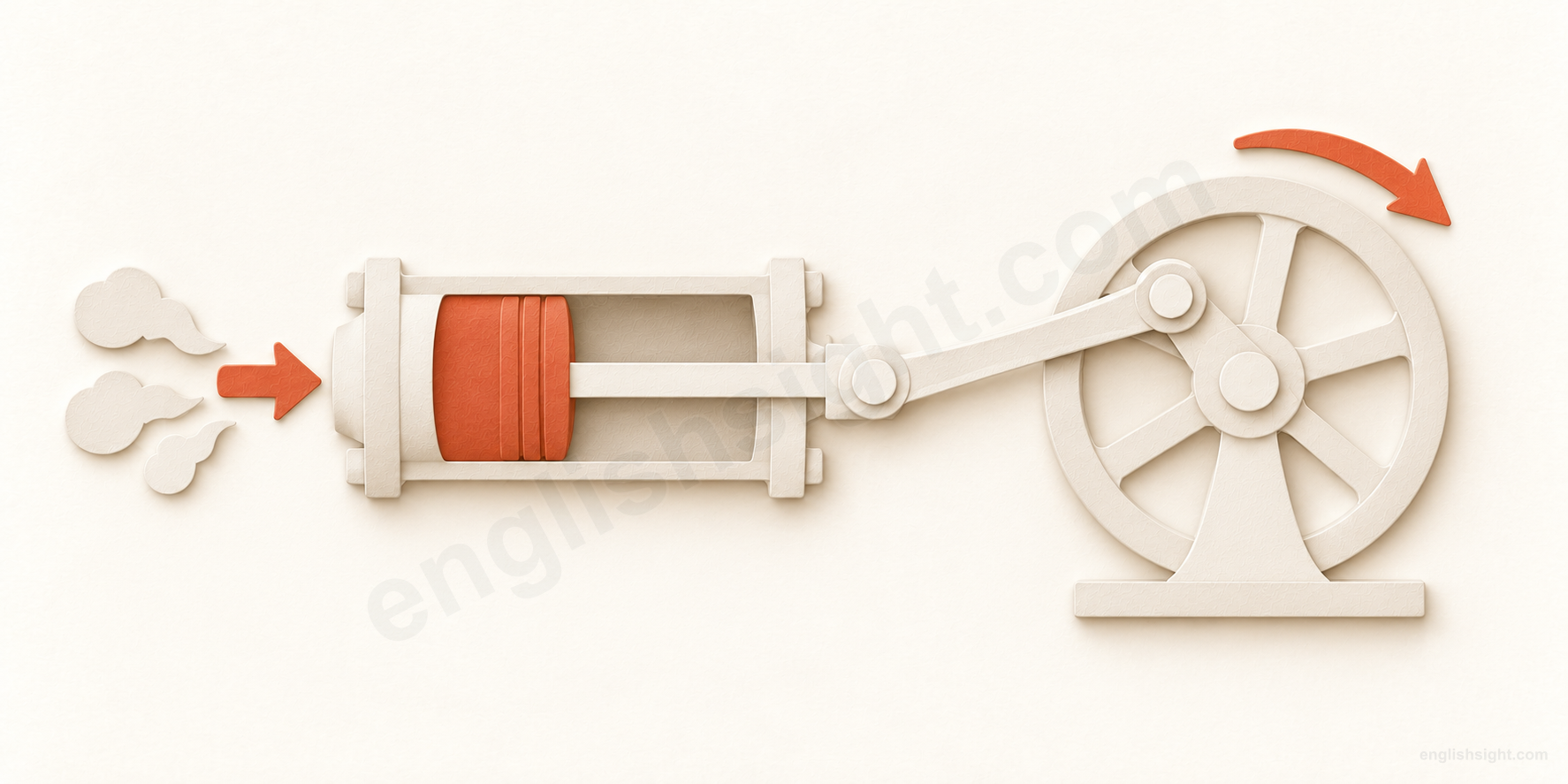
Steam carries energy into the cylinder.
engine
The flywheel rotates.
The piston and connecting rod turn the crank.
Supplied energy becomes driving motion.
An engine uses energy to produce force or motion that drives something else. Figuratively, an engine is something that makes a process work or develop.
The sketch uses a simple piston-and-wheel model to show input, conversion, and driven motion. It is not a design shared by all engines: jet engines produce thrust, and figurative or software engines do not burn fuel.
An engine turns supplied energy into force or motion. That driving role helps connect a vehicle’s power unit with figurative engines of growth and the working engines inside software.
Some expressions name whole things: a railway engine is a locomotive, and a fire engine is a firefighting vehicle. The complete phrase and its context decide what is being named.
01
Power, types, and everyday operation
Identify the power-producing unit, describe its type, and talk about starting, running, and problems. These are uses of the noun with different surrounding words.
01
an engine; something has an engine; the engine of + vehicle
an engine / the engine of a vehicle
the unit that produces power for movement
Situation
You are describing the machinery inside a boat.
What is being described?
You identify the unit that drives it.
The engine supplies driving power; the vehicle is the larger thing it powers.
An engine uses energy to produce force or motion. In a car, boat, or aircraft, it is the power-producing unit, rather than the whole vehicle. Engines can also power machinery that stays in one place.
Engine is countable: an engine, two engines. Use an before its initial vowel sound. Say The boat has an engine or the engine of the boat; in ordinary conversation, the boat’s engine is also natural.
Motor overlaps with engine, so a strict rule that one word is always right and the other always wrong would mislead you. For a small device driven by electricity, electric motor is the usual useful expression: The fan’s motor is noisy. A machine is a broader category; it need not be an engine.
In a sentence
This small boat has a surprisingly powerful engine.
Watch the difference Do not use engine as a general replacement for car: We bought a new engine means the power unit, unless a special context supplies another established sense.
02
a + type + engine; an engine runs on + fuel; be powered by + engine; twin-engine / twin-engined + noun
a diesel / steam / jet engine
identify the engine’s fuel, mechanism, or configuration
Situation
You compare two machines or read a vehicle description.
What is being described?
The modifier tells you what kind of engine is involved.
The words around engine describe its type; they do not create a new verb.
Petrol engine is British wording; gasoline engine is American wording. A diesel engine uses diesel fuel. A steam engine uses steam to produce mechanical work. A jet engine drives an aircraft by sending gases backwards; it need not turn the wheel shown in our sketch.
The engine runs on diesel identifies its fuel. The boat is powered by a diesel engine identifies what drives the boat. On and by belong to these different patterns; they are not interchangeable.
Descriptions can give a number or arrangement too: a plane with two engines, a twin-engine plane, or a twin-engined plane. In the last form, -engined means having the engines specified. A four-cylinder engine describes cylinders, not four separate engines.
In a sentence
The museum’s pump is powered by a steam engine.
Watch the difference A steam engine can be stationary machinery as well as a locomotive. Do not translate every occurrence as a train.
03
start / stop / switch off / turn off / cut + the engine; the engine starts
start / switch off / cut the engine
begin or end the engine’s operation
Situation
A driver has finished parking.
What is being described?
The driver stops the power unit from running.
The action is expressed by start, stop, switch off, or cut; engine names the thing affected.
Start the engine means make it begin operating. The engine starts describes the engine beginning to work without naming who caused it. If it won’t start, it fails to begin operating; won’t does not give the machine a human intention.
Switch off or turn off the engine clearly describes stopping its operation. Cut the engine is another established way to say this; it does not mean damage it with a sharp tool.
These are verb-and-noun combinations, not phrasal verbs built from engine. With switch off or turn off, a pronoun goes between the verb and off: switch it off. Engine stays a noun in all of them.
In a sentence
Once she had parked, Nina switched the engine off.
Watch the difference Stopping the car and stopping its engine are different: a car can be stationary with the engine still running.
04
the engine is running / idling; leave / keep the engine running; rev (up) the engine
the engine is running / idling / revving
describe an engine in operation and its speed
Situation
The car is waiting at the entrance.
What is being described?
Its engine continues to operate although the car is not moving.
Engine activity and vehicle movement are separate facts.
The engine is running means it is operating. Leave the engine running or keep it running describes allowing that operation to continue. Here running does not mean the engine is moving from one place to another.
An idling engine runs slowly while the vehicle is stationary. In British English, tick over is another expression for this, usually used in progressive forms such as The engine is ticking over. In The engine is idling, idle is a verb; the engine has not necessarily been switched off.
Rev the engine means make it run fast, and The engine revs describes it running fast. Revving is about engine speed; a driver can rev an engine without the vehicle moving faster. Both subject and object patterns are possible.
In a sentence
The car was still outside, with its engine idling.
Watch the difference Do not infer that a car is moving just because its engine is running, or that idling means the engine is off.
05
have engine trouble; suffer engine failure; engine + noun
engine trouble / engine failure / engine oil
describe a problem, a breakdown, or something used in an engine
Situation
A mechanic asks why the car was brought in.
What is being described?
You describe a problem with its power unit.
Engine can modify another noun; that following noun supplies the main category.
Engine trouble means a problem with the engine; it need not identify an exact fault or a complete breakdown. Engine failure describes an engine failing to operate. The engine broke down or died also says it stopped working, with died presenting the machine as if it were alive.
Engine oil is oil used in an engine. Engine noise, engine power, and engine repairs similarly name noise, power, and repairs connected with an engine. These are noun combinations, not independent meanings of a verb engine.
The main noun controls counting: an engine but some engine trouble and some engine oil. You can say two engines and two engine failures. For a single problem, a problem with the engine is a clear alternative to engine trouble.
In a sentence
We cancelled the trip because the van had engine trouble.
Watch the difference Do not say an engine trouble for an unspecified problem. Use engine trouble or a problem with the engine.
02
Whole vehicles and places
In some established expressions, engine refers to a locomotive or belongs to the name of a vehicle or compartment. Read the complete expression.
06
a train / railway engine; an engine pulls a train; an engine driver
a train engine / a steam engine
the locomotive that pulls a train
Situation
You are looking at a locomotive and the passenger carriages attached to it.
What is being described?
Engine identifies the locomotive as a whole.
In railway contexts, engine can name a whole powered vehicle rather than a component inside it.
An engine can be a locomotive: the powered railway vehicle that pulls a train. A steam engine in a railway story can therefore mean the entire locomotive, whereas a steam engine in a factory can mean the power-producing machine.
This is an established railway sense; it is not a rule that any vehicle may be called an engine. A train can include the locomotive and its attached carriages or cars.
Engine driver names the person who drives a railway engine. It is British wording, marked as becoming old-fashioned by Oxford; train driver is a clear alternative. North American English uses engineer in this railway job sense, which differs from engineer as a designer or technical professional.
In a sentence
A restored steam engine pulled the carriages out of the station.
Watch the difference Read the context before deciding whether engine means a power unit or a locomotive. It does not normally mean the whole passenger train.
07
a fire engine; two fire engines
a fire engine
a vehicle carrying firefighting equipment
Situation
An emergency vehicle arrives near a burning building.
What is being described?
You name the complete firefighting vehicle.
Fire engine is a fixed compound naming the whole vehicle.
A fire engine carries equipment for fighting fires. Here engine does not mean just the motor under its bonnet or hood. Learn the two-word name as a unit.
Fire truck is another name, especially in North American English. In everyday descriptions both can refer to the firefighting vehicle; detailed professional distinctions between kinds of equipment are outside this lesson.
The plural is fire engines: Two fire engines arrived. Fire describes the vehicle’s purpose, not a claim that its engine is burning.
In a sentence
Two fire engines stopped beside the warehouse.
Watch the difference An engine fire means a fire in an engine. A fire engine means a firefighting vehicle. Word order changes the meaning.
08
in / into the engine room; the ship’s engine room
in the engine room
inside the part of a ship containing its engines
Situation
A crew member needs to inspect the ship’s machinery.
What is being described?
The crew member goes to the compartment where its engines are.
Engine room names a place containing engines, rather than an engine itself.
On a ship, the engine room is the compartment containing the engines. In tells you where a person or event is located: The crew member is in the engine room.
Engine modifies room, the main noun. The ship’s engine room identifies that particular room; an engine room introduces one without assuming the listener already knows which ship or compartment.
Do not confuse the engine room with the room or position from which a ship is steered. This expression locates the power machinery; it does not name every control area on a ship.
In a sentence
The engineer went down to the engine room to inspect the machinery.
Watch the difference The last word names the thing: an engine room is a room, while a room’s engine would mean an engine belonging to or associated with a room.
03
What drives a process
The idea of driving power extends to organizations and software. These uses concern activity and results rather than literal fuel or wheels.
09
an engine of + noun; an engine for + noun / -ing; the engine behind + noun
an engine of growth / an engine for change
something that strongly drives a process or result
Situation
New local businesses are creating jobs and activity.
What is being described?
You describe them as a force driving the town’s development.
The subject drives a process figuratively; no actual machinery is required.
Calling something an engine of growth presents it as a major cause of development. The connection with a physical engine is driving power: one thing helps make a larger process work or advance. It need not be the only cause.
Engine of + noun can name the result or process. Engine for + noun or -ing form emphasizes what it helps achieve: an engine for change or an engine for creating jobs. Engine behind + noun points to a driving contributor, sometimes a person: She was the engine behind the campaign.
This metaphor often appears in reporting, business, and discussion of public affairs. It does not mechanically tell you which cause is strongest; the speaker is making an assessment.
In a sentence
Small local businesses have become an engine of growth for the town.
Watch the difference In an engine for creating jobs, for is followed by creating, not create. The phrase describes a driving role rather than a literal machine.
10
the engine room of + organization
the engine room of an organization
the part where important work or decisions happen
Situation
A small operations team organizes most of a charity’s daily work.
What is being described?
You describe that team as its central working part.
The ship’s machinery compartment becomes a metaphor for a working center.
The engine room of an organization is its center of important activity or decision-making. The expression can refer to a team, department, or office, rather than a room full of machinery.
Compare the two metaphors: an engine of growth emphasizes what drives development; the engine room of the company emphasizes the part where its essential activity takes place. They are related but not identical.
An organizational engine room need not be the most visible or prestigious part. The metaphor highlights its role in keeping the organization working; it does not establish a precise job title.
In a sentence
The scheduling team is the engine room of our delivery service.
Watch the difference Use context to distinguish a literal ship’s compartment from an organization’s working center.
11
use a search engine; enter / type + search words + into a search engine
use a search engine
use software that finds information on the internet
Situation
You need to find websites about local history.
What is being described?
You enter search words and receive relevant results.
Search identifies the engine’s job: finding information.
A search engine is a program or service for finding information on the internet, typically using words you enter. It is a software use of engine, not a machine that physically powers your computer.
Say use a search engine or type words into a search engine. The complete expression is countable: a search engine, several search engines. Search stays singular when it modifies engine.
A browser is the application in which you open and view websites. You may use a search engine within it. The two have different jobs even when a browser’s address box also lets you search.
In a sentence
I used a search engine to find the museum’s official website.
Watch the difference Do not assume search engine and browser mean the same thing: finding pages and displaying pages are different functions.
12
a software engine; the engine of / inside + software system
a software engine
software that carries out a fundamental function
Situation
A developer describes the working core of an application.
What is being described?
Engine names software that performs a basic task within the system.
The driving role is functional, not mechanical.
In computing, an engine can be software that performs a fundamental function, especially within a larger program. The word draws attention to the part that does important underlying work.
For example, The app’s software engine processes each request describes a working component, not an extra physical engine inside the device. The surrounding description tells you the task it performs.
This general software sense explains why you may encounter engine in technical product descriptions. Search engine is an established everyday example, but engine alone does not mean search: you still need context to identify its function.
In a sentence
The developers replaced the app’s software engine while keeping the familiar interface.
Watch the difference Do not assume that every engine is a separate device, or that every piece of software is naturally called an engine.
Name the thing, then read the surrounding words
Engine and motor overlap
Both can describe devices that produce movement. Engine is familiar for a vehicle’s power unit; electric motor is a useful default for a fan or similar electrical device. Avoid a universal rule based only on fuel versus electricity.
Engine is normally a countable noun
Say an engine and several engines. In engine oil or engine trouble, the following noun is the main noun and determines counting. There is no ordinary family of phrasal verbs formed with engine.
Grammar belongs to the surrounding verb
In The engine was repaired, repaired supplies the passive meaning; engine is the thing repaired. In We had the engine repaired, have supplies the arrangement pattern. These are not extra verb senses of engine.
Useful scope
This lesson covers modern general noun uses, everyday operation, major transport compounds, and figurative and software uses. It leaves detailed engineering classifications, historical war machines, obsolete senses, and the specialized verb meaning equip with engines for later study.
Choose the meaning in context
Use the whole phrase and the situation to decide what engine names.
1. A parked car has its engine idling. What is happening?
2. The article calls tourism an engine of growth. What does it mean?
3. You want to name the vehicle carrying firefighters and their equipment. Which phrase fits?
4. A steam engine pulls three passenger carriages. What does engine name here?
5. You use a search engine to find a website. What is its job?
Sources and teaching notes
The linked dictionary entries support the meanings and usage patterns. Explanations and examples are original; the energy-to-motion sketch is a teaching model, not a dictionary claim about a shared mental image.
The diagram explains a useful connection; different English speakers need not picture the word in the same way.