Use enough for sufficiency, a limit, and familiar conversational expressions.
A requirement and an available amount
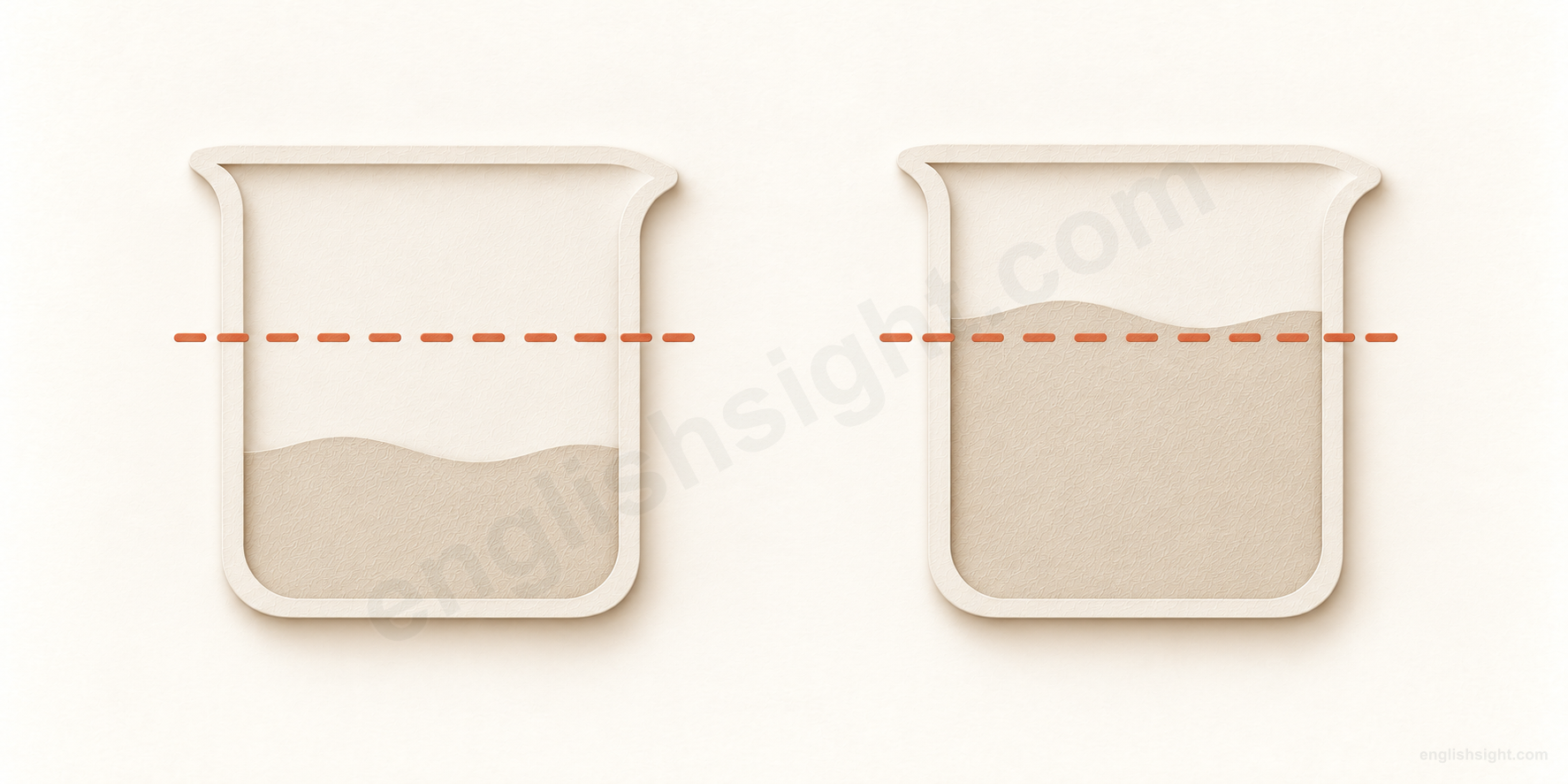
Compare what is available with what is required
The amount on the left falls short.
enough
The amount on the right meets the need, with some to spare.
The dashed lines mark the same required amount.
The line marks the need. Enough meets it and can leave some to spare.
Enough means that the amount or degree meets a relevant need, purpose, or expectation. In stopping expressions, the boundary is how much someone wants or will tolerate.
The vessels illustrate one measurable requirement. The same comparison can concern time, space, skill, effort, or patience; those uses do not involve literal filling.
Enough /ɪˈnʌf/ asks whether an amount or degree meets what the situation requires. Two blankets may be enough for two guests and not enough for six. The word does not itself mean a large amount or exactly the minimum.
This lesson connects sufficient quantities, sufficient qualities, and limits of tolerance. Fixed expressions such as sure enough also need to be learned as whole phrases; the picture cannot predict them all.
01
An amount that meets a need
Name the resource, identify a particular supply, or leave the noun understood. The amount is judged against a purpose, not against a fixed large number.
Enough comes before an uncountable noun or a plural count noun.
Use enough money, water, time, or space for an uncountable amount, and enough chairs, tickets, or copies for a countable number. A question asks whether the amount meets the need; a negative says it falls short.
There is enough room means sufficient space is available. There are enough rooms means a sufficient number of separate rooms is available. Match is or are to the noun, not to the unchanging word enough.
Enough need not be a lot: one coin may be enough to pay a small charge. Very much and very many are not needed before enough.
The ordinary order is enough time. Time enough remains an established alternative, and reason enough or proof enough is also found in emphatic writing. A general phrase such as food enough for all sounds old-fashioned; do not move enough after every noun by analogy.
In a sentence
We have enough chairs for the six visitors.
Watch the difference Say enough chairs, not enough chair. Use enough water, not enough waters for an ordinary amount of water.
02
enough + noun + to-infinitive; enough + (noun) + for + noun; enough + (noun) + for + person + to-infinitive
enough time to finish / enough for everyone
state what an amount must cover
Situation / requirement
A task requires time or a group needs supplies.
What the expression says
You identify the purpose or people covered.
For names a beneficiary or purpose; to introduces an action.
Enough time to finish names both a resource and what it needs to allow. Enough food for everyone identifies the people whose needs must be met. For the journey names the occasion or purpose.
You can combine them: We have enough money for Sam to buy a ticket. Sam is the subject of buy, not necessarily the person who owns the money. With the action understood, Enough for Sam may simply mean a sufficient share for him.
In a sentence
We saved enough money for Sam to buy a train ticket.
Watch the difference Use to finish for an action, not for finish. For finishing may occur in other noun phrases, but it is not the standard replacement in this purpose pattern.
03
enough; be / have / do + enough; enough + for / to-infinitive
That is enough. / Have you had enough?
leave a recoverable quantity unnamed
Situation / requirement
Someone offers you another serving.
What the expression says
You say the amount already received meets your need.
The context supplies the missing noun.
Enough can stand alone when people understand the resource: Do we have enough? may refer to money, food, or tickets. Enough for two keeps the people explicit while leaving the resource unstated.
No, thanks, I have had enough can politely decline more food or drink. The same words in an angry voice may express frustration; enough alone does not decide which reading applies.
In a sentence
“Would you like more soup?” “No, thank you. I’ve had enough.”
Watch the difference Do not assume I’ve had enough always means anger. Context can make it a neutral statement about food.
04
enough of + determiner + noun; enough of + us / you / them / it
enough of the rice / enough of us
refer to an adequate part of an identified whole
Situation / requirement
You consider a particular supply or group.
What the expression says
A sufficient part of it is available or involved.
Of links enough to the specified supply or group.
Use enough of before the, this, that, a possessive, or an object-form pronoun: enough of the rice, enough of your work, enough of us. It refers to a sufficient amount or number from that identified whole.
Compare enough rice, which does not identify a particular supply. Enough of us are ready uses are for the people; enough of the rice is left uses is for the uncountable food. In informal speech, there’s before a plural is also heard, but plural agreement is a clear choice in careful writing.
In a sentence
Enough of us are free on Saturday to run the stall.
Watch the difference Say enough of them, not enough them; say enough rice for an ordinary unspecified amount, not enough of rice.
05
enough of a/an + singular count noun + (to-infinitive)
enough of a reason
have a sufficient instance or degree of a countable thing
Situation / requirement
You judge whether one reason justifies a decision.
What the expression says
You consider that reason sufficient.
Enough of a keeps the singular count noun and its article.
Enough of a reason means a reason sufficient for the decision. With a person category, She is enough of an expert to notice the error measures how far the person has the relevant qualities or knowledge.
This is not the ordinary plural-count pattern enough reasons. Enough reasons asks about the quantity of reasons; enough of a reason judges whether one consideration has sufficient force.
In a sentence
The broken lock is enough of a reason to change rooms.
Watch the difference Do not write an enough reason. The of a construction keeps the article with a singular count noun.
06
just / barely / almost + enough; more than enough; nowhere near enough
just enough / more than enough / nowhere near enough
compare a supply with the required amount
Situation / requirement
You compare available water with a recipe’s needs.
What the expression says
You locate the amount close to, above, or well below the requirement.
Modifiers tell us how the amount compares with the need.
Just enough means the supply meets the need with little or nothing to spare. More than enough means it exceeds what is required. Barely enough suggests that it only narrowly suffices, often with concern.
Not quite enough and almost enough still fall short. Nowhere near enough emphasizes a substantial shortfall. These are amount comparisons, not extra numbered senses of enough.
In a sentence
We have just enough flour for one loaf, with none left over.
Watch the difference Almost enough is still insufficient. More than enough does not itself mean an unusable or harmful excess.
02
A sufficient degree or result
With qualities and actions, enough measures how far something meets a requirement. Its position tells you what is being measured.
07
adjective + enough + (for + noun / to-infinitive)
old enough / good enough
meet a standard of quality or capacity
Situation / requirement
You judge an item against a use.
What the expression says
Its quality reaches the required level.
Enough follows the adjective it measures.
Good enough, strong enough, and old enough ask whether the quality meets a relevant standard. The standard may be explicit, as in good enough for the exhibition, or understood from the situation.
Very good praises a high degree of quality; good enough says it meets the relevant need. Something can be good enough without being excellent. Conversely, a very tall ladder may still not be tall enough for a particular wall.
In a sentence
This draft is clear enough for the team to review.
Watch the difference Say clear enough, not enough clear. Sufficiently clear has the opposite modifier order.
An activity needs adequate speed, frequency, or effort.
What the expression says
You judge whether the performance meets that need.
Enough follows an adverb or comes after the verb phrase.
Speak clearly enough measures clarity; act quickly enough measures speed. Arrive early enough measures timing, and often enough measures frequency. The adverb tells us which scale matters.
Practise enough and sleep enough leave the measure to context: sufficient practice or sleep. With an object, keep a natural verb-object sequence, as in I know the route well enough. Do not insert enough between know and the route to measure knowledge.
In a sentence
She spoke slowly enough for me to take notes.
Watch the difference Say slowly enough, not enough slowly. An adjective describes a thing; an adverb describes how the action is done.
distinguish quantity from degree inside a noun phrase
Situation / requirement
You need large boxes for a move.
What the expression says
The problem is either their number or their size.
Moving enough changes what is measured.
We do not have enough big boxes means there are too few boxes of the big kind. We do not have big enough boxes means the boxes are too small. In the first phrase enough applies to the number; in the second it follows and modifies big.
A big enough box is possible with a singular count noun because a belongs to box while enough modifies big. This is different from trying to put enough directly before a singular count noun.
In a sentence
We have six boxes, but none is big enough for the lamp.
Watch the difference Enough big boxes and big enough boxes are not interchangeable: one checks number and the other checks size.
10
adjective / adverb + enough + to-infinitive
strong enough to lift it
reach the degree needed for an action
Situation / requirement
A person needs strength to lift a box.
What the expression says
Their strength allows the action.
The infinitive names the action made possible or relevant.
Maya is strong enough to lift it has Maya as both the person with strength and the understood subject of lift. The rope is strong enough to hold it describes a thing with sufficient capacity. No causative meaning belongs to enough by itself.
A degree can also lead to an actual result: The alarm was loud enough to wake the whole house describes a sound with sufficient loudness to cause waking, and in an event narrative can report that waking happened. Strong enough to lift it alone does not say the person actually lifted it.
Enough can also stand without a preceding adjective: One small error was enough to ruin the result. The event or circumstance itself is judged sufficient to produce the consequence; enough to make someone laugh follows the same pattern.
In a sentence
Maya is strong enough to lift the box, but she asks for help to protect her back.
Watch the difference Do not infer a completed action from every enough to sentence. Capability, purpose, and actual result depend on context.
11
Would you be kind enough to + base verb?; person + be + kind enough to + base verb
Would you be kind enough to…?
make a formal request or acknowledge a helpful action
Situation / requirement
You want someone to send a document.
What the expression says
You frame the requested action as a kindness.
The adjective and sentence form give this enough-to pattern its social purpose.
Would you be kind enough to send me the form? is a formal way to request an action. The speaker is asking for help, rather than testing whether the listener possesses a measurable minimum of kindness. Depending on tone and context, the form can also function as an instruction.
Compare She was kind enough to send me the form. This normally reports that she sent it and presents the action appreciatively. Unlike strong enough to lift it, this description of a helpful action normally includes the action actually happening. The whole construction and context determine that reading.
In a sentence
Would you be kind enough to email me a copy of the receipt?
Watch the difference This is a formal request, not a neutral question about someone’s character. Could you email me a copy? is a simpler everyday alternative.
12
thing + be + adjective + enough + for + person + to + verb (+ preposition)
small enough for me to carry
name the person who can perform the following action
Situation / requirement
You judge a suitcase’s size for your own use.
What the expression says
You can carry that suitcase.
For me supplies the subject of carry; the suitcase is its understood object.
This suitcase is small enough for me to carry means I can carry this suitcase. The suitcase is the main-clause subject, but me names the person performing carry. The understood object is already supplied by this suitcase.
Compare enough money for me to buy a case, where money is the resource and a case is the stated object. With an activity such as sitting, a final preposition may be needed: The bench is wide enough for us to sit on.
In a sentence
This suitcase is small enough for me to carry upstairs.
Watch the difference In this pattern, do not repeat the object: small enough for me to carry, not small enough for me to carry it.
13
not + adjective / adverb + enough + to-infinitive; not enough + noun + to-infinitive
not old enough to… / too young to…
fall short of what an action requires
Situation / requirement
A course has a minimum age.
What the expression says
The learner does not meet the age condition.
Not enough denies sufficiency; too marks an obstructing excess.
Not old enough to join says the required age has not been reached. Too young to join describes the same barrier from the opposite scale. Not enough money to buy it similarly describes insufficient funds.
Choose the opposite adjective carefully: not warm enough may correspond to too cold, but not good enough does not always mean too bad in natural English. The relevant scale and situation control the paraphrase.
In a sentence
Lena isn’t old enough to join the adult class yet.
Watch the difference Enough to is followed by the base verb: old enough to join, not old enough for join.
14
adjective / adverb + enough, often without an explicit purpose
pleasant enough / well enough
describe an acceptable or moderate degree
Situation / requirement
You assess a hotel that meets ordinary expectations.
What the expression says
You give qualified rather than enthusiastic approval.
The degree may be tolerable without being impressive.
The room was pleasant enough can mean it was reasonably pleasant, with no strong praise. The evening went well enough can similarly express a satisfactory outcome. Context and tone may add a reservation.
Good enough for a stated task directly names a standard. Pleasant enough without a task often gives a moderate evaluation. Enough does not always hide criticism, so use the rest of the conversation to judge the attitude.
In a sentence
The room was pleasant enough, though the view was disappointing.
Watch the difference Do not automatically read pleasant enough as very pleasant or as definitely unpleasant.
03
Satisfaction, burdens, and stopping
Meeting a need can mean no more is wanted. In complaints and commands, the relevant boundary is what someone will tolerate.
15
adjective + enough + as it is / without + noun or -ing; as if that were not bad enough
bad enough as it is
say a difficulty should not increase
Situation / requirement
A situation is already difficult.
What the expression says
You reject adding to the burden.
The relevant boundary is what someone wants to bear.
The task is hard enough as it is says the existing difficulty is already substantial and should not be increased. Without adds the extra problem you do not need: The task is hard enough without another deadline.
This is a tolerance reading, not a claim that difficulty is a desirable target. As if that were not bad enough introduces a further unwelcome event: The train was late. As if that were not bad enough, it began to rain.
In a sentence
Packing is stressful enough without losing the keys.
Watch the difference Do not translate bad enough here as a positive achievement. The speaker does not want a greater degree of trouble.
16
Enough!; That’s enough!; Enough of + noun / that!; Enough is enough.; Enough already!
Enough! / That’s enough! / Enough is enough.
demand that something stop
Situation / requirement
An argument or disturbance continues.
What the expression says
You declare a limit and call for an end.
The amount tolerated has been reached.
Enough! and That’s enough! can be direct commands to stop arguing, joking, or making noise. Enough of that! identifies the activity being rejected. They can sound sharp, especially with strong stress.
Enough is enough emphasizes that the situation must not continue. Enough already is an informal version associated especially with North American English. These expressions call for stopping; they do not merely count a supply.
In a sentence
“That’s enough! Let your sister finish speaking.”
Watch the difference That’s enough can also neutrally confirm a quantity. Tone and context distinguish a calm measurement from a command.
17
have / has / had + had enough + (of + noun / pronoun / -ing)
have had enough of…
be unwilling to tolerate something any longer
Situation / requirement
A person repeatedly cancels at the last minute.
What the expression says
You say that you no longer want to accept the behavior.
Of identifies the person, thing, or activity that has exhausted patience.
I have had enough of the delays expresses frustration and a wish for the delays to end. Of can take a noun, an object-form pronoun, or an -ing form: enough of waiting. I had had enough puts this judgment before another past event.
Compare I have had enough soup, which can simply express satisfaction after eating. I have had enough of this soup may instead sound like a complaint about it, depending on context. The perfect form does not make every occurrence an idiom of anger.
In a sentence
I’ve had enough of waiting for an answer, so I’m calling them.
Watch the difference Say enough of waiting, not enough to waiting. Enough to wait would instead connect sufficiency with an action.
18
can’t / cannot + get enough of + noun; can’t / cannot + thank + person + enough + for + noun / -ing
can’t get enough / can’t thank you enough
express a desire or gratitude that never feels satisfied
Situation / requirement
You enjoy a song repeatedly or receive major help.
What the expression says
You express strong enjoyment or gratitude.
A negative sufficiency pattern can express a very strong positive feeling.
I can’t get enough of this song means I enjoy it so much that I keep wanting more. Contrast I don’t get enough sleep, which normally reports a real shortage. Context makes the song expression an enthusiastic exaggeration.
I can’t thank you enough for your help means my thanks feel inadequate to the help you gave. It expresses strong gratitude, not a refusal to thank you. In I can’t stress this enough, the same rhetorical pattern emphasizes how important the point is.
These are conventional conversational applications of an unmet standard. The general amount and degree meanings support the comparison, but the exact emotion comes from get, thank, or stress and the situation, not from enough alone.
In a sentence
I can’t thank you enough for staying to help us pack.
Watch the difference Compare I’ve had enough of this song, which says you want it to stop, with I can’t get enough of it, which says you want more.
04
Responses, comments, and established phrases
Learn the whole expression here. Some phrases still suggest adequacy; others signal agreement, surprise, confirmation, or a familiar figurative situation.
19
Fair enough.; fair enough, but + clause
Fair enough.
accept a point, decision, or suggestion as reasonable
Situation / requirement
Someone explains why they cannot attend.
What the expression says
You acknowledge that their position is reasonable.
The full reply marks acceptance, sometimes with a reservation.
Fair enough is an informal response, particularly associated with British English, that accepts a reason or proposal. It need not signal enthusiastic agreement with every detail.
You can continue with a qualification: Fair enough, but please let us know earlier next time. Here fair means reasonable; the phrase is not about receiving a sufficient share.
In a sentence
“I need to leave early to collect my son.” “Fair enough.”
Watch the difference Fair enough and sure enough serve different purposes: acceptance versus confirmation of an expectation.
20
sure enough, + clause
Sure enough, …
confirm an expectation or suspicion
Situation / requirement
You expect the bakery to be closed.
What the expression says
What you find matches that expectation.
The phrase presents confirming evidence, not a degree of personal certainty.
Sure enough introduces what proves to be as expected or suspected. It can follow a prediction or a clue, and may refer to good or bad news.
I am sure enough to decide would measure someone’s confidence using an ordinary adjective pattern. Sure enough, it was closed is a fixed sentence comment with a different function.
The informal expression right enough can affirm a fact: You heard me right enough, so please answer. It means certainly or unmistakably here. It need not refer to a prediction, unlike the usual confirming function of sure enough.
In a sentence
I thought the bakery might be closed, and sure enough, the shutters were down.
Watch the difference Do not use sure enough as a routine replacement for certainly in a promise such as I will certainly come.
comment on a whole fact as surprising or noteworthy
Situation / requirement
A coincidence or unexpected fact comes up.
What the expression says
You frame the fact as remarkable.
The adverb comments on the proposition that follows.
Strangely enough and oddly enough signal an unexpected fact. Funnily enough commonly introduces a curious coincidence; it does not require something laugh-out-loud funny. Interestingly enough presents a fact as noteworthy.
In Oddly enough, I recognized her, oddly enough comments on recognizing her at all. In He behaved oddly enough to attract attention, oddly describes how he behaved, and enough to names a consequence. Position and syntax distinguish the readings.
In a sentence
Funnily enough, we both chose the same book without discussing it.
Watch the difference Do not read funnily enough as sufficient amusement. In this sentence-comment pattern, learn the whole expression.
22
Enough said.
Enough said.
indicate that you understand and need no further explanation
Situation / requirement
A short explanation makes the issue clear.
What the expression says
You signal that no further detail is necessary.
The amount of explanation already given is sufficient.
Enough said is a compact conversational response: the point is understood and further discussion is unnecessary. It may be sympathetic, amused, or abrupt depending on the situation.
Do not confuse it with I have said enough, which is a full statement about how much the speaker has said. Enough said often responds to the other person’s explanation.
In a sentence
“Why are you taking a taxi?” “My bike has a flat tyre.” “Enough said.”
Watch the difference Enough said can close a topic sharply. Use tone and context to judge whether it will sound dismissive.
23
near enough; value + near enough
near enough
accept a small difference as unimportant
Situation / requirement
You estimate a length or number.
What the expression says
You treat the approximation as adequate.
The value is close enough for this purpose.
Near enough is an informal British expression meaning approximately, with the difference small enough not to matter. It can answer an estimate: Is that two metres? Near enough.
Do not confuse this with nowhere near enough, which says a quantity is far below what is needed. The small difference is acceptable in near enough but the shortage is emphasized in nowhere near enough.
In a sentence
The shelf is a metre long, near enough.
Watch the difference An acceptable approximation is not necessarily safe for a precise task; the phrase reflects the speaker’s chosen tolerance.
24
not go far enough; go far enough?; have gone far enough
not go far enough / have gone far enough
judge either insufficient action or an overextended activity
Situation / requirement
A new measure helps but leaves the main problem.
What the expression says
You say more action is needed.
Enough evaluates the extent achieved or tolerated.
The changes do not go far enough means they fail to achieve all that is wanted. Do they go far enough? asks whether their reach or effect is sufficient; it need not involve physical travel.
The joke has gone far enough reverses the practical demand: it has continued to the limit of what is acceptable and should stop. The affirmative complaint and negative assessment must be read in context.
In a sentence
The new rules help, but they don’t go far enough to prevent further delays.
Watch the difference Not go far enough asks for more; The joke has gone far enough typically asks for stopping.
25
enough / something + to be going on with
enough to be going on with
be sufficient for now
Situation / requirement
Only an initial supply is available.
What the expression says
It covers the immediate need until more is available.
The established phrase limits sufficiency to the short term.
Enough to be going on with is a British expression for an amount that serves for the time being. It does not promise that the supply will last indefinitely or complete the entire project.
The final with belongs to the established expression. For now is a simpler alternative: These notes are enough for now. The phrase is about making do temporarily, not necessarily moving anywhere.
In a sentence
These notes should be enough to be going on with until the full report arrives.
Watch the difference Do not omit with from this expression or interpret going as literal travel.
26
be + old enough to know better
old enough to know better
criticize behavior below the maturity expected
Situation / requirement
Someone behaves foolishly despite being mature enough to know the consequences.
What the expression says
You say their age makes the behavior inexcusable.
Knowing better involves judgment and conduct, not merely possessing information.
You are old enough to know better criticizes someone for acting less sensibly than they should. The speaker assumes that the person is mature enough to recognize that the action is inappropriate.
This is more pointed than the neutral age requirement in old enough to join. It does not mean the person is older than the speaker or knows more facts in general.
In a sentence
You’re old enough to know better than to hide someone’s keys as a joke.
Watch the difference The phrase is a rebuke and may sound patronizing; it is not a neutral statement of eligibility.
27
have + enough / a lot / too much + on + possessive + plate
have enough on your plate
already have plenty of work or problems to handle
Situation / requirement
A colleague with several deadlines is offered another task.
What the expression says
You explain that their existing workload is sufficient.
The plate is a figurative capacity for responsibilities.
Have enough on your plate means already having a substantial workload or enough problems to deal with. It often explains why another task would be unwelcome or unreasonable.
The longer idiom supplies the responsibility meaning. Enough alone does not mean work, and an actual plate of food can still be described literally. Have too much on your plate more directly says the burden exceeds your capacity.
In a sentence
Nora has enough on her plate with the launch, so I’ll handle the booking.
Watch the difference On her plate refers to Nora’s responsibilities here, not to a meal.
28
give + person + enough rope (+ to hang themselves)
give someone enough rope
allow freedom that may expose someone’s mistakes
Situation / requirement
A person is allowed to explain an unconvincing claim without interruption.
What the expression says
Their own choices may reveal their weaknesses.
The rope is an established metaphor for freedom to act.
Give someone enough rope means allow them freedom, often expecting them to make a mistake or reveal a problem in their conduct. The longer version is give someone enough rope to hang themselves.
The phrase can sound calculating or critical. It describes a strategy of non-interference, not straightforward kindness, and it does not imply literal rope or physical harm in ordinary figurative use.
In a sentence
The interviewer gave him enough rope, and his own explanation exposed the contradiction.
Watch the difference Do not treat this as a general synonym for helping someone. The full idiom often carries an expectation of failure.
29
let well enough alone; leave / let well alone
let well enough alone
avoid interfering in a situation unnecessarily
Situation / requirement
You could become involved in someone else’s argument.
What the expression says
You choose not to interfere.
The full idiom recommends leaving things as they are.
Let well enough alone is a North American expression advising against unnecessary involvement or change. A situation may be acceptable as it stands, or intervention may create fresh difficulties.
British English also uses leave well alone or let well alone. The meaning belongs to the whole fixed phrase; well enough by itself can simply mean reasonably well, as in The meeting went well enough.
In a sentence
Their disagreement is between them; I’d let well enough alone.
Watch the difference This is not an instruction to leave someone physically alone because they have recovered enough from illness.
Keep the requirement and the construction in view
Enough is relative, not necessarily large
Enough can describe a small amount for a small task. It does not require an exact match: a supply above the minimum may also meet the need. Too much says the amount is excessive; not enough says it is insufficient.
Word order changes the question
Use enough time, good enough, and quickly enough. Enough large boxes asks about the number of large boxes; large enough boxes asks whether the boxes are sufficiently large. With a singular count noun, use a pattern such as enough of a reason, not enough reason when you mean one countable reason.
A threshold does not guarantee an event
Old enough to apply describes eligibility, not a completed application. Context can instead report an actual result, as in a noise that was enough to wake someone. Read the whole sentence before deciding whether the outcome happened.
Forms and labels
Enough does not change for plural nouns or comparative and superlative degrees. Dictionaries classify its uses differently: determiner or adjective before nouns, pronoun or noun when standing alone, and adverb with a degree. It is not a verb, so its own tense, progressive, passive, causative, and particle-verb forms do not apply. Verbs in expressions such as have had enough carry their own tense.
Choose the meaning that fits
Use the situation, the word order, and the whole expression.
1. You need six large boxes. You have only two, and their size is fine. Which sentence identifies the problem?
2. You need four volunteers from your group. Six people are free. Which sentence uses the pronoun naturally?
3. Maya is strong enough to lift the box. What does this sentence establish on its own?
4. Which sentence correctly describes a case that I can carry?
5. A friend plays the same album all week and says, “I can’t get enough of it.” What do they mean?
6. You suspected the shop was closed. You arrive and see the closed shutters. Which phrase presents confirmation?
7. A recipe requires 300 grams of flour. You have 290 grams. Which expression fits if the full amount is required?
8. A colleague says, “The joke has gone far enough.” What do they most likely want?
Sources and teaching notes
Dictionary headwords, idiom entries, and the British Council grammar explanation support the uses below. Explanations, examples, and the diagram are original teaching material; the comparison in the picture is a teaching model.
This picture is a teaching aid, not a shared mental image of every English speaker.