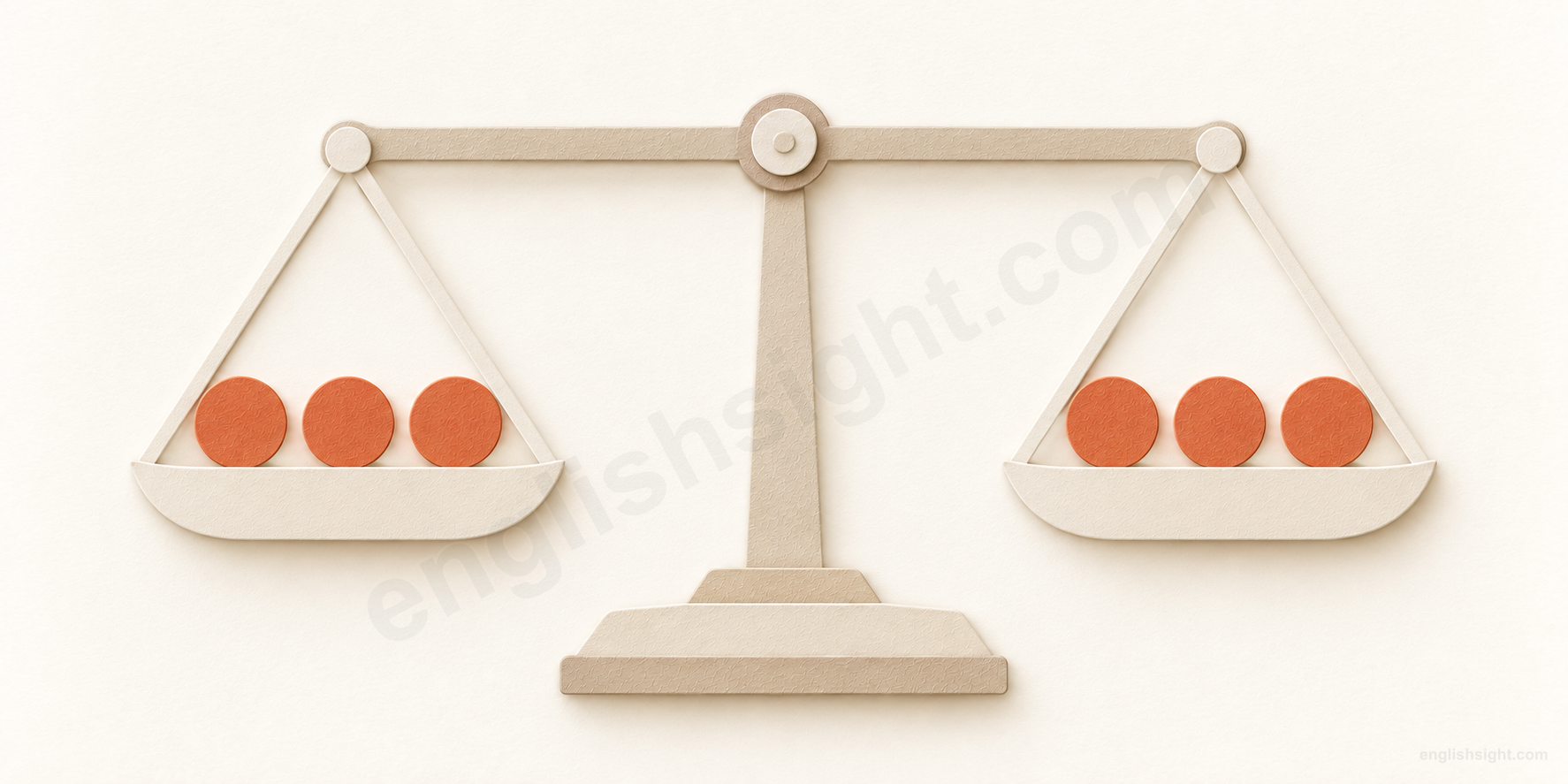
Compare amounts, rights, ability, and achievements with equal.
Compare on the relevant scale
Compare on the relevant scale
Three matching counters on the left
equal
Three matching counters on the right
Compare the two quantities
The quantities match. Equal concerns the chosen aspect, not necessarily every detail.
Equal places two things at the same level in the respect being compared, such as amount, value, or status.
The scale is a teaching model. Equal to the task concerns sufficient ability; equation-like result statements and fixed expressions need their own explanations.
Equal asks us to compare: the same in what respect? Things can be equal in weight but different in shape. People can have equal rights while living very different lives.
A useful teaching picture is a balanced scale holding matching quantities. It highlights comparison, not a universal mental picture shared by every English speaker. The whole construction decides how the comparison works.
01
Amounts and qualities
First decide what you are comparing: size, quantity, value, or importance. Equal concerns that particular aspect.
01
A and B + be + equal in + respect
equal in size
match in one specified respect
Situation / first side
Two rooms have different layouts.
Comparison / interpretation
Their floor areas are the same.
In names the feature being compared.
The rooms are equal in size compares size, without saying that their shapes or furniture match. You can also compare length, number, value, or strength.
Choose the relevant scale before using the word. Two teams equal in strength may have very different players; two equal prices can belong to completely different products.
In a sentence
The two rooms are equal in size but have different shapes.
Watch the difference Equal in size does not mean identical in every detail.
02
A + be + equal to + B; equal in + respect + to + B
be equal to
have the same amount or value as a reference
Situation / first side
A quantity is expressed in hours.
Comparison / interpretation
It is compared with the same duration in minutes.
To introduces the quantity or thing used as the reference.
In Two hours are equal to 120 minutes, be carries the tense and agreement, and equal is an adjective. The units differ, but the duration does not.
Compare equal in length with equal to this rope: in identifies a respect, while to identifies a reference. You can combine them: This rope is equal in length to that one.
In a sentence
Two hours are equal to 120 minutes.
Watch the difference Use equal to for this adjective comparison, not equal than or equal as.
Equal describes the resulting portions; the action comes from divide or share.
Divide something into equal parts specifies the size of each part. Share something equally describes how you share it. Equal is the adjective; equally is the adverb.
Use an equal number of chairs for countable items and an equal amount of water for a quantity of material. Equal shares can describe money or responsibility as well as physical portions.
In a sentence
We divided the six counters into two equal groups.
Watch the difference Two groups are not necessarily equal: one could contain four counters and the other two.
04
A and B + be + of equal importance / value; be equally important
of equal importance
matter just as much
Situation / first side
A team is considering cost and safety.
Comparison / interpretation
Neither consideration is ranked above the other.
An abstract quality can be compared without measuring physical size.
Of equal importance describes the importance of two or more things. You can also say equally important. The adjective equal modifies the noun importance; the adverb equally modifies important.
Of equal value may concern a price or someone’s judgment of worth. Name the context rather than assuming that value must always mean money.
In a sentence
Cost and safety are of equal importance in this decision.
Watch the difference Say equally important, not equal important. The comparison does not itself tell you which decision to make.
02
Rights, opportunity, and conditions
With people, equal often concerns how they are treated or what they can access. It does not erase personal differences.
05
equal rights / pay / treatment; people + be + equal under / before the law
equal rights / equal treatment
the same rights or standard of treatment
Situation / first side
People differ in background or identity.
Comparison / interpretation
Those differences do not justify fewer rights.
Social equality concerns rights and treatment, not identical talents or lives.
People are equal under the law is a claim about legal standing. Equal rights and equal treatment put equal before nouns describing what people receive or can claim.
A more equal society is natural when discussing progress toward social equality. In contrast, exact numerical equality is not normally graded: two exact totals either match or do not.
Some people are more equal than others is an ironic criticism of unfair privilege. It points out a conflict between a claim of equality and actual treatment.
In a sentence
The campaign calls for equal rights for all workers.
Watch the difference Equal rights does not claim that everyone has the same personality, skill, or income.
06
equal opportunities; equal opportunity employer; equal access to + something
equal opportunities / equal access
access and chances without discrimination
Situation / first side
People apply to join a training course.
Comparison / interpretation
Their backgrounds do not determine whether they can apply.
Opportunity concerns access and treatment, not a promise of identical results.
Equal opportunities is an established expression in education and employment. Equal opportunity is also used, including in equal opportunity employer. Equal access to something specifies what should be available.
An equal opportunities policy describes an organization’s approach to fair treatment. It does not say every applicant is equally qualified or that everyone will receive the same outcome.
In a sentence
The college aims to provide equal access to training.
Watch the difference Access takes to: access to training, not access of training.
07
on equal terms with + somebody; on an equal footing with + somebody
on equal terms / on an equal footing
with comparable status or conditions
Situation / first side
Two teams want a fair contest.
Comparison / interpretation
They compete under comparable conditions.
The comparison concerns the conditions, not the final score.
Compete on equal terms with someone means that neither side has an unfair advantage in the relevant conditions. The teams may still differ in skill.
On an equal footing with someone similarly presents equal standing or status. Footing is a conventional metaphor here; it need not concern anyone’s actual feet.
In a sentence
Both teams should be able to compete on equal terms.
Watch the difference On equal terms does not mean that the teams must finish with equal scores.
03
Ability and people who match a standard
A person may meet a challenge, match another person, or be so outstanding that nobody matches them. Read the whole construction.
08
be / feel / prove + equal to + the task / challenge / demands
be equal to the task
have enough ability or strength to handle a demand
Situation / first side
A difficult job needs a capable person.
Comparison / interpretation
Mara has the ability required to handle it.
The demand is a standard to meet, not another person to resemble.
Be, feel, or prove equal to a task describes sufficient ability, strength, or courage. This use is relatively formal; be up to the job or be able to handle it is often simpler in conversation.
The to belongs to equal to and is a preposition. A person equal to a challenge need not have exactly the minimum ability: more than equal to the task emphasizes ample ability.
In a sentence
Mara proved equal to the challenge of leading the team.
Watch the difference For this meaning, use equal to the task, not equal to do the task.
09
an equal; somebody’s equal; the equal of + somebody / something; as / between equals
an equal / somebody’s equal
a person or thing matching another in status or quality
Situation / first side
One colleague has a senior job title.
Comparison / interpretation
She still treats the others as people of equal standing.
Equal is now a countable noun, so it can take an article or a plural ending.
Treat someone as an equal focuses on respectful standing. Be someone’s equal at chess compares ability in a particular activity. The equal of something can also compare products or achievements.
Between equals describes a relationship between peers. The more formal phrase first among equals gives one member leading status within a group otherwise regarded as peers.
In a sentence
Despite her senior role, she treats us as equals.
Watch the difference Compare We are equal (adjective) with We are equals (plural noun). Both are possible, but their grammar differs.
10
have no equal; be without equal; have few equals
have no equal / be without equal
have nobody or nothing that matches the same excellence
Situation / first side
You compare someone with others in a field.
Comparison / interpretation
You judge that nobody matches their standard.
Negating a matching peer creates strong praise.
Have no equal and be without equal are emphatic, fairly formal praise. Context tells us the field in which the person or thing is considered outstanding.
Have few equals is less absolute: very few competitors match the standard. It does not mean the person has very few friends or owns very few things.
In a sentence
As a storyteller, my grandfather has no equal.
Watch the difference Has no equal is an evaluation of excellence, not a statement that the person has no partner.
04
Use equal as a verb
Equal can state a numerical relationship, describe matching an achievement, or present a cause and result in a compact formula.
11
A + equal / equals + B; A + be + equal to + B
three plus four equals seven
state that two quantities have the same value
Situation / first side
You calculate a sum.
Comparison / interpretation
You state its value as seven.
Equals is the finite verb, so another is is not needed.
Compare Three plus four equals seven with Three plus four is equal to seven. The first uses the verb equal; the second uses be and the adjective equal. The symbol = is called an equals sign or equal sign.
An arithmetic expression such as three plus four can be treated as one calculation, hence equals. With an ordinary plural subject, use equal: The combined payments equal the total cost.
In a sentence
Three plus four equals seven.
Watch the difference Do not mix the two patterns into is equals seven or equals to seven.
12
equal + somebody / a record / achievement; be equalled / equaled by + somebody / something
equal a record / achievement
reach the same standard as an existing performance
Situation / first side
A school record is 24 goals in one season.
Comparison / interpretation
A player also scores 24 goals.
Matching a record is different from surpassing it.
Equal a record means reach it; break a record means go beyond it in the successful direction. Equal someone’s achievement similarly describes matching what they accomplished. The object can also be a person: No one can equal her means that nobody performs as well as she does in the activity being discussed.
Passive wording is possible: That record has never been equalled. Here the performance is the thing matched, not a person being made equal. British spelling usually has equalled and equalling; American spelling usually has equaled and equaling.
In a sentence
Jo scored 24 goals, equalling the school record.
Watch the difference Equal the record does not mean break the record. Use the object directly, without to.
13
situation / factor A + equals + result B
better planning equals fewer delays
present something as leading to a result
Situation / first side
A manager considers the effect of better planning.
Comparison / interpretation
She predicts fewer project delays.
The formula expresses a practical claim, not literal numerical identity.
Equal can give a compact cause-and-result message, especially in slogans and summaries. Here Better planning means fewer delays. Planning names one activity, so the verb is equals.
This is a rhetorical extension of an equation. It states the speaker’s proposed connection; it does not prove that the result is inevitable or give a mathematical formula.
In a sentence
For this project, better planning equals fewer delays.
Watch the difference Use clearer wording such as leads to when the equation-like style could make a complex claim sound too simple.
05
Two useful expressions
These phrases compare degrees or hold other conditions constant. Learn the function of the complete phrase.
14
A and B + in equal measure; thanks / credit + go + in equal measure + to + recipients
in equal measure
to the same degree
Situation / first side
A new responsibility creates two feelings.
Comparison / interpretation
The speaker feels both just as strongly.
Measure expresses degree here, not a physical measuring device.
In equal measure can balance two reactions, qualities, or contributions. Excited and nervous in equal measure means that both feelings are present to a similar degree.
The phrase is relatively formal. Our thanks go in equal measure to both teams gives both teams the same degree of thanks. With feelings, it often sounds more considered or literary than equally excited and nervous, and it does not require an exact numerical measurement of emotion.
In a sentence
I felt excitement and fear in equal measure before the performance.
Watch the difference The phrase does not mean that one feeling disappears when the other appears.
15
other / all things being equal, + main clause
other / all things being equal
assuming other relevant conditions are comparable or unchanged
Situation / first side
Two rooms differ in price.
Comparison / interpretation
You compare the price while holding other factors constant.
The phrase states an assumption for a comparison or prediction.
Other things being equal lets you focus on one difference. In choosing a room, you may temporarily assume that location, size, and quality are comparable.
All things being equal can also qualify a prediction: All things being equal, we should finish by Friday. Here it means assuming the situation develops normally, without a relevant change or unexpected problem.
In a sentence
Other things being equal, I would choose the cheaper room.
Watch the difference It states an assumption; it does not confirm that all real-world conditions actually are equal.
Choose the comparison and the grammar
Equal, same, similar, and fair
Equal compares a relevant amount or standard. The same can identify one particular thing or describe sameness; similar allows differences. Fair judges what is reasonable or just. An equal split gives matching portions, but people can disagree about whether that split is fair.
Exact equality and social equality
For exact numbers, avoid using more equal to mean a closer numerical match; say more nearly equal. In discussions of rights and social conditions, more equal is accepted because equality can be approached by degrees. Roughly equal and approximately equal explicitly allow an approximate comparison.
Forms and constructions
The pronunciation is /ˈiːkwəl/. The adjective does not take a plural ending; the countable noun can be equals. Verb forms are equal, equals, equalled/equaled, and equalling/equaling. Numerical relationships normally use simple forms; record matching allows passive wording. The expressions here are not a family of separable phrasal verbs.
Making something equal
For the ordinary action of creating equality, use make the shares equal or equalize the shares. Do not assume that the verb equal normally means make equal. This lesson covers modern general uses, rather than older meanings or specialized mathematical theory.
Find the right comparison
Look at the construction and the aspect being compared.
1. Choose the complete sentence using equal as an adjective.
2. Rina proved equal to the task. What does this tell us?
3. The record was 24 goals. Jo equalled it. What happened?
4. Equal rights are promised to the members. Which interpretation fits?
5. Other things being equal, I would choose the cheaper room. What is being assumed?
Sources and teaching notes
Definitions and usage were checked against the sources below. Explanations, example sentences, and the diagram were written for this lesson; the visual connection is a teaching interpretation.
The balance illustrates one comparison; it is a teaching aid, not a picture shared by every native speaker.