Use error for mistakes, wrong beliefs, technical problems, and differences from a reference.
A result compared with a reference
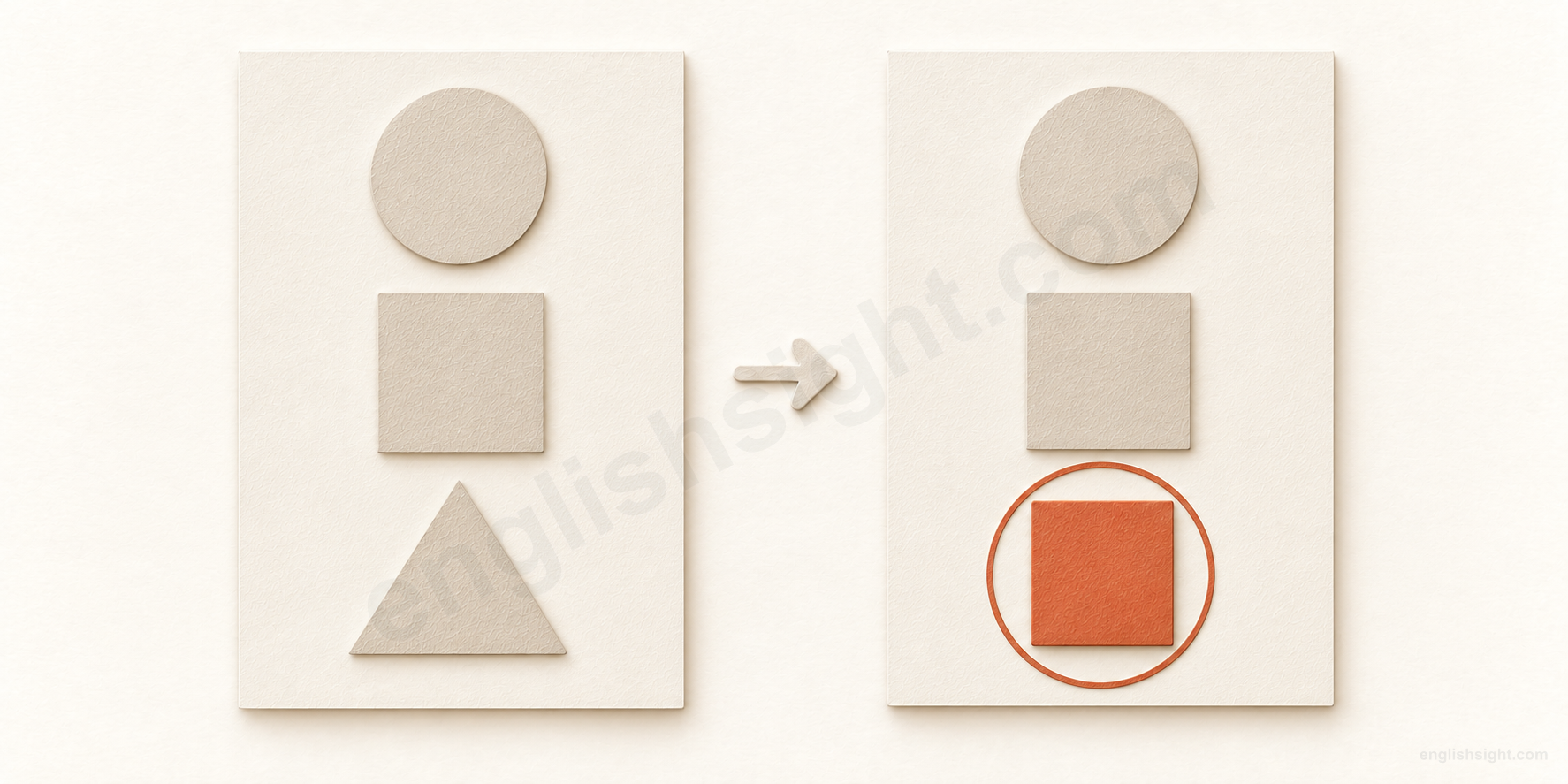
Compare the result with the reference
The left reference shows a circle, a square, and a triangle.
error
The last shape is a square where a triangle is required.
Compare the copied shapes on the right with the reference.
The circled square differs from the required triangle: an incorrect result, with no correction shown.
An error is a departure from what is true, correct, intended, or required in the situation.
The reference-copy sketch shows one incorrect result. An error need not be a copying mistake, visible on paper, deliberate, or caused by carelessness. The noun does not itself include correction.
A wrong digit in an address, an unsuccessful computer operation, and an inaccurate measurement can all involve error. Ask what the correct fact, intended action, or reference value is, then notice how the actual result differs.
This comparison is a useful teaching model. The surrounding construction tells you whether you are counting mistakes, explaining an accident, measuring a difference, or using an established expression.
01
Name, locate, and correct a mistake
Start with a particular wrong action, item, or decision. Choose verbs and prepositions to say who made it, where it is, and how you respond.
01
make + an error / errors
make an error
do something incorrectly
Situation / reference
You copy a booking number.
Result / interpretation
One digit in your copy is wrong.
Make links a person to a particular mistake.
In I made an error, I names the person responsible for the action and an error names the mistake. You can count separate errors: one error, two errors. A minor error may be easy to fix; a serious or costly error has larger consequences.
Error often suits reports, instructions, and discussions of accuracy. Mistake is a natural everyday alternative: I made a mistake with the booking. Choosing error does not by itself tell us how severe the problem is. Commit an error is possible but sounds more formal.
In a sentence
I made an error when I copied the booking number.
Watch the difference Say make an error, not do an error. The article is an before the vowel sound.
02
an error in + noun / -ing; contain + errors
an error in the report
identify where incorrect information occurs
Situation / reference
A report is ready for checking.
Result / interpretation
You find a statement that does not match the records.
In locates the mistake; a modifier identifies its type.
An error in the report puts the error inside that piece of work. The report contains an error makes the report the subject; it does not say that the report itself performed an action. Use spelling, typing, grammatical, factual, or calculation to identify the kind of problem.
There is an error in the address tells someone what needs checking. There are errors in calculating the total points instead to the calculation process. A factual error concerns what is true; a grammatical error concerns the way the sentence is formed.
A glaring error is very obvious: The headline has a glaring error in the year. Obviousness says how easily the mistake can be noticed, not how much harm it causes.
In a sentence
There is a factual error in the second paragraph.
Watch the difference Use errors in a document for its contents; an error on my part assigns responsibility to me.
03
an error of judgment / fact / omission; the error of + -ing
an error of judgment
make a poor assessment or decision
Situation / reference
You assume the small room will be large enough.
Result / interpretation
Guests arrive and cannot all fit inside.
Of identifies the kind of error or the action judged mistaken.
An error of judgment concerns how someone assessed a situation or chose what to do. In an error of fact, a claim or assumption is factually wrong. These are useful contrasts: using the wrong room dimensions is different from judging that a known small room will be sufficient.
The error of doing something identifies the mistaken action: We made the error of booking before checking the date. An error of omission involves leaving something out. These are noun phrases, not phrasal verbs. Both judgment and judgement are accepted spellings; judgement is common in British English.
In a sentence
Booking such a small room was an error of judgment.
Watch the difference An error of judgment evaluates a decision; it does not necessarily accuse someone of dishonesty.
04
check + something + for errors; correct / admit / learn from + an error / errors
check for and correct errors
look for mistakes and put them right
Situation / reference
A draft may contain mistakes.
Result / interpretation
You inspect it and repair any mistakes you find.
Checking, noticing, admitting, and correcting are different steps.
Check a form for errors means examine it to find possible mistakes; it does not say that any are present. Find, spot, or catch an error means notice one. Point out an error draws another person’s attention to it, while admit an error accepts that you made it.
Correct an error means put it right; fix an error is a less formal choice, especially with software. The error was corrected focuses on the result without naming the person. You can also learn from errors and avoid repeating them; error alone does not imply that any repair has happened.
In a sentence
Please check the form for errors before you send it.
Watch the difference Checking for errors does not guarantee finding or correcting every one.
02
Causes, computer problems, and amounts
Error can describe a cause, a failed operation, or a measurable difference. These uses do not all imply that somebody was careless.
05
(due to / caused by) + human error; a human error
human error
attribute a mistake to human action
Situation / reference
A person enters the order manually.
Result / interpretation
The wrong item is selected.
Human identifies a possible source of the problem.
Human error often treats mistakes by people as a general cause rather than counting individual acts: The delay was due to human error. Operator error and pilot error specify a role. Because this use is uncountable, it usually has no article.
An individual act can still be counted: A human error during data entry changed the order. The general label does not explain the whole chain of events or prove that one person alone caused the problem; a process may also make mistakes easier to make.
In a sentence
The wrong item was sent because of human error during data entry.
Watch the difference Use human error without an article for the general cause. For one particular mistake, say a human error, with a before the pronounced /h/.
06
get / display / return + an error; an error message
a system error / an error message
report that a computer operation has gone wrong
Situation / reference
You try to upload a file.
Result / interpretation
The upload stops and the screen reports a problem.
The error is the problem; the message is the notification.
A computer or system error can prevent a task from finishing. An error message tells you about a problem, for example that the file could not be saved. It is a message about an error, not necessarily a message whose words are incorrect.
I get an error when I upload this file is ordinary troubleshooting language. The software may display or return an error. This does not establish whether the cause is your input, the program, or another system. A fatal error can mean that an operation cannot continue; in computing it need not concern a death.
In a sentence
The website displays an error message when I try to upload the file.
Watch the difference Report the message or code if you have it; error alone does not identify the cause.
07
measurement / rounding error; an error of + amount
measurement error
describe a difference from the true or reference value
Situation / reference
A reference weight has a known mass.
Result / interpretation
A scale gives a slightly different reading.
Here error can be an amount of difference, rather than a blunder.
In measurement and calculation, error can name a difference between a result and the relevant true or reference value. If a scale shows 102 grams for a known 100-gram weight, the reading is 2 grams high. This comparison makes the reference explicit.
Measurement error can occur even when a person follows the procedure carefully. Rounding error comes from approximating numbers. The everyday model of a mismatch still helps, but technical discussions need their own units and definitions; not every difference proves negligence.
In a sentence
The scale has an error of two grams when tested with this reference weight.
Watch the difference An error of two grams is an amount; two errors counts two separate mistakes.
08
a margin of error of + amount; within the margin of error
a margin of error
allow for limited accuracy in an estimate
Situation / reference
You calculate an approximate amount.
Result / interpretation
You state how much uncertainty must be allowed for.
A margin describes an allowance around a result.
A margin of error tells readers that a number is not perfectly exact. In a simple estimate, an amount such as plus or minus two units shows a band around the estimate. The phrase is useful when reading measurements and survey reports.
Keep the stated unit: three percentage points is not the same calculation as three percent of a reported figure. In statistics, the conditions attached to a reported margin matter. The phrase alone does not promise to include every possible source of error.
In a sentence
The estimated weight is fifty grams, with a margin of error of two grams.
Watch the difference A margin of error is an allowance for uncertainty, not a count of mistakes already found.
09
an error rate of + percentage; a high / low error rate
an error rate
compare incorrect items with all items checked
Situation / reference
A system processes one hundred records.
Result / interpretation
Two records contain incorrect data.
Rate expresses a proportion, not just the number of errors.
An error rate can describe how often items are incorrect within a defined set. If two of one hundred records are incorrect, the error rate for those records is two percent. Specify what counts as an incorrect item and what set you measured.
A lower error rate means a smaller proportion of errors under the stated counting method. It does not necessarily mean fewer total errors if the amount of work has increased greatly. Keep error rate separate from margin of error: a measured proportion and an allowance for uncertainty answer different questions.
In a sentence
Two incorrect records out of one hundred give an error rate of two percent.
Watch the difference Do not compare error rates without checking that the same kinds of items and errors were counted.
03
Accidents, learning, and established expressions
Read each whole phrase. Its grammar can describe an accidental action, a wrong belief, a method of learning, or an attitude toward mistakes.
10
send / receive / charge + something + in error; be + past participle + in error
sent in error
say that an action happened by mistake
Situation / reference
A notice is intended for another customer.
Result / interpretation
It is accidentally sent to you.
In error describes how the action came about.
The notice was sent in error means that sending it was a mistake. In error is a fixed prepositional phrase without an article. It often appears in administrative explanations and apologies; by mistake is an easy everyday alternative.
The passive was sent leaves the sender unnamed. Compare The notice contains an error: that says the contents are wrong. A perfectly accurate notice can still be sent to the wrong person in error.
In a sentence
Your account was charged in error, and we have refunded the payment.
Watch the difference In error can describe a mistaken action even when the document or amount itself is accurate.
11
be + in error + (about + noun)
be in error about something
hold an incorrect belief or assessment
Situation / reference
You believe the meeting is on Thursday.
Result / interpretation
The invitation shows that it is on Friday.
After be, in error can describe being mistaken.
I was in error about the date acknowledges that my belief was wrong. In this pattern, in error describes a state of being mistaken; there need not have been an accidental action such as sending a message.
This wording can sound formal or deliberately careful. In conversation, I was wrong about the date is usually simpler. The reference may be a fact, a calculation, or a claim; the expression does not inherently mean morally bad.
In a sentence
I was in error about the meeting date; it is on Friday.
Watch the difference Distinguish I was in error, a mistaken belief, from It was sent in error, a mistaken action.
12
by / through trial and error; a trial-and-error approach
by trial and error
find a workable method by testing and adjusting
Situation / reference
You do not know which setting will work.
Result / interpretation
You try settings, observe failures, and adjust.
The whole phrase names a method of learning.
By trial and error describes learning from attempts and their results. You try one approach, notice what does not work, and change the approach. Trial here means a test or attempt, not a court case.
Use trial and error as a complete phrase: We learned by trial and error. Before a noun, it can become a compound modifier: a trial-and-error approach. The expression does not mean deliberately making mistakes for their own sake, and it does not guarantee that every problem can be solved this way.
In a sentence
We found the best printer setting by trial and error.
Watch the difference Keep the order trial and error; it is not an ordinary list of a trial plus an error.
13
there is + no / little room for error; leave + no room for error
no room for error
say that mistakes cannot be tolerated
Situation / reference
A task requires very precise alignment.
Result / interpretation
Even a small mistake would spoil the result.
Room is a metaphor for the amount of error a task can tolerate.
There is no room for error emphasizes that the consequences of a mistake would be unacceptable. It need not refer to physical space: a carefully timed performance or a precise calculation can leave no room for error.
Little room for error allows only a small amount of deviation. Error is uncountable here because the phrase concerns tolerance for mistakes generally. This is a strong statement about requirements, not proof that the people doing the work are incapable of making mistakes.
In a sentence
The pieces must fit exactly; there is no room for error.
Watch the difference Do not read room as a bedroom or office in this expression.
14
see / realize + the error of + possessive + ways
see the error of your ways
recognize that your behavior has been wrong
Situation / reference
Someone keeps interrupting other people.
Result / interpretation
They recognize the problem and decide to change.
Ways refers to behavior, not a travel route.
See or realize the error of your ways concerns a person’s habits or conduct. The recognition often points toward changing that behavior. The possessive changes with the person: I saw the error of my ways; they saw the error of their ways.
The expression can sound serious and judgmental, or deliberately humorous. Saying I finally saw the error of my ways and started backing up my files uses a grand phrase for a practical change. It is stronger and more personal than simply pointing out a typing error.
In a sentence
After hearing the complaints, he saw the error of his ways and stopped interrupting.
Watch the difference Use ways in the plural and the matching possessive; the expression concerns conduct, not navigation.
15
an event + be / become / turn into + a comedy of errors
a comedy of errors
describe a ridiculous series of mistakes
Situation / reference
One person goes to the wrong venue.
Result / interpretation
Further misunderstandings turn the event into a muddle.
The phrase evaluates a whole sequence of mishaps.
A comedy of errors describes an event made absurd by repeated mistakes and misunderstandings. The speaker may be amused, frustrated, or both. It does not require actors, a stage, or a deliberately funny performance.
Use a comedy of errors for the whole episode, rather than for a single small typo. The humorous framing may be unsuitable when discussing serious harm; that judgment comes from the situation and your audience, not from a special grammatical rule.
In a sentence
With the wrong address and two missing keys, our arrival became a comedy of errors.
Watch the difference Keep errors plural in this established phrase.
04
Describe a person, process, or result
The compounds error-prone and error-free describe different things: a tendency to go wrong and the absence of mistakes.
16
an error-prone person / process; an error-free document; be + error-prone / error-free
error-prone / error-free
describe susceptibility to mistakes or their absence
Situation / reference
You assess a method and check its output.
Result / interpretation
You distinguish likely mistakes from a checked result with none.
Prone predicts a tendency; free describes absence.
An error-prone process tends to produce mistakes; an error-prone person tends to make them. The compound does not mean that every attempt fails. For example, copying long codes by hand can be error-prone even when a particular copy is correct.
An error-free document has no errors within the relevant scope. Compare an error-prone method with an error-free result: the same method can sometimes produce a perfect result. Keep the hyphens in these compounds, including after be: The final list is error-free.
In a sentence
Manual copying is error-prone, so we check every code before sending it.
Watch the difference Error-free is stronger than checked for errors; checking alone does not establish that none remain.
Keep the kind of error clear
A noun, with countable and uncountable uses
Use an error for one mistake and errors for several. General expressions include human error, room for error, and trial and error. Error is a noun in these uses; say I made an error or I was wrong, rather than I errored, in ordinary general English. The related verb err is a separate, more formal word.
Error, mistake, fault, and failure
Mistake is usually an easy everyday choice; error often fits formal or technical discussion. A fault can be a defect or responsibility for a problem: It was my fault. A failure concerns something not succeeding. These words overlap in some situations, but an incorrect digit need not cause a whole task to fail.
Do not add blame automatically
A measurement can differ from its reference without anyone acting carelessly. A computer error message reports a problem without identifying who caused it. An error may be minor or serious; read the modifiers and situation.
Pronunciation and boundaries
Stress the first syllable: /ˈerə(r)/ in British English and /ˈerər/ in American English. This lesson covers general modern use and accessible technical expressions. Specialist legal, medical, religious, stamp-collecting, and sports definitions need their own context and are not developed here. The noun has no verb tense, causative, or phrasal-verb paradigm to list.
Choose what error means here
Read the complete expression and decide what it tells you.
1. You receive an accurate invoice intended for another customer. Which statement explains the mistake?
2. A known 100-gram weight produces a 102-gram reading. Which statement describes the difference?
3. You test several printer settings, change what fails, and find one that works. Which phrase fits?
4. You believed the meeting was on Thursday, but it is on Friday. Which sentence acknowledges your mistaken belief?
5. A colleague has checked a document but cannot guarantee that every mistake was found. Which statement is justified?
Sources and teaching notes
Dictionary entries support the meanings and constructions below. Explanations and examples were written for this lesson; the reference-copy diagram is a teaching comparison.
The diagram is a teaching aid, not an image shared by every native speaker.