Use even for matching levels and steady patterns, or to highlight something beyond an expectation.
Matching levels and amounts
Compare parts: does one stand above another?
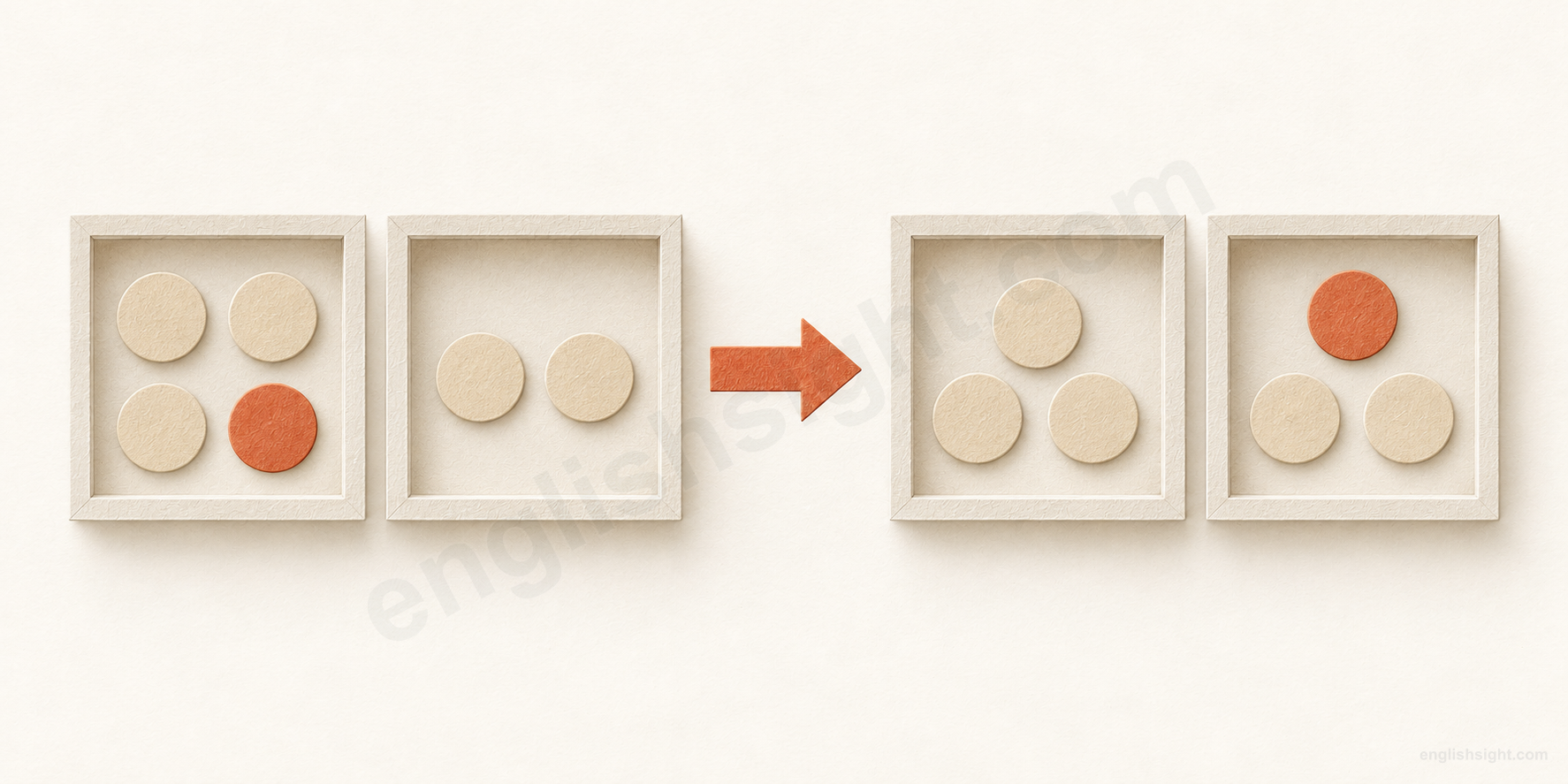
Four counters in one tray, two in the other
even
Three counters in each tray
Move the orange counter to make the shares even.
The total stays six; equal shares make an even split.
As an adjective, even often describes matching amounts or levels, or little variation across a pattern or time. As an adverb, it highlights an unexpected case or strengthens a comparison. Keep these branches distinct.
The drawing illustrates equal distribution only: the total stays six while the shares change. An even surface, an even pace, and even-number arithmetic require their own context. The adverb’s surprise is explained in the lesson, not proved by the drawing.
Even /ˈiːvn/ works as an adjective, an adverb, and a verb. An even surface has no troublesome irregularity; even Lina came highlights a surprising person. Start by asking which grammatical job the word is doing.
The balance model connects many adjective and verb uses. The adverb needs a separate idea: include or emphasize a case that stretches an expectation. These are teaching connections, not a rule that derives every expression or a claim about a picture shared by all native speakers.
01
Level, regular, and steady
With a surface, a pattern, or a changing condition, even describes an absence of disruptive differences. The noun tells you which differences matter.
01
an even + surface / floor; something + be + even; keep / make + something + even
an even surface
a surface without bumps or hollows
Situation / starting point
You need a stable area for a model.
Meaning / result
The board provides a flat working surface.
Even describes the shape of the surface.
For a floor or worktop, even concerns bumps, dips, and levelness. A surface can be clean but uneven; cleaning and leveling solve different problems.
Keep the board even describes its condition. Make the board even describes producing that condition. The sketch’s matching levels offer a memory link, but its equal shares are a different use.
In a sentence
Put the model on an even surface so that it does not tilt.
Watch the difference Smooth often highlights texture; even often highlights levelness or regularity. They overlap but are not interchangeable in every setting.
02
something + be + even with + reference; keep + something + even with + reference
even with the edge
at the same height or in the same line
Situation / starting point
One end of a shelf projects beyond a cabinet.
Meaning / result
The front edges line up.
With names the reference for alignment.
In even with the edge, even is an adjective and with introduces the thing used for comparison. You can check alignment by sight or measurement.
The shelf is even with the cabinet means their relevant edges or levels match. Even the cabinet is damaged has a different grammar: even is an adverb highlighting a surprising item.
In a sentence
Keep the front of the shelf even with the edge of the cabinet.
Watch the difference Even with can also introduce a surprising circumstance: Even with help, it was difficult. That is the adverb, not physical alignment.
03
even + stitches / teeth; space + objects + evenly
even stitches
parts that follow a regular size or spacing
Situation / starting point
You sew a row of stitches.
Meaning / result
The stitches form a consistent pattern.
Compare neighboring parts, not the total number.
Even stitches are consistent in length and spacing. Similar uses include even teeth or an even row. The important feature is regularity across the pattern.
Use evenly for the manner of arranging things: Space the hooks evenly. An even number of hooks instead concerns whether the count is divisible by two.
In a sentence
Try to keep the stitches even along the whole seam.
Watch the difference Even describes the stitches; evenly describes how you place or space them.
04
at an even pace / rate; keep + something + at an even temperature
an even pace
a rate or condition with little variation
Situation / starting point
A runner starts too fast and then slows sharply.
Meaning / result
A steadier pace avoids repeated changes.
Here the comparison runs through time.
At an even pace, movement continues at a fairly consistent rate. An even temperature similarly avoids large rises and falls. It need not be fast or high.
Walk at an even pace describes the pace; breathe evenly describes how breathing happens. Neither means that two people must move or breathe together.
In a sentence
We walked at an even pace instead of rushing and stopping.
Watch the difference An even pace is a consistent pace, not necessarily a slow one.
05
an even voice / temper / temperament; speak evenly
an even voice / temper
controlled expression or a disposition without sharp swings
Situation / starting point
A complaint could lead to an argument.
Meaning / result
The reply remains controlled.
Emotional steadiness is a metaphorical extension.
An even voice sounds controlled rather than suddenly rising or breaking. An even temper describes a person who is not easily upset; it concerns disposition, not a single sound.
The related adjective even-tempered is useful for a person: our even-tempered guide. A controlled voice can conceal strong feelings, so it does not prove that the speaker feels nothing.
In a sentence
She answered the complaint in an even voice.
Watch the difference Even does not mean friendly or cheerful; a controlled reply can still be firm.
02
Equal amounts, numbers, and chances
Compare shares, scores, or possibilities. Learn the mathematical and exact-amount uses separately: an even number and an even amount are not the same test.
06
an even split / division / distribution; divide + something + evenly
an even split
equal portions or a balanced distribution
Situation / starting point
Six counters are shared four to two.
Meaning / result
Each tray receives three counters.
The sketch shows equal shares of one unchanged total.
An even split gives the relevant sides equal shares. An even distribution spreads resources without concentrating them disproportionately in one place or group.
In the drawing, moving one counter changes four and two into three and three. Even describes the result; evenly describes the manner: Divide the counters evenly.
In a sentence
We agreed on an even split of the six tickets: three each.
Watch the difference An even split concerns equality between shares, not whether the total is an even number. Six tickets could also be split unevenly.
07
an even contest / match; the scores / teams are even; the honours are even
an even contest; the scores are even
closely matched abilities, or equal scores
Situation / starting point
Two players have similar abilities.
Meaning / result
Neither has an obvious advantage.
A balanced contest and a tied score are related but distinct.
An even contest means the sides are closely matched. It can finish with a winner. The scores are even means the scores are equal at the moment you are describing.
The honours are even, or American honors, is an established expression for neither side having an overall advantage. It can refer to an argument as well as a sporting contest.
In a sentence
It was an even contest, but Maya won the final point.
Watch the difference A match can be even in quality without ending in a draw.
08
an even chance of + noun / -ing; an even chance that + clause
an even chance
a possibility about as likely to happen as not
Situation / starting point
You consider two possible outcomes.
Meaning / result
You judge their likelihood as roughly balanced.
This compares chances, not scores or quantities.
An even chance of success usually means success and failure are about equally likely. There is an even chance that… gives the outcome in a clause.
More than an even chance moves the judgment above that balance. In everyday conversation these can be estimates, not measured probabilities.
In a sentence
There is an even chance that the outdoor show will go ahead.
Watch the difference Do not assume every participant has a fifty-percent chance in a competition with many participants. Read which alternatives are being compared.
09
an even number; even numbers / pages / years
an even number
an integer divisible by two without a remainder
Situation / starting point
You need to make pairs.
Meaning / result
Eight objects make four complete pairs.
This is a mathematical property of the count.
Even numbers divide by two exactly; odd numbers do not. Eight is even, while seven is odd. Zero and negative integers such as minus two are also even.
An even page or an even year has an even page number or year number. The adjective does not mean every second item is physically identical.
In a sentence
Choose an even number of students so everyone can have a partner.
Watch the difference Uneven is the usual opposite for a rough surface or unequal distribution; odd is the mathematical opposite of even.
10
an even + amount / measurement
an even ten dollars
an exact whole or round amount
Situation / starting point
The price could include extra cents.
Meaning / result
The final price is exactly ten dollars.
Exact amount and mathematical parity are different ideas.
In an even ten dollars, even emphasizes the exact round amount, without extra cents. An even five dollars can use this meaning although five is an odd number.
This exact-amount use is particularly useful to recognize in American money and measurement expressions. Exactly ten dollars is a straightforward alternative.
In a sentence
After the discount, the total came to an even ten dollars.
Watch the difference Do not decide this meaning by asking whether ten is divisible by two. An even five dollars also means an exact amount.
03
Include the unexpected case
The adverb even directs attention to something beyond an ordinary expectation. Its position and the surrounding words determine what is surprising.
11
even + focused noun / phrase; even + main verb; first auxiliary / modal + even + verb; be + even + complement
even Lina; even in winter
include an item or circumstance that exceeds an expectation
Situation / starting point
Lina is usually the last person to volunteer.
Meaning / result
This time she volunteers too.
Even points to the surprising member of a set.
Even Lina volunteered highlights Lina as an unexpected volunteer. Lina volunteered, too simply adds her; even also signals an expectation being challenged.
Position helps identify the focus: Lina works even on Sundays highlights the day. Even Lina works on Sundays highlights the person. Stress and context can refine the interpretation.
The focus can also be a circumstance: even without help highlights the absence of help; even after midnight highlights an unusually late time. The words after even still supply their ordinary relationships.
When the action is the surprising addition, even usually goes before a main verb: Lina even offered to pay. With an auxiliary or modal, it normally follows the first one: Lina has even offered to pay; Lina can even repair the machine. With main-verb be, it normally follows be: Lina is even willing to pay. These are usual positions, not a ban on moving even to highlight a different phrase.
In a sentence
Even Lina volunteered to speak at the meeting.
Watch the difference Do not use even as a general substitute for also. The implication of surprise can sound rude if it suggests someone is unusually incapable.
12
not even + phrase; auxiliary / modal + not + even + verb
not even; can’t even
a surprisingly basic step or small amount is missing
Situation / starting point
You expect at least a brief reply.
Meaning / result
There is no reply at all.
Negation reaches even the low threshold you expected.
She didn’t even reply suggests that replying was a minimum expectation. It is stronger in attitude than She didn’t reply, though both deny a reply.
Place even after a modal or the first auxiliary in the usual neutral order: I can’t even find the key; She hasn’t even started. With be, She isn’t even ready is natural. Not even one emphasizes a tiny quantity.
In a sentence
He did not even send a short message.
Watch the difference I can’t even… can be an unfinished informal reaction of disbelief; it is not a model for a complete formal sentence.
13
question word + auxiliary / modal + subject + even + verb
What does that even mean?
express surprise or difficulty in understanding a question’s subject
Situation / starting point
An explanation sounds confusing or implausible.
Meaning / result
You ask for its basic meaning.
Even adds an attitude to the question rather than giving the answer.
What does that mean? asks for a meaning. What does that even mean? adds a sense that the wording is puzzling, hard to interpret, or questionable. The same emphatic use appears in How did you even find this place? when finding it seems surprising.
These questions can convey honest amazement, frustration, or a challenge. Context and tone matter. For a neutral request in a sensitive conversation, the version without even can be easier to use.
In a sentence
“The plan needs more blue thinking.” “What does that even mean?”
Watch the difference Even adds emphasis; it does not turn the question into a negative sentence or automatically make it rude.
14
even + comparative; even more / less + adjective / adverb / noun
even better / even more slowly
a comparison goes further than an existing reference
Situation / starting point
One route already seemed short.
Meaning / result
Another takes less time still.
The comparative supplies the direction; even strengthens it.
Even shorter presents an additional step down in length; even worse presents an additional step toward a worse result. Even itself does not mean improvement.
Use even with a comparative adjective, adverb, or amount: even more slowly, even less time. It does not replace very before an ordinary adjective.
In a sentence
The new route is even shorter than the one we used yesterday.
Watch the difference Say even better, not even good, when the intended meaning is better still. Even a good plan can fail uses a different focus pattern.
15
description, even + stronger description
unhelpful, even rude
add a stronger or more pointed description
Situation / starting point
Calling a reply unhelpful seems insufficient.
Meaning / result
You extend the judgment to rude.
The second description pushes the assessment further.
Even can introduce a stronger description after an initial one. In The reply was unhelpful, even rude, rude is a further assessment, not a comparison formed with -er.
This is a way of sharpening what you say. The alternative He was rude even to his friends instead highlights the unexpected recipients of his rudeness.
In a sentence
The reply was unhelpful, even rude.
Watch the difference Punctuation and word order matter. Do not treat every adjective after even as a missing comparative.
16
even if + clause, main clause; main clause + even if + clause
even if
the main statement holds despite a possible condition
Situation / starting point
Rain may or may not come.
Meaning / result
Your plan to walk remains the same.
The condition is considered without deciding that it is true.
Even if it rains, we’ll walk says rain would not change the decision. Ordinary if can make the decision depend on the condition; even if presents the condition as insufficient to change it.
For this future condition, use the present form rains. Even if can also concede an accepted fact in some contexts. For a clear beginner contrast, use even though for a known fact and even if for a possibility.
In a sentence
We will walk to the station even if it rains.
Watch the difference Even alone does not normally introduce this conditional clause: use even if it rains, not even it rains.
17
even though + clause, main clause; main clause + even though + clause
even though
concede a fact that might suggest a different result
Situation / starting point
It really is raining.
Meaning / result
The group still goes for a walk.
The obstacle is presented as a fact.
Even though introduces an accepted circumstance that contrasts with the main statement. In the example, the rain is real, and the walk happened despite it.
Compare Even if it rains tomorrow, we’ll walk: tomorrow’s rain is treated as a possibility. Though and although also introduce concessions; even though adds emphasis to the contrast.
In a sentence
Even though it was raining, we went for a walk.
Watch the difference Despite takes a noun or -ing phrase: despite the rain. Even though takes a clause: even though it was raining.
18
even when + clause, main clause; main clause + even when + clause
even when
include a time or recurring situation that might seem exceptional
Situation / starting point
Busy periods usually make people impatient.
Meaning / result
This person stays calm in those periods too.
When identifies the time or situation; even marks it as a surprising case.
Even when can include a known or recurring circumstance: even when the café is busy refers to busy periods as well as other times. Even if it gets busy instead considers a possible condition without saying that it occurs.
When can also refer to an expected future event. Choose it when locating the main action in that situation is your point; choose if when the uncertainty or condition is your point. Even contributes emphasis in both.
In a sentence
Even when the café is busy, Noor stays calm.
Watch the difference Do not mechanically replace every even when with even if. The choice changes how the situation is presented.
19
statement. Even so, + clause
even so
nevertheless; despite the point just made
Situation / starting point
The instructions look clear.
Meaning / result
You still make a mistake.
So refers back to the previous situation.
Even so links a new statement to something already mentioned. It acknowledges that point and then gives a result that might not be expected from it.
The instructions were clear. Even so, I made a mistake. uses two independent sentences. Even though the instructions were clear, I made a mistake combines the ideas into one sentence with a subordinate clause.
In a sentence
The instructions were clear. Even so, I made a mistake.
Watch the difference Even so does not mean exactly so in this everyday connective use.
20
even now / then + clause; clause + even now / then
even now / even then
despite events up to that time, or at that very moment
Situation / starting point
You have explained the problem several times.
Meaning / result
At this point the listener still does not accept it.
Time can mark a surprising persistence or an exact moment.
Even now he refuses suggests that something has happened which should have changed his position. Even then can refer to a past point or a situation just proposed: Offer a refund; even then, she may complain.
A more formal use emphasizes the exact moment: The repairs are even now being completed means they are being completed at this very time. Context distinguishes this from despite everything that has happened.
In a sentence
I have explained it three times, but even now he does not believe me.
Watch the difference Then may point to a hypothetical situation, not only to a past time.
21
even as + clause, main clause
even as
at precisely the same time as
Situation / starting point
An announcement begins.
Meaning / result
The event it describes is already happening.
As supplies the time connection; even emphasizes the coincidence.
Even as is a formal or literary way to make two events overlap precisely. It often highlights an irony or contrast, though a contrast is not required.
This is useful to recognize in reports and stories. While or just as is often simpler in everyday speech. It does not mean despite in every sentence.
In a sentence
Even as the guide described the sunshine, rain began to fall.
Watch the difference Do not replace even though with even as when you mean only despite the fact that.
04
Settle, stabilize, or balance things
These expressions use balance in established ways. Some describe an account or a recovery; others describe revenge or a change in distribution.
22
be even (with + person)
we’re even
neither person owes the other money or a favor
Situation / starting point
You paid for lunch; your friend pays for the taxi.
Meaning / result
You accept that the obligations balance.
Being even can describe a settled relationship.
We’re even is an informal acknowledgment that a debt or favor has been balanced. The amounts need not be mathematically identical if the people agree the exchange settles things.
You can say I’ll buy the tickets and then we’re even. This is about what is owed, not about matching abilities or being the same age.
In a sentence
You paid for lunch, so I will pay for the taxi and we will be even.
Watch the difference Get even with someone usually suggests revenge. Use repay or settle up when you need an unambiguous money expression.
23
get even (with + person) (for + wrong); even the score
get even with someone
retaliate for a wrong
Situation / starting point
Someone has treated you badly.
Meaning / result
You consider causing trouble in return.
The balance is a conventional metaphor for retaliation.
Get even with names retaliation, often in an angry or threatening context. With identifies the target, and for can introduce the earlier wrong.
Even the score also has an idiomatic revenge meaning. In sports, the plain verb can describe an actual equalizer: The late goal evened the score. Context decides whether the score is literal or stands for a grievance.
In a sentence
He wanted to get even with his colleague for spreading the rumor.
Watch the difference This expression describes revenge; it does not imply that the response is fair or justified.
24
break / broke / broken even; break-even point
break even
cover costs without making a profit
Situation / starting point
A stall has sales income and operating costs.
Meaning / result
Income just covers those costs.
The two sides of the financial account balance.
A business breaks even when its income covers its costs without a profit or a loss. The expression can also describe a single event, project, or sale.
Use break even as the verb phrase: We broke even. Before a noun, break-even is a compound modifier: the break-even point. The figures in the example illustrate arithmetic, not a business forecast.
In a sentence
We took in eighty dollars and spent eighty, so the stall broke even.
Watch the difference Breaking even is different from having no income. Money may have come in and gone out in equal amounts.
25
be / stay / get back on an even keel; keep + something + on an even keel
on an even keel
stable and functioning without sudden disruption
Situation / starting point
A move has upset your normal routine.
Meaning / result
Daily life becomes manageable again.
The fixed expression borrows an image of balanced sailing.
Be on an even keel describes a stable course of life, work, or business. Get back on an even keel emphasizes returning to that condition after disruption.
You do not need a literal boat. Learn the whole expression with on and an; the noun keel is part of the established metaphor, not a freely replaceable word.
In a sentence
A regular routine helped her get back on an even keel after the move.
Watch the difference An even keel means stability, not that every difficulty has disappeared.
26
even out + object; even + object + out; be evened out
even something out
remove irregularity or spread something more equally
Situation / starting point
One worker has many more tasks than another.
Meaning / result
Some tasks are reassigned.
The verb makes the result more even.
Even out the workload redistributes work so that differences between people are reduced. Even out a surface instead removes bumps or dips. The object decides which kind of unevenness is being changed.
These are separable uses: even out the workload or even the workload out. A pronoun goes between the verb and particle: even it out. Work can be evened out, so a passive is possible.
In a sentence
We moved two tasks to my list to even out the workload.
Watch the difference Out does not mean movement outdoors here. The full verb describes reducing variation.
27
subject + even / evens / evened out
things even out
differences or fluctuations become less marked
Situation / starting point
Monthly demand rises and falls sharply.
Meaning / result
The pattern becomes steadier over time.
There is no object in this construction.
Demand evened out describes a change that happens to demand itself. Someone evened out demand would describe a person or action causing a more regular pattern.
Differences can also even out across a longer period: a busy week may be balanced by a quiet one. The expression can describe an overall balance without claiming that every individual day is identical.
In a sentence
Orders rose and fell at first, but demand eventually evened out.
Watch the difference With no object, there is nothing to move between even and out. Do not force an object into every use of the verb.
28
even up + object; even + object + up; even it / them up
even something up
make sides or opportunities more balanced
Situation / starting point
One team has an extra experienced player.
Meaning / result
A player changes sides to improve the balance.
Up emphasizes bringing the sides toward equality.
Even up the teams changes their relative strengths or numbers to make the competition more balanced. Even up the odds similarly reduces an advantage.
Use even the teams up or even up the teams, but even them up with a pronoun. The verb forms are even, evens, evened, and evening. Here evening is a verb form, not the noun for the end of the day.
In a sentence
We moved one experienced player to the other side to even the teams up.
Watch the difference Even up and even out overlap. Up often emphasizes balancing sides; out often emphasizes reducing irregularity or spreading something more equally.
Check grammar, focus, and the whole expression
Even and evenly do different jobs
An even layer describes the layer; spread it evenly describes the action. The ordinary manner adverb is evenly. In She even spread the butter, even instead adds surprising emphasis to the action.
The opposite depends on the use
An uneven floor contrasts with an even floor. Odd contrasts with even in integer arithmetic. The emphasis adverb even does not have one universal opposite.
Do not turn a memory model into a derivation
Equal shares, a steady voice, and a settled debt have useful connections to balance. Even if, even so, and get even have established meanings that must be learned with their grammar. An expectation suggested by even is the speaker’s framing, not a proven fact about everyone’s expectations.
Forms and boundaries
The adjective and adverb do not take tense endings. The verb has evens, evened, evened, evening, including passive forms such as The workloads were evened out. More even is natural for degrees of regularity; arithmetic evenness is a yes-or-no property. This lesson excludes the archaic noun even meaning evening and the specialist mathematical sense even function.
Choose the meaning that fits
Use the context, the position of even, and the complete expression.
1. Lina usually avoids public speaking. This time she volunteers. Which sentence highlights the surprising person?
2. Tomorrow’s rain is uncertain, but you will walk either way. Choose the clearest expression.
3. A price is an even five dollars. What does even mean here?
4. You repay a friend and agree that nothing remains owed. Choose the ordinary acknowledgment.
5. One team is much stronger. You change the lineups to balance them. Complete: “We need to ___.”
6. One bag is heavy; the other weighs more still. Which sentence expresses that comparison?
7. A stall earns eighty dollars and costs eighty dollars to run. What happened?
Sources and teaching notes
The linked dictionary entries support the meanings and constructions. Explanations, examples, exercises, and the diagram were created for this lesson; the balance model is a teaching aid.
The diagram illustrates a teaching connection; speakers do not all share one mental picture.