From things that happen to planned occasions, sports contests, and conditional expressions.
One happening within the flow of time
One happening within the flow of time
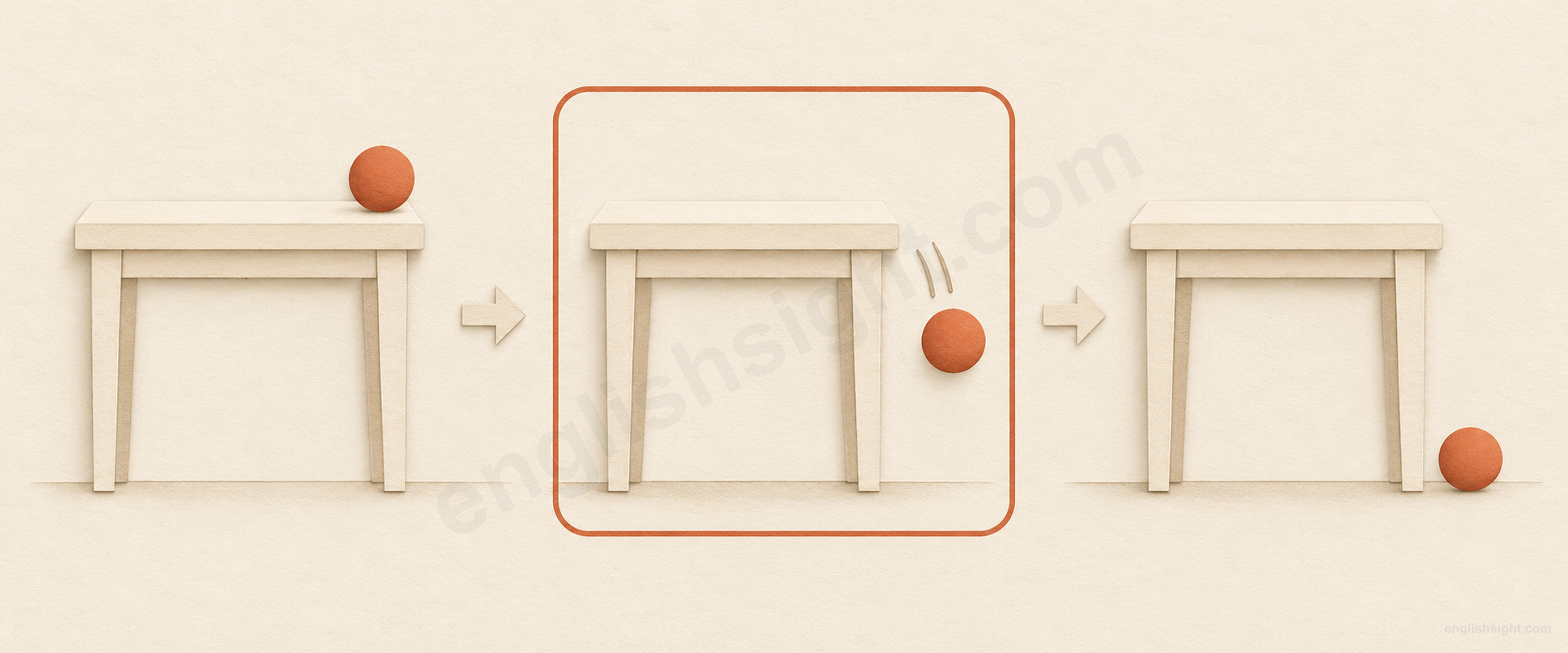
The ball rests near the edge of the table.
event
The ball rests on the floor after the fall.
The ball falls off the table: one identifiable happening.
The fall is an event; the ball is an object. The three views place the happening in time.
An event is a happening treated as a distinct occurrence or occasion in time.
An event need not be planned, pleasant, or brief. A planned or possible event may never occur. The sketch shows one actual fall; the conditional expressions must be learned as whole patterns.
An event is something that happens, considered as a distinct occurrence or occasion. We can describe one event, follow a series, or plan an event that has not happened yet.
This lesson connects those uses without treating every fixed expression as a literal scene. The diagram is a teaching aid; it does not claim that all English speakers share the same mental image.
01
Describe what happens
Name a happening, relate several happenings, or distinguish their development from a person’s account of them.
01
an / the + event; adjective + event; events
an event / a life event
something that happens and is considered as one occurrence
Situation
Someone has lived in one country for many years.
What you express
She moves abroad; you describe the move as a major event in her life.
Event names a happening, rather than the object involved.
The ball is an object; the ball’s fall is an event. Event often draws attention to something notable, but neither importance nor advance planning is compulsory. A surprising arrival or a change in someone’s life can also be an event.
Event is countable in these everyday meanings: an event, the event, several events. A major life event might be moving to another country. The adjective tells us why the happening matters; event alone does not say whether it is good or bad. You can witness an event, meaning see it happen, or record an event by preserving information about it. To mark an event is to acknowledge or commemorate it, for example with a gathering.
An event can last a moment or several days. The diagram selects one fall from the surrounding time; it is a teaching example, not a rule that every event involves motion.
In a sentence
Moving to another country was a major event in her life.
Watch the difference Use an event for one unspecified occurrence, not a event. Do not confuse event with even, which is a different word.
02
current / recent / world events; the events of + period; events in + place
current events / world events
things happening in public life that people discuss in the news
Situation
A class reads reports about several countries.
What you express
The students discuss what has been happening.
Plural events can refer collectively to developments in a situation.
The expression current events refers to happenings of present interest, not a timetable of parties. The expression world events usually refers to international public affairs. Context distinguishes these uses from a list of upcoming organized events.
We can narrow the reference with the events of a period or events in a place. In the events of that evening, of connects the happenings with the evening; it does not make event an uncountable noun.
In a sentence
We discuss current events at the start of each class.
Watch the difference When events refers to several happenings, use plural agreement: Recent events have changed our plans, not Recent events has changed our plans.
03
a sequence / series / chain of events
a sequence / chain of events
several happenings connected by order or by their consequences
Situation
A missed alarm is followed by a late departure and a missed train.
What you express
You explain the order and how one problem led to another.
Sequence emphasizes order; chain often emphasizes links between happenings.
A sequence of events presents happenings in order. A series of events groups several happenings across time. A chain of events often suggests that one leads to another; the connection comes from the whole expression.
The head noun controls agreement: A sequence of events was recorded, but The events were recorded. Events stays plural because the sequence contains more than one happening.
In a sentence
A missed alarm started a chain of events that made us miss the train.
Watch the difference A list in time order does not by itself prove that each event caused the next.
04
someone’s version of events; give + a version of events
someone’s version of events
a person’s account of what happened
Situation
Two witnesses describe the same afternoon differently.
What you express
You compare their accounts.
Version concerns the description; events concerns what happened.
Someone’s version of events is how that person says the situation unfolded. Two people may give different versions of the same events without there being two separate afternoons.
Version can suggest that an account is open to comparison or dispute, but the phrase does not automatically accuse someone of lying. To describe actual changes, use a turn or the course of events instead.
In a sentence
The driver’s version of events differed from the passenger’s.
Watch the difference Do not treat version as the happening itself; it is an account of it.
05
a surprising / unexpected / dramatic turn of events
a turn of events
a development that changes how a situation is going
Situation
An outdoor show has been cancelled.
What you express
The organizers move it online so it can still go ahead.
Turn pictures a change in the unfolding situation.
An unexpected or surprising turn of events is a development that changes the situation. Turn contributes the idea of a change in direction; events supplies the happenings being discussed.
The phrase can describe welcome or unwelcome changes. It is not limited to a literal turn, a scheduled activity, or a physical movement.
In a sentence
In a surprising turn of events, the cancelled show was moved online.
Watch the difference The fixed expression is a turn of events, with plural events.
06
the course of events; in the normal course of events
the course of events
the way a situation develops over time
Situation
Negotiations are continuing without agreement.
What you express
A new offer changes what happens next.
Course concerns the development of the whole situation.
The course of events is how happenings develop. Changing the course of events means affecting that development, rather than merely changing a written account of it.
In the normal course of events means if things happen in the usual or expected way. It can introduce a normal expectation: In the normal course of events, the parcel would arrive tomorrow. The surrounding tense and context tell us whether that expectation still holds.
In a sentence
One phone call changed the course of events.
Watch the difference Do not confuse the course of events with someone’s version of events: development and description answer different questions.
07
plan / report / proposal + be overtaken by events
be overtaken by events
become out of date or less relevant because the situation has changed
Situation
A report recommends repairing an old bridge.
What you express
Before publication, the bridge is replaced.
New developments can make an earlier plan or account no longer useful.
When a plan or report is overtaken by events, later developments have moved the situation beyond it. The passive expression focuses on the thing that has lost relevance.
Events are not literally walking past the report. This established metaphor belongs to the full phrase. In Our report has been overtaken by events, has been overtaken is a passive verb form; event itself remains a noun.
In a sentence
Our repair proposal was overtaken by events when the bridge was replaced.
Watch the difference This does not simply mean the proposal was completed or that its deadline was missed.
02
Plan an occasion or enter a contest
An event can be an organized gathering or one competition within a larger programme. Choose verbs that match your role.
08
hold / host / organize / attend an event; an event takes place; at / during an event
hold / host / attend an event
organize, provide for, or go to a planned occasion
Situation
A community group arranges a public reading.
What you express
Visitors come to the organized occasion.
The planned-occasion meaning supports different roles for organizers and visitors.
An event may be a concert, a fundraising evening, a business gathering, or another organized occasion. Hold an event says that it is arranged and takes place; host an event emphasizes providing the setting or acting as its host; attend an event means go to it.
The event takes place on Saturday gives its time. The event is held at the library is passive: organizers hold it there. Say attend the event without a following to, or go to the event. At the event locates someone there; during the event places something within its duration.
An upcoming event can be postponed or cancelled. Calling it an event does not guarantee it has already happened or eventually will. The focus is an identifiable planned occasion.
In a sentence
The library is hosting a free reading event on Saturday.
Watch the difference For a planned occasion, use take place or be held: The event takes place here, not The event is happened here.
09
enter / compete in / take part in / win + an event; track / field / team events
compete in an event
take part in a particular race or contest
Situation
A sports meeting has several competitions.
What you express
A swimmer enters two of them.
Event can name one contest within a larger sports programme.
An event can be a specific race or competition. A swimming meeting may contain separate individual and team events; track events are races run on a track, while field events include jumping and throwing.
A major sporting event may also refer to an entire organized occasion. Context tells you whether event names the larger occasion or one contest within it. The main event is the principal attraction or contest, not necessarily the final item.
Compete in an event describes participation. Win an event describes the result. Saying an athlete entered an event does not say the athlete won.
In a sentence
She is competing in two swimming events this weekend.
Watch the difference For participation, use compete in the event, not compete the event.
03
Discuss what might happen
These fixed expressions introduce a condition, refer back to one possibility, or make a point that holds either way.
10
in the event of + noun phrase; in the unlikely event of + noun phrase
in the event of…
if the named situation happens
Situation
You prepare a backup plan for a possible power failure.
What you express
The backup will be used if that failure occurs.
Of introduces the possible situation as a noun phrase.
In the event of is a formal way to introduce a contingency, common in instructions and arrangements. The situation need not happen. In the event of a power failure means if there is a power failure.
After of use a noun phrase, such as heavy rain or a cancellation, not a complete finite clause. For a subject and verb use in the event that the power fails. In the unlikely event of adds the speaker’s assessment that the situation is not expected.
In a sentence
In the event of a power failure, we will use the backup generator.
Watch the difference This introduces a condition, not the time at which a planned social event starts.
11
in the event that + subject + verb, + result clause
in the event that…
if a situation described by a clause happens
Situation
A delivery might arrive while you are out.
What you express
You arrange where it should be left if that happens.
That introduces a clause with its own subject and verb.
In the event that is the clause-based counterpart of in the event of. Compare in the event of a delay with in the event that the train is delayed. The difference here is grammatical shape, not a different kind of event.
For a straightforward future condition, a present form is natural in the condition clause: In the event that the shop is closed, call me. The result can contain will. Plain if is usually simpler in everyday conversation.
In a sentence
In the event that the parcel arrives while I am out, please leave it with my neighbour.
Watch the difference Do not mix the patterns: use of a delay or that there is a delay, not of there is a delay.
12
possible situation. In that event, + consequence
in that event
if the previously mentioned possibility happens
Situation
You mention that the last train might be cancelled.
What you express
You give the plan for that particular possibility.
That points back to an already stated possible situation.
In that event avoids repeating the condition. The train may be cancelled. In that event, we will stay overnight means we will stay if the cancellation happens.
It does not mean regardless of what happens. Compare In any event, we will stay overnight: that presents staying as the decision whatever the outcome.
In a sentence
The hall may be unavailable. In that event, we will meet online.
Watch the difference Identify what that refers to; this expression relies on a specific previously mentioned possibility.
13
in any event, + statement; at all events, + statement; in either event, + statement (two alternatives)
in any event / at all events
whatever happens, or despite the circumstances just discussed
Situation
You are unsure whether more guests will come.
What you express
You say the existing plan remains appropriate either way.
Any makes the statement hold across the possibilities under discussion.
In any event presents a point as still valid despite what has happened or might happen. It can also return to the point that matters after discussing uncertain details. It is close to in any case or anyway in this function.
At all events is another established form. Learn the whole expressions: in any event has singular event, while at all events has plural events. These are discourse expressions, not literal descriptions of being inside every social occasion.
In either event narrows the possibilities to two: We may meet on Monday or Tuesday; in either event, I will bring the notes. Bringing the notes applies whichever of those two arrangements is chosen. Either supplies the two-way choice; it does not refer back to just one outcome as that does.
In a sentence
Two more guests may come; in any event, we have enough food.
Watch the difference In that event depends on one stated outcome; in any event presents the point as valid either way.
04
Report what actually happened
Distinguish the actual outcome from knowledge or advice offered afterwards.
14
in the event, + clause describing the actual outcome
in the event
as things actually turned out
Situation
You expect a long meeting.
What you express
It lasts only ten minutes.
This expression reports the actual outcome after considering possibilities.
In the event, used especially in British English, introduces what actually happened. The contrast is often with a previous fear or expectation. It is close to as it turned out.
Keep it distinct from in the event of and in the event that, which introduce conditions. Compare In the event, we stayed home, reporting a result, with In the event of rain, we will stay home, giving a conditional plan.
In a sentence
We expected a long discussion, but in the event the meeting lasted ten minutes.
Watch the difference In this example, the speaker reports a result, rather than giving a future condition. Read the surrounding expectation and outcome instead of treating every occurrence of in the event as if.
15
after the event; be wise after the event
after the event / be wise after the event
after something has happened; understand the right action only afterwards
Situation
An outcome has become known.
What you express
People offer advice they could not give with certainty beforehand.
Later knowledge can make an earlier decision look easier than it was.
After the event, especially in British English, means after the relevant happening. It can simply give a time: We heard about the change only after the event.
Be wise after the event adds a judgment about hindsight. It is often critical: someone now sees what should have been done, but that does not establish that the choice was obvious beforehand. Wise contributes this evaluation; after the event alone does not.
After the event can also literally mean after an organized occasion, as in We cleaned the hall after the event. Context determines whether it refers to a gathering or another happening.
In a sentence
It is easy to be wise after the event and say we should have left earlier.
Watch the difference After the event concerns later knowledge or timing; in the event concerns what actually happened.
Keep the happening, grammar, and fixed expression distinct
Countability and pronunciation
The everyday noun has singular event and plural events. Use a determiner with an ordinary singular reference: an event, this event, the event. The pronunciation is /ɪˈvent/, with stress on the second syllable.
Event, incident, and occasion
Event is a broad choice for a happening or an organized occasion. Incident often draws attention to a particular episode or problem; it is not a mechanical replacement in a phrase such as current events. Occasion can emphasize a particular time or gathering. Choose by context, rather than by assuming each has one fixed translation.
Which word is the verb?
In The event was cancelled, event is the noun and was cancelled is passive. In The event takes place tomorrow, takes place is the verb expression. Everyday event does not have a productive family of phrasal verbs. The specialist equestrian verb event is outside this lesson.
Scope of this lesson
The course covers modern general uses and familiar fixed expressions. It does not expand technical computing, probability, physics, or medical terminology. The old-fashioned a happy event for a birth and the older standalone outcome sense are noted in the coverage record rather than taught as everyday defaults.
Choose the meaning from the whole expression
Notice whether the sentence names a happening, states a condition, or reports an outcome.
1. A ball rolls off a table. What is the event in this description?
2. Choose the formal condition with a noun phrase.
3. More guests might come, but there is enough food whether they do or not. Which fits?
4. A British speaker says, “We expected rain, but in the event it stayed dry.” What happened?
5. “She entered three events at the swimming meeting.” What does events refer to?
6. Someone says, “It is easy to be wise after the event.” What is the point?
Sources and teaching notes
The dictionary sources below support the meanings and expressions. Lesson explanations and examples are original; the visual model is a teaching interpretation.
The diagram helps connect a happening with its place in time; it is not a universal mental image.