Use existence for the fact that something is real, its continuation, or a way of living.
The fact of being there
Existing is not the same as being seen.
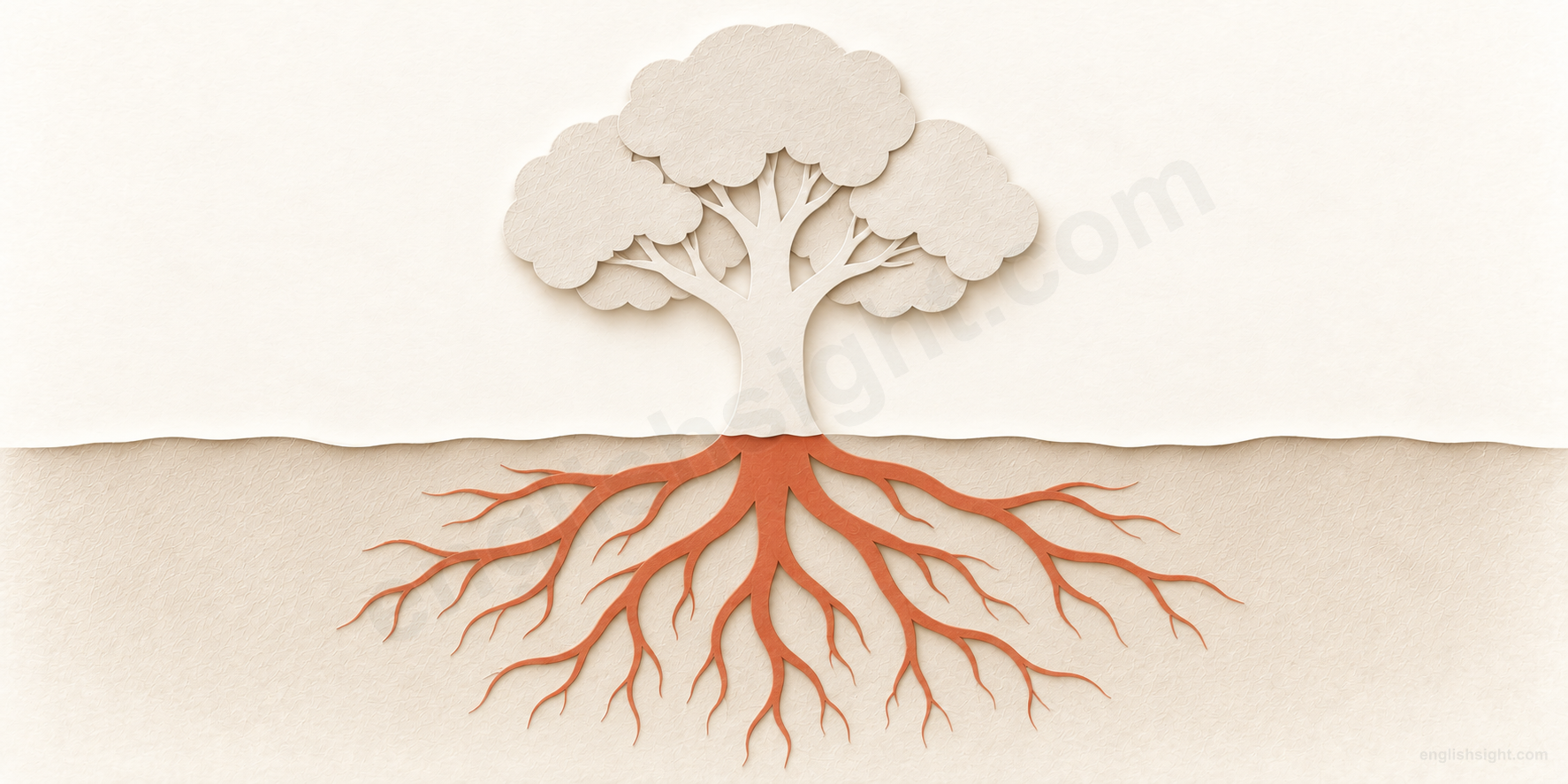
The trunk and crown are above the soil.
existence
The connected roots are below the soil.
Visible branches and hidden roots exist at the same time.
Hidden does not mean nonexistent; the cutaway reveals roots that are already there.
Existence is the fact or state of being real, present, or alive; knowing about it is a separate matter.
A tree with hidden roots illustrates the distinction between existence and visibility. It does not limit existence to physical objects or explain every phrase by itself. In lifestyle expressions, the word describes how a life is lived.
Existence asks whether something is there at all. It can concern a hidden root, a rule, a business, or a living person. Not noticing something does not stop it from existing.
When we speak of a quiet or difficult existence, we shift from the bare fact of being alive to the character of a life. The surrounding grammar tells us which use is intended.
The diagram offers a teaching connection, not a picture that every English speaker necessarily imagines.
01
Whether something is there
Existence names a fact or state. These patterns let you discuss something real, ask about evidence, or say that something remains.
01
the existence of + noun phrase; possessive + existence
the existence of something
the fact that something is real or is present
Situation
An inspection finds a leak behind a wall.
What the expression says
The report discusses the fact that the leak is there.
Existence names a fact, not the object itself or its location.
In the existence of a leak, of names what exists. The leak may have been hidden for weeks: finding it and its existence are different things. Problems, rules, agreements, and organizations can exist too; they need not be physical objects.
Use the existence of… when the fact itself matters: The existence of a second entrance changed our plan. For a simple announcement, There is a second entrance is usually more direct. The second entrance exists uses the related verb.
The mere existence of a rule stresses that the rule being there is enough, regardless of how it is used. His existence means the fact that he exists; the possessive replaces the of-phrase.
In a sentence
The existence of a second entrance changed our evacuation plan.
Watch the difference Existence is a noun. Write The entrance exists or The existence of the entrance matters, not The entrance existence.
02
verb + the existence of + noun; be aware / unaware of + possessive + existence
prove / acknowledge / deny the existence of…
discuss evidence for something or whether people accept that it exists
Situation
Staff report a problem that the manager has dismissed.
What the expression says
The manager finally accepts that the problem exists.
Evidence, knowledge, and acceptance are added by the surrounding words.
Prove or verify the existence of something concerns evidence. Acknowledge or recognize its existence concerns accepting or admitting it. Deny its existence means say that it does not exist; ignoring its existence means behaving as if it were not there.
Be unaware of its existence means not knowing that it exists. None of these expressions makes discovery the starting point of existence. You can fail to notice something that has long been present.
In evidence for the existence of life elsewhere, for links the evidence to the claim, while of links existence to life. The phrase describes what the evidence supports; it does not by itself settle whether the evidence is convincing.
In a sentence
The manager finally acknowledged the existence of a serious problem.
Watch the difference Denying existence is a claim about whether something exists; disapproving of it is a different judgment.
03
be / remain in existence; superlative + noun + in existence
be / remain in existence
exist or continue to exist
Situation
A club started many years ago.
What the expression says
The same club still operates today.
In marks a state, with no literal container.
Be in existence says that something exists; remain or still be in existence emphasizes continuation. Has been in existence since 1986 links that state to its starting date and to the present.
An object described as the oldest copy in existence is the oldest copy that still exists. That does not guarantee that it is nearby, on display, or available to buy.
This wording is useful in history, reports, and comparisons. In casual conversation, The club still exists is a shorter alternative.
Throughout its existence means during the whole time that something exists or existed: The club has changed its name twice during its existence. Here existence refers to the duration of its being, not to a separate way of living.
In a sentence
The walking club has been in existence since 1986.
Watch the difference Use in existence for the state and into existence for a beginning; they are not interchangeable.
02
Beginning, ending, and continuing
The verbs and prepositions add change, cause, or survival. Existence itself does not mean creation or destruction.
04
something + come into existence (+ as + noun phrase)
come into existence
begin to exist
Situation
No such organization has yet been formed.
What the expression says
The new organization has been established.
Come into adds the beginning of the state.
The subject is the thing that starts to exist: a company, system, country, species, or other entity. Into presents existence as a state being entered; the expression is not physical travel.
The cooperative came into existence in 2010 reports its beginning. The cooperative was in existence in 2010 only says it existed then; it could be much older.
As can specify the form or role at the beginning: It came into existence as a small neighborhood group. The phrase does not explain who created it unless the sentence supplies that information.
In a sentence
The cooperative came into existence as a small neighborhood group.
Watch the difference Do not turn it into a passive: say came into existence, not was come into existence.
05
cause / creator + bring + object + into existence; object + be brought into existence
bring something into existence
cause something to begin to exist
Situation
Residents want an organization, but none has been created.
What the expression says
Their work creates a new cooperative.
Bring introduces a cause or creator and a separate result.
Compare The cooperative came into existence with The residents brought the cooperative into existence. Come makes the new entity the subject; bring makes the cause or creator the subject and the new entity the object.
The passive is natural when the creator is less important: The cooperative was brought into existence through local fundraising. Into existence stays together as the resulting state.
This is a fairly formal way to say create or establish. The causal meaning comes from bring plus a result phrase, not from existence alone.
In a sentence
Months of local fundraising brought the cooperative into existence.
Watch the difference Keep the object after bring: bring a cooperative into existence. Do not say bring into a cooperative existence.
06
something + go out of existence; something + cease to exist
cease to exist / go out of existence
stop existing
Situation
Two separate associations operate.
What the expression says
They merge, and the original associations no longer exist separately.
The whole expression marks an ending, not a change of address.
Go out of existence describes the end of an entity. Cease to exist is a common alternative using the verb exist. Both can describe an organization that closes or loses its separate identity.
A shop moving away has not necessarily gone out of existence. Likewise, an old building may remain after the organization that occupied it has ceased to exist.
These expressions are more formal than The club closed. Choose the wording according to whether your point is closure of an activity or the end of the entity itself.
In a sentence
After the merger, both original associations went out of existence.
Watch the difference Out of existence does not mean simply out of sight or out of business premises.
07
verb + object + out of existence; object + be + past participle + out of existence
hunt / tax something out of existence
cause something to disappear completely through an action or pressure
Situation
A species or small business is already vulnerable.
What the expression says
Hunting or financial pressure may eliminate it.
The verb supplies the cause; out of existence supplies the endpoint.
An animal species hunted out of existence has been hunted until none remain. This is a result construction: hunting causes the species to stop existing. Be hunted out of existence is the corresponding passive.
The same result pattern can be used with other suitable causes. Small businesses taxed out of existence are forced to close by a tax burden. This claim is stronger than saying their profits fall.
The action and the kind of disappearance depend on the subject and verb: extinction for a species, closure for a business. Learn the complete construction rather than treating out of as a literal exit.
In a sentence
The report warned that the birds could be hunted out of existence.
Watch the difference Use the full phrase out of existence; hunted out existence is incomplete.
08
continued existence; threaten + possessive + very existence; a struggle for existence
continued existence / threaten someone’s very existence
continuation or survival, sometimes under threat
Situation
A theater is running out of money.
What the expression says
It may have to close unless support arrives.
The issue is whether it can continue at all.
Continued existence emphasizes remaining in being. For a living thing it can mean staying alive; for a theater or business it means continuing as an institution. Its existence depends on funding names a condition for that continuation.
In threaten its very existence, very emphasizes existence itself: survival is at stake, not just comfort or success. It does not mean a large amount of existence.
A struggle for existence is a struggle to stay alive or survive. For is followed by the noun existence here; struggle to exist uses the verb. The struggle may involve people, wildlife, or, figuratively, organizations.
In a sentence
The loss of its main sponsor threatens the theater’s very existence.
Watch the difference A threat to existence is stronger than a temporary inconvenience; use it when continuation itself is in question.
09
something + owe + possessive + (continued) existence + to + cause
owe its existence to…
exist because of a particular person, event, or condition
Situation
A donation makes a local museum possible.
What the expression says
The museum exists as a result of that support.
Owe…to attributes existence to a cause.
The subject is what exists; the phrase after to identifies what made it possible. The museum owes its existence to a donation credits the donation as a reason the museum was created.
Owe does not mean that the museum has an unpaid financial debt in this expression. The cause may be an accident, discovery, or person’s effort as well as money.
Compare owe its continued existence to volunteers: continued shifts the focus from the original creation to what keeps the institution going.
In a sentence
The museum owes its existence to a gift from a local artist.
Watch the difference Use to for the cause in this pattern, not from: owes its existence to the gift.
03
Life, living conditions, and a familiar complaint
For people, existence can mean life in general or a particular way of living. Learn the whole expression when it adds difficulty, lack of money, or annoyance.
10
human existence; the meaning / nature of existence
human existence
human life or the condition of being alive
Situation
A discussion asks broad questions about human life.
What the expression says
Attention turns to what living as a human means.
Existence can refer to life itself without describing a single lifestyle.
Human existence and the meaning of existence occur in discussions of life, purpose, and experience. Existence is normally uncountable here: the topic is being alive, not a list of separate entities.
This broad use is often reflective or formal. For a routine personal question, What is your life like? is more natural than What is your existence like?
This lesson explains the language, not a philosophical theory. It does not settle questions about why people exist or what kinds of things count as real.
In a sentence
The film explores the loneliness of human existence.
Watch the difference Do not automatically add an article: human existence is a general uncountable topic here.
11
lead / live / have + a(n) + adjective + existence
lead / live a quiet existence
have a particular way of living
Situation
Someone leaves a noisy city for a calmer home.
What the expression says
Their everyday life becomes quiet.
A descriptive adjective presents what that life is like.
Here existence is countable: a quiet existence, a lonely existence, a comfortable existence. The adjective describes someone’s circumstances or experience of life.
The word is often used for difficult, dull, or limited living conditions, but it is not inherently negative. A peaceful existence can be desirable. Lead and live both occur with these descriptions.
Compare the uncountable fact sense, her existence, with the lifestyle description, a sheltered existence. The plural existences is possible when contrasting several people’s or characters’ ways of life; it is not the usual way to count people.
In a sentence
After years in the city, Maya now leads a quiet existence by the sea.
Watch the difference Keep a/an with a singular lifestyle description: a quiet existence, not leads quiet existence.
12
eke out + an existence / a living (+ on + resources / by + -ing)
eke out an existence
manage to stay alive with very limited resources
Situation
A family earns very little from occasional work.
What the expression says
They manage to meet basic needs, with difficulty.
Eke out adds effort and scarcity to the life being maintained.
Eke out an existence focuses on barely managing to live, usually with very little money. A modifier such as meager or precarious makes the shortage or insecurity explicit.
The survival meaning belongs to the established combination eke out an existence or eke out a living. It does not mean start a new life or enjoy a comfortable one.
By selling vegetables describes how the family manages; on a tiny income describes its limited resources. These phrases add information and are not required parts of the expression.
In a sentence
For months, the family eked out an existence by selling vegetables.
Watch the difference Spell the verb eke, not eek. Do not drop out from this expression.
13
a hand-to-mouth existence; live (from) hand to mouth
a hand-to-mouth existence
a life in which earnings cover basic needs with nothing left to save
Situation
Every payment is needed immediately for essentials.
What the expression says
Little or no money remains for the future.
Hand-to-mouth specifies a financial condition.
The compound adjective hand-to-mouth describes living from one small amount of money to the next. The point is lack of financial reserves, not the physical action of eating with a hand.
In a hand-to-mouth existence, the adjective has hyphens before the noun. The related expression live from hand to mouth normally has no hyphens.
Unlike a quiet existence, this expression says something about resources. Unlike an isolated existence, it does not necessarily say anything about social contact.
In a sentence
Unpredictable wages left them with a hand-to-mouth existence.
Watch the difference Hand-to-mouth does not mean careless spending; people may have too little income to build savings.
14
something + be + the bane of + possessive + existence / life
the bane of my existence
something that repeatedly causes me great annoyance or trouble
Situation
A printer jams every time you need it.
What the expression says
You complain about the recurring frustration.
The whole expression is often an emphatic complaint.
The bane of my existence means a major source of trouble in my life. In a complaint about a printer or paperwork, it is often humorous exaggeration, not a statement that your life is in danger.
Bane supplies the idea of a troublesome source; existence supplies the life affected. The bane of my life is a close alternative. Change my to her, our, or another possessive to name whose life is affected.
This expression belongs with lifestyle and experience, not with proof that something exists. Learn it as a whole rather than trying to infer annoyance from existence alone.
In a sentence
This constantly jamming printer is the bane of my existence.
Watch the difference Keep the articles and of: the bane of my existence, not a bane my existence.
Choose the fact, the change, or the way of life
Noun and verb
Existence /ɪɡˈzɪstəns/ is a noun. Exist is the related verb: a problem exists. A noun phrase such as the existence of a problem needs a verb when it forms a complete statement. Existence itself has no verb tenses or phrasal verbs; the verbs in this lesson contribute their own grammar.
Countability follows the meaning
The fact or state is normally uncountable: evidence of existence, the existence of a problem, in existence. A particular way of living is countable: a lonely existence. The plural existences can describe distinct lives or modes of life, but people and things are usually called people, beings, or entities rather than existences.
Existence, presence, and life
Existence concerns whether something is real or continues to be. Presence often concerns being at a particular place or occasion: your presence at the meeting. Life is the ordinary word for being alive and for everyday experience; existence can sound more formal, reflective, or focused on basic survival.
The diagram has a boundary
Hidden roots give a concrete example of something existing independently of our seeing it. The picture is not evidence that a disputed thing exists, and it cannot decide philosophical or religious questions. In, into, and out of describe states and changes here, not literal containers.
Read the whole expression
Choose the sentence or interpretation that fits the intended meaning.
1. A group began in 1990 and is still active. You want to describe its continuing state since then. Which fits?
2. Residents created a new cooperative. Which sentence makes the residents the cause of its beginning?
3. You are describing someone’s peaceful way of life. Which sentence fits?
4. Their pay covers basic needs, but they cannot save any money. Which expression states that condition?
5. Someone discovers a hidden passage that was built a century ago. What is the distinction?
6. Someone calls a jamming printer “the bane of my existence.” What do they usually mean?
Sources and teaching notes
The sources below support the meanings and usage patterns. Explanations and example sentences are original; the tree diagram is a teaching interpretation, not dictionary evidence.
This teaching diagram illustrates a distinction; it does not represent a picture shared by every native speaker.