Understand eyes as a body part, a focus of attention, and part of familiar English expressions.
From seeing to directed attention
From seeing to directed attention
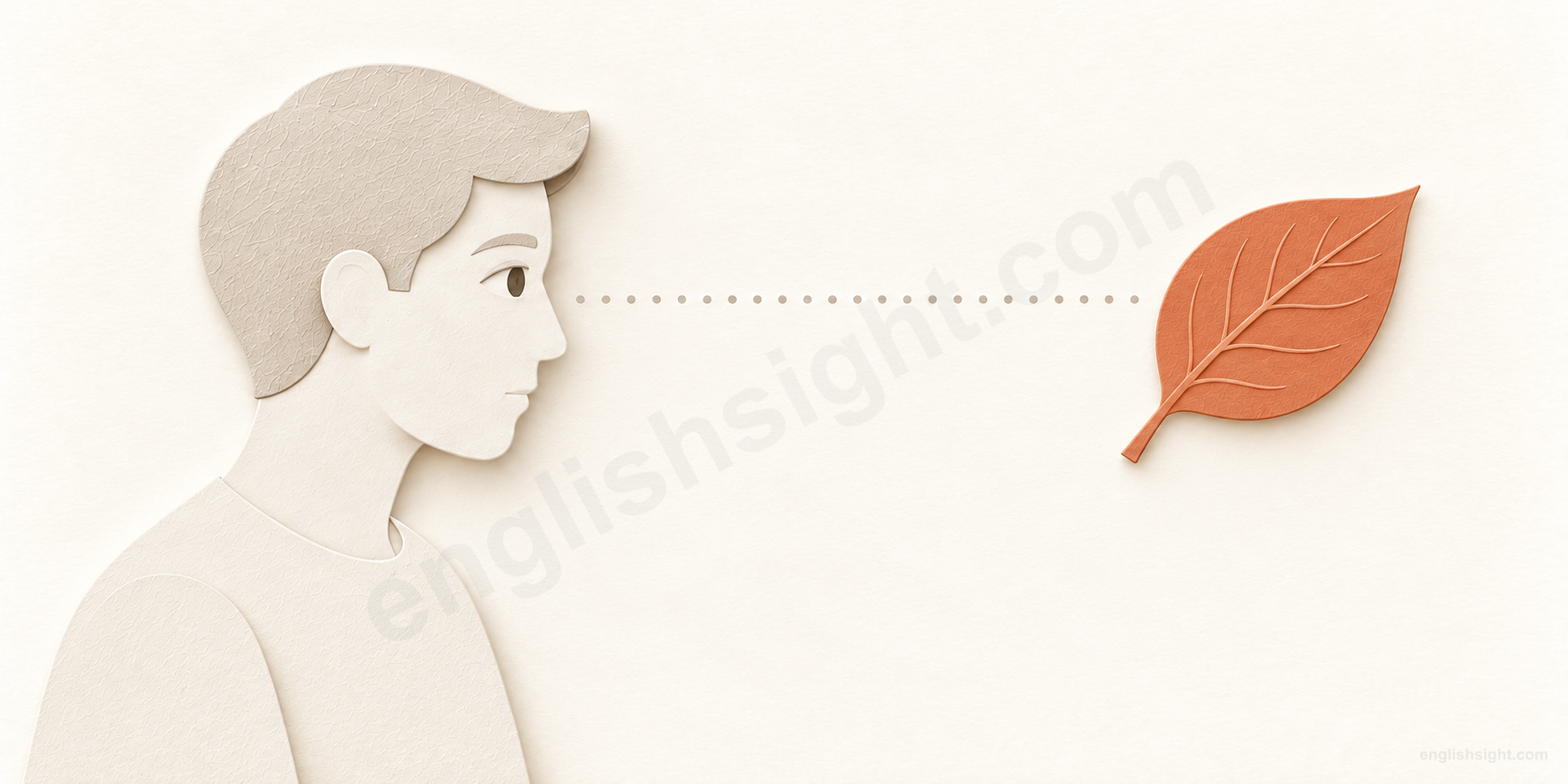
The eye belongs to the viewer.
eye
The leaf is the object of attention.
The viewer looks toward the leaf.
The eye links seeing with attention; the dots mark a focus, not a beam of light.
An eye is an organ for seeing; in many everyday expressions it stands for the attention or judgment a person directs toward something.
The sketch connects an eye with a leaf as the focus of attention. It shows an ongoing relationship, not a transfer or a before-and-after change. Object meanings and idioms need their own explanations.
Start with an eye: a body part used for seeing. In many expressions, eye stands for the attention or judgment a person directs toward something. Follow who is watching, what is noticed, and how the full phrase changes the intention.
This connection helps with keep an eye on and have an eye for, but it cannot generate every meaning. A needle’s eye, a potato’s eye, and fixed sayings have their own established uses. The sketch is a learning aid, not a claim about every speaker’s mental imagery.
01
Eyes, sight, and visible reactions
Start with the body part. Then notice how English describes looking, mutual gaze, visible feelings, and the limits of sight.
01
an / the / possessive + eye; plural eyes; eye + noun; adjective + -eyed
an eye / your eyes
the body part used for seeing
Situation
You describe a person or a problem with seeing.
What this expresses
Eye names one organ; eyes names more than one.
The literal eye belongs to a person or animal.
Eye is a countable noun: one eye, two eyes. Use a possessive naturally: Open your eyes; There is dust in my left eye. Eye /aɪ/ sounds like I; eyes ends in /z/.
My eyes hurt describes discomfort; an eye test checks vision. In eye drops, eye identifies the purpose and stays singular. A blue-eyed child uses -eyed to form an adjective, not the plural noun eyes.
In a sentence
I closed my eyes while the photographer moved the light.
Watch the difference Say My eyes are tired, with plural agreement; say a blue-eyed child, not a blue-eyes child.
02
roll + possessive + eyes; possessive + eyes + light up / widen / fill with tears
roll your eyes / your eyes light up
show a reaction through your eyes
Situation
Someone hears an unwelcome suggestion or welcome news.
What this expresses
Their expression makes the reaction visible.
The eyes can be described as showing a feeling.
Roll your eyes means move them upward or around, often to show annoyance or disbelief. If someone’s eyes light up, their expression becomes visibly pleased or excited: His eyes lit up when he spotted his sister.
Eyes widen can accompany surprise; eyes fill with tears describes tears appearing. These are descriptions in context, not a rule for reading everyone’s emotions. In His eyes followed the dog, the person kept watching it; the eyes did not leave his face.
In a sentence
Mara rolled her eyes when the printer jammed again.
Watch the difference Lit is the past form in Her eyes lit up; the phrase does not mean her eyes produced light.
03
get / have a black eye; give someone a black eye
a black eye
bruising around an eye after an injury
Situation
A ball hits someone near an eye.
What this expresses
The skin around the eye becomes dark.
Black eye refers to an injury, not ordinary eye colour.
A black eye is a bruise around the eye. Get a black eye describes receiving the injury; have a black eye describes the resulting condition.
She has dark brown eyes describes colour. She has a black eye describes an injury. The article and singular count noun help distinguish these everyday meanings.
In a sentence
He had a black eye after a ball struck his face.
Watch the difference Do not use a black eye as the ordinary description of someone’s naturally dark eyes.
04
make / avoid eye contact with someone; look someone in the eye; people’s eyes meet
make eye contact / look someone in the eye
look directly toward another person’s eyes
Situation
Two people are speaking face to face.
What this expresses
Their gaze connects directly.
The other person’s eyes are the target of the gaze.
Make eye contact with someone means look at each other’s eyes; avoid eye contact means avoid this mutual gaze. Their eyes met describes the moment their gazes connected. Here the people, not detached eyes, are looking.
Look someone in the eye adds a direct, open manner, often in a situation involving confidence, embarrassment, or honesty: She looked me in the eye and apologized. This is an expression about behaviour, not proof that a person is truthful.
In a sentence
I made eye contact with the guide before asking a question.
Watch the difference Say look me in the eye, not look in my eye when you mean face me directly.
05
visible to / with the naked eye; judge / estimate something by eye; see with one’s own eyes
the naked eye / by eye
see without an optical instrument, or estimate by looking
Situation
You compare two marks without special equipment.
What this expresses
You rely on sight rather than a device or measurement.
The full phrase tells us how sight is being used.
With or to the naked eye means without an instrument such as a microscope or telescope. The crack is visible to the naked eye says you can see it directly.
By eye is different: it describes estimating by looking instead of measuring. I placed the pictures at equal distances by eye means I judged the spacing visually. With my own eyes instead stresses that I personally witnessed something: I saw the bird escape with my own eyes.
In a sentence
We spaced the labels by eye rather than using a ruler.
Watch the difference By eye does not guarantee an exact measurement; naked eye is about unaided sight, not accuracy.
06
see / notice something + out of the corner of one’s eye
out of the corner of your eye
notice something at the side of your vision
Situation
You face a noticeboard; someone moves beside you.
What this expresses
You notice the movement without looking straight at it.
The object is seen at the edge of attention and vision.
See something out of the corner of your eye describes a side glimpse, often brief or accidental. You may notice movement before turning to check what it is.
Compare I looked straight at him, which puts him at the centre of your gaze. This phrase describes how you saw something, not the person’s location inside a physical corner.
In a sentence
Out of the corner of my eye, I saw a cat slip behind the curtain.
Watch the difference Keep the possessive: out of the corner of my eye, not out of the corner of eye.
07
as far as the eye can / could see; before one’s very eyes; set / lay eyes on someone
as far as the eye can see / before your eyes
describe the extent or immediacy of what is visible
Situation
You describe a landscape or something happening in front of you.
What this expresses
Your view supplies either a limit or direct witness.
Distance and witnessing come from different full phrases.
As far as the eye can see means right to the limit of the view. In a past account use could: Fields stretched as far as the eye could see. It does not claim the fields cover the whole world.
Before my very eyes means right in front of me, often emphasizing a striking event: The ice melted before my very eyes. Very strengthens the witness claim; before is not earlier than my eyes.
Set or lay eyes on someone means see them, often for the first time or after a gap: I had never set eyes on that dog before. A sight met my eyes reverses the usual wording: I saw that sight.
In a sentence
Sunflowers stretched as far as the eye could see.
Watch the difference Before my eyes concerns witnessing an event; as far as the eye can see concerns the reach of a view.
08
at / above / below eye level; a bird’s-eye view of something
at eye level / a bird’s-eye view
describe height or a view from above
Situation
You position a display or look down from a high place.
What this expresses
The expression sets a viewpoint in space.
A person’s eye height and a high downward view are different perspectives.
At eye level means at the height of a person’s eyes: Hang the sign at eye level. The reference person may be standing or sitting, so context supplies the actual height.
A bird’s-eye view is a view looking down from high above: From the tower, we had a bird’s-eye view of the harbour. It need not be a view taken by a real bird. The possessive and hyphen belong to the established compound.
In a sentence
The small map was fixed to the wall at eye level.
Watch the difference Say at eye level without an article; say a bird’s-eye view when introducing one view.
02
Noticing, watching, and keeping a focus
Eye often stands for someone’s attention. Read the complete expression: watching a known object, looking out for one, and wanting one are different intentions.
09
something catches someone’s eye; catch a person’s eye
catch someone’s eye
be noticed or get someone to look at you
Situation
An object stands out, or you want a person’s attention.
What this expresses
Someone notices the object or looks toward you.
Catching an eye means gaining attention, not touching it.
The red label caught my eye means I noticed it. The label is the subject; the person noticing appears in my. This does not require a deliberate action by the object.
I caught the server’s eye means I managed to get the server to look toward me, often so I could make a request. The same expression can describe accidental noticing and a person’s deliberate attempt to attract a gaze. Eye-catching is a related adjective for something that readily attracts attention.
In a sentence
A tiny orange flower caught my eye beside the path.
Watch the difference Caught is the past of catch; do not confuse catch her eye with keep an eye on her, which continues the watching.
10
keep an eye / a close eye on + person or thing
keep an eye on
watch or check someone or something over time
Situation
You need something looked after or a change monitored.
What this expresses
Someone continues to check it.
The object is already identified; attention stays with it.
Keep an eye on my coat asks someone to watch it while you are away. Keep an eye on the temperature asks for continued checking, not staring without a break. Context tells whether this is care, supervision, or monitoring.
A close or careful eye emphasizes closer attention: We are keeping a close eye on the leak. Compare keep an eye out for a taxi: there you are alert for one to appear, rather than monitoring an already identified taxi.
In a sentence
Could you keep an eye on my suitcase while I buy a ticket?
Watch the difference Use on for the thing you watch; keep an eye out for has a different search-and-notice purpose.
11
keep an eye out / open for something; keep one’s eyes open / peeled for something
keep an eye out / keep your eyes peeled
stay alert so you notice something if it appears
Situation
You are walking toward a place and looking for a sign.
What this expresses
You are ready to notice the sign.
For introduces what you hope or need to spot.
Keep an eye out for the blue gate asks someone to watch for it as they go. It may not be in sight yet. Keep your eyes open for and the informal keep your eyes peeled for express similar alertness.
Peeled is figurative here; nothing happens to the skin or eyes. The expression can stand alone if the target is understood: Keep your eyes peeled! The fixed plural belongs to that version; keep an eye out uses singular an eye.
In a sentence
Keep an eye out for a sign to the village on the left.
Watch the difference Say keep an eye out for it, not keep an eye on for it.
12
have / have got + possessive + eye on someone
have your eye on someone
watch someone’s behaviour carefully
Situation
A supervisor is concerned about someone’s actions.
What this expresses
That person is being watched.
Have describes attention already directed at a person.
I have my eye on you can warn that I am watching what you do. It can sound suspicious or controlling, depending on the relationship and tone.
Do not assume every have your eye on use is a warning. With a potential recruit, She has her eye on a new designer can mean she is considering hiring that person. In a dating context, He has his eye on someone in his class can mean he is attracted to that person and may ask them out. With a desired object, the phrase often means wanting it. The situation decides which reading fits.
In a sentence
The coach had her eye on the players who kept arriving late.
Watch the difference Match the possessive to the watcher: I have my eye on you; she has her eye on them.
13
have / have got + possessive + eye on + a desired thing
have your eye on something
want or be considering a particular thing
Situation
You notice a bicycle you might buy.
What this expresses
That bicycle becomes a possible purchase.
Attention can point to something desired rather than something being guarded.
Have your eye on a bicycle commonly means you are interested in getting it. You need not be looking at it now: I’ve had my eye on that model for months.
Compare I’m keeping an eye on the bicycle while you shop: I am watching it, not saying I want to own it. The desired object use is established, so the verb and surrounding situation matter as much as on.
In a sentence
I’ve got my eye on a second-hand bicycle in the shop window.
Watch the difference This does not say you have already bought it or are physically watching it at this moment.
14
all eyes are on something; take / keep one’s eyes off something; be all eyes
all eyes on / take your eyes off
direct attention toward something or stop looking
Situation
A performer appears, or your attention moves elsewhere.
What this expresses
People focus on the performer, or a viewer looks away.
On marks the focus; off marks leaving that focus.
All eyes were on the drummer means everyone was watching the drummer. It can also describe public attention to an event: All eyes are on Friday’s decision. It need not mean everyone is physically present.
Take your eyes off something means stop looking at it. I couldn’t take my eyes off the display describes strong interest or attraction. Be all eyes similarly describes watching eagerly: The children were all eyes as the model train appeared.
In a sentence
I couldn’t take my eyes off the dancers as they crossed the stage.
Watch the difference Couldn’t take my eyes off is usually an expression of fascination, not a literal physical inability.
15
keep / take + possessive + eye on / off the ball
keep your eye on the ball
keep concentrating on what matters
Situation
Minor distractions are interfering with a project.
What this expresses
You maintain attention on the main task.
The ball is literal in sport and a task focus in the idiom.
In a ball game, keep your eye on the ball can be a literal instruction to watch it. At work, it means remain focused on the important task or goal.
Take your eye off the ball is the contrasting expression: We took our eye off the ball and missed the deadline. No sports equipment is required in that example. Keep your eyes on the prize also emphasizes staying focused on the goal.
In a sentence
We need to keep our eye on the ball and finish the safety checks.
Watch the difference Do not interpret a workplace use as a requirement to look at a real ball.
16
run / cast one’s eye over something; run one’s eye down a list
run / cast your eye over
look through something quickly
Situation
Someone asks you to check a short message.
What this expresses
You give it a quick inspection.
Over presents the material as something to scan.
Run your eye over the draft asks for a quick look or read. Cast an eye over it is a similar expression. An adjective can describe the quality of the look: cast a critical eye over the plan.
Run your eye down a list specifies the direction of scanning. These are noun phrases inside larger expressions: run is the verb and eye is its object. They are not examples of the verb eye plus over.
In a sentence
Could you run your eye over this invitation before I send it?
Watch the difference A quick scan does not promise a complete proofread; ask for a detailed check when that is what you need.
17
under the watchful eye of someone; under someone’s watchful eye
under the watchful eye of
while being carefully watched or supervised
Situation
A beginner tries a task beside an experienced person.
What this expresses
The experienced person watches the work closely.
Under describes supervision, not physical position beneath an eye.
Under the watchful eye of a teacher describes an activity that the teacher is observing carefully. The teacher may be protecting, guiding, or checking; the phrase alone does not say which.
In under her watchful eye, her identifies the supervisor. Compare through her eyes, which gives her viewpoint, and in her eyes, which gives her opinion.
In a sentence
The children used the tools under the watchful eye of their teacher.
Watch the difference The person after of is the watcher, not the person receiving supervision.
18
be / remain / live in the public eye; stay out of the public eye
in the public eye
receiving attention from the public
Situation
A person’s work brings them public recognition.
What this expresses
Many people know about and pay attention to them.
Public attention extends beyond one observer.
A singer in the public eye attracts attention through news, interviews, or other public exposure. The person need not be visible to everyone at the same moment.
Stay out of the public eye means avoid this public attention: After retiring, she stayed out of the public eye. It is different from merely standing out of someone’s line of sight.
In a sentence
The actor found it difficult to raise a family in the public eye.
Watch the difference Use the public eye, with the article; this is an established expression about publicity.
19
be + for + possessive + eyes only
for your eyes only
intended only for the named person to see
Situation
You share a confidential draft with one person.
What this expresses
That person is allowed to see it; wider sharing is excluded.
Eyes stands for the person who can view the material.
This note is for your eyes only marks the note as private to the addressee. Change the possessive or name to change the permitted viewer: for her eyes only; for Daniel’s eyes only.
Only limits who should see the material. It does not mean the person should look without reading, or that the note contains information about eyes.
In a sentence
The draft budget is for your eyes only until Monday.
Watch the difference Do not remove only when you need to express restricted access.
03
Judgment, viewpoints, and awareness
Seeing supplies a useful teaching connection to judging and understanding. These patterns are established English expressions; their prepositions cannot be freely exchanged.
20
have a good / keen eye for + noun
have an eye for
be good at noticing or judging something
Situation
Someone notices design problems other people miss.
What this expresses
Their skill helps them judge relevant details.
For names the area of perceptive skill.
Have an eye for detail means notice details well. An eye for colour, design, or a bargain concerns good perception or judgment in that area, not a separate physical eye.
A keen or good eye strengthens the description. Compare an eye test, which concerns physical vision, and have your eye on a painting, which may mean you want to buy it. The preposition and whole pattern keep these meanings apart.
In a sentence
Ravi has an eye for detail and spotted the missing date immediately.
Watch the difference Use for to name the skill area; eye on detail is not a substitute for this fixed skill expression.
21
in someone’s eyes; in the eyes of someone; through someone’s eyes; with a critical eye; to my eye
in someone’s eyes / through someone’s eyes
state an opinion or adopt a perspective
Situation
Two people interpret the same decision differently.
What this expresses
The expression identifies whose judgment or experience matters.
The viewpoint belongs to the person named.
In my eyes, she is a good leader reports my judgment. In the eyes of the law uses the same structure for assessment according to the law. The person or institution named supplies the viewpoint.
Through a child’s eyes means from a child’s perspective: Try seeing the journey through your son’s eyes. With a critical eye instead describes the manner of examination. To my eye often introduces how something looks: To my eye, the frame is crooked.
Beauty is in the eye of the beholder is a saying about differences in judgments of beauty. It does not say there are no shared preferences; it leaves room for personal taste.
In a sentence
Through a child’s eyes, an ordinary bus ride can be an adventure.
Watch the difference Through her eyes gives her perspective; under her eye describes her watching or supervision.
22
see eye to eye with someone on / about something
see eye to eye
agree in opinion
Situation
Two people discuss a decision.
What this expresses
They share a view, or a negative form says they disagree.
This is agreement, not literal mutual gaze.
See eye to eye with someone means agree with them. Add on or about to name the topic: We don’t see eye to eye on the timetable. The negative is common, but affirmative uses are possible too.
Compare make eye contact, which describes looking at each other. You can make eye contact and still disagree. Agreement comes from this entire idiom, not from a general rule that eye to eye means facing someone.
In a sentence
We see eye to eye on the need for a quieter office.
Watch the difference Say see eye to eye with her, not see eye to eye to her.
23
there is more to someone / something than meets the eye
more than meets the eye
more involved than first appearances suggest
Situation
A repair looks simple until you examine it.
What this expresses
You realize there are less obvious details.
What is immediately apparent may be only part of the situation.
There is more to the problem than meets the eye means the problem has hidden complexity or interest. It can warn against a quick judgment without accusing anyone of dishonesty.
The pattern there is more to X than meets the eye lets you name the person, thing, or issue. The idiom is established: it is not about an object physically touching an eye.
In a sentence
There is more to this loose handle than meets the eye; the frame is damaged too.
Watch the difference More than meets the eye need not imply a secret plot; ordinary complexity is enough.
24
something opens someone’s eyes to + noun or clause (for example, how much work is involved)
open someone’s eyes to
make someone realize something they had not understood
Situation
A visit reveals how a service actually works.
What this expresses
The visitor gains a new understanding.
Opening eyes is a teaching connection to becoming aware.
The visit opened my eyes to the effort involved means it made me recognize that effort. The thing causing the realization is the subject; the person whose understanding changes appears in my.
This differs from the literal Open your eyes, which asks you to stop keeping them shut. To introduces the newly recognized reality: open her eyes to the risks. It can also introduce a clause such as how much work the team does. The related adjective eye-opening describes an experience that brings such a realization.
In a sentence
Helping for a day opened my eyes to how much work the kitchen team does.
Watch the difference Do not treat every open your eyes as figurative; a photographer may simply be asking you to open them.
25
turn a blind eye to something; close / shut one’s eyes to something
turn a blind eye / close your eyes to
deliberately ignore a problem
Situation
Someone knows rules are being broken.
What this expresses
They choose not to acknowledge or deal with it.
The lack of attention is deliberate in this figurative use.
Turn a blind eye to something criticizes choosing not to notice bad behaviour or a problem. The manager turned a blind eye to the cheating means the manager allowed it to pass unchallenged.
Close or shut your eyes to a problem similarly means refuse to acknowledge it: We cannot close our eyes to the damage. Neither phrase describes a person’s actual sight or requires anyone to shut an eyelid.
In a sentence
The club cannot turn a blind eye to repeated cheating.
Watch the difference Use to before the ignored problem. Accidentally missing a detail is different from deliberately overlooking it.
26
do something with one’s eyes open; could do something with one’s eyes shut / closed
with your eyes open / with your eyes shut
act knowingly, or say a familiar task is extremely easy
Situation
You understand a choice’s risks, or know a routine task very well.
What this expresses
The full phrase describes informed choice or effortless familiarity.
Open and shut participate in different conventional meanings.
Do something with your eyes open means do it knowing the likely difficulties: We accepted the offer with our eyes open. It does not mean you expect no problems or approve of every detail.
I could sort these cards with my eyes shut usually means the task is so familiar that it would be easy. Collins also records eyes shut for acting without full awareness; context can set that opposite of eyes open reading. The full situation distinguishes familiarity, unawareness, and physically closed eyes.
In a sentence
I took the temporary job with my eyes open; I knew it would end in June.
Watch the difference With my eyes shut can describe ease or lack of awareness; use the surrounding sentence to choose the interpretation.
27
with an eye to + noun / -ing
with an eye to
act with a future aim or consideration in mind
Situation
You choose a room because you may use it differently later.
What this expresses
That possible use guides your current choice.
To introduces a noun or -ing form after this expression.
With an eye to saving space means with saving space as a goal. The immediate action is chosen partly for that purpose. We chose folding chairs with an eye to saving space does not guarantee how much space was saved.
The expression also allows a consideration rather than a promised future event: with an eye to cost means taking cost into account. In this construction to is a preposition, so say with an eye to reducing waste, not with an eye to reduce waste.
In a sentence
We bought a larger table with an eye to hosting family meals.
Watch the difference Distinguish with an eye to doing something, a purpose, from have an eye for something, a skill.
28
see / picture / imagine something in one’s mind’s eye
in your mind’s eye
picture something in imagination or memory
Situation
You recall a place that is not in front of you.
What this expresses
You form or remember a visual image.
Mind’s eye names imagined seeing, not another physical organ.
In my mind’s eye, I can still see the old kitchen describes an imagined or remembered picture. The kitchen does not need to be physically visible now.
The expression can describe a possible future too: She pictured the finished garden in her mind’s eye. It is a familiar way to talk about visual imagination; it does not claim that everyone experiences mental pictures equally.
In a sentence
In my mind’s eye, I could see the empty room filled with plants.
Watch the difference Keep the possessive mind’s: in my mind’s eye. This is imagination, not evidence that the scene already exists.
29
pull the wool over + possessive + eyes
pull the wool over someone’s eyes
deceive someone or hide the truth from them
Situation
Someone gives a misleading account of a mistake.
What this expresses
They try to make another person believe the wrong explanation.
The person whose eyes are mentioned is the one being misled.
Pull the wool over my eyes means deceive me. The wool is part of the established expression; no actual fabric is involved.
Compare turn a blind eye: the person with the eye there chooses to ignore a problem. In pull the wool over someone’s eyes, another person tries to prevent them from recognizing the truth. An attempt can fail: He tried to pull the wool over our eyes, but we checked the dates.
In a sentence
They tried to pull the wool over our eyes by changing the dates on the form.
Watch the difference Do not interchange the deceiver and the person after over: her eyes identifies the person being deceived.
04
Affection, surprise, and vivid expressions
These phrases use eyes in familiar figurative ways. Learn each whole expression, its tone, and a situation where it makes sense.
30
be + the apple of + possessive + eye
the apple of someone’s eye
someone or something especially loved
Situation
A grandparent talks warmly about a child.
What this expresses
The phrase expresses deep affection.
The whole idiom names a cherished person or thing.
The apple of her eye means someone she loves very much. It often describes a child or another close family member, but it is not restricted to a particular family role.
Use be the apple of someone’s eye: Their grandson is the apple of their eye. The singular eye belongs to the expression; the apple is not literal, and the phrase does not describe how someone looks.
In a sentence
Her youngest grandson is the apple of her eye.
Watch the difference Keep the in the apple of her eye; it is a fixed phrase, not an ordinary fruit comparison.
31
only have eyes for someone; make eyes at someone; give someone the eye
only have eyes for / make eyes at
express exclusive attraction or a flirtatious look
Situation
A story describes someone’s romantic attention.
What this expresses
The full phrase tells whether it is devotion or a look intended to attract.
Romantic meaning belongs to these established patterns.
Only have eyes for someone means be romantically interested in that person alone: Omar only has eyes for his partner. For names the person receiving this exclusive interest.
Make eyes at someone or give someone the eye describes looking in a flirtatious way. Collins marks make eyes at as informal and old-fashioned; Oxford labels the paired expressions informal. These are useful to recognize in dialogue, not neutral substitutes for look at someone.
In a sentence
Even at a crowded party, Lena only had eyes for her partner.
Watch the difference Only have eyes for does not mean a physical inability to see other people.
32
feast one’s eyes on something; be easy on the eye; a sight for sore eyes
feast your eyes on / easy on the eye
enjoy looking at something attractive
Situation
You come across a beautiful display.
What this expresses
Looking itself gives pleasure.
The eyes stand for visual enjoyment.
Feast your eyes on the display is a vivid invitation to enjoy looking at it. On introduces the object of admiration; no food is required.
Easy on the eye means pleasant to look at: The simple layout is easy on the eye. A sight for sore eyes is a welcome person or thing: After the long walk, the café was a sight for sore eyes. These expressions concern pleasure or welcome, not treatment for painful eyes.
In a sentence
We stopped at the window to feast our eyes on the handmade toys.
Watch the difference Keep on in feast your eyes on; the phrase describes looking with enjoyment, not eating.
33
cry one’s eyes out; there is / was not a dry eye in the house
cry your eyes out / not a dry eye
describe strong crying or a deeply moving moment
Situation
A farewell or story makes people very emotional.
What this expresses
The phrases emphasize the amount of crying or emotion.
These are vivid expressions, not literal damage to the eyes.
Cry your eyes out informally means cry a great deal: I cried my eyes out when the dog went missing. Out intensifies the established expression; the eyes do not come out.
There wasn’t a dry eye in the house is a humorous exaggeration that an audience or group was deeply moved. House can mean the audience setting, not necessarily someone’s home. People may cry from happiness as well as sadness.
In a sentence
I cried my eyes out after saying goodbye to my old dog.
Watch the difference These phrases are emotional emphasis; they do not report the exact number of tears or prove that every person cried.
34
cannot / could not believe one’s eyes; not bat an eye / eyelid
not believe your eyes / not bat an eye
show great surprise, or show none
Situation
An unexpected sight or announcement occurs.
What this expresses
The phrase describes the person’s reaction.
The negative words do not give the two phrases the same meaning.
I couldn’t believe my eyes means I was very surprised by what I saw: I couldn’t believe my eyes when the empty garden was suddenly full of flowers. It need not mean I truly distrusted my vision.
She didn’t bat an eye means she showed no surprise or concern. Not bat an eyelid is a common British form; not bat an eye is a North American form. A calm outward reaction does not tell us everything the person felt.
In a sentence
He didn’t bat an eye when we told him the meeting had moved to six in the morning.
Watch the difference Couldn’t believe my eyes expresses surprise; didn’t bat an eye describes the absence of a visible surprised reaction.
35
in the blink of an eye; in the twinkling of an eye
in the blink of an eye
extremely quickly
Situation
Something happens so fast it is hard to follow.
What this expresses
The expression emphasizes a very short time.
A brief eye movement supplies a comparison for speed.
In the blink of an eye presents an event as extremely quick: The squirrel disappeared in the blink of an eye. It is an idiom of emphasis, not a scientific unit of time.
A blink is one quick closing and opening of the eyes. In the twinkling of an eye is another established expression for speed. Neither requires the speaker to have actually blinked.
In a sentence
The last slice of cake vanished in the blink of an eye.
Watch the difference Keep in the blink of an eye as a phrase; it does not specify an exact fraction of a second.
36
be + up to + possessive + eyes in something
up to your eyes in
have a great deal to deal with
Situation
You have more forms to finish than usual.
What this expresses
You describe being extremely busy or heavily burdened.
The expression imagines being deeply surrounded by the burden.
Up to my eyes in paperwork informally emphasizes how much paperwork I have. It is figurative even when the papers are not piled around me.
The same pattern works with debt or other burdens: They are up to their eyes in debt. The noun after in names the load. The phrase says there is a great amount; it does not provide a numerical measure.
In a sentence
I’m up to my eyes in paperwork this week.
Watch the difference Use in before the burden: up to my eyes in work, not up to my eyes with work.
37
possessive + eyes + be + bigger than + possessive + stomach
your eyes are bigger than your stomach
take more food than you can eat
Situation
Food looks tempting and you serve yourself too much.
What this expresses
You cannot finish the amount you chose.
Wanting food exceeds the amount you can comfortably eat.
My eyes were bigger than my stomach is a familiar way to admit that I chose more food than I could eat. The eyes stand for what looked tempting, not their physical size.
It often sounds light or self-mocking: I filled my plate, but my eyes were bigger than my stomach. It is not a statement about someone’s body shape.
In a sentence
I couldn’t finish the huge lunch; my eyes were bigger than my stomach.
Watch the difference Keep the possessives aligned: her eyes were bigger than her stomach.
38
an eye for an eye (and a tooth for a tooth)
an eye for an eye
punishment or revenge matching the original harm
Situation
People disagree about how to respond to wrongdoing.
What this expresses
The phrase proposes equivalent harm in return.
This is a fixed saying about retaliation, not visual skill.
An eye for an eye names the principle of repaying an injury with a similar injury. It can be discussed critically or approvingly; using the phrase does not automatically mean the speaker endorses it.
Compare an eye for detail, which describes a skill. The second an eye makes this a separate saying. The longer form adds and a tooth for a tooth.
In a sentence
She rejected an eye for an eye and argued for repairing the damage instead.
Watch the difference The phrase describes a principle of retaliation; it is not a rule supplied by the noun eye alone.
05
Other things called an eye
A small opening, a growing point, and a storm’s centre are separate established uses. They do not literally watch anything.
39
the eye of a needle; a hook and eye
the eye of a needle / a hook and eye
a threading hole or a fastening loop
Situation
You thread a needle or fasten clothing.
What this expresses
Thread passes through an opening, or a hook catches a loop.
Eye can name a small opening; its exact function depends on the object.
The eye of a needle is its small threading hole. Put the thread through the eye means pass it through that opening, not through the point.
A hook and eye is a fastening with a small hook and a matching loop. On clothing, the eye is the loop that receives the hook. These uses can be remembered by the opening’s shape; they do not involve sight.
In a sentence
I could not get the thick thread through the eye of the needle.
Watch the difference The eye is the opening, not the sharp point. In a hook-and-eye fastening it is the loop, not the hook.
40
an eye on a potato; a potato’s eyes
the eyes of a potato
small growing points on a potato
Situation
You notice marks beginning to sprout on a stored potato.
What this expresses
Those points can produce new shoots.
This eye is a plant growing point, not a hole or an organ.
A potato’s eyes are the small points from which shoots can grow. A potato may have several eyes; the plural is literal for these multiple growing points.
The eye-of-a-needle meaning is not a general definition for all non-body eyes. On a potato, you are identifying a growing point rather than an opening for thread.
In a sentence
Tiny shoots were growing from the eyes of the potato.
Watch the difference Do not assume eye always means a hole when the object is not a person or animal.
41
the eye of a hurricane / storm; be in / at the eye of the storm
the eye of the storm
a storm’s calm centre, or the centre of a controversy
Situation
You describe a hurricane or a person at the centre of criticism.
What this expresses
The same words can locate a weather feature or a public dispute.
The literal and figurative uses must be distinguished.
In a hurricane, the eye is the relatively calm area at the centre. The surrounding storm is still violent; eye does not mean the whole storm has become calm.
In news or discussion, someone in the eye of the storm is at the centre of a major disagreement: The director was in the eye of the storm after the decision. That figurative use can describe intense criticism rather than personal calm.
In a sentence
The director was in the eye of the storm after closing the local theatre.
Watch the difference Do not carry the literal calmness into every figurative use; a person in a controversy may be under great pressure.
06
Eye as a verb
To eye something is to look at it with particular attention. The verb takes a direct object, unlike look at.
42
eye + direct object (+ adverb / with-phrase); be eyeing something
eye someone or something
look at or consider something with particular attention
Situation
You are curious, suspicious, or interested in a choice.
What this expresses
You look at the person or thing carefully, or consider an option.
The viewer is the subject; the thing examined is the direct object.
She eyed the parcel suspiciously means she looked at it with suspicion. Eye often carries an attitude supplied by an adverb or context: eagerly, warily, with interest. It is more pointed than simply saying she saw it.
Eye can also describe considering a choice or opportunity, as in The club is eyeing a larger venue. Regular forms are eye, eyes, eyed, eyeing; eying is also accepted. A passive is possible when the thing watched is foregrounded: The proposal is being eyed with interest.
In a sentence
Nina eyed the unfamiliar package with suspicion.
Watch the difference Say eyed the package, not eyed at the package. Look needs at in look at the package; eye does not.
43
eye someone up; eye up + noun; eye + object pronoun + up
eye someone up
look someone over with particular, often sexual, interest
Situation
A story describes a noticeably interested look.
What this expresses
Someone examines another person as a potential romantic or sexual interest.
Up belongs to an established informal verb expression.
Eye someone up is informal, especially in British English, and often suggests sexual interest. It is useful to recognize in dialogue, but can sound intrusive or objectifying when used about an interaction.
It is separable: He eyed the stranger up; He eyed up the stranger. With an object pronoun use He eyed her up, not He eyed up her. Unlike keep an eye on, eye is the verb here, and up is its particle.
In a sentence
In the novel, the guest notices someone eyeing her up across the room.
Watch the difference Do not use this as a neutral substitute for see someone. With a pronoun, put it between eye and up.
Keep the whole pattern in view
A useful connection has limits
Seeing connects naturally with attention and judgment, but the lesson does not claim a single proven historical origin for every meaning. Learn established expressions and object senses with their contexts.
Articles, possessives, and prepositions matter
Compare keep an eye on the bag, keep an eye out for a bag, have an eye for design, and have your eye on a bag. These express monitoring, alert searching, skill, and desire. They are not interchangeable versions of one phrase.
Noun and verb have different grammar
The noun is normally countable: an eye, eyes. In the verb eye the package, eye takes a direct object. Forms are eyes, eyed, and eyeing or eying. A continuous form and a suitable passive are possible; do not import the restrictions of a linking verb such as seem.
Literal reactions and figurative language
Eyes can roll, widen, or fill with tears in literal descriptions. Cry your eyes out and eyes bigger than your stomach are figurative. Describing a gaze or an expression does not prove a person’s feelings, intentions, or honesty.
What is outside this lesson
The eye of a camera and an electric eye extend the viewing or detection idea, but detailed optical equipment, anatomy, nautical terms, and rare historical verbs are not expanded here. Compounds such as private eye, red-eye, and rib-eye have separate entries in dictionaries.
Choose the meaning that fits
Use the situation and the complete expression, including its preposition.
1. Your friend leaves a suitcase beside you to buy a ticket. What are they asking you to do?
2. You are good at choosing colours that work well together. Which phrase describes this skill?
3. Two colleagues look directly at each other but disagree about the budget. Which statement is supported?
4. You know a simple card-sorting task extremely well and say you could do it with your eyes shut. What do you mean?
5. Which sentence correctly gives saving space as the purpose?
6. Someone puts thread through the eye of a needle. Which part is the eye?
7. Which sentence uses eye as the verb for looking carefully?
8. A news report calls a director the person in the eye of the storm after a disputed closure. What does this imply?
Sources and teaching notes
Usage was checked in the publisher sources below. The explanations and examples are original. The core connection is a teaching model, not an etymology or a rule for predicting every phrase.
The sketch connects seeing with attention. It is a teaching aid, not a shared mental picture for all speakers.