From a person’s face to surfaces, direction, and what we must confront.
The front and what it meets
The front and what it meets
A face is the front of the head.
face
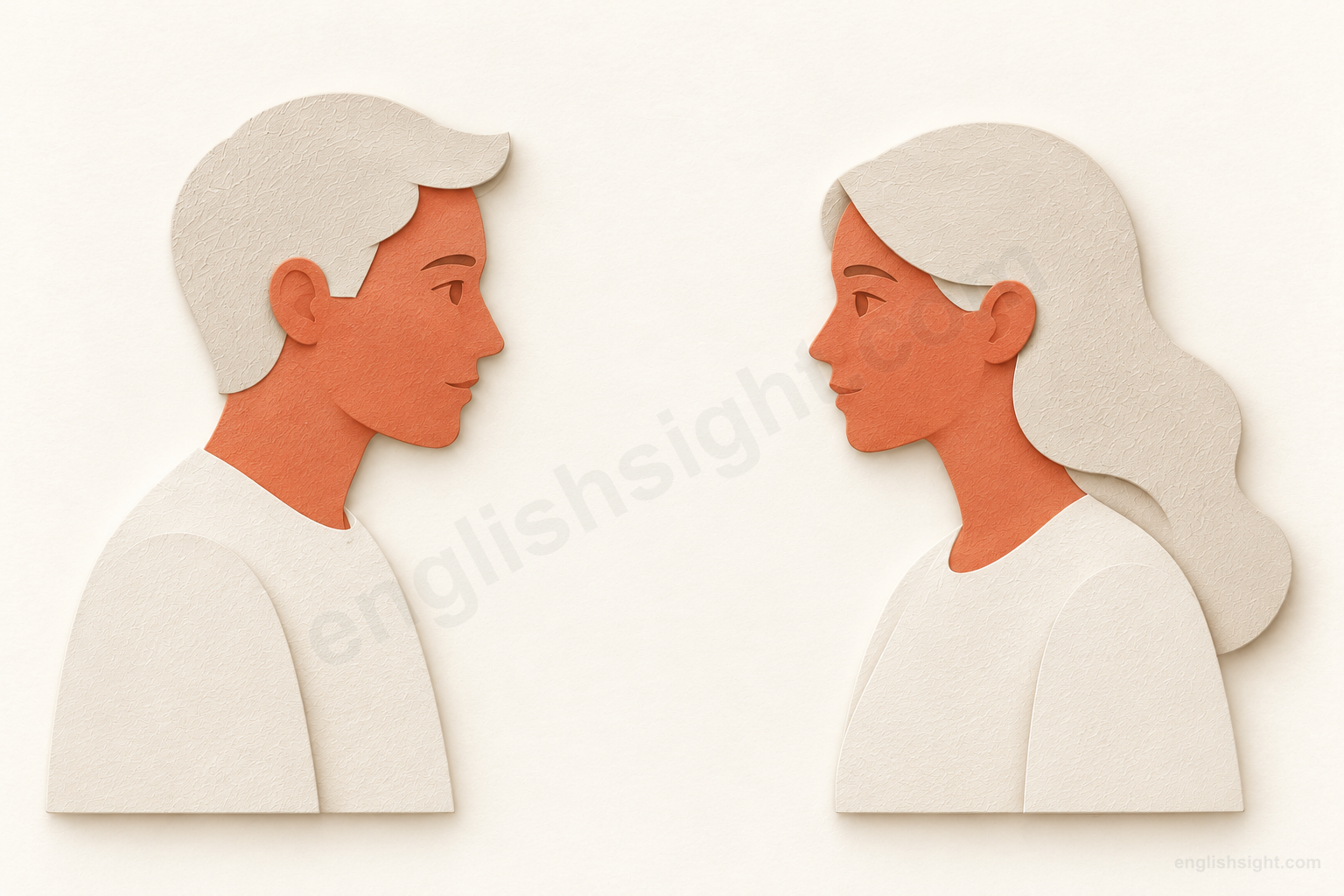
The two people face one another.
Each person's face points toward the other.
Facing is a front-toward relation; this picture shows physical orientation.
A face is a front or outward surface; to face is to have or turn that front toward someone or something, and figuratively to meet or acknowledge what is there.
Two people oriented toward each other make the front-toward relation visible. This static relation needs no movement arrow. Material surfaces, public image, and fixed idioms are explained separately; the sketch does not show a universal mental picture.
Face /feɪs/ is a countable noun for the front of the head and many kinds of surface. As a verb, it can describe where a front points, what someone encounters, or a truth they acknowledge. Fixed phrases add meanings you need to learn as complete expressions.
A useful teaching connection is a front presented to what is there: a person’s face, an object’s outer side, and facing a person or situation. Social dignity and other idioms are established branches, not meanings that one picture can mechanically predict.
01
Faces, expressions, and recognizable people
Begin with the front of the head. Face can then pick out an expression or stand for the person whose face we recognize.
01
possessive + face; on someone’s face; hit someone in the face
wash your face
the front part of your head
Situation / starting point
Paint is on the child’s cheeks.
Meaning in this situation
The child washes that part of the head.
The face includes the eyes, nose, and mouth; it is not the whole head.
Use a possessive for an ordinary personal action: I washed my face. Face is countable here: one face, several faces. Face cream and a face mask use the noun to specify the body area.
Compare a mark on her face with a ball hitting her in the face. On describes a mark on the surface; hit someone in the face is the usual body-part construction. Pale-faced and round-faced are compound adjectives describing appearance.
In a sentence
There was blue paint on his face, so he washed it off.
Watch the difference A headache affects your head; a face mask covers your face. The words are not interchangeable.
02
someone’s face + light up / fall; emotion + be written all over someone’s face
her face lit up / fell
show a feeling through facial expression
Situation / starting point
A message arrives with good or bad news.
Meaning in this situation
The person’s expression visibly changes.
Face can mean the expression shown by the face.
Her face lit up when she saw the photo describes visible delight. His face fell when the flight was cancelled describes visible disappointment. Neither expression means a face physically moved or produced light.
A long face suggests sadness, and a face like thunder suggests anger. If worry is written all over your face, the feeling is easy to see. These phrases describe a visible impression; they do not guarantee that an observer knows your private feelings.
In a sentence
Maya’s face lit up when her brother walked into the room.
Watch the difference A long face in this expression is an unhappy expression, not necessarily a long-shaped head.
03
make / pull a face (at someone/something); make faces
make / pull a face
deliberately change your expression to react or amuse
Situation / starting point
The soup tastes unexpectedly sour.
Meaning in this situation
The child wrinkles his nose in reaction.
Make and pull describe producing an expression, not making a new body part.
You can make a face at a taste, a comment, or a person. Making faces at someone can be playful or rude; the context supplies the intention. Pull a face is especially familiar in British English.
The plural make faces can describe repeated or varied expressions. A funny face may be intended to entertain; a disgusted face signals dislike. Simply seeing someone’s face does not imply this deliberate action.
In a sentence
He made a face when he tasted the unsweetened lemon juice.
Watch the difference Say make a face or make faces; do not omit the article before singular countable face.
04
keep a straight face; say something with a straight face; maintain a poker face
keep a straight face / a poker face
control what your expression reveals
Situation / starting point
A ridiculous suggestion makes you want to laugh.
Meaning in this situation
You continue looking serious.
A straight face suppresses laughter; a poker face hides thoughts or feelings more generally.
Keep a straight face is useful when something is funny but you do not laugh or smile. With a straight face describes the serious expression maintained while speaking or listening.
A poker face need not involve anything funny or a card game. A negotiator might maintain a poker face to avoid revealing disappointment. The two expressions overlap when the hidden feeling is amusement.
In a sentence
I could barely keep a straight face when she called the tiny shed a palace.
Watch the difference A straight face describes an expression, not a straight or narrow facial shape.
05
a familiar / friendly / new / famous face; new faces
a familiar / new face
a recognizable person or a newcomer
Situation / starting point
You enter a group and look around.
Meaning in this situation
You recognize someone, or notice a new member.
A visible part stands for the whole person.
A familiar face is someone you recognize, even if you cannot remember their name. We need some new faces means the group needs new people, not new appearances for its existing members.
Famous faces can refer to well-known people appearing at an event. This use is a conventional way of identifying people by appearance, rather than a separate sense for every adjective.
In a sentence
It was my first day, and I was relieved to see a familiar face in the office.
Watch the difference A new face usually means a newcomer; a new hairstyle alone does not make you a new member.
02
Surfaces, appearances, and value
Objects have faces too. Distinguish a physical surface, an applied outer material, an outward character, a representative, and the established expression face value.
06
the face of + object; a cliff / rock face; the faces of a solid
a cliff face / the faces of a cube
an exposed side or surface
Situation / starting point
A rock or solid object has distinct sides.
Meaning in this situation
You identify one of those surfaces.
An object’s face can be a side; it need not be the front of a human head.
A cliff face is a steep exposed rock surface. In geometry, a cube has six faces: each flat side is a face. This is useful elementary vocabulary, even though some further surface senses are technical.
Face does not replace side everywhere: the side of a road is not normally its face. Learn the object-based combinations. The front face of a building identifies its forward surface, while the north face of a mountain identifies a side by compass direction.
In a sentence
The climbers followed a narrow crack up the rock face.
Watch the difference An edge is where two faces meet; it is not another face.
07
a clock face; the face of a clock / watch
the face of a clock
the visible front that displays the time
Situation / starting point
A clock has hands and a display surface.
Meaning in this situation
You refer to the surface people read.
Face names the display front, not the moving hands alone.
The clock face is the part on which the time is shown, typically with numbers, marks, and hands. The face of a watch is the same kind of combination.
This belongs with surface meanings, but the familiar object combination is worth learning separately. A clock’s face and a person’s face are both visible fronts; neither requires us to imagine that the clock is alive.
In a sentence
The clock had a white face and thin black hands.
Watch the difference Face is the front display; hands are the pointers.
08
the changing face of something; change the face of something; the public face of an organization
the changing face / public face of…
an outward character, aspect, or representative
Situation / starting point
A town changes, or an organization needs a recognizable representative.
Meaning in this situation
People encounter a different appearance or a particular public identity.
The outward aspect can belong to a place, system, or person representing an organization.
The changing face of a town concerns its overall appearance or character. New transport can change the face of the town. This is broader than repainting one building.
The ugly face of corruption names a disturbing aspect. A spokesperson who becomes the public face of a charity is the person the public associates with it. That representative need not own or lead it; the role is public visibility.
In a sentence
After years behind the scenes, Noor became the public face of the campaign.
Watch the difference A public face is a representative or outward image, not necessarily the person with final authority.
09
at / above / below face value; the face value of something
face value
the stated value on a ticket or financial item
Situation / starting point
A ticket has a stated price.
Meaning in this situation
You compare that value with a resale price.
The stated amount and the actual trading price can differ.
A ticket sold at face value is sold for its stated value. A resale price can be above or below face value, so face value does not automatically mean what someone will actually pay.
This is an established compound noun. It is useful for tickets, coins, stamps, and financial documents; do not extend it to every object’s visible surface.
In a sentence
The concert ticket’s face value was forty pounds, but the seller wanted sixty.
Watch the difference Face value is not automatically market value or resale value.
10
take / accept something at face value
take something at face value
accept something as it appears without further questioning
Situation / starting point
An explanation sounds convincing.
Meaning in this situation
You accept it without checking for hidden problems.
The apparent account is treated as sufficient.
Taking a statement at face value means accepting the straightforward meaning or appearance presented. It does not mean calculating a money amount.
Compare on the face of it, which frames an initial assessment and leaves room to revise it. Take at face value describes how you accept something; on the face of it describes the basis of a judgment.
In a sentence
I took his promise at face value and booked the room.
Watch the difference Keep at in this expression: take it at face value.
11
be faced with + material; a wall / building faced with something
be faced with stone
have an outer surface covered with a material
Situation / starting point
A wall has a structural base.
Meaning in this situation
Stone is applied as the visible outer layer.
The material object of with distinguishes cladding from being confronted by difficulty.
A building faced with stone has stone on its outer surface. This surface-related verb is commonly passive. It is useful to recognize in descriptions of buildings and materials.
Compare We are faced with a problem. The same passive shape has a different sense because a problem is a difficulty, whereas stone is an outer material. The diagram’s front-surface connection supports this branch without turning it into confrontation.
In a sentence
The lower wall is faced with pale limestone.
Watch the difference Faced with stone does not mean the wall is looking at a stone.
03
Which way the front points
Face as a verb describes orientation or a turn toward someone. Other expressions describe the position of a body or a direct meeting.
12
face + person / object / direction; face towards something; north-facing + noun
face the door / face north
have or turn your front toward something
Situation / starting point
People or objects are arranged in a room.
Meaning in this situation
Their fronts point in a particular direction.
Orientation may be a continuing position or the result of a turn.
The chairs face the door describes their position. Turn and face the door describes changing direction. A window can face the street without moving. Face north uses a direction directly; face towards the door is also possible.
A north-facing room is oriented toward the north. Facing can also introduce a position: a desk facing the window. None of these uses by itself says that someone is worried, brave, or actually seeing the object.
In a sentence
Please turn your chair so that you face the screen.
Watch the difference Face the screen needs no at. Look at the screen uses a different verb pattern.
13
lie / place / put something face up / down
face up / face down
with the face or front pointing upward or downward
Situation / starting point
A card has a marked side and a back.
Meaning in this situation
You place it so that one side points down.
The phrase describes position rather than an act of confronting somebody.
A card lying face down hides its marked front; face up exposes it. A person lying face down has the front of the body directed downward. Context supplies which object’s front matters.
Compare She faced him down, a verb phrase about resisting someone. In Put the card face down, put is the verb and face down describes the card’s resulting position.
In a sentence
Put your answer sheet face down until everyone has finished.
Watch the difference Face down in a position is different from the phrasal verb face someone down.
14
meet / speak face to face; a face-to-face meeting; come face to face with something
face to face (with…)
meet directly, or encounter a reality you cannot avoid
Situation / starting point
People have only exchanged messages, or a difficulty has remained abstract.
Meaning in this situation
They meet in person, or experience the difficulty directly.
The construction can express a literal meeting or a figurative confrontation.
We finally spoke face to face normally describes direct personal contact, often contrasted with email or calls. Before a noun, use hyphens: a face-to-face meeting.
Coming face to face with a difficult reality means confronting it directly: The visit brought us face to face with poverty. There is no literal face on poverty. With introduces the person or situation encountered.
In a sentence
We had exchanged emails for months before we met face to face.
Watch the difference Say face to face with her, not face to face to her.
04
What you have to meet or accept
A problem can face you, or you can face it. Read the construction to distinguish exposure to difficulty, acknowledging reality, emotional readiness, and confrontation.
15
someone faces something; something faces someone; be faced with something
face a problem / be faced with a problem
have a difficulty that requires attention
Situation / starting point
The project has less funding than it needs.
Meaning in this situation
The team must deal with a shortage.
The subject may be the affected person or the problem presenting itself.
We face a shortage, We are faced with a shortage, and A shortage faces us present the same broad difficulty with different subjects. Facing a problem does not promise that we have accepted it bravely or solved it.
The problems facing students places problems as the things that affect students. The problems faced by students uses a passive form with students as those experiencing them. Both are useful in reports.
In a sentence
We are faced with a choice between delaying the trip and paying more.
Watch the difference Use We face a problem or We are faced with a problem, not We are face with a problem.
16
face + charges / trial / criticism / a fine / the prospect of something
face charges / a fine
be exposed to a difficult process or possible consequence
Situation / starting point
A rule may have been broken.
Meaning in this situation
A person may have to undergo a formal process or penalty.
Face can describe a threat or prospect rather than a completed outcome.
A company facing a fine is in a situation where a fine may follow; the sentence does not say the money has already been paid. Face trial concerns undergoing a trial, while face charges concerns allegations.
The object can also be criticism, competition, higher costs, or the prospect of closure. Read any conditional wording: could face a fine is weaker than was fined. Facing charges alone does not establish guilt.
In a sentence
The company could face a large fine if it ignores the order.
Watch the difference Face trial and be convicted describe different stages; do not treat them as synonyms.
17
face the facts / truth / reality; face the fact that + clause
face the facts / the truth
acknowledge a reality you would rather avoid
Situation / starting point
A plan has failed, but people keep denying it.
Meaning in this situation
They recognize the actual situation.
Here facing includes acceptance, beyond merely being exposed to a problem.
Face the fact that… introduces the uncomfortable proposition in a that-clause. Face facts and face reality are compact ways to urge acknowledgment. Facing the future concerns meeting what lies ahead.
The front-toward relation supplies a useful teaching connection: no longer turn away from what is there. This is a metaphor for acknowledgment, not a claim about physical eye direction or a guarantee of a solution.
In a sentence
We must face the fact that the original deadline is no longer realistic.
Watch the difference To state a particular unwelcome proposition, use face the fact that plus a full clause. Face facts and face the facts can also stand alone as calls to acknowledge reality.
18
Let’s face it, + clause; Face it, + clause
Let’s face it, …
invite frank agreement about an unwelcome truth
Situation / starting point
The group avoids saying what is obvious.
Meaning in this situation
Someone makes a direct assessment.
This conversational opener presents a reality the speaker wants everyone to acknowledge.
Let’s face it often introduces a blunt, practical judgment: Let’s face it, this car is too small for us. It points toward the following claim rather than a visible object.
The speaker presents the judgment as something to accept, but listeners can disagree. It is an established conversational expression, not proof that the claim is objectively true.
In a sentence
Let’s face it, we need a bigger room for thirty people.
Watch the difference Do not read it as an instruction to turn toward a physical object here.
19
cannot / could not face + noun / pronoun / -ing
can’t face doing something
feel unable or unwilling to deal with an unpleasant activity
Situation / starting point
You feel exhausted after a long day.
Meaning in this situation
Even thinking about a task feels too much.
The difficulty is emotional or psychological readiness, not necessarily physical ability.
I can’t face cooking means I do not feel able to cope with preparing food now. I can’t face the kitchen can express the same kind of reluctance with a noun object.
Use an -ing form for an activity: can’t face getting up early. This does not establish that the activity is impossible; it often communicates dread, exhaustion, or strong unwillingness.
In a sentence
After the overnight journey, I couldn’t face cooking a full meal.
Watch the difference Say can’t face cooking, not can’t face to cook.
20
face + person / group; cannot face someone
face someone
meet or deal with someone despite discomfort
Situation / starting point
You have let a colleague down.
Meaning in this situation
You must talk to that colleague.
A person as object can bring the social difficulty of an encounter into focus.
I can’t face Sam after losing his keys means that embarrassment makes meeting him difficult. The difficulty comes from the situation, rather than from the grammar of every face + person sentence.
Compare The chairs face Sam, which only describes orientation. A witness facing the press may be meeting questions or scrutiny. Context distinguishes physical direction from an uncomfortable encounter.
In a sentence
How will I face Priya after forgetting her invitation?
Watch the difference Face a person does not always mean oppose or defeat them.
21
face up to + noun / pronoun / -ing; face up to the fact that + clause
face up to something
acknowledge and deal with a difficult reality
Situation / starting point
Someone has avoided taking responsibility.
Meaning in this situation
They begin accepting what must be handled.
The established phrasal verb emphasizes confronting what was difficult to accept.
Face up to a mistake or a responsibility goes beyond being in its presence. Face up to the fact that… introduces the reality acknowledged. It can overlap with face the facts.
To is a preposition here, so a pronoun follows it: face up to it. Keep the combination together. If an activity follows to, use an -ing form, as in face up to having made a mistake.
In a sentence
We finally faced up to the fact that we had spent too much.
Watch the difference Say face up to it, not face it up to. Up does not mean upward movement here.
22
face someone down; face down + noun; face + pronoun + down
face someone down
resist or overcome someone through direct confidence
Situation / starting point
Someone tries to intimidate a group.
Meaning in this situation
The group refuses to give way.
Down contributes to the established confrontation meaning, not physical downward orientation.
Face down a bully describes meeting pressure directly and confidently, often until the other person backs down. It need not involve violence.
This verb is separable: face the bully down or face down the bully. A personal pronoun belongs in the middle: face him down. Compare a card lying face down, where the two words describe position.
In a sentence
The residents faced the developer down and kept access to the path.
Watch the difference Say faced him down, not faced down him.
23
face off; face off against someone; a face-off
face off (against someone)
compete or confront; begin play in a sport such as hockey
Situation / starting point
Opponents are ready to meet.
Meaning in this situation
They begin competing, or prepare for a confrontation.
Off belongs to a conventional verb combination; it does not mean a face is removed.
Two teams can face off against each other, and candidates can face off in a debate. The expression is especially familiar in North American sports and news contexts; ordinary meet is more neutral.
In ice hockey, face off also names beginning or restarting play. Both teams are ready to face off can have that specific sports meaning. The related countable noun is written face-off: a tense face-off.
In a sentence
The two finalists will face off on Saturday.
Watch the difference Against can introduce the opponent in face off against someone. Unlike face someone down, this use does not put an object between face and off.
05
Public appearance and social standing
People can manage what others see, preserve dignity, or confront someone directly. These meanings belong to established phrases.
24
save / lose face; help someone save face; a loss of face
save face / lose face
preserve or lose public respect and dignity
Situation / starting point
An error risks public embarrassment.
Meaning in this situation
A response protects someone’s dignity or makes them look foolish.
Face here concerns how someone appears socially, rather than a body part.
To lose face is to suffer a loss of respect or dignity. To save face is to avoid that humiliation. Allowing someone to correct an error privately can help them save face without hiding the error itself.
In this meaning face is normally uncountable: lose face, save face, a loss of face. Save someone’s face is also possible. This differs from saving someone’s life or physically protecting their face.
In a sentence
She offered him a private chance to correct the figures so he could save face.
Watch the difference Use lose face without a in the social-standing expression.
25
put on a brave face; put a brave face on something
put on a brave face
appear cheerful or confident despite worry
Situation / starting point
Someone feels disappointed or afraid.
Meaning in this situation
They present a more confident outward expression.
The displayed attitude can differ from the feeling underneath.
Put on a brave face does not require the person to stop being worried. It highlights what they show other people. Put a brave face on something names the situation whose seriousness or pain they try not to show.
Compare face a problem bravely, which emphasizes how you deal with it. Putting on a brave face emphasizes appearance; it may accompany courageous action, but the phrase alone does not say the problem is being solved.
In a sentence
Although the cancellation upset her, she put on a brave face for the children.
Watch the difference Keep a in a brave face; brave is not an adverb modifying face here.
26
show + possessive + face (at a place/event)
show your face
appear where other people can see you
Situation / starting point
You consider avoiding a gathering.
Meaning in this situation
You attend or become visible there.
Showing your face can mean being present, without any literal unveiling.
I should show my face at the reunion means I should at least appear there. It can suggest a brief visit, although it does not specify a length of stay.
I’m afraid to show my face often signals embarrassment about appearing in public. Compare Show me your face in a photo instruction: that can be literal. The social meaning depends on the context.
In a sentence
I can’t stay all evening, but I’ll show my face at the party.
Watch the difference In the idiom meaning appear in public, match the possessive to the person appearing: she showed her face, and I showed mine.
27
say something to someone’s face; tell someone something to their face
say it to someone’s face
say something directly to the person concerned
Situation / starting point
Someone criticizes an absent colleague.
Meaning in this situation
They address that colleague directly instead.
To marks the recipient of direct speech.
Tell her to her face means tell her directly rather than talk about her when she is absent. It often occurs with criticism or an uncomfortable truth, though direct speech need not be hostile.
Compare face to face, which describes a direct encounter, and in her face, which can suggest aggressive interference. The preposition changes the expression and its usual social tone.
In a sentence
If you dislike my decision, please tell me to my face.
Watch the difference Do not substitute in for to when you simply mean direct speech.
28
get / be in someone’s face; in-your-face + noun
get in someone’s face / in-your-face
act aggressively or confrontationally
Situation / starting point
Someone wants to pressure another person.
Meaning in this situation
They crowd or challenge the person in an intrusive way.
The personal-space image gives this expression a confrontational tone.
Get in someone’s face is informal and suggests aggressive confrontation. Be in my face can also complain about repeated intrusive criticism. It is stronger than speaking to me directly.
The adjective in-your-face describes a bold, aggressive, or deliberately shocking style: an in-your-face advertising campaign. Shut your face! is a separate rude order to stop talking; recognize its tone rather than use it as a neutral request.
In a sentence
He kept getting in the referee’s face after every decision.
Watch the difference In-your-face is an adjective; to your face is a phrase about direct communication.
06
Established images in conversation
Learn these expressions as wholes. Their meanings cannot be calculated merely by imagining a literal face.
29
On the face of it, + clause
on the face of it
according to an initial or surface assessment
Situation / starting point
An offer looks attractive before checking details.
Meaning in this situation
You give a provisional judgment.
An outward impression leaves room for what closer inspection might reveal.
On the face of it frames what seems true from the information immediately available. It often prepares for a qualification, but a following contradiction is not compulsory.
Compare taking the offer at face value: that describes accepting what is presented without questioning. On the face of it can introduce your assessment while you continue checking the conditions.
In a sentence
On the face of it, the rent is low, but heating is not included.
Watch the difference Learn on the face of it as a fixed phrase; in the face of has a different meaning.
30
in the face of + difficulty / opposition / evidence
in the face of something
despite a difficulty, or in response to something confronting you
Situation / starting point
A group encounters opposition or new evidence.
Meaning in this situation
They continue despite it, or change course because of it.
The same phrase can frame resistance or a response; the main clause decides.
They continued in the face of opposition means they continued despite opposition. Here the obstacle did not stop them.
In the face of new evidence, he withdrew the claim instead means the evidence confronted him and led to a change. Do not translate every occurrence as despite. Look at whether the action resists or responds to what is presented.
In a sentence
In the face of repeated objections, the team revised its plan.
Watch the difference Do not confuse in the face of with on the face of it, which introduces a first impression.
31
fly / flies / flew in the face of + evidence / advice / convention
fly in the face of something
strongly contradict or go against something accepted
Situation / starting point
Evidence supports one conclusion.
Meaning in this situation
A claim or action goes against it.
The whole idiom expresses opposition to evidence, expectations, or rules.
A decision can fly in the face of expert advice, common sense, or established evidence. The subject need not be a person and nothing needs to fly physically.
Compare in the face of criticism, which situates an action against difficulty or prompts a response. Fly in the face of criticism is not a general substitute for despite criticism; fly specifies contradiction or defiance.
In a sentence
His claim flies in the face of the measurements we took yesterday.
Watch the difference Keep the whole expression, including in the face of.
32
face the music
face the music
accept criticism or punishment for what you did
Situation / starting point
You made a mistake and have been avoiding discussion.
Meaning in this situation
You meet the resulting criticism or consequences.
This informal idiom is about accountability, not listening to sound.
If I broke the equipment, I’ll have to face the music suggests I must accept the unpleasant reaction or punishment. The wrong action is usually already known or admitted.
Compare face a problem, which need not involve any blame, and face a fine, which names a possible consequence more specifically. Face the music adds the familiar idea of answering for one’s conduct.
In a sentence
I deleted the shared file, so I’ll have to face the music at the meeting.
Watch the difference Do not use this idiom for a neutral visit to a concert.
33
be / feel like a slap in the face to / for someone
a slap in the face
an action felt as an insulting rejection
Situation / starting point
Volunteers expect their work to be appreciated.
Meaning in this situation
A decision makes them feel disregarded.
The figurative blow is an insult, not necessarily a physical attack.
Calling an action a slap in the face expresses the speaker’s feeling that it rejects or disrespects someone. This is a strong evaluation, not a neutral label for every disappointing result.
An actual slap in someone’s face is physical contact. In The decision was a slap in the face, the subject is a decision and the meaning is figurative. To or for can identify the people affected.
In a sentence
Cancelling the award without explanation felt like a slap in the face to the volunteers.
Watch the difference Disappointment alone need not imply disrespect; this idiom adds that evaluation.
34
have / be left with / end up with egg on your face
have egg on your face
look foolish after a mistake or failed claim
Situation / starting point
You make a confident prediction in public.
Meaning in this situation
Events prove it wrong, and you feel embarrassed.
The idiom describes visible foolishness rather than literal food.
End up with egg on your face often follows a boast, a confident claim, or a badly judged decision. The embarrassment is about how you now appear to other people.
Compare lose face, which concerns respect or dignity more broadly. Egg on your face is an informal, vivid way to describe looking foolish; neither expression requires a physical change to the face.
In a sentence
I said the repair would take five minutes and ended up with egg on my face.
Watch the difference Egg is normally uncountable in this idiom: egg on your face, not an egg.
35
argue / explain / talk until / till you are blue in the face
until you are blue in the face
keep trying or talking without achieving the intended result
Situation / starting point
Someone repeatedly tries to persuade a listener.
Meaning in this situation
The listener still will not agree.
The exaggerated image emphasizes fruitless persistence.
You can explain until you’re blue in the face often means that even repeated explanation will not persuade this person. It can be used to warn that further effort will not help.
It is an informal exaggeration, not a claim about a real medical symptom. The main activity is commonly arguing, explaining, or asking repeatedly, rather than any ordinary action continued for a long time.
In a sentence
You can argue until you’re blue in the face, but the deadline is fixed.
Watch the difference The expression normally suggests lack of success, not merely enthusiasm or a long conversation.
36
fall flat on + possessive + face
fall flat on your face
fall forward physically, or fail embarrassingly
Situation / starting point
You trip, or launch a plan with confidence.
Meaning in this situation
You land on your front, or the plan fails badly.
The figurative outcome borrows the humiliating image of a fall.
After tripping, someone may literally fall flat on their face. A project can also fall flat on its face when it fails completely or embarrassingly; no body is involved.
The subject helps identify the sense: The new scheme fell flat on its face is figurative. Compare simply fall, which does not by itself specify this emphatic kind of failure.
In a sentence
The grand launch fell flat on its face when nobody could log in.
Watch the difference Match the possessive to the subject: the scheme fell flat on its face.
37
disappear / vanish off the face of the earth; wipe something off the face of the earth
vanish off the face of the earth
disappear completely or seem impossible to find
Situation / starting point
You cannot find a person or object anywhere.
Meaning in this situation
You describe the disappearance emphatically.
The earth’s face stands for the visible world in an exaggerated expression.
You might say a missing tool has vanished off the face of the earth after searching everywhere. The phrase often exaggerates the searcher’s frustration rather than reports a literal disappearance from the planet.
Wipe something off the face of the earth means destroy or remove it completely and is much stronger. It describes destructive removal, not merely failing to find something.
In a sentence
My spare key seems to have vanished off the face of the earth.
Watch the difference Preserve the fixed wording the face of the earth; it is not about a human face.
38
a plan / scheme + blow up in someone’s face
blow up in someone’s face
go badly wrong and harm or embarrass the person involved
Situation / starting point
Someone expects a plan to help them.
Meaning in this situation
The plan fails in a damaging way.
The idiom links failure to its unpleasant effect on the person behind it.
A publicity trick can blow up in its organizer’s face if it produces damaging criticism instead of good publicity. The image is of a harmful result returning directly to the person involved.
A machine can also literally blow up near someone’s face. When the subject is a plan, scheme, or joke, a figurative failure is usually intended. This is more specific than a harmless plan simply not working.
In a sentence
The fake discount campaign blew up in the shop’s face when customers compared prices.
Watch the difference The person affected follows in; do not confuse it with blow up at someone, meaning become angry with them.
39
cut off your nose to spite your face
cut off your nose to spite your face
hurt yourself while trying to hurt or defy someone else
Situation / starting point
Anger makes a person want to retaliate.
Meaning in this situation
The retaliation also damages that person’s own interests.
The established image warns about self-defeating revenge.
If you reject useful help only to annoy the person offering it, someone may warn that you are cutting off your nose to spite your face. The criticism concerns the harm you bring on yourself.
This is a disapproving idiom, not an instruction and not a phrase for every sacrifice. Spite expresses the hostile motive; the nose-and-face image makes the self-damage memorable.
In a sentence
Refusing the refund just to annoy the manager would be cutting off your nose to spite your face.
Watch the difference Do not treat an ordinary thoughtful sacrifice as spite; the hostile or defiant motive matters.
40
something stares someone in the face; someone stares something in the face
stare someone / something in the face
be obvious or unavoidable; confront an imminent outcome
Situation / starting point
An answer is available, or a bad outcome is close.
Meaning in this situation
Someone overlooks the answer, or must confront the outcome.
Subject and object distinguish the related idiomatic uses.
The answer was staring me in the face means it was obvious, even though I had missed it. Defeat was staring us in the face instead means defeat seemed imminent or unavoidable.
We were staring defeat in the face reverses the grammatical roles: we were confronting that threatened outcome. No actual eyes are attributed to defeat. Read both the noun and its role before choosing the interpretation.
In a sentence
The solution was staring us in the face: the cable was unplugged.
Watch the difference Do not give every use the meaning obvious; defeat can be an imminent threat instead.
41
shut / slam the door in someone’s face
shut the door in someone’s face
close a door on someone, or rudely reject their approach
Situation / starting point
Someone tries to enter or begin a conversation.
Meaning in this situation
The other person closes off access or refuses to engage.
The expression can be literal or describe an emphatic social rejection.
Slamming a door in someone’s face can describe physically closing it as they approach. Figuratively, an organization can shut the door in an applicant’s face by refusing even to discuss their request.
The phrase emphasizes the harshness of rejection. It is stronger than saying an application was unsuccessful. It does not mean that every negative answer is rude.
In a sentence
When I asked for an explanation, they simply shut the door in my face.
Watch the difference Context must establish whether a real door is involved; the phrase alone permits both readings.
Keep the relation and the construction distinct
Noun, verb, and inflections
The noun has plural faces /ˈfeɪsɪz/. The verb forms are face, faces, faced /feɪst/, facing. Face and faces can therefore be nouns or verbs. In facing, the final silent e is dropped; faced keeps it. We are facing a problem is ordinary progressive use; the same form can describe orientation.
Face, look at, and confront
Face the window describes orientation; look at the window concerns visual attention. Face a problem can mean having to deal with it without claiming success. Face the facts adds acknowledgment. Confront can sound more deliberately challenging than face in a neutral description of a difficulty.
Do not make all combinations phrasal verbs
Face north is an ordinary verb with a direction. Face up to, face someone down, and face off are established phrasal verbs. Face down after place or lie describes position. Save face and face the music are idioms. With in be faced with introduces either a difficulty or an outer material, depending on the sense.
What the picture can explain
The inward-facing profiles show a physical front-toward relation. Acceptance, public standing, and idiomatic images require the explanations here. The picture is a teaching model, not an account of what every native speaker visualizes.
Coverage boundary
This is a selection of common modern uses, not a frequency ranking or every dictionary entry. Specialist mining, machining, typography, sewing, and military commands are not expanded. Some regional or less central idioms are listed in the coverage record rather than taught as active targets. The surface-covering verb is included because its passive form can be confused with confronting a difficulty.
Choose the meaning and construction
Use the situation, the subject, and the complete expression.
1. A chair’s front points toward a window. Which sentence describes that orientation?
2. You feel too exhausted to cook. Which expression is natural?
3. You must deal with a difficult choice. Which sentence fits?
4. You need to accept an uncomfortable fact. Replace the fact with it.
5. The instruction says Put the card face down. What does it mean?
6. A building is faced with marble. Which interpretation fits?
7. You let a colleague correct an error privately so they avoid humiliation. What do you help them do?
8. In the face of new evidence, she withdrew her claim. What role does the evidence play?
Sources and teaching notes
Usage was checked against Oxford and Collins entries linked below. The explanations, examples, and visual teaching connection were created for this lesson. The coverage record maps individual uses to source sections.
The diagram illustrates a teaching connection; speakers need not visualize face in the same way.