Separate reality, reported information, and the conversational patterns built around fact.
A statement and the situation it describes
A statement and the situation it describes
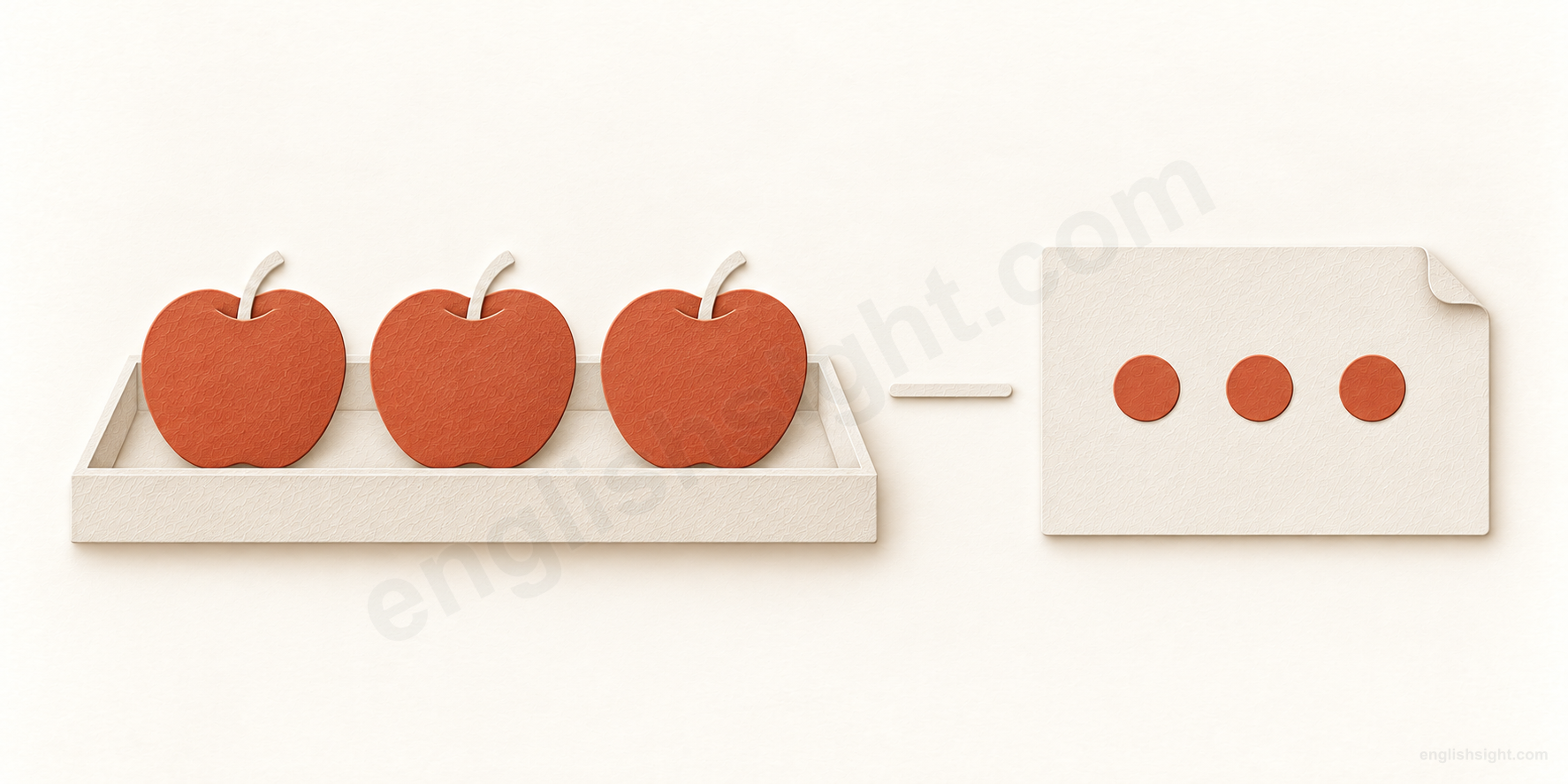
Three apples sit on a tray.
fact
The card shows three marks, matching the three apples.
Compare the record with the actual count.
Three apples and three recorded marks: the description fits the situation.
A fact concerns what is actually the case; calling a statement a fact presents it as true.
The sketch pairs an actual arrangement with a matching record. It shows correspondence, not a process that turns a guess into truth. Fixed expressions can add functions that this visual model cannot predict.
A fact can be a real situation or a piece of information presented as true. In everyday speech, facts can also mean the details someone has collected or reported, so checking them still matters.
This lesson connects those uses without treating every fixed phrase as a literal picture. The diagram is a teaching model, not a claim about a picture shared by every English speaker.
01
Truth, information, and accuracy
A fact can be one item of information or reality considered as a whole. The words around it tell us whether we are counting details, checking accuracy, or selecting evidence.
01
a / one + fact; facts about + topic; the facts of + situation
a fact / facts about…
one or more pieces of information treated as true
Situation
You prepare a short guide to a town.
What the expression does
You choose specific details readers can learn or check.
Count the separate details, not the amount of confidence.
In a useful fact or three facts, fact is a countable noun. About introduces the topic: facts about the town. The facts of the case instead points to the details of a particular situation.
An interesting fact, a basic fact, and a little-known fact describe the information differently without creating new meanings of fact. Information itself is normally uncountable: three facts, but three pieces of information.
Calling information a fact presents it as true. People can still get their facts wrong; the label is not a guarantee that someone has verified it.
It’s a fact that the library is closed on Mondays asserts the following statement as true. A well-known fact adds that many people already know it; it does not change the that-clause pattern.
In a sentence
The guide gives a few useful facts about the town.
Watch the difference For one unspecified item, use a fact, not bare fact: I learned a fact.
02
based on fact; distinguish / separate fact from fiction or opinion
based on fact; fact or fiction
reality rather than invention or personal evaluation
Situation
A story mixes real events with imagined conversations.
What the expression does
You distinguish its real basis from the invented parts.
Here fact is an uncountable category.
Based on fact means grounded in what actually happened or exists. The contrast fact or fiction asks about reality versus invention. It does not count individual statements.
The phrase fact and opinion contrasts what is presented as objectively true with a person’s judgment or preference. An opinion may be informed by facts; an opinion is not simply another name for a lie.
Compare based on a fact, which singles out one true detail, with based on fact, which describes a basis in reality more generally. A story based on fact can still contain invented scenes.
A statement of fact presents something as objectively true, rather than as a preference. Historical fact and scientific fact use the same truth category in particular domains.
In a sentence
The film is based on fact, but several scenes were invented.
Watch the difference Uncountable fact needs no article here. Based on fact does not mean every detail is accurate.
03
check + (your / the) facts; get + possessive + facts + right / straight / wrong
check your facts; get your facts right
make sure the information you use is accurate
Situation
You are about to post an opening time online.
What the expression does
You check the current notice before making the claim.
The information is checked against a reliable basis.
Check the facts and check your facts ask someone to verify information. Your facts means the details you are using, not truths that belong only to you.
Get your facts right asks for accurate information. Get your facts straight asks for a clear, correct understanding of the details. These requests can sound sharp in an argument; Could we check the date first? is gentler.
In We got our facts wrong, facts refers to the details we believed or reported. The sentence does not claim that a genuine truth became false.
In a sentence
Please check your facts before you post the opening time.
Watch the difference Get your facts right is an ordinary verb construction, not a phrasal verb called fact right.
04
hard facts; the bare facts (of / about + situation)
hard facts; the bare facts
provable information, or the essential details without additions
Situation
A report contains both records and speculation.
What the expression does
You ask either for firm evidence or for a brief account.
Hard concerns support; bare concerns what has been left out.
The phrase hard facts emphasizes information that can be substantiated, rather than guesses or wishes. Hard does not describe the physical texture of the information.
The phrase the bare facts means the plain essential details, without extra explanation, description, or decoration. Compare She gave us the bare facts: the flight was cancelled and no replacement was available.
These combinations overlap, but they answer different requests. A long technical report may contain hard facts; asking for the bare facts asks someone to strip the account down.
In a sentence
We need hard facts about the cost, not another guess.
Watch the difference Bare does not mean false or unsupported, and hard does not necessarily mean unpleasant.
05
stick to + the facts (of + situation)
stick to the facts
keep an account focused on factual details
Situation
Someone adds guesses about another person’s motives.
What the expression does
You ask them to report only the relevant details they can support.
The request limits the content of the account.
Stick to the facts asks a speaker to stay with factual information rather than speculation or unrelated comments. Stick to contributes the idea of keeping to a subject or rule.
It is different from check your facts: a person may have accurate information but still wander into guesses. It also differs from face the facts, which asks someone to accept a situation.
In a sentence
In your account of the accident, please stick to the facts.
Watch the difference Keep the preposition to in stick to the facts; stick the facts is not this expression. The instruction can sound firm.
06
facts and figures about / on + topic
facts and figures
detailed information, often including numbers
Situation
You must decide whether a project is affordable.
What the expression does
You request concrete details and numerical information.
Figures means numbers in this established pairing.
Facts and figures presents a body of precise information, often dates, amounts, costs, or other statistics. It is useful in reports, presentations, and decisions.
The expression does not refer to pictures of people or to grammatical figures. A speaker asking for facts and figures usually wants something more concrete than general enthusiasm.
In a sentence
Bring the facts and figures about last year’s sales to the meeting.
Watch the difference Keep both nouns plural in the familiar expression facts and figures.
02
Turn a situation into something you can discuss
The fact that… lets a whole statement act as a noun phrase. Prepositions then add a reason, a contrast, or an exception; those relations do not come from fact alone.
07
the fact that + subject + verb; verb + the fact that + clause
the fact that…
treat a whole situation as a noun phrase
Situation
The shop closes early; this matters to your plan.
What the expression does
You discuss that situation as the reason for making a change.
The clause after that gives the content of the fact.
The fact that the shop closes early packages a complete statement as something you can accept, ignore, hide, acknowledge, mention, or discuss. The phrase can also be the subject: The fact that it closes early changes our plan.
That introduces the content here; it does not replace a subject or object inside the clause. Compare the fact that surprised me, where that means which and is the subject of a relative clause.
A singular head noun takes singular agreement: The fact that two shops are closed is a problem. The plural subject inside the that-clause does not make fact plural. In straightforward prose, I know that… is often shorter than I know the fact that….
In a sentence
We cannot ignore the fact that the shop closes at five.
Watch the difference Use the fact that… for this frame, not the fact of it closes….
08
the fact of + noun phrase / -ing form; the fact that + clause
the fact of being…
refer to an existing state or event with an of-phrase
Situation
Simply being present has an effect on a meeting.
What the expression does
You discuss the presence itself.
Of takes a noun phrase or an -ing form here.
The fact of being there names the state of being present. The fact of their being there makes the participants explicit; this possessive form is relatively formal.
The fact of her arrival refers to the arrival as something that happened. The fact that she arrived uses a full clause instead. Choose the pattern to fit what follows of or that, rather than treating the two words as interchangeable.
This of-pattern is often more formal than a direct that-clause. It does not automatically give a reason; surrounding words establish how the fact matters.
In a sentence
The simple fact of being there gave her some comfort.
Watch the difference After of, use being there or a noun phrase, not an ordinary finite clause such as she was there.
09
the mere / very fact that + clause; the mere fact of + -ing
the mere / very fact that…
focus on the fact alone or emphasize its significance
Situation
Someone thinks a visit had no importance.
What the expression does
You explain that coming at all was meaningful.
Mere and very put different kinds of focus on the situation.
The mere fact that you came means that your coming alone, without anything further, matters. Mere can minimize what is required or single out something that seems small.
The very fact that you came emphasizes that particular fact as significant. Very modifies the noun phrase here; it does not mean that you came very much.
Neither expression proves the conclusion that follows it. The speaker still needs a reasonable connection between the stated situation and the judgment.
In a sentence
The mere fact that you came means a lot to me.
Watch the difference Very is possible in the very fact, but a very fact is not an ordinary way to say a very true statement.
10
despite / in spite of + the fact that + clause
despite the fact that…
introduce a situation that makes the outcome surprising
Situation
It is raining, so you might expect an event to stop.
What the expression does
The event continues anyway.
Despite supplies the contrast; fact that introduces the clause.
Despite the fact that it was raining, we continued means that the rain did not prevent continuing. The rain and the continuing are both presented as real in this example.
Compare Although it was raining, we continued and Despite the rain, we continued. Despite is a preposition; the fact that… supplies a noun phrase containing a clause.
In spite of the fact that… follows the same pattern. Keep of in in spite of, but do not add it directly after despite.
In a sentence
We held the picnic despite the fact that it was raining.
Watch the difference Say despite the rain or despite the fact that it rained; not despite of the rain or despite it rained.
11
because of / due to + the fact that + clause; because + clause
because of / due to the fact that…
give a situation as the reason for something
Situation
A room is unavailable because it is too small.
What the expression does
You state that reason in a longer noun-phrase construction.
The causal meaning belongs to because of or due to.
Because of the fact that the room was too small gives the same basic reason as because the room was too small. The longer phrase makes a clause available after the preposition of.
Due to the fact that… also introduces a reason. Both longer forms can be useful in formal explanation, but because + clause is usually a clear, direct choice when no special emphasis is needed.
Compare Despite the fact that the room was small, we used it. Changing the words before the fact changes a reason into a contrast; fact itself does not determine the relation.
In a sentence
We changed rooms because of the fact that the first room was too small.
Watch the difference Keep of in because of the fact that; because of takes a noun phrase, while because can take a clause directly.
12
in view of / given + the fact that + clause; given that + clause
in view of the fact that…
take an existing situation into account when deciding
Situation
The last bus is leaving soon.
What the expression does
You use that information to decide when to leave.
In view of presents a consideration supporting the decision.
In view of the fact that… means considering that situation. It often introduces a reason for a judgment, plan, or practical response rather than a direct physical cause.
Given the fact that… can do similar work. Given that… is a shorter alternative: Given that the last bus leaves soon, we should go now.
The relation comes from in view of or given. A fact about tomorrow can support a decision today; this construction is not about literally seeing something.
In a sentence
In view of the fact that the last bus leaves soon, we should go now.
Watch the difference Keep the full frame in view of the fact that; in view that is not its ordinary shortened form.
13
apart from + the fact that + clause
apart from the fact that…
set aside an exception or add another relevant point
Situation
A flat meets most of your needs.
What the expression does
You identify the one drawback in an otherwise positive assessment.
Apart from can express an exception or an additional consideration.
The flat is ideal apart from the fact that it is noisy means that noise is an exception to the positive assessment. The rest of the sentence helps establish that reading.
Apart from the fact that it is noisy, it is also too expensive adds a second objection. Here apart from works more like besides. The presence of also makes the additional-point reading clear.
Fact that packages each situation; apart from creates the exception or addition. Do not force the same interpretation onto every sentence with this phrase.
In a sentence
The flat is ideal apart from the fact that the street is noisy.
Watch the difference Use context to choose except for or besides as a paraphrase. They are not interchangeable in every sentence.
14
statement + not to mention + the fact that + clause
not to mention the fact that…
add another relevant point to strengthen what you are saying
Situation
You are explaining why a flat would not be a good choice.
What the expression does
You add the need for repairs to the problem of its price.
Not to mention adds information; it does not tell someone to stay silent.
Not to mention the fact that… introduces an additional point that reinforces the preceding statement. In a list of objections, it can add a further reason against a choice.
The fact that… supplies the noun phrase after the fixed expression not to mention. A shorter noun phrase is also possible: The flat is expensive, not to mention the repairs it needs.
Compare in fact, which may correct an earlier impression. Not to mention normally adds a relevant point in support of the direction already taken; it need not correct anything.
In a sentence
The flat is expensive, not to mention the fact that it needs repairs.
Watch the difference Do not read not to mention as a literal instruction not to say something; the speaker is actually adding that information.
15
statement + never mind + the fact that + clause
never mind the fact that…
point out a surprising contrast that is being brushed aside
Situation
Someone praises a flat while overlooking a serious problem.
What the expression does
You draw attention to the problem that makes the praise questionable.
The speaker highlights a contrast by presenting a fact as if it could be ignored.
Never mind the fact that… can draw attention to a situation that contrasts surprisingly with what has just been said. It often sounds ironic or critical: someone is acting as though an inconvenient reality does not matter.
In He calls the flat perfect—never mind the fact that the roof leaks, the speaker draws attention to the leak. The expression does not necessarily mean that the speaker really considers it unimportant.
This differs from the reassuring reply Never mind, which can tell someone not to worry. Fact that introduces the situation; the established never mind expression supplies the dismissive or ironic framing.
In a sentence
He calls the flat perfect—never mind the fact that the roof leaks.
Watch the difference Do not automatically treat this as friendly reassurance or as a neutral request to ignore evidence; the contrast may be pointed.
03
Correct, add, insist, and react
Learn these expressions as complete conversational patterns. Some correct an assumption, some add detail, and some show the speaker’s confidence or surprise.
16
in (actual) fact, + clause; subject + be / auxiliary + in fact + continuation
in fact; in actual fact
correct an assumption or contrast it with the actual situation
Situation
Someone thinks a museum closes on Sundays.
What the expression does
You correct that belief with its actual opening pattern.
The next statement replaces or qualifies the earlier impression.
In fact can introduce information that conflicts with what was said, expected, or implied. In actual fact adds emphasis; in point of fact can serve the same function and often sounds more formal.
In fact does not itself mean but. It marks the following information as what is actually the case, and the contrast comes from the relation between the two statements.
It can appear at the start or inside a clause: The museum is, in fact, open every day. Keep the fixed phrase without a: in fact, not in a fact.
In a sentence
I thought the museum closed on Sundays. In fact, it is open every day.
Watch the difference Do not use in fact as a general replacement for because; it does not introduce a reason by itself.
17
statement; in fact, + more specific or stronger statement
in fact, … [adding detail]
make an earlier statement more precise or stronger
Situation
You say that you know the area well.
What the expression does
You add the stronger detail that you lived on that street.
The second statement supports or sharpens the first.
In fact does not always correct an error. It can introduce a more specific detail or a stronger version of what came before.
The walk is short; in fact, it takes only five minutes strengthens short with a concrete measure. Both statements can be true. Read the connection in context rather than automatically looking for a contradiction.
In a sentence
I know the area well. In fact, I used to live on that street.
Watch the difference Do not assume that every sentence beginning In fact rejects the previous sentence.
18
as a matter of fact, + clause
as a matter of fact
add a relevant detail or correct what someone expects
Situation
A person assumes you have not booked yet.
What the expression does
You explain that the booking is already complete.
This is a whole conversational expression.
As a matter of fact can correct an assumption: “You haven’t booked yet, have you?” “As a matter of fact, I booked yesterday.” It can sound pointed if it challenges someone directly.
It can also add something of interest: I know that café. As a matter of fact, my sister works there. This second example adds information without contradicting the first statement.
Compare the adjective matter-of-fact in a matter-of-fact voice: that describes a practical, unemotional manner. It is a different grammatical expression, not a substitute for as a matter of fact.
In a sentence
“You haven’t booked yet, have you?” “As a matter of fact, I booked yesterday.”
Watch the difference Learn all the words: as a matter of fact. Do not replace it with as matter fact.
19
know + for a fact + that-clause; know + something + for a fact
know for a fact that…
emphasize that you are certain something is true
Situation
Someone asks whether the parcel reached the office.
What the expression does
You answer confidently because you signed for it.
For a fact marks the speaker’s claimed certainty.
I know for a fact that… stresses certainty. It is stronger than I think… or It seems…. The speaker may have direct knowledge or reliable information; the phrase does not specify which.
Compare I know for a fact that it arrived with In fact, it arrived yesterday. The first foregrounds your certainty; the second adds or corrects information in the conversation.
A confident speaker can still be mistaken. For a fact expresses a stance, not an automatic proof of the statement.
In a sentence
I know for a fact that the parcel arrived; I signed for it.
Watch the difference Keep a in for a fact; this differs from the article-free phrase in fact.
20
the fact (of the matter) is + (that) + clause
the fact (of the matter) is that…
introduce the point the speaker considers decisive
Situation
A group discusses several attractive plans.
What the expression does
You draw attention to the budget that determines the choice.
The expression brings the discussion back to a central point.
The fact is that… introduces what the speaker treats as the important reality. The longer the fact of the matter is that… can make the point more forceful.
The fact is, we have no money left omits that and uses a pause. In both forms, the following clause supplies the content. The phrase may introduce an unwelcome truth or challenge a hopeful suggestion.
It is an emphasis device, not an evidence marker. An opinion introduced with The fact is… still needs support if its truth is disputed.
In a sentence
The fact of the matter is that we cannot afford a new car.
Watch the difference The verb agrees with singular fact: the fact is, not the fact are.
21
the fact remains / remained that + clause
the fact remains that…
insist that a relevant situation still has to be accepted
Situation
Someone offers a reasonable explanation for missing a deadline.
What the expression does
You acknowledge it but return to the unfinished work.
Remains keeps the point in force despite other considerations.
The fact remains that… stresses that a situation still holds or still matters even after explanations, objections, or excuses. It often follows but.
It differs from The fact is… by explicitly keeping a point in view despite the surrounding discussion. Remained is possible when the discussion is set in the past.
This can sound firm or unsympathetic. Consider whether you are clarifying a constraint or dismissing someone’s concerns.
In a sentence
We understand the delay, but the fact remains that the work is unfinished.
Watch the difference Use singular remains with the fact; fact does not name the unfinished work as a plural subject.
22
statement, + and that’s a fact
and that’s a fact
insist that a preceding statement is true
Situation
You have just made a claim about how busy the week has been.
What the expression does
You add an emphatic final comment.
That points back to the statement you just made.
And that’s a fact reinforces a preceding claim. It is informal and may sound emphatic or argumentative rather than neutral.
A speaker can even use it after an evaluation: This is our toughest week yet, and that’s a fact. The phrase shows commitment to that assessment; it does not turn every evaluation into an objectively measured result.
In a sentence
We have worked hard this week, and that’s a fact.
Watch the difference That refers to the whole preceding claim, not just the nearest noun.
23
statement → Is that a fact?
Is that a fact?
react to surprising, interesting, or doubtful information
Situation
A friend reports an unexpected change of plans.
What the expression does
You respond with interest or with skepticism.
Tone and context decide whether the question sounds curious or challenging.
Is that a fact? can mean something like Really? in an informal reply. It is not always a literal request for evidence or a definition of fact.
With a skeptical tone, it can challenge the claim. With friendly interest, it can invite more information. If you need neutral confirmation, Is that confirmed? is less dependent on tone.
In a sentence
“Our neighbor is moving to Canada.” “Is that a fact?”
Watch the difference Do not assume that this response agrees with the claim; it may express disbelief.
04
Accepting reality and looking back
These established expressions concern unavoidable situations, persuasive information, or events that have already happened. A literal picture of one fact cannot predict all of them.
24
face + (the) facts; let’s face + (the) facts
face (the) facts
accept the actual situation, especially when it is unwelcome
Situation
The tickets are sold out, but you keep hoping to buy some at the door.
What the expression does
You accept that you need another plan.
Face adds the idea of confronting and accepting reality.
Face facts and face the facts ask someone to stop avoiding an unwelcome truth. They do not mean physically turn toward written information.
Let’s face the facts includes the speaker in the need to accept reality. You need to face facts can sound blunt or critical. The speaker should still be prepared to support the supposed facts.
Compare stick to the facts: that limits what you say. Face the facts concerns what you accept and act on.
In a sentence
Let’s face the facts: the tickets are sold out, so we need another plan.
Watch the difference Both face facts and face the facts are established; neither requires a literal face or a written list.
25
something + be + a fact of life; explain / learn + the facts of life
a fact of life; the facts of life
an unavoidable reality; a separate expression about sex and reproduction
Situation
A person is frustrated by a routine difficulty.
What the expression does
You describe it as something that must be taken into account.
Articles, number, and context distinguish two established expressions.
A fact of life is a situation treated as unavoidable, often an unpleasant one. The phrase asks for acceptance: Delays are a fact of life on this route.
The facts of life has a separate established meaning: basic information about sex and how babies are born, especially when explained to children. For example, The book helps parents talk to children about the facts of life.
Plural facts of life can also refer to several ordinary unavoidable realities when the context makes that meaning clear. Do not identify the meaning by plural spelling alone; read the whole situation.
In a sentence
Occasional delays are a fact of life on this route.
Watch the difference Do not assume the facts of life always means general knowledge; in a child-education context it often concerns sex and reproduction.
26
the facts + speak / spoke + for themselves
the facts speak for themselves
claim that the available information already makes the conclusion clear
Situation
A record shows repeated missed appointments.
What the expression does
You argue that the record needs little further explanation.
Speak for themselves is figurative: information is treated as persuasive.
The facts speak for themselves means that the speaker sees the information as sufficient to support the point without a long explanation.
The expression does not mean facts literally speak or that interpretation is never needed. Someone else may challenge which facts were selected or what conclusion they support.
In a sentence
Five missed appointments in a month: the facts speak for themselves.
Watch the difference Themselves refers to plural facts. The expression asserts clarity; it does not settle every disagreement.
27
verb / action + after the fact
after the fact
after an event or action has already happened
Situation
A decision is made without asking you.
What the expression does
You are informed when the decision is already in place.
Fact refers to an accomplished event in this established phrase.
After the fact means afterward, often with the implication that the chance to prevent, influence, or change something has passed. It is useful when discussing late notice or a review of an event.
It is not about the position of a sentence after a factual statement. The definite article belongs to the expression: after the fact.
In legal language, an accessory after the fact concerns assistance after an offence. That specialist legal application is not the everyday decision-making example taught here.
In a sentence
We were told about the change only after the fact.
Watch the difference Before the fact is chiefly a legal expression; do not automatically use it as the ordinary opposite. Say beforehand or before the decision.
Keep truth, grammar, and speaker stance distinct
Fact is a noun
The ordinary headword is a noun, pronounced /fækt/, with plural facts /fækts/. It can be countable, uncountable, or a singular noun naming a situation. Tense, passive voice, and verb-particle placement belong to surrounding verbs, not to fact as a noun.
A label is not evidence
Calling something a fact presents it as true. A person may report wrong facts or use a fact-expression to insist on an opinion. Ask what supports the claim and distinguish the information from an interpretation of it.
The construction supplies the relation
Despite the fact that gives a contrast; because of the fact that gives a reason. For a fact expresses certainty; in fact adds or corrects information. Do not exchange their prepositions as if the phrases meant the same thing.
Related words have their own jobs
Factual, fact-check, fact sheet, and matter-of-fact are related forms or compounds, not additional verb uses of fact. The adjective matter-of-fact describes a practical, unemotional manner. Detailed legal and philosophical classifications are outside this everyday noun lesson.
Read the whole expression
Choose the sentence or interpretation that fits the situation. Pay attention to articles, prepositions, and the relation between statements.
1. You learned three separate pieces of information about a town. Which wording is natural?
2. Real events inspired a film, but the dialogue was invented. Which description fits?
3. It rained, but the picnic still took place. Choose the correct contrast.
4. “The walk is short. In fact, it takes only five minutes.” What does in fact do here?
5. You signed for a delivery and want to stress that you are certain it arrived. Choose the established phrase.
6. Tickets are sold out. Someone keeps planning to buy one at the door. Which request asks them to accept the situation?
7. A book helps parents explain the facts of life to children. Which topic is the established expression likely to refer to?
8. Two shops are closed. Which sentence correctly makes that situation the subject?
9. A change was made yesterday. You are informed today, after the chance to influence it has passed. Which phrase fits?
Sources and teaching notes
The sources below support the word meanings and constructions. The explanations, examples, and visual model were written for this lesson. Coverage records distinguish dictionary usage from teaching interpretation.
The diagram models a relation between a situation and a description. It does not represent a picture shared by every English speaker.