Follow what changes, then read the whole expression.
From a higher position downward
From a higher position downward
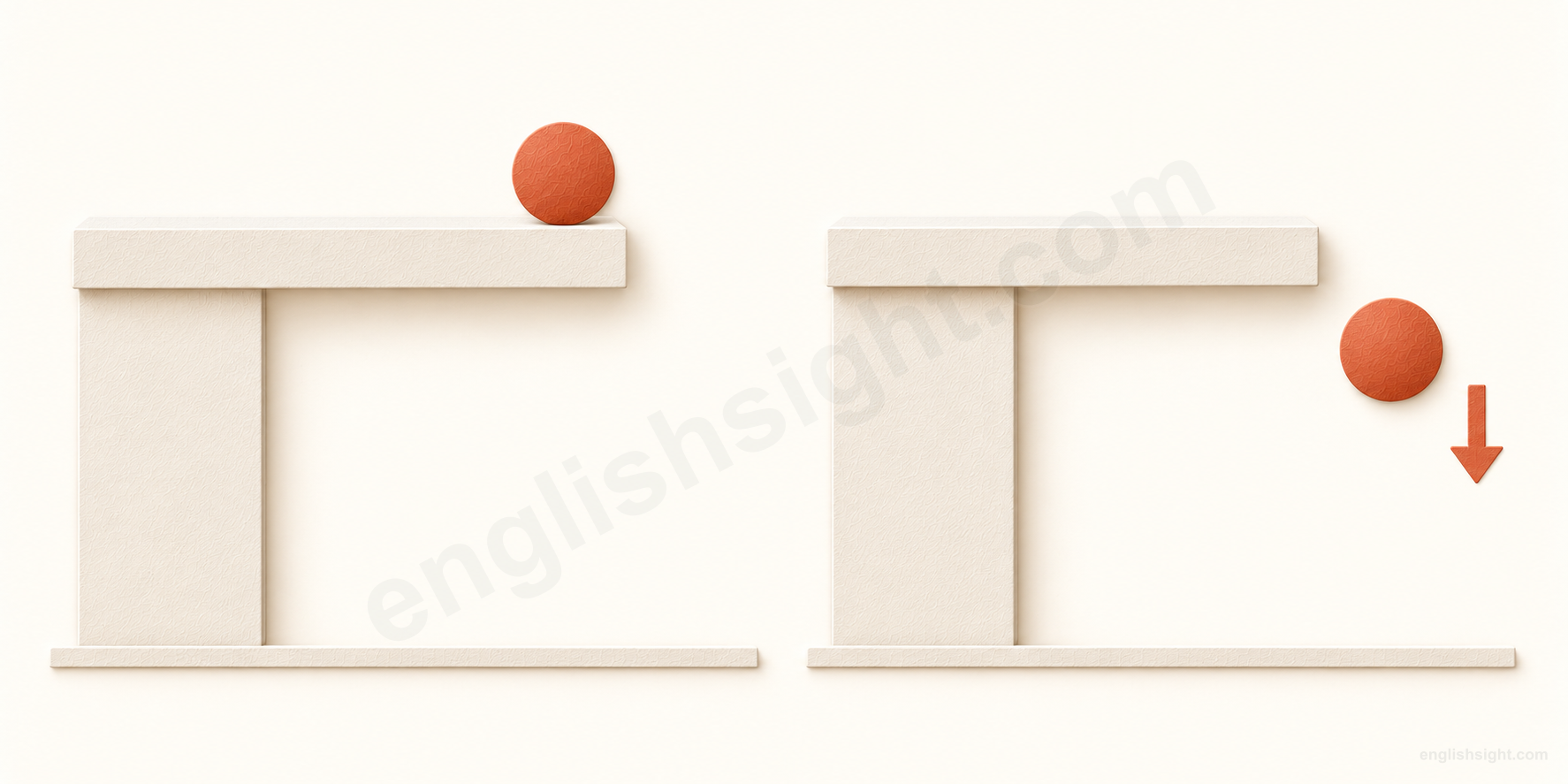
A ball rests near the edge of a high ledge.
fall
The same ball is lower in the air and still falling.
Beyond the edge, the ball loses support and moves downward.
Without the ledge's support, the ball falls toward the ground.
In the physical starting point, something moves from a higher position toward a lower one, often when support or balance is lost.
Lower amounts and lost stability connect readily with downward movement. State changes, dates, classification, and idioms need their own constructions; falling in love does not mean that love is a lower or worse state.
When a ball goes over an edge, it falls: the ball is the subject of fall because it is the thing moving down. To describe someone causing that movement, use drop, let it fall, or make it fall. Physical descent offers a useful starting point for falling prices and lost stability.
Other patterns concern entering a state, belonging to a category, or happening on a date. These are established uses, not rules that every combination can be predicted from gravity. The diagram is a teaching model, not a shared picture inside every English speaker’s mind.
01
Movement, balance, and visible shape
Identify the thing that moves, where it comes from, and where it goes. Some descriptions show a hanging shape rather than an event.
01
something falls + direction / source / destination
fall from / off / into / onto
move downward from a higher position
Starting situation
A key is near the edge of a shelf.
What changes or holds true
The key moves down to the floor.
The falling thing is the subject; the preposition identifies part of its route.
Fall reports downward movement, often caused by gravity or a loss of support. The sketch shows one example, not a requirement that every falling thing must first sit on a ledge.
From marks a starting point; off emphasizes leaving a surface or support; into marks entry; onto marks landing on a surface. A key can fall off a shelf and onto the floor. He fell into bed can describe an exhausted, partly deliberate collapse rather than an accident.
A measure can follow fall directly: The stone fell two metres. Two metres measures distance; it is not an object being moved by the subject. This is different from the incorrect I fell the stone.
In a sentence
The key fell off the shelf and onto the floor.
Watch the difference Fall does not take the moved object as a direct object: I dropped the key, not I fell the key.
02
fall (over / down); fall over + obstacle; fall down + stairs
fall over / fall down
lose an upright position or collapse
Starting situation
A child slips; a weak wall is still upright.
What changes or holds true
The child lands on the ground; the wall collapses.
Over highlights toppling; down highlights the downward result.
Someone can fall, fall over, or fall down after losing balance. A wall can fall down. Fall down the stairs describes the route down steps; down there introduces a place, not a new figurative meaning.
In I fell over a bag, over introduces what I tripped over. It does not mean I deliberately jumped across it. Informally a computer or program can fall over: The app fell over during the update means it crashed.
For a roof or ceiling collapsing inward, use fall in: Part of the ceiling fell in during the storm. Compare fall into the room, where into introduces a destination. In The ceiling fell in, no destination noun is required.
In a sentence
I slipped on the wet path and fell over.
Watch the difference A fall can cause injury, but the verb alone does not say how serious the injury is.
03
something falls off (something); something falls out (of something)
fall off / fall out
come loose and drop away
Starting situation
A button is attached to a coat.
What changes or holds true
The loose button detaches and drops.
The particle identifies the relation that is lost.
A button falls off a coat; a tooth falls out; hair can fall out. Off commonly concerns attachment or a supporting surface, while out commonly concerns leaving an enclosing or holding position.
The button fell off and The button fell off my coat both work. Hair falling over your face describes where attached hair hangs; hair falling out describes losing hair. These are different situations.
In a sentence
One of the buttons has fallen off my coat.
Watch the difference Say My tooth fell out, not I fell out my tooth.
04
rain / snow + fall; a light / heavy fall of + snow
rain / snow falls; a fall of snow
describe precipitation and an amount that comes down
Starting situation
Clouds bring snow during the night.
What changes or holds true
Snow descends and leaves a fresh layer.
The verb describes descent; the noun can name a quantity or occurrence.
Rain falls, snow falls, and tears fall. Was falling presents the process; has fallen can report the amount received so far. Ten centimetres of snow fell overnight measures what came down.
A heavy fall of snow is a noun phrase naming a substantial snowfall. A rock fall similarly names an occurrence of rocks falling. In ordinary conversation, It snowed heavily is often a simpler alternative.
In a sentence
A light fall of snow covered the garden overnight.
Watch the difference In a fall of snow, fall is a countable noun, not the autumn season.
05
hair / material falls + position; land falls (away) + direction
hair falls; the ground falls away
extend downward or slope to a lower level
Starting situation
Long hair hangs below someone’s shoulders.
What changes or holds true
You describe its shape, not necessarily a new movement.
Fall can describe a downward arrangement rather than an accident.
Her hair falls to her waist tells us how far down it hangs. A skirt can fall in soft folds. The hair or cloth may be completely still.
The ground falls away toward the stream describes a downward slope. Away adds the sense of the land extending lower as it continues from the viewpoint; the ground is not breaking apart.
In a sentence
Her hair falls just below her shoulders.
Watch the difference Do not confuse hanging hair with hair falling out and being lost.
06
have / take a fall; something breaks someone’s fall
have a fall / break someone’s fall
name an accident or soften its impact
Starting situation
A cyclist loses balance beside soft grass.
What changes or holds true
The grass reduces the force of landing.
A fall names the event; break a fall means interrupt or cushion it.
Have a fall and take a fall can describe an accident: he had a nasty fall. A fall from a ladder names the starting height or object. The countable noun needs a determiner in the singular.
Soft ground, a net, or another person can break someone’s fall by preventing a hard landing or reducing its impact. Break here does not mean causing a broken bone.
In a sentence
The thick grass broke her fall.
Watch the difference Compare take a fall, an accident, with take the fall, the blame-taking idiom later in this lesson.
02
Lower amounts and lost stability
Numbers, activity, and power can fall without any object physically moving downward.
07
fall by + amount; fall to + level; fall from X to Y; a fall in + measure
fall by / to / from / below
become lower in amount, value, strength, or pitch
Starting situation
A ticket costs 50 dollars.
What changes or holds true
It costs 40 dollars after a reduction.
By gives the change; to gives the endpoint.
The price fell by ten dollars describes the size of the reduction. It fell to forty dollars gives the new price; it fell from fifty to forty gives both endpoints. Demand, temperatures, and a voice’s pitch or volume can also fall. By can be omitted before a measure of the decrease: The price fell ten dollars. Ten dollars measures the change; it is not a direct object.
Below compares the new level with a boundary: temperatures fell below zero. Against compares currencies: one currency can fall against another. The noun uses a fall in prices for what decreased and a fall of ten dollars for the amount.
In a sentence
The price fell from fifty dollars to forty.
Watch the difference If a rate falls by 10%, that is a relative decrease. A fall of 10 percentage points subtracts ten points from the rate: 50% becomes 40%, rather than 45%.
08
activity / interest falls off; support / doubts fall away
fall off / fall away
decrease, weaken, or gradually disappear
Starting situation
A shop is busy during a holiday.
What changes or holds true
Fewer people visit afterward.
Off and away can describe a decline without physical detachment.
Business fell off after the holiday means business activity decreased. Interest or attendance can fall off too. Compare a sign falling off the shop wall: that involves physical detachment.
Fall away can emphasize becoming smaller or fewer, or gradually disappearing: Her doubts fell away as she listened. With land, fall away describes a slope instead. The subject and context select the meaning.
In a sentence
Attendance fell off after the first few weeks.
Watch the difference These patterns have no object to move between verb and particle: attendance fell off, not fell attendance off.
09
government / city + fall; city falls to + force; the fall of + power
a government falls; the fall of a city
lose power or be captured
Starting situation
A government holds office; a city resists an army.
What changes or holds true
The government loses power; the city is captured.
Lost stability becomes a loss of political control.
A government can fall without a building collapsing. A city falls to an opposing army when that army takes control. To names the new controlling side, not a physical destination.
The fall of the government or the fall of the city names the event. The rise and fall of a leader traces increasing success followed by decline. In literary and memorial language, soldiers who fell are soldiers who died in battle.
In a sentence
The government fell after losing a crucial vote.
Watch the difference The city fell does not mean that all of its buildings physically fell down.
03
Entering a state or situation
Learn which adjectives and prepositional phrases naturally follow fall. The new state is not necessarily bad.
10
fall + asleep
fall asleep
begin to sleep
Starting situation
Someone is awake on the train.
What changes or holds true
Sleep begins.
Fall marks the change into sleep, not the continuing state.
Fall asleep answers when sleep starts. Be asleep describes the state afterward; go to bed describes going to the place where you intend to sleep. A person can go to bed and remain awake.
He was falling asleep describes the transition in progress. He has fallen asleep reports that it has happened. The adjective is asleep, not sleep: I fell asleep during the film.
In a sentence
I fell asleep before the film ended.
Watch the difference Do not say fell to sleep in this ordinary pattern; fall asleep is the standard choice.
11
fall + ill / sick / silent / quiet / open; someone’s face falls
fall ill / silent / open
enter an established state
Starting situation
A conversation is lively.
What changes or holds true
The room becomes quiet.
Selected adjectives describe what the subject becomes.
Fall ill or fall sick means become ill; fall silent or fall quiet means stop making noise. A book or someone’s mouth can fall open, sometimes with physical movement contributing to the result.
These are established combinations, not a freely usable replacement for become. We normally say become happy or get angry, rather than fall happy or fall angry. Fall ill is often more formal than get sick. Her face fell means her expression showed disappointment.
In a sentence
The room fell silent when the music stopped.
Watch the difference An adjective after fall describes the subject; it is not a direct object.
12
fall in love with + person / thing; fall out of love (with)
fall in love with
develop feelings of love
Starting situation
Two people get to know each other.
What changes or holds true
One begins to love the other.
Fall marks the beginning; in love names the resulting relationship or feeling.
Fall in love with someone describes developing love, often without presenting it as a deliberate decision. Be in love with describes the continuing feeling. Fall out of love means stop feeling that love.
With introduces the person or thing loved. People also say they fell in love with a city or a piece of music to express strong affection or enthusiasm. This positive use is not a downward decline in value.
In a sentence
They fell in love while working at the same café.
Watch the difference In love is a fixed phrase here; do not replace it with into love.
13
fall into + state / activity; fall into the habit of + -ing
fall into debt / a habit / conversation
enter a situation or begin an activity
Starting situation
Small expenses build up unnoticed.
What changes or holds true
A person is now in debt.
Into presents entry into a state, activity, or pattern of behavior.
Fall into debt and fall into disrepair describe entering an unwanted condition. Fall into the habit of checking your phone describes beginning a repeated behavior, often without a clear plan. Of is followed by an -ing form.
Fall into conversation means start talking; it need not be unpleasant. Fall into teaching can mean begin that career by chance. Compare fall into a river, a physical destination, with these established abstract complements.
In a sentence
I fell into the habit of checking my phone before breakfast.
Watch the difference The pattern is not automatically negative: conversation and an unexpected career can be welcome.
14
fall under + someone’s influence / control
fall under someone’s influence
begin to be affected or controlled by an influence
Starting situation
Someone makes decisions independently.
What changes or holds true
Another person’s influence begins shaping those decisions.
Under describes a relationship of influence or control, not a lower physical location.
Fall under someone’s influence describes coming to be affected by that person’s ideas or power. Under names the relationship being entered; it does not mean that the person physically stands above you.
Compare fall under a heading, which classifies a subject rather than describing a new influence. Be under someone’s influence describes an existing relationship; fall under highlights its beginning.
In a sentence
He fell under his older cousin’s influence and began copying his opinions.
Watch the difference Falling under an influence does not by itself tell us whether the influence is helpful or harmful.
15
night / darkness falls; silence falls (over / on + place / people)
night / darkness / silence falls
begin or settle over a place
Starting situation
Daylight fades at the campsite.
What changes or holds true
It becomes dark.
The approaching condition is the subject.
Night fell and darkness fell describe the start of night, especially in storytelling or description. No physical object has to drop. A silence fell over the room similarly presents silence as a condition settling there.
Compare The room fell silent, where the room is the subject and silent is its new description. Both patterns can describe the same event, but the grammar organizes it differently.
In a sentence
We lit the lamps as darkness fell.
Watch the difference Use fell for a past event, not fallen without an auxiliary.
04
Dates, categories, attention, and duties
Here fall locates something in time, a group, a field of attention, or a person’s responsibility.
16
fall into + category / groups; fall under + heading; fall within / outside + scope
fall into / under / within / outside
belong to a category, heading, or scope
Starting situation
You sort several kinds of expenses.
What changes or holds true
One expense belongs to the travel category.
The construction locates membership; no change of category is required.
Fall into a category means belong to it; fall into three groups can mean be divided into three groups. Fall under a heading identifies a label, rule, or area covering the subject.
Fall within the scope and fall outside the scope say whether something is included. This can describe an existing classification rather than a new event. Into does not always mean a physical movement or a recent change.
In a sentence
Hotel costs fall under travel expenses.
Watch the difference Say It falls into this category, not It falls this category.
17
event falls on + day / date; falls in + period; payment falls due
fall on a date; fall due
occur on a date or become payable
Starting situation
A birthday has a particular calendar date.
What changes or holds true
This year that date is a Tuesday.
Fall locates the event in the calendar; due adds payment readiness.
My birthday falls on a Tuesday this year identifies its weekday. A holiday can fall in June or fall early in the year. The verb is especially useful when the weekday or calendar position varies.
A payment falls due when the time to pay arrives. Due supplies the payable meaning; fall alone does not mean pay. This is common in financial or administrative writing.
In a sentence
The final payment falls due next Friday.
Watch the difference My birthday falls on Tuesday describes a calendar fact, not an accident.
18
it falls to + person + to-infinitive; duty / blame falls on + person
fall to / fall on someone
become someone’s task or burden
Starting situation
Several people could organize a meeting.
What changes or holds true
One person has to do it.
To identifies the responsible person; on often presents a burden or blame.
It fell to Mira to organize the meeting means organizing it became her responsibility. In this pattern, the second to begins an infinitive; the first to introduces the person.
The responsibility fell on Mira puts the responsibility in subject position. Blame, suspicion, costs, or a burden can also fall on someone. The wording does not say the person volunteered or was necessarily at fault.
In a sentence
It fell to me to explain the delay.
Watch the difference Do not use It fell me to explain; keep to before the person.
19
light / eyes / stress falls on + target; shadow falls across + surface
light / a shadow / someone’s eyes fall on
reach a surface or become directed toward a target
Starting situation
A reader looks across a desk.
What changes or holds true
A note attracts the reader’s attention.
The complement identifies where light, shadow, or attention goes.
Light fell on the page describes where the light reached; a shadow fell across the page describes its coverage. Neither requires a separate object to be dropped.
My eyes fell on a note means I happened to notice it, especially in written narrative. Stress falls on the first syllable similarly identifies where emphasis is placed, rather than a downward change in volume.
In a sentence
My eyes fell on a small note beside the keyboard.
Watch the difference Eyes fell on is figurative noticing; eyes falling out would describe a very different situation.
05
Common combinations in work and relationships
Read the whole expression. Similar particles can contribute very different meanings, and a changed complement can select another sense.
20
object falls apart / falls to pieces
fall apart / fall to pieces
break up or deteriorate into loose parts
Starting situation
An old shoe’s seams are failing.
What changes or holds true
Parts start separating.
Apart describes the loss of a whole structure.
A shoe, book, or old machine can fall apart as its pieces separate. Falling to pieces is a similar expression, often used for a badly worn object. It need not break completely in one instant.
Unlike tear it apart, fall apart describes what happens to the subject. Someone can cause it to happen, but ordinary fall apart does not take the damaged thing as a direct object.
In a sentence
My old boots are falling apart at the seams.
Watch the difference Use The boots fell apart, not I fell the boots apart.
21
relationship / system / plan + fall apart
a relationship / plan falls apart
stop holding together or functioning
Starting situation
A team has a working agreement.
What changes or holds true
Serious disagreements destroy the arrangement.
A functioning whole loses its organization or stability.
A marriage, business, or agreement can fall apart without physical pieces. Repeated problems make it unable to continue. Fall to pieces can also describe a person, plan, or organization losing the ability to function.
Compare fall through: a proposed arrangement fails to happen or be completed. Fall apart can describe an existing relationship or system breaking down, as well as negotiations collapsing.
In a sentence
Their partnership fell apart after months of arguments.
Watch the difference Do not assume fall apart always means a final legal breakup; context determines the extent.
22
person + fall apart (after / when + upsetting event)
someone falls apart
become too upset to cope calmly
Starting situation
A person is holding their feelings together.
What changes or holds true
Distress makes it hard to think or manage normally.
The person’s ability to cope is what loses stability.
Informally, I’m falling apart can mean I am so upset or overwhelmed that I cannot cope well. It describes emotional distress, rather than a body physically breaking into pieces.
Context distinguishes this from an organization falling apart. She fell apart after hearing the news describes her reaction; Their partnership fell apart describes the relationship’s breakdown. The expression is everyday figurative language, not a precise medical diagnosis.
In a sentence
I nearly fell apart when I heard that our home had been destroyed.
Watch the difference A person can fall apart emotionally while a plan falls apart operationally; read the subject and situation.
23
fall behind (someone); fall behind with / on + work / payments
fall behind; fall behind with / on
fail to keep up or do things on time
Starting situation
Work or payments are up to date.
What changes or holds true
Unfinished or unpaid items accumulate.
Behind places progress below the pace or schedule required.
A runner falls behind the leaders by failing to keep their pace. A student can fall behind in class. Fall behind with schoolwork or fall behind on payments means not doing or paying them when required.
With is common in British usage; on is especially common in North American usage for obligations. Compare be behind, which describes the current position, with fall behind, which highlights getting into it.
In a sentence
We fell behind on the rent when our working hours were cut.
Watch the difference Fall behind on payments does not mean the amount of rent itself decreased.
24
fall back; figures fall back (to + level)
fall back
move backward or decline after an earlier level
Starting situation
A group advances toward a barrier.
What changes or holds true
It retreats to an earlier position.
Back marks retreat; with figures it can mark a lower level.
Fall back can describe people or troops moving back, sometimes in an organized retreat. It need not mean that they topple backward onto the ground.
Prices can also fall back after an earlier rise. Compare He fell back onto the sofa, a literal backward movement ending on the sofa. The context identifies whether the movement is a retreat, a price change, or a bodily fall.
In a sentence
The guards fell back as the crowd moved forward.
Watch the difference Fall back on a resource is the separate support pattern in the next unit.
25
fall back on + person / resource
fall back on
use a source of help or a reserve when needed
Starting situation
The first plan no longer works.
What changes or holds true
A reserve resource provides another option.
On introduces the person or resource relied on in difficulty.
You can fall back on savings, previous experience, or a trusted friend when the preferred option fails. The resource may already exist before the problem begins.
The full pattern is fall back on something or someone. Keep on before a pronoun: fall back on it. A fallback plan is a related noun phrase for a reserve plan, not the verb written as one word.
In a sentence
We have some savings to fall back on if the shop closes.
Watch the difference Do not say fall it back on or fall back it.
26
fall for + person
fall for someone
become romantically attracted to someone
Starting situation
Someone meets a new colleague.
What changes or holds true
Strong romantic attraction develops.
With a person as complement, fall for can express attraction.
Fall for someone is an informal way to describe becoming attracted or falling in love. She fell for him focuses on her feelings, without claiming that he felt the same.
Compare fall in love with him, which is a more explicit love expression. The person complement often selects the attraction sense, but context still matters: a person may also be a deceiver.
In a sentence
I think Sam has fallen for his new neighbor.
Watch the difference The feeling belongs to the subject; the sentence does not guarantee a relationship.
27
fall for + trick / false claim; fall for it
fall for a trick / lie
be deceived into believing something
Starting situation
A fake message promises a prize.
What changes or holds true
A reader believes the false promise.
With a deceptive claim, fall for means accept it as true.
Fall for a trick, lie, or scam is informal and describes being fooled. Don’t fall for it warns someone not to accept the deception. This meaning belongs to the whole expression, not to for meaning deception by itself.
Compare believe an explanation, which need not suggest it is false. Fall for an explanation usually presents the speaker’s view that the explanation is misleading.
In a sentence
The message looked official, but I didn’t fall for it.
Watch the difference The passive is not the ordinary pattern: say People fell for the lie, not The lie was fallen for.
28
fall out (with + person) (over / about + issue)
fall out with someone over something
quarrel and damage a friendly relationship
Starting situation
Two friends are on good terms.
What changes or holds true
A dispute leaves them unfriendly.
With names the other person; over names the disputed issue.
Fall out with someone means have an argument that harms your friendship or good relations. They fell out can leave the other person implicit. Over money or about a decision identifies the cause.
Compare disagree with someone, which can be polite and leave the relationship intact. Fall out usually suggests a personal rupture. It does not mean that someone physically falls out of a place.
In a sentence
Nina fell out with her brother over their holiday plans.
Watch the difference Keep with for the person: fell out with him, not fell him out.
29
plan / sale / arrangement + fall through
a plan falls through
fail to happen or reach completion
Starting situation
A purchase has been arranged.
What changes or holds true
A necessary condition fails and the purchase does not happen.
The plan is the subject of a failed arrangement.
A sale, trip, or deal falls through when it does not go ahead or cannot be completed. The sentence often explains which condition failed: funding, permission, or agreement.
Compare someone fell through the ice: that is physical movement through a broken surface. A plan falling through is an established figurative use; there is no missing physical floor to locate.
In a sentence
The sale fell through when the buyer could not get a loan.
Watch the difference Fall through does not mean the plan succeeded by overcoming an obstacle; go through can mean that.
30
argument / theory falls down; person / service falls down on + aspect / task
a theory falls down
prove inadequate or fail at a point
Starting situation
An explanation seems convincing.
What changes or holds true
A test reveals a serious weakness.
Down can present the loss of an argument’s support.
That is where the theory falls down identifies a point where it stops being convincing or workable. A proposal can fall down because it ignores the real cost.
Compare a wall falling down, a physical collapse. The metaphor helps connect the two, but a theory’s failure must be established by reasoning or evidence, not by the diagram.
Fall down on a detail, task, or responsibility identifies the weak part of someone’s performance: The service falls down on delivery times. It can describe one unsatisfactory aspect even when the rest works well.
In a sentence
The theory falls down when you compare it with the actual results.
Watch the difference This use concerns adequacy or truth, not a numerical decrease in the number of theories.
31
fall in with + people / plan
fall in with a group / a plan
become involved with people or agree to an arrangement
Starting situation
A traveler meets a group by chance.
What changes or holds true
The traveler begins spending time with them.
The complement distinguishes association from agreement.
Fall in with a group means meet people and become involved with them, often without a deliberate search. It can sound cautionary with a bad crowd, but the group need not be bad.
Fall in with a plan or suggestion means agree to it or go along with it; this use is particularly British. These are different uses of the same full pattern, not a literal fall into a room.
In a sentence
She fell in with a group of hikers and joined them for the weekend.
Watch the difference We fell in with their proposal means we accepted it, not that we met a proposal as a person.
32
fall on / upon + person / food
fall on / upon someone or something
attack suddenly or seize something eagerly
Starting situation
Hungry children see the food arrive.
What changes or holds true
They begin eating with great eagerness.
The complete expression adds an energetic reaction toward a target.
Fall on an attacker can describe a forceful attack. Fall on the food uses a similar energetic image for starting to eat eagerly. Upon is an alternative, often more formal or literary.
Compare a branch fell on the car, where the branch physically landed on it. With food, no one needs to lose balance. The subject, target, and context determine which relation on introduces.
In a sentence
The children fell on the sandwiches after the long walk.
Watch the difference This vivid use is especially associated with British English; begin eating eagerly is a neutral paraphrase.
06
Results and reactions in fixed expressions
These expressions describe success, failure, neglect, or misfortune. Their full wording matters.
33
fall short (of + target / standard / expectation)
fall short of
fail to reach a needed level or expectation
Starting situation
A project has a target of one hundred responses.
What changes or holds true
It receives fewer responses than needed.
Short names a gap between the result and the requirement.
Fall short of a target, standard, or expectation means not reach it. The expression can concern quality as well as numbers. Fall short can stand alone when the required level is understood.
Fall short of the mark is a related fixed expression. Falling short does not always mean complete failure: a strong result may still be slightly below an ambitious target.
In a sentence
The results fell short of our expectations.
Watch the difference Use of, not from or to: fell short of the target.
34
joke / event falls flat; person / venture falls flat on their / its face
fall flat / fall flat on your face
fail to produce the intended effect or fail embarrassingly
Starting situation
A speaker expects a joke to make people laugh.
What changes or holds true
The audience does not react as hoped.
Flat presents an unsuccessful effect, not just a low position.
A joke, story, or event falls flat when it fails to create the intended reaction. My joke fell flat does not mean the speaker fell over.
Fall flat on your face can literally mean land face down, but figuratively means fail completely and embarrassingly: The new campaign fell flat on its face. Learn the whole idiom and use context to distinguish it from an injury.
In a sentence
My opening joke fell flat, so I moved straight to the main point.
Watch the difference Fall flat concerns response or success; fall short compares a result with a standard.
35
warning / request / advice + fall on deaf ears
fall on deaf ears
receive no attention or effective response
Starting situation
Someone repeatedly asks for a repair.
What changes or holds true
The person responsible takes no notice.
The request or advice is the subject that goes unheeded.
Advice, warnings, appeals, and requests can fall on deaf ears. The expression says people do not pay attention or respond; it does not diagnose anyone’s hearing.
Compare They ignored my warning with My warning fell on deaf ears. The first names the people ignoring it; the second puts the unsuccessful message in focus.
In a sentence
Our requests for a safer crossing fell on deaf ears.
Watch the difference Keep the fixed plural ears; the idiom is not fall in deaf ear.
36
things / details / everything + fall into place
fall into place
become organized or clear
Starting situation
Several facts seem unconnected.
What changes or holds true
A new fact makes their connection understandable.
Pieces fitting together provide a metaphor for clarity and order.
When details fall into place, you begin to understand how they connect. The same expression can describe arrangements becoming organized: Once we booked the room, the rest fell into place.
It can happen gradually, not necessarily in one sudden revelation. Compare fall into a category, which classifies something; fall into place concerns a coherent fit or understanding.
In a sentence
When I read the final email, the details fell into place.
Watch the difference The idiomatic phrase uses singular place without an article.
37
fall victim to + harmful cause
fall victim to
be harmed, damaged, or deceived by
Starting situation
A business is operating normally.
What changes or holds true
A scam causes it serious harm.
To introduces the harmful cause; victim describes the affected subject.
People can fall victim to fraud or illness; plants can fall victim to frost. This relatively formal expression emphasizes suffering the effects of something.
Compare fall for a scam, which focuses on being fooled into believing it. Fall victim to a scam focuses on being affected or harmed. The expression does not imply that the victim deserves what happened.
In a sentence
Several small firms fell victim to the same payment scam.
Watch the difference In the fixed pattern use fall victim to, without a before victim.
38
person / organization + fall on hard times
fall on hard times
begin experiencing hardship, especially financial trouble
Starting situation
A family has enough money to manage.
What changes or holds true
Lost income makes life difficult.
The phrase presents a transition into hardship.
Fall on hard times often describes people, businesses, or communities becoming financially insecure. It is a relatively indirect way to explain a difficult change in circumstances.
Compare have a hard time doing something, which means find that activity difficult. I had a hard time opening the jar is not the same as I fell on hard times.
In a sentence
The family fell on hard times after both parents lost their jobs.
Watch the difference Hard times is plural in this idiom, and on is part of its wording.
39
person falls from grace; someone’s fall from grace
fall from grace
lose trust or respect, often after wrongdoing
Starting situation
A public figure is widely trusted.
What changes or holds true
A dishonest act damages that reputation.
From names the respected position that is lost.
Fall from grace describes a loss of approval, especially after behavior considered wrong. The noun phrase a fall from grace names the same kind of reputational event.
Compare lose power, which concerns control or office. Someone can fall from grace while still holding a job. This modern expression does not require a religious context.
In a sentence
The director fell from grace when the false accounts were discovered.
Watch the difference Not every minor mistake is a fall from grace; the expression suggests a significant loss of standing.
40
project / habit / participant + fall by the wayside
fall by the wayside
fail to continue or stop receiving attention
Starting situation
A team begins several projects.
What changes or holds true
Some projects are abandoned while others continue.
The roadside image suggests being left behind during progress.
A plan, activity, or organization falls by the wayside when it fails to continue or make progress. It may lack time, money, or support; there need not be a dramatic final cancellation.
Compare fall behind, which can mean still continuing but at a slower pace. Fall by the wayside suggests dropping out of the continuing effort or being left unattended.
In a sentence
Our weekly reading sessions fell by the wayside during the busy season.
Watch the difference Learn the full phrase with by the wayside; it is not a literal instruction about where to fall.
41
fall / land on + possessive + feet
fall / land on your feet
come out of difficulty in a fortunate or successful position
Starting situation
Someone unexpectedly loses a job.
What changes or holds true
A better opportunity appears soon afterward.
The figurative landing is a good outcome, not an injury.
Fall on your feet or land on your feet describes ending up successful or lucky despite uncertainty or trouble. It can imply that events worked in someone’s favor without great effort.
He always lands on his feet may express admiration, relief, or mild envy. Compare fall flat on your face, which describes embarrassing failure. Neither expression requires a bodily fall in its figurative use.
In a sentence
She lost one contract but landed on her feet with a much better offer.
Watch the difference Use the possessive matching the subject: I landed on my feet; they landed on their feet.
42
fall over + reflexive pronoun + to-infinitive
fall over yourself to do something
try very eagerly, sometimes excessively, to do something
Starting situation
A visitor receives unusually enthusiastic attention.
What changes or holds true
Several people compete to help.
The whole expression emphasizes eagerness rather than clumsiness.
Fall over yourself to help, apologize, or be friendly describes trying very hard. It can sound amused or critical if the effort seems excessive, though the exact tone depends on context.
The reflexive pronoun agrees with the subject: she fell over herself; they fell over themselves. To introduces the action being attempted, not a physical destination.
In a sentence
The staff were falling over themselves to help the famous guest.
Watch the difference Compare fall over a suitcase, which is a literal trip; the reflexive-plus-infinitive pattern is idiomatic.
07
The season, waterfalls, and taking the blame
Fall is also a noun. Its grammar and regional use help distinguish these meanings from the verb.
43
in (the) fall; this / last / next fall; fall + noun
in the fall / next fall
name the season between summer and winter
Starting situation
Summer is ending.
What changes or holds true
The autumn season follows.
The season is a separate noun use, especially North American.
Fall commonly means autumn in North American English. In the fall, this fall, last fall, and next fall refer to the season. The fall semester and fall colors use the noun before another noun.
Use next fall without a preposition in ordinary time expressions: We will move next fall. In the fall of 2027 specifies a particular year. British English usually uses autumn.
In a sentence
We plan to start the new course next fall.
Watch the difference In the fall of the government, fall means loss of power, not a season.
44
the falls + plural verb; place name + Falls
the falls / Niagara Falls
refer to a waterfall, especially in a place name
Starting situation
A river reaches a steep drop.
What changes or holds true
Water descends over the drop.
The plural noun can name a single waterfall or a group of them.
The falls often refers to a waterfall already identified. Place names such as Niagara Falls use the capitalized form. A waterfall and the falls can refer to the same physical feature.
This noun is distinct from the verb falls in Water falls over the edge. In The falls are nearby, falls is the plural noun and takes are.
In a sentence
We could hear the falls before we saw them.
Watch the difference Do not interpret every falls as a plural noun: The ball falls uses a singular present-tense verb.
45
take the fall (for + person / wrongdoing)
take the fall for
accept blame or punishment for wrongdoing
Starting situation
Several people share responsibility for a failure.
What changes or holds true
One person accepts the punishment.
The fixed noun phrase the fall concerns blame, not an accident.
Take the fall for someone or something is informal, especially North American. It often suggests that the person punished did not do the wrong thing, or was not the only person responsible.
Compare He took a fall while cycling, an accident, with He took the fall for his manager, accepting the blame or punishment. The article changes the established expression.
In a sentence
The assistant refused to take the fall for the missing money.
Watch the difference The idiom uses take as its verb: its past tense is took the fall, not fell the fall.
Keep the subject and the construction clear
Fall, fell, fallen
Use fall / falls, fell, has fallen, and falling. Yesterday she fell; she has fallen twice. Fell can also be a separate verb meaning cut down a tree: they felled it. A fallen branch is a branch that has fallen.
Fall versus drop
The glass fell describes what happened to the glass. I dropped the glass names the person who let it go. In ordinary modern English, do not say I fell the glass or The glass was fallen by me. You can say I let it fall or I made it fall. Drop also works without an object: the temperature dropped.
Changes and ongoing events
Rain was falling and prices are falling describe events in progress. Fall asleep describes entering sleep; be asleep describes the resulting state. Use has fallen asleep for a completed change with present relevance, rather than has fell asleep.
Particles, prepositions, and idioms
Fall off a bike names a source, fall on Monday locates a date, and fall for a lie has an established figurative meaning. These are not all one separable particle pattern. Keep pronouns after the relevant preposition: fall for it, fall out with him, fall back on them.
Choose the meaning that fits
Use the subject, complement, and situation together.
1. A price changes from 80 dollars to 60 dollars. Which sentence gives the size of the decrease?
2. Someone is already sleeping. Which sentence describes that state rather than its beginning?
3. A fake message asks for a password. Which sentence says someone was deceived?
4. An agreed trip cannot go ahead because permission is refused. Which expression fits?
5. A manager caused a problem, but an assistant is expected to accept the punishment. Which expression describes the assistant’s expected role?
6. Which sentence classifies a cost rather than describing a drop in its amount?
Sources and teaching notes
Definitions and usage were checked against the sources below. Explanations, example sentences, and the diagram were written for this lesson; the visual connection is a teaching interpretation.
The diagram illustrates downward movement. It is a teaching aid, not a picture shared by every native speaker.