Use false for untrue claims, artificial substitutes, insincere displays, and familiar expressions.
Presentation and reality do not match
Presentation and reality do not match
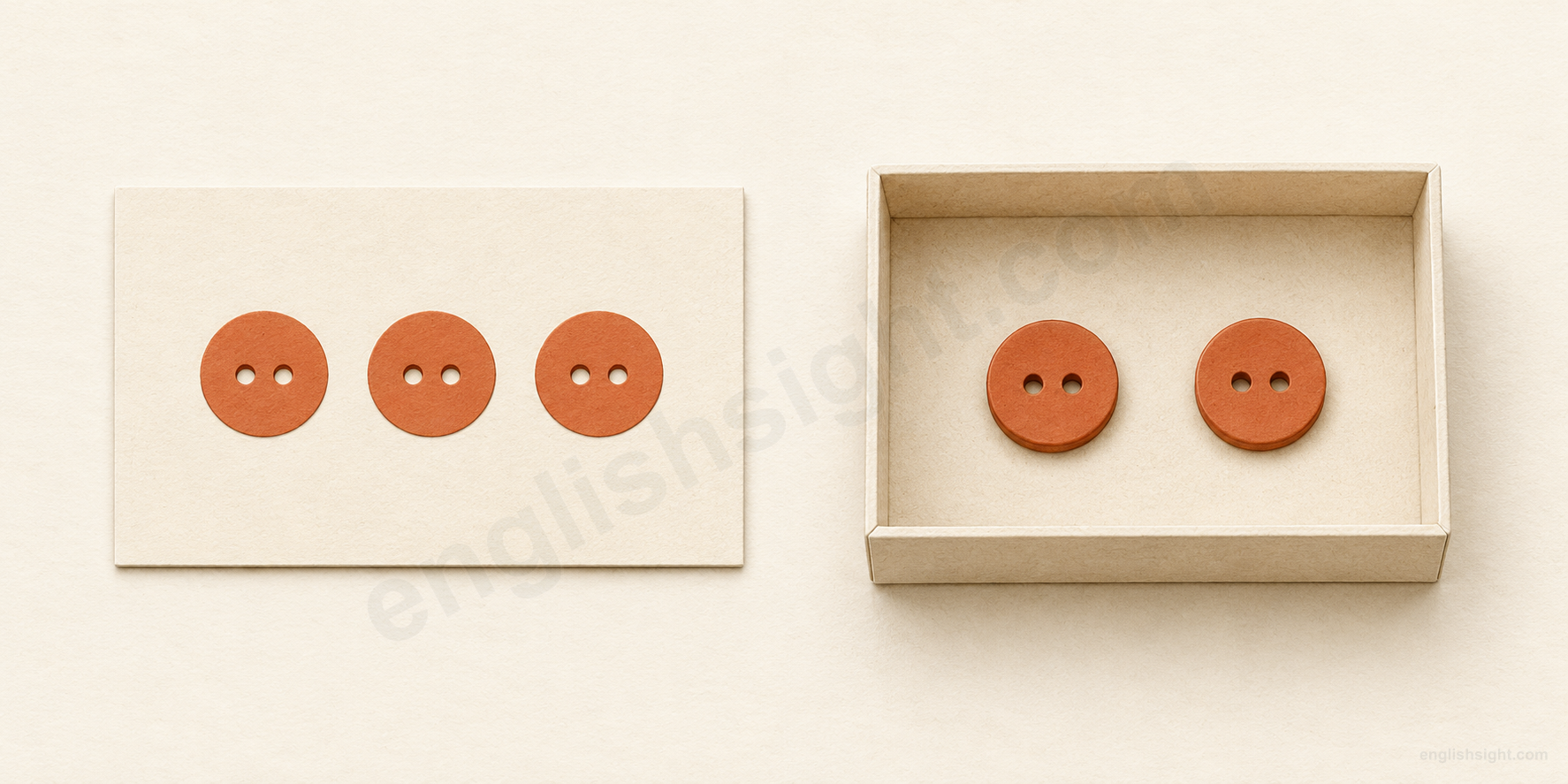
The record depicts three buttons.
false
The open box contains only two buttons.
Compare the record with the actual contents.
The record is false because it does not match the contents. The picture compares a claim with reality, not a change in quantity.
False marks a mismatch between what is stated, presented, or expected and what is true, genuine, or justified.
The diagram compares a claim with a situation; it does not show a change from three objects to two. Artificial substitutes and fixed expressions need their own explanations. False does not always imply an intention to deceive.
A statement can be false because it does not fit the facts. A beard can be false because it is manufactured rather than grown. A smile can be false because it does not express the person’s real feelings. Notice what is being compared in each use.
A useful teaching connection is a mismatch between what is stated, presented, or expected and what is true, genuine, or justified. This connection helps organize the uses; it is not a rule that predicts every expression or a picture shared by all English speakers.
01
Check claims and information
Decide whether a statement fits the facts. A mistake and a deliberate lie can both produce false information.
01
false + statement / claim; statement + be / prove / turn out to be + false
true or false; be false
not agree with the facts
Situation / expectation
A label says there are three buttons in a box.
What the expression tells us
You count only two buttons.
The statement fails the factual check; the buttons do not change.
False evaluates a statement, not the person checking it. “There are three buttons” is false when the box contains only two. This is the comparison in the diagram.
Use false before a noun or after be: a false statement; the statement is false. Proved false and turned out to be false describe what a later check establishes. In a true-or-false question, choose between two truth values.
Original example
The claim that the shop opens on Sundays turned out to be false.
Choose carefully Say You are wrong or mistaken about the hours. You are false normally criticizes sincerity, not a factual mistake.
02
false + information / report / accusation; make a false claim
false information / accusations
information or allegations that are untrue
Situation / expectation
A message wrongly says that Nina took the money.
What the expression tells us
The records show that she did not.
Untrue content need not have been invented deliberately.
False information, false reports, and false accusations concern what is communicated. False information is uncountable: some false information, not a false information.
A person may pass on a mistaken report honestly. Add knowingly or deliberately when intentional deception is part of your meaning. A false accusation says something untrue about someone; an unproven accusation has not been established and is not automatically false.
Original example
The email spread false information about the cancelled event.
Choose carefully A lie involves deliberate untruth. False alone does not establish what the speaker knew.
03
a false assumption / belief / premise; based on the false assumption that + clause
a false assumption / belief
an idea used in thinking that is mistaken
Situation / expectation
You assume the office is open every day.
What the expression tells us
Your plan fails because it closes on Tuesdays.
The error is in the premise, not necessarily in the reasoning after it.
An assumption is something you accept without checking. Calling it false rejects its content. A false belief can be sincerely held; a false premise can lead careful reasoning to an unreliable conclusion.
Use based on a false assumption to identify the starting error. False does not itself tell us whether the mistake came from poor evidence, misunderstanding, or dishonesty.
Original example
Our plan was based on the false assumption that the office opened every day.
Choose carefully Do not treat false belief as another name for pretending to believe.
04
have / form a false memory of + event; false memories
a false memory
remember an event that did not actually happen
Situation / expectation
Someone feels sure that a particular visit took place.
What the expression tells us
The remembered visit did not actually happen.
The person can sincerely remember something without the event being real.
A false memory is a memory of an event that did not occur. The term is used in psychology and in discussion of how remembering can go wrong. It concerns the relation between a recollection and events, not whether someone is consciously inventing a story.
Compare forgetting a visit: forgetting leaves you without the memory; a false memory gives you a recollection of something that did not happen. This vocabulary explanation does not offer a method for deciding whether a particular memory is accurate.
Original example
I had a false memory of visiting that house as a child, although I had never been there.
Choose carefully A false memory is not automatically a lie. Feeling certain about a memory does not define the term.
02
Identity, substitutes, and hidden construction
Something can be presented as genuine, replace a natural part, or conceal another part. These uses do not all imply wrongdoing.
05
use / give a false name; travel under a false name; a false passport
a false name / passport
an identity or document presented as genuine when it is not
Situation / expectation
Someone wants a hotel to record a different identity.
What the expression tells us
They register using an invented name.
What is presented does not match the genuine identity or document.
A false name conceals or misrepresents identity. A false passport may be fabricated or altered to appear valid. The adjective here goes beyond an accidental spelling error.
Compare a wrong address entered by mistake with a false address supplied to mislead. Context determines the intended contrast; do not call every nickname or openly used pen name a false identity.
Original example
The visitor checked in under a false name.
Choose carefully False is an adjective: a false name. Fake is also natural with a forged document, but collocations are not freely interchangeable everywhere.
06
false + teeth / eyelashes / beard
false teeth / eyelashes
manufactured substitutes for or additions to natural parts
Situation / expectation
An actor prepares for a costume scene.
What the expression tells us
The actor attaches an artificial beard.
The item resembles a natural part without being that natural part.
False teeth, false eyelashes, and a false beard name familiar manufactured substitutes or additions. They are physical objects, not statements with a truth value.
There need be no attempt to cheat: an actor can openly wear a false beard. Learn the noun pairing; artificial flowers is the usual broad description of manufactured flowers.
Original example
For the play, Ben wore a false beard.
Choose carefully False teeth are real usable objects. False here contrasts with natural teeth, not with objects that do not exist.
07
a false bottom; a false ceiling
a false bottom / ceiling
an added surface distinct from the main structural surface
Situation / expectation
A suitcase seems to end at its visible inner base.
What the expression tells us
Lifting that base reveals a compartment beneath it.
The apparent surface is not the underlying structural boundary.
A false bottom can conceal space below a visible base. A false ceiling is an additional ceiling below the main one, for example to cover pipes. The noun identifies the construction.
Concealment in a suitcase can be deceptive, but a suspended ceiling is ordinary building work. Do not transfer a judgment of dishonesty to every structural use of false.
Original example
The case had a false bottom with a small compartment beneath it.
Choose carefully Bottom and ceiling describe different surfaces; false does not mean broken or badly built.
03
Feelings, impressions, and trust
Ask what is genuine or justified: an emotion, a belief about a situation, or a relationship.
08
false + smile / enthusiasm / modesty; sound false
a false smile / false modesty
an outward display that does not reflect genuine feeling
Situation / expectation
A person dislikes the result but wants to look pleased.
What the expression tells us
They give a smile without real pleasure.
The displayed feeling and the inner feeling do not match.
A false smile, false enthusiasm, or false modesty presents a feeling or attitude that is not genuine. False modesty is pretending to be less able or less proud than you really feel.
The speaker is judging sincerity, not measuring whether a facial movement occurred. A false smile still is a smile. Describing someone as false is a strong personal criticism.
Original example
She thanked him with a false smile, still annoyed by his remark.
Choose carefully Use a false smile for the display; use smiled falsely when the adverb describes the action.
09
an apology / explanation + ring(s) false; rang false
ring false
seem unconvincing or insincere
Situation / expectation
A speaker offers a polished apology.
What the expression tells us
The listener finds it unconvincing.
This evaluates how the words strike a listener, not their sound volume.
An apology, explanation, or piece of dialogue can ring false if it does not feel believable or genuine. Ring is used figuratively; nothing needs to make a ringing noise.
The past form is rang: His explanation rang false. Compare rings true, which gives the opposite impression. An impression of insincerity is not by itself proof that every detail is factually false.
Original example
His apology rang false after he repeated the same insult.
Choose carefully Keep false as the complement in ring false; do not replace this expression with ring falsely.
10
give / create a false impression of + noun; give the false impression that + clause
give a false impression
make a situation appear different from how it really is
Situation / expectation
A tightly cropped photo hides a tiny room.
What the expression tells us
Viewers think the room is spacious.
What someone comes to believe does not fit the actual situation.
An impression is a view formed from clues. Give or create a false impression focuses on a misleading result. The photo may be genuine even though the impression it creates is wrong.
Use a false impression of size or the false impression that the room is large. The of-phrase names an aspect; a that-clause states the mistaken belief.
Original example
The wide-angle photo gave the false impression that the room was huge.
Choose carefully Misleading presentation is not always an explicitly false sentence.
11
give someone false hope; raise false hopes
give false hope; raise false hopes
encourage an expectation without a sound basis
Situation / expectation
There is no realistic chance of another place becoming available.
What the expression tells us
A vague promise makes an applicant expect admission.
The hope is felt sincerely, but the expectation lacks support.
Give someone false hope and raise false hopes warn against encouraging an unrealistic expectation. The adjective questions the basis of the hope, not whether the hopeful feeling is real.
Use I don’t want to give you false hope when explaining uncertainty carefully. False promises can create false hope, but mistaken optimism can create it too.
Original example
I don’t want to give you false hope: all the places have been filled.
Choose carefully A reasonable hope that later fails is not automatically a false hope from the beginning.
12
give someone / lull someone into a false sense of security
a false sense of security
feel safer than the situation justifies
Situation / expectation
A backup icon appears on your screen.
What the expression tells us
You feel protected, although the backup has failed.
The feeling of safety exceeds the actual protection.
The feeling is real; the safety it suggests is unreliable. Something can give you a false sense of security or lull you into one, making you less alert to danger.
In the backup example, the reassuring sign and the actual protection do not match. The phrase does not mean that all confidence is foolish or that the person deliberately deceives themselves.
Original example
The green icon gave me a false sense of security; no files had actually been saved.
Choose carefully Security here means safety or protection, not a security guard or a financial investment.
13
a false friend; false friends
a false friend
someone whose apparent friendship cannot be trusted
Situation / expectation
Someone acts supportive in front of you.
What the expression tells us
They betray your confidence elsewhere.
The appearance of friendship is not backed by trustworthy behavior.
A false friend seems to be on your side but is not dependable or loyal. This is a judgment about the relationship, not an error in the person’s name.
Compare a mistaken friend: a genuine friend can misunderstand something. False friend questions trust. The separate language-learning meaning appears later in this lesson.
Original example
I discovered that my supposed supporter was a false friend.
Choose carefully Do not call a friend false merely because they give an incorrect answer.
04
Learn the whole expression
Familiar combinations describe mistaken warnings, unsuccessful beginnings, apparent savings, and other specific situations. The noun and the established phrase matter.
14
raise a false alarm; turn out to be a false alarm
a false alarm
a warning or scare that does not correspond to a real danger
Situation / expectation
An alarm sounds and everyone leaves.
What the expression tells us
A check finds no fire.
The warning happens, but the danger it indicates is absent.
A false alarm can be an actual alarm signal or a mistaken belief that danger is imminent. It can result from an error or a deliberate hoax; the phrase alone does not decide which.
It was a false alarm is also a conversational way to close a scare: you thought your wallet was lost, then found it in another pocket. Alarm is countable here: a false alarm; several false alarms.
Original example
The smoke detector went off, but it turned out to be a false alarm.
Choose carefully A real alarm sound can be a false alarm. False does not mean that nobody heard anything.
15
make a false start; after one / several false starts
a false start
a premature or unsuccessful beginning
Situation / expectation
A runner moves before the starting signal.
What the expression tells us
The official stops the start.
Something begins, but it does not count or lead into the intended activity.
In a race, a false start occurs when a competitor starts before the signal. The phrase names an invalid beginning, not an invented race.
Outside sport, it describes an attempt that fails to get properly under way: After two false starts, we finally launched the club. The sporting and project uses share an unsuccessful beginning, but only the race sense requires an official signal.
Original example
The runner made a false start before the whistle.
Choose carefully A slow start may still be valid and successful. False start does not simply mean a slow beginning.
16
be a false economy; it is a false economy to + verb
a false economy
an apparent saving that ends up costing more
Situation / expectation
You buy a cheap cable to save money.
What the expression tells us
It fails repeatedly, and replacements cost more.
The saving disappears when the later costs are counted.
Economy here means saving resources, especially money. A false economy looks cheaper at first but creates greater expense. It criticizes the total outcome, not just the initial price.
Use It is a false economy to… to evaluate a decision. Something inexpensive is not necessarily a false economy; the phrase needs a reason why the apparent saving will not hold up.
Original example
Buying the cheapest cable was a false economy; I had to replace it three times.
Choose carefully This phrase concerns a misleading saving, not false information about a national economy.
17
gain / obtain something under false pretences (US: false pretenses)
under false pretences
obtain an advantage by misrepresenting who you are or what you intend
Situation / expectation
Someone pretends to be a repair worker.
What the expression tells us
They gain entry on that misleading basis.
Another person acts on a deliberately false presentation.
Under false pretences describes deception about identity, intentions, or the basis for an arrangement. Unlike a merely false belief, this expression normally involves misleading another person.
British spelling is pretences; American spelling is pretenses. By false pretences also occurs. The phrase is used in everyday criticism as well as legal contexts, but this lesson does not define a particular offence.
Original example
He gained access to the building under false pretences, claiming to be a repair worker.
Choose carefully Pretences is plural in this fixed expression. Learn under false pretences as a whole.
18
make a false move; one false move and + consequence
one false move
one wrong or ill-judged action with serious consequences
Situation / expectation
A delicate model is balanced near an edge.
What the expression tells us
An incautious movement could knock it down.
The action can be real while being dangerous or inappropriate.
A false move is an action that risks a bad outcome or breaks a restriction. It is often used in a warning: One false move and…. Move may be a physical movement or a decision.
The phrase evaluates the risk or suitability of an action. It does not normally mean a pretend move, and it does not require someone to tell a lie.
Original example
One false move and the whole model could fall off the table.
Choose carefully The consequence may only be possible: could fall does not assert that the model has fallen.
19
prove to be a false dawn; a false dawn for + organization / activity
a false dawn
an apparent improvement that does not develop as hoped
Situation / expectation
Sales rise briefly after months of decline.
What the expression tells us
They fall again instead of continuing to recover.
An encouraging beginning fails to bring the expected better period.
A false dawn is a formal figurative expression for a hopeful sign that does not lead to the expected improvement. It often appears in discussion of recovery, reform, or progress.
Dawn contributes the image of a new day beginning. Calling an improvement a false dawn is often a later judgment; a small improvement is not automatically false merely because it is small.
Original example
The brief rise in sales proved to be a false dawn for the company.
Choose carefully This is a figurative expression, not a description of an inaccurate clock or weather forecast.
20
A and B are false friends; a pair of false friends
false friends in two languages
similar-looking words whose meanings differ
Situation / expectation
A learner recognizes a familiar-looking foreign word.
What the expression tells us
Its actual meaning differs from the expected one.
Resemblance between word forms does not guarantee equivalent meanings.
In language learning, false friends are words in different languages that look similar but have different meanings. The “friend” metaphor suggests a misleadingly familiar form.
For example, English actual means real, whereas French actuel usually means current in everyday use. Learning this pair helps avoid a misleading translation. The term describes words, not dishonest speakers.
Original example
English actual and French actuel are false friends.
Choose carefully The human and linguistic meanings of false friend need separate contexts. Do not assume every related-looking word is misleading.
21
follow / follow up a lead; turn out to be a false lead
a false lead
a promising clue that turns out to point the wrong way
Situation / expectation
A report suggests that a lost dog was seen near a station.
What the expression tells us
The animal was a different dog, so that clue does not locate yours.
An apparent route to the truth fails when the information is checked.
A lead is information that might help you discover facts or find something. A false lead appears useful but proves misleading. You can follow up a lead before you know whether it is reliable.
Lead here is the countable noun pronounced /liːd/, not the metal /led/. In a search or investigation, false identifies a clue that does not support the hoped-for conclusion; it need not have been planted deliberately.
Original example
The sighting near the station was a false lead; it was a different dog.
Choose carefully An unchecked lead is not necessarily a false lead. False usually reflects what is discovered about its reliability.
05
Results and word forms
Distinguish a result that misclassifies something from the adverb that describes a false claim or accusation.
22
a false positive / negative; a false-positive / false-negative result
a false positive / false negative
a result that wrongly indicates presence or absence
Situation / expectation
A filter labels a legitimate message as spam.
What the expression tells us
The message has been classified incorrectly.
False evaluates the classification; positive and negative specify its direction.
A false positive indicates that a target condition is present when it is absent. A spam filter wrongly flagging a genuine message provides an everyday analogy. A false negative misses something that is actually present: the filter lets a spam message through.
These are countable nouns: a false positive; two false negatives. Before another noun, hyphens are common: a false-positive result. Positive does not mean good news, and negative does not mean bad news in this classification.
Original example
The spam filter produced a false positive by blocking a genuine message.
Choose carefully False positive and false negative are opposite error types, not two names for the same incorrect result.
23
a false accusation; be falsely accused of + noun / -ing; falsely claim / believe
falsely accused / claimed
use an adverb to describe an untrue accusation or claim
Situation / expectation
Someone is blamed for damage they did not cause.
What the expression tells us
The accusation is untrue.
False describes a noun or a state; falsely modifies an action or claim.
Compare a false accusation with someone was falsely accused of causing damage. The adjective modifies accusation; the adverb modifies accused. The passive belongs to accuse, not to false.
Falsely claimed means made an untrue claim; falsely believed means held a mistaken belief. Falsely can also describe an insincere display: smiled falsely. It does not always prove deliberate lying.
Original example
Omar was falsely accused of breaking the window.
Choose carefully Do not say was false accused. The ordinary adverb is falsely; false is not a productive everyday verb.
Choose the contrast and the grammar
False, wrong, fake, and artificial
Use wrong or mistaken for a person who has made a factual error. False commonly evaluates a claim or presentation. Fake often emphasizes something passed off as genuine; artificial emphasizes manufacture. Learn natural noun combinations rather than replacing one adjective with another everywhere.
Adjective, not an action
False normally comes before a noun or after a linking verb: false information; the story is false; the apology sounds false. It has no ordinary transitive, passive, causative, or phrasal-verb system. In give someone false hope, give supplies the action and false modifies hope.
Degree and comparison
A factual claim is often described as completely or demonstrably false. An insincere voice may sound slightly false. For comparisons, more false or less false can describe degrees of insincerity or inaccuracy; falser and falsest are recorded forms but are not needed for ordinary beginner use.
Scope and further uses
This lesson covers the modern adjective and selected established expressions, plus falsely and a few vocabulary extensions. False dawn is formal; false memory is psychology vocabulary; false positive/negative are classification terms. Literary loyalty uses such as a false lover and play someone false, specialist plant names, musical terminology, and legal compounds are not expanded here. This is a selection of common uses and useful extensions, not a frequency ranking.
Check the intended contrast
Read the situation, then choose the expression that says what you mean.
1. A friend honestly thinks the library opens at nine, but it opens at ten. What is the natural correction?
2. Someone wears false teeth. What does false mean here?
3. A detector sounds, but there is no fire. Which expression fits?
4. A cheap tool breaks so often that replacements cost more than a durable tool. What was buying it?
5. A spam filter lets an actual spam message into your inbox. Which error did it make?
6. An accusation wrongly blames Amy. Complete: Amy was ___ accused.
Sources and teaching notes
The dictionary pages below support the uses and constructions. Explanations and examples are original. The comparison between presentation and reality is a teaching model, not a dictionary claim about a single origin for all meanings.
The diagram is a teaching comparison, not a shared mental picture of all native speakers.