Talk about relatives, children, shared life, and groups of related things.
Relationships make a group
Relationships make a group
Individual members
family
One family group
Family relationships connect them.
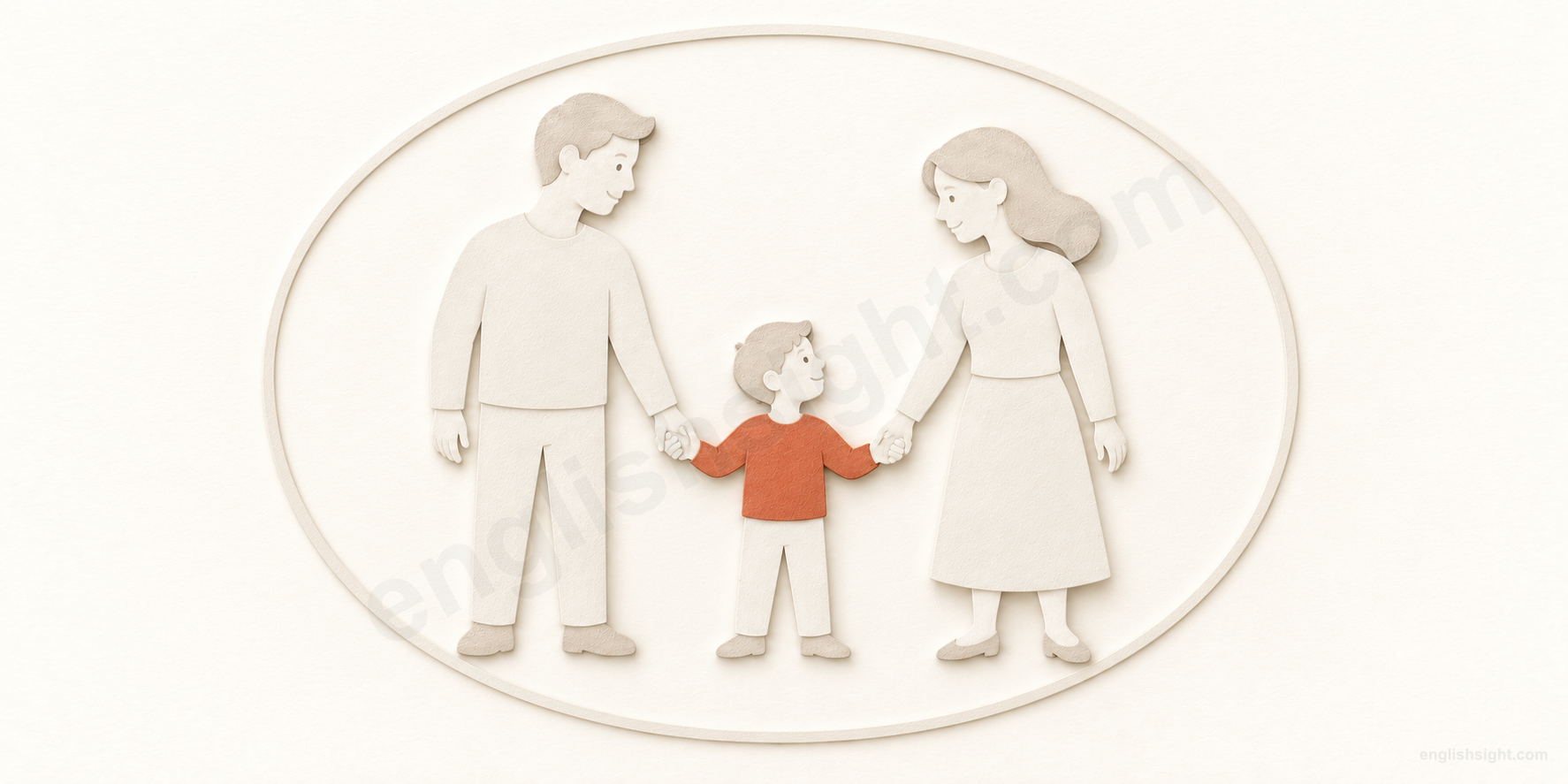
Family relationships connect the members of a group. This is one possible family.
A family is a group whose members are connected through kinship or family relationships; extended uses group people or things through shared affiliation, origin, or characteristics.
The people in the sketch illustrate one family, not a required family shape. Family relationships can involve birth, adoption, marriage, partnership, or a sense of lasting belonging. Living at one address is not necessary, and simple resemblance does not make people relatives.
Family names a group and the relationships that make its members belong together. In conversation, the intended group may be your parents and siblings, your partner and children, or a wider circle of relatives. Let the context tell you who is included.
The word also extends to close communities and related languages, living things, or products. A shared connection is a useful teaching link; each context still has its own rules.
01
Who belongs to the family?
Identify the people meant, count the group, and choose a wider or narrower circle.
01
possessive + family; a member of the family; have family + place
my family / family members
the people connected to you as a family
Situation
You arrange a visit with relatives.
What you mean
You refer to the people rather than their house.
Family names the group; member names one person within it.
My family can mean a smaller everyday group or a wider group of relatives. It does not specify an exact list without context. My aunt is a member of my family identifies one person; my aunt is my family can instead emphasize that she is the family you have or rely on.
I have family in Canada uses family without an article for relatives collectively. Does she have any family nearby? asks about relatives, not necessarily children. A family can live across several homes.
In a sentence
I have family in Leeds, so I usually stay with my aunt.
Watch the difference Say a family member or a relative for one person; a family normally means a group.
02
a family of + number; number + families
a family of four / two families
count one group or several groups
Situation
A booking form asks how many people will come.
What you mean
You describe the group’s size.
Of four counts people in one family, not four separate families.
A family of four contains four people in the group being described. Two families counts two groups. The plural spelling changes y to ies: families.
How many people are there in your family? asks about size. How many families live here? asks how many groups. In a family of five children, children narrows what the number counts; read the entire phrase.
In a sentence
We booked a table for a family of four.
Watch the difference A four-person family is possible; avoid a four persons family.
03
family + singular verb; British family + plural verb; families + plural verb
the family is / the family are
choose grammar for a group or its members
Situation
You describe what your family is doing.
What you mean
You choose an agreement pattern appropriate to the variety and viewpoint.
A singular group word can refer to several people.
The family is moving describes the family as a unit and is a safe ordinary choice, particularly in American English. In British English, my family are coming is also normal when the members are in view.
For an explicit plural in any variety, use my family members are coming. Two families are coming always has a plural subject. In careful writing, keep coordinated verbs consistent: The family is arriving and needs a taxi.
In a sentence
My family is moving to Bristol next month.
Watch the difference Do not assume family must always take are because it contains several people.
04
immediate / extended / single-parent / nuclear + family
immediate family / extended family
distinguish close relatives from a wider family circle
Situation
You decide whom to invite to a small meal.
What you mean
You distinguish the closest circle from a larger group.
Immediate and extended change the scope of the group.
Immediate family usually includes parents, siblings, a spouse, and children. Extended family can include grandparents, aunts, uncles, cousins, and a broader circle. The phrase can describe an extended household or relatives living separately.
These are useful everyday distinctions, not one universal list for every situation. Single-parent family describes a family with one parent raising children; it does not mean one person without relatives. Nuclear family is the narrower parents-and-children unit, unlike the wider extended circle.
In a sentence
Only our immediate family came to dinner; our cousins will visit next week.
Watch the difference Extended family does not mean a physically bigger house.
02
Children, ancestry, and shared life
The accompanying verb or noun shows whether you mean parenting, family history, ownership, or suitability.
05
have a family; start a family
have a family / start a family
have children or begin becoming a parent
Situation
Someone discusses plans for parenthood.
What you mean
Family specifically refers to children.
The parenting context narrows family to children.
Start a family conventionally means begin having children, especially a first child. It does not normally mean merely move into a house or get married. Have a family can also mean have children; the surrounding conversation determines that reading.
Compare Do you have any family in town?, which asks about relatives. The children-related expression is a conventional use, not a claim that people without children cannot be a family.
In a sentence
They hope to start a family after they finish their training.
Watch the difference Do not automatically interpret every have family as have children.
06
raise / bring up / support + a family
raise / bring up / support a family
care for children or provide for the family group
Situation
A parent talks about care and expenses over many years.
What you mean
The verb tells you what responsibility is involved.
Raising concerns upbringing; supporting often concerns material needs.
Raise a family and bring up a family describe bringing children through childhood. Support a family often means earn or provide what the household needs; support can also be emotional when context makes that clear.
The action comes from raise, bring up, or support, while family supplies the people. These are verb–noun combinations, not phrasal verbs built from family. Compare start a family, which focuses on the beginning rather than years of care.
In a sentence
She worked evenings to support her family while the children were young.
Watch the difference Support a family does not by itself say how many children there are.
07
come from + a family of + plural noun; on someone’s side of the family; marry into + a family
come from a family / on my mother’s side
describe background and branches of relatives
Situation
You explain your relatives’ history.
What you mean
The listener learns your family background.
Family can reach back across generations.
Come from a family of teachers describes your background, not a journey out of a building. My mother’s side of the family selects relatives connected through your mother; my father’s side selects the other branch.
Marry into a family means become part of that family through marriage. A family history records what happened across generations; in a health conversation, a family history of a condition refers to its occurrence among relatives.
In a sentence
There are several musicians on my mother’s side of the family.
Watch the difference Side means a branch of relatives here, not the left or right side of a room.
08
draw / trace / research + a family tree
family tree
show family relationships across generations
Situation
You connect names in a chart of relatives.
What you mean
The chart records who is related to whom.
Branches represent relationships, not physical movement.
A family tree can be the diagram or the ancestry it records. It connects generations and branches so you can trace relationships. Draw a family tree names the chart; research your family tree names the investigation of your ancestry.
A family photo simply shows people, often at one moment. It does not necessarily tell you their relationships. The word tree supplies the branching metaphor; family tells you what the branches represent.
In a sentence
We added my grandfather’s sisters to our family tree.
Watch the difference A family tree does not need to be drawn in the shape of a real tree.
09
family name; given name and family name
family name
the surname, as distinct from a given name
Situation
A form asks you to separate parts of your name.
What you mean
You enter the surname in the appropriate field.
Family name identifies a type of name, not every name used in a family.
Family name means surname. On a form it contrasts with given name or first name. The term is useful when name order differs: a family name is not necessarily the last part of a person’s full name.
Members of one family may have different surnames. Conversely, sharing a surname does not establish that two people belong to the same family.
In a sentence
Please write your family name in the upper box.
Watch the difference Do not infer surname position from the word family.
10
family + life / reunion / gathering / relationships / doctor
family life / a family reunion
describe activities, relationships, and occasions involving a family
Situation
Relatives arrange to meet after years apart.
What you mean
The event brings family members together.
Before a noun, family says what people or relationships it concerns.
Family life concerns life with and among family members. A family reunion is an occasion when relatives meet again; a family gathering is a broader expression for getting together.
In these combinations, family is a modifier before the main noun. Dictionaries may label this an adjective or a noun used as a modifier. The head noun tells you whether you mean an event, a relationship, or everyday life.
A family doctor is a doctor a family regularly consults. Our family doctor knows our medical history identifies that professional relationship; it does not mean a relative who happens to be a doctor.
In a sentence
We are planning a family reunion for the summer.
Watch the difference Family life means shared personal life; the family’s lives refers to the lives of its members.
11
the family + business / home / car; family-owned / family-run + noun
the family business / the family home
something belonging to or associated with a particular family
Situation
A shop has been owned by relatives for years.
What you mean
You identify its connection with that family.
Here family marks ownership or association, not the customer group.
The family business usually means the business owned or run by that family. The family home is the home associated with them. A family-owned business makes the ownership relation explicit; a family-run business emphasizes management.
A family restaurant can instead mean a restaurant suitable for parents and children. It need not be owned by one family. Read the noun and the situation rather than assigning one meaning to every family modifier.
In a sentence
After college, Nora joined the family business.
Watch the difference The family’s business is also possible; the family business uses family as a modifier without an apostrophe.
12
family + film / entertainment; for the whole family; family-friendly + noun
a family film / for the whole family
suitable for adults and children together
Situation
You choose an activity for people of different ages.
What you mean
You describe who can enjoy it.
Suitability is different from being about or owned by a family.
A family film or family entertainment is presented as suitable for adults and children. A film about a family may have adult themes; its subject alone does not make it a family film.
For the whole family explicitly includes the members together. Family-friendly is a common compound with a similar suitability meaning. These descriptions guide the intended audience; they are not a guarantee that every individual will enjoy the activity.
In a sentence
The museum has a weekend activity for the whole family.
Watch the difference A family ticket is a ticket package for a family group; check the stated numbers rather than assuming a fixed family size.
03
Belonging and established expressions
Some expressions extend family relationships; others have a fixed meaning that must be learned as a whole.
13
be family; be / feel like family; treat someone like family
be family / like family
state family belonging or compare a close relationship to it
Situation
A long-standing friend is included in intimate everyday life.
What you mean
You describe a strong sense of belonging.
The comparison can extend beyond relatives.
We’re family states a family relationship or a strong sense that the people belong together. She’s like family makes the comparison explicit: she is treated with the closeness associated with family, even if she is not a relative.
A church family or a team that feels like a family extends the group idea through affiliation and closeness. The expression describes the speaker’s attitude; it does not prove legal kinship or guarantee that every member feels the same way.
In a sentence
We are not related, but Maya feels like family to me.
Watch the difference She is a friend of the family means she is a friend connected to the family; it does not make her a relative.
14
in + the / possessive + family; stay in the family; keep something in the family
in the family / stay in the family
within a family group or its possession
Situation
A ring passes from one relative to another.
What you mean
It remains connected with the same family.
In describes membership or continued possession, depending on the subject.
Someone in the family means a person who belongs to the group: There is a teacher in the family. A ring that has been in the family for years has been owned by members of that family over time.
Stay in the family or keep something in the family can describe retaining an object or business among relatives. With private information, keep it in the family asks people not to share it outside the family circle. The object and context identify whether possession or knowledge is being restricted.
In a sentence
This ring has been in our family for three generations.
Watch the difference In our family does not necessarily mean inside our home.
15
characteristic + run(s) in + the / possessive + family
run in the family
a feature recurs among relatives across generations
Situation
Several generations show a similar characteristic.
What you mean
You describe the repeated family pattern.
The trait is the subject; the people are not physically running.
A characteristic that runs in the family appears among family members in different generations. A sense of humor, a skill, or a physical feature can be described this way. The expression itself does not establish why the similarity occurs.
The verb agrees with the characteristic: a sense of humor runs, but dimples run. In It runs in the family, it refers back to the characteristic or tendency already mentioned.
In a sentence
A love of gardening runs in our family.
Watch the difference Learn the full expression; run here means recur, not move quickly on foot.
04
Families beyond people
Related things can form a family too. The type of relationship depends on the subject.
16
a family of + plural things; product family
a family of products
a group of related things
Situation
A company introduces several related devices.
What you mean
You treat the models as one connected range.
The members are things linked by design or other shared features.
A family of products or devices groups related models. The connection may be a common design, purpose, technology, or manufacturer. Family contributes the grouping idea; the context tells you the actual basis.
The manufacturer’s family of printers groups products. A printer for the family describes intended users. These two constructions answer different questions.
In a sentence
The new camera belongs to a family of compact travel cameras.
Watch the difference A product family is not a family that has bought the product.
17
the + animal / plant + family; belong to + a family
the cat family / the rose family
a biological group containing related kinds of organisms
Situation
You read a nature guide.
What you mean
Family identifies a classification group.
A biological family is not necessarily a parent and its young.
In biology, family is a classification rank above genus and below order. The cat family includes different related species, not just a pet cat and her kittens. Plant families use the same classification sense.
Compare a family of foxes seen near a den: in an everyday wildlife story this may mean parents and young. The classification term and the everyday social group are different readings.
In a sentence
Domestic cats and leopards belong to the cat family.
Watch the difference Family and species are different ranks; not all animals in one family belong to one species.
18
language family; word family; belong to + a family
a language family / a word family
group languages by origin or words by their relationship
Situation
You compare languages and related word forms.
What you mean
You specify what kind of linguistic relationship you mean.
Languages and words form different kinds of family.
A language family groups languages with a common ancestral source. It does not simply mean languages spoken in the same country or written with the same alphabet.
A word family groups related words within a language. Help, helpful, and helpless form a useful learner’s example: the word forms are related but have different grammatical jobs and meanings. A language family groups whole languages, while a word family groups words.
In a sentence
Finnish and Hungarian belong to the same language family.
Watch the difference Similarity in a few words alone does not establish that languages belong to the same family.
Keep the group and the context in view
Family, relative, household, and home
A family usually emphasizes relationships; a relative is one related person. A household groups people by living arrangements and may include unrelated housemates. Family can also mean the people living together as one household, so the words overlap in some contexts; living together alone does not necessarily make housemates relatives. Home usually names a place or the life associated with it. Say I miss my family for people and I miss home for the place or familiar life.
Forms and pronunciation
The plural is families. One group has a family’s history; several groups have families’ histories. Pronunciations commonly have either two syllables or three, with stress at the beginning. Family is mainly a noun and also works before another noun; it is not an ordinary verb, so tense, passive, causative, and phrasal-verb paradigms do not apply.
A useful connection has limits
The grouping idea helps connect the uses but does not tell you every expression’s meaning. Family does not guarantee kindness or harmony. Nor does family entertainment describe who owns the cinema. Specialist mathematical families, chemical groupings, crime families, and historical servant or staff senses are outside the main lesson.
An older expression to recognize
In the family way means pregnant in older informal usage. It may occur in older stories; pregnant or expecting a baby is clearer neutral wording today. It is unrelated to how a particular family normally does things.
Choose the intended connection
Use the whole expression and its context.
1. Two parents and two children travel together. Which phrase counts all four people as one group?
2. In a conversation about having a first child, what does start a family usually mean?
3. A shop is owned by relatives but sells equipment only for professional adults. Which description identifies ownership?
4. Three generations enjoy growing vegetables. What does Gardening runs in our family communicate?
5. A guide says two different species belong to the cat family. What does family mean here?
Sources and teaching notes
Dictionary entries below support the meanings and usage notes. The explanations, examples, practice questions, and visual model were created for this lesson.
The picture is a teaching model of relationships, not an image shared by every English speaker.