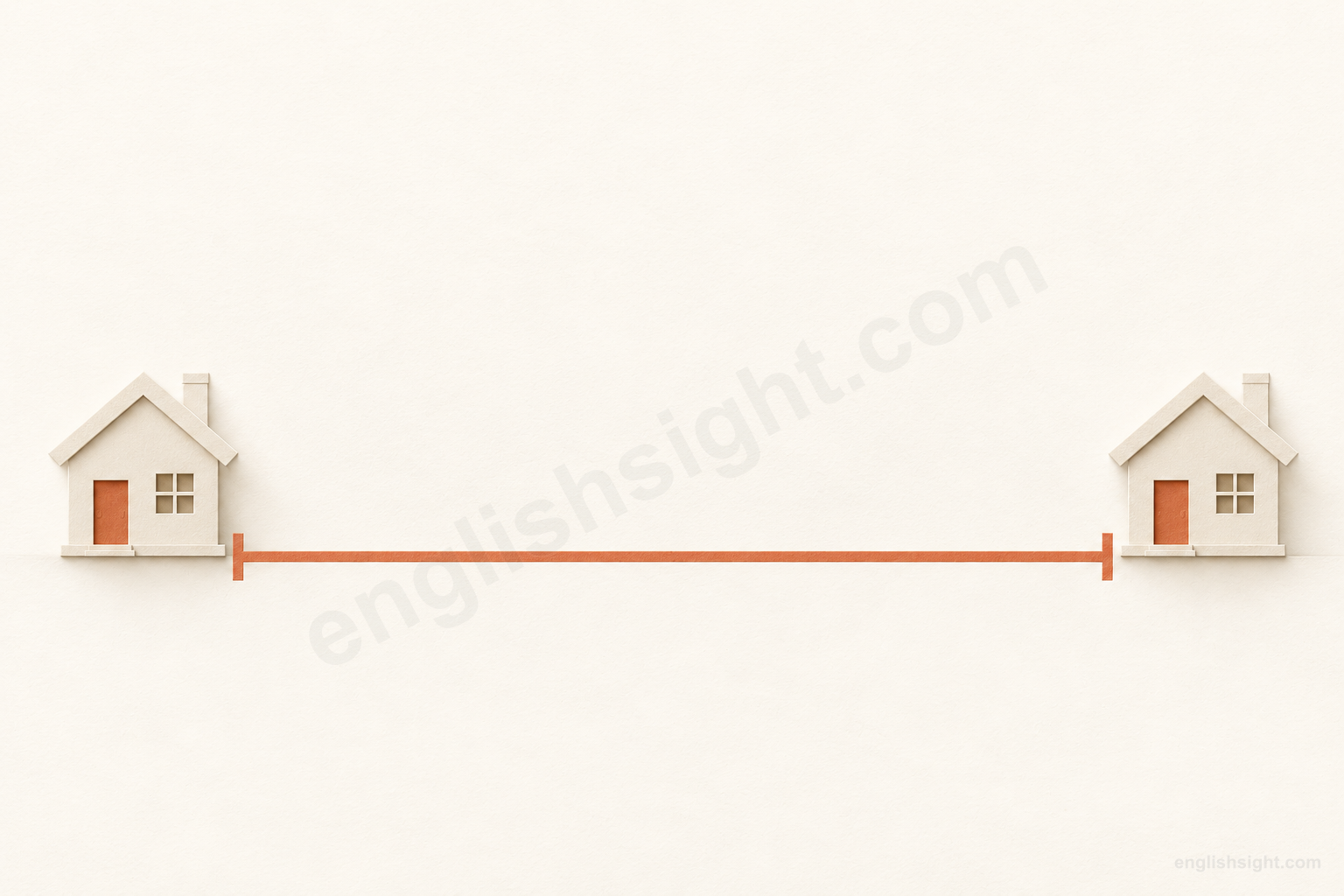
Use far for distance, degree, progress, and the limits of a claim.
Separation needs a reference
Separation needs a reference
Reference place
far
Distant place
A large distance separates the two places.
The long marker shows separation from the reference place; neither house moves.
Far commonly places something at a large distance from a reference point; related constructions measure reach on physical or abstract scales.
The sketch shows a static distance, not a journey or a before-and-after change. Questions, endpoint constructions, and fixed phrases may specify a reach without asserting a large distance.
Far often describes a large interval from a reference point: a distant place, a remote time, or a large difference on a scale. In how far and as far as, it can ask about or set a reach without saying that the interval is large.
The distance model helps connect many uses. Established phrases such as so far, far from it, and a far cry from still need their own grammar and context. This is a teaching model, not a claim that all English speakers share one mental picture.
01
Distance, position, and forms
Start with a reference place, then distinguish a distance question, a route’s endpoint, and the more distant part of an object.
01
be / travel + far (away); far from + place; far + directional expression
far away / far from here
locate something at a large distance
Situation / reference
You use your home as a reference.
Meaning / reach
The village is a long distance from it.
Far describes separation; no journey has to occur.
Far can describe where something is, or how much distance someone travels. Away emphasizes separation; from names the reference place. The reference may be supplied by the conversation: Is it far?
In ordinary affirmative statements, a long way is often more natural than bare far: We walked a long way. Far is especially natural in questions, negatives, and combinations such as far away, very far, and too far. This is a usage preference, not a ban on affirmative far.
Far can modify a direction or relation: far above the valley, far below us, far apart, or far from home. Two things can remain far apart without moving.
In a sentence
The village is far away, but the station is not far from our house.
Watch the difference Say far from here, not far of here. Far away from here is also possible.
02
how far + be / do / can + subject …?
How far is it?
ask about distance without assuming it is large
Situation / reference
You need to decide whether to walk.
Meaning / reach
You ask for the distance to the museum.
How far asks for a measure, not necessarily a distant place.
Use How far is it from A to B? or How far is B from A? The answer may be a short distance. How far did you walk? asks about distance traveled.
Compare How long does it take? That asks about time. Someone may answer a distance question with a walking time in conversation, but the questions have different literal targets.
In a sentence
How far is the museum from the station?
Watch the difference Do not use how much far. How much farther asks how much additional distance remains.
03
too far (for someone) to + verb; far enough; so / that / this far
too far / far enough / that far
judge distance against a purpose or reference
Situation / reference
A child can manage only a short walk.
Meaning / reach
The beach is beyond a comfortable walking distance.
Too and enough supply the practical limit; far supplies distance.
Too far to walk means the distance exceeds what is suitable for walking in that situation. Far enough means the required distance has been reached: Move the chair far enough away from the heater.
So far and that far can refer to a stated or demonstrated distance: I cannot throw that far. Here so far does not mean until now; the context is spatial.
In a sentence
The beach is too far for the children to walk.
Watch the difference Say far enough, not enough far. Too far expresses excess; very far only emphasizes distance.
04
go / walk / stretch + as far as + place; as far as the eye can see
as far as the bridge
state the point that a route or view reaches
Situation / reference
Your route continues beside the river.
Meaning / reach
The bridge marks the end of this part of the walk.
As far as identifies a reach or endpoint, not movement past it.
With a place, as far as means up to that place. It does not by itself say what happens afterward. Walk as far as the bridge can be an instruction to reach the bridge before doing something else.
As far as the eye can see describes the full visible reach of a landscape: Snow covered the fields as far as the eye could see. The subject need not be moving.
In a sentence
We walked as far as the bridge and then turned back.
Watch the difference Do not confuse as far as the bridge with far beyond the bridge, which places something past it.
05
the far + side / end / corner + of + noun
the far side / end
identify the more distant part of a place or object
Situation / reference
You are standing at one end of a room.
Meaning / reach
You point to the end away from you.
Adjective far selects a part by its position relative to a viewpoint.
Before a noun, far can identify the more distant side, end, corner, wall, or similar part. The far side of a small table can be only a short distance away: the choice is relative, not necessarily a claim of many kilometres.
In The station is far from here, far follows is as an adverb of distance. For an ordinary noun description use a distant town or a faraway town; a far town is not the neutral everyday pattern taught here.
In a sentence
Your bag is on the far side of the table.
Watch the difference The far side depends on the viewpoint; it is not a permanent name for the right or left side.
06
the far north / south; on / at the far left / right; far-left / far-right + noun
the far north / far left
identify an extreme part of an area or scale
Situation / reference
You describe a region of a country.
Meaning / reach
You select its northernmost area.
Far can mark an outer position along a named direction.
The far north and the far south refer to extreme regions in those directions. In a photograph, on the far left selects the outermost left position, rather than saying the person is a long way from the camera.
The far left and the far right also name political extremes. A far-right party is described by its politics, not by where its members sit in a photograph. The full context determines whether the scale is physical or political.
In a sentence
My aunt lives in the far north of the country.
Watch the difference Distinguish far north, an area, from far to the north, which locates something a long distance north of a reference point.
07
far → farther / further → farthest / furthest
farther / further; farthest / furthest
compare distances and choose the appropriate form
Situation / reference
Two stops are at different distances.
Meaning / reach
One requires more travel than the other.
The comparative and superlative forms are irregular.
For physical distance, farther and further are both standard, as are farthest and furthest. Further is especially common in British English; farther is often chosen for physical distance in American English. This is not an absolute regional rule.
For abstract extent, further is normally preferred: discuss the matter further. Further also means additional in further information; farther does not have that use. These related uses are not separate distance measurements.
In a sentence
The next stop is farther away than I thought.
Watch the difference Do not form more far or the most far. Use further information, not farther information.
02
Distance in time and the present endpoint
Far can locate remote times. The established expression so far instead reports what is true up to the current point.
08
far back (in time); far ahead; far into + period; far in advance; as far back as + date
far back / far ahead / far into the night
describe temporal distance or a late point in a period
Situation / reference
You are discussing events across a long period.
Meaning / reach
You locate an event well before or after a reference time.
Time can be treated as an interval measured from a reference point.
Far back in time points to the distant past; far ahead or far into the future points forward from a reference time. Something can also be not far off, meaning it is coming soon: The holidays are not far off. As far back as + a date highlights how early something happened: They were using this method as far back as 1920.
Far into the night describes reaching a late part of the night. It measures how deep into a period an activity continues, not how far a person walks. Far in advance means a long time before an event.
In a sentence
We talked far into the night.
Watch the difference Far is about separation or extent in time here; for an activity’s duration, a long time is often the direct choice.
09
so far + clause; present perfect + so far; so far, so good
so far / so far, so good
report the situation up to the present point
Situation / reference
A project is still underway.
Meaning / reach
You report its results up to now.
The endpoint is now, with later developments left open.
So far means up to now or up to the current point in a story. Present perfect is common for accumulated results: We have received three replies so far. A present-state sentence is also possible: So far, everything is fine. Thus far is a more formal alternative.
So far, so good is a conversational assessment that things are going well up to this point, while the process continues. It is not a guarantee about the final result.
In a sentence
We have tested four rooms so far, and all of them are quiet.
Watch the difference Distinguish so far meaning until now from I cannot walk so far, where it refers to distance.
03
Large differences and degrees
A physical interval offers a useful teaching analogy for a difference on a scale. The comparative, preposition, or main verb determines which scale is involved.
10
far + comparative adjective / adverb; far more / less / fewer + noun
far better / far more
emphasize a large difference in a comparison
Situation / reference
You compare two possible routes.
Meaning / reach
One is much easier than the other.
Far increases the size of a comparative difference.
Far can strengthen a comparative adjective or adverb: far cheaper, far less useful, far more carefully. The comparison may be stated with than or understood from context.
It does not replace very before an ordinary positive adjective: very useful is natural; far useful is not. Far more useful has the comparative more, which makes far possible.
In a sentence
This route is far safer than the road through the tunnel.
Watch the difference Use far better or much better, not very better. Far does not simply mean very in every position.
11
far too + adjective / adverb; far too much / many + noun
far too much / far too expensive
emphasize how greatly something exceeds an acceptable level
Situation / reference
You need a small amount of glue.
Meaning / reach
Someone has used much more than necessary.
Too sets an excessive level; far emphasizes the excess.
Far too expensive means much more expensive than is acceptable or affordable. Far too much and far too many emphasize an excessive amount or number.
Compare far more glue, which describes a large comparison without necessarily judging the amount excessive. The judgment of excess comes from too.
In a sentence
You have put far too much glue on that piece.
Watch the difference Match much with an uncountable noun and many with a plural count noun: far too much glue, far too many labels.
12
by far / far and away + comparative or superlative; superlative + by far
by far / far and away
emphasize a large margin in a comparison or ranking
Situation / reference
You compare all the available rooms.
Meaning / reach
One is clearly the quietest.
The whole phrase emphasizes the margin separating the leading item.
By far is especially useful with a superlative: by far the easiest option or the easiest option by far. Far and away can similarly emphasize a clear lead: far and away the best.
Both by far and far and away can also strengthen comparatives: Of the two rooms, this is by far the quieter. This room is far and away better than the other one. For a simple comparison, far quieter than is another natural choice.
In a sentence
This is by far the quietest room in the building.
Watch the difference Keep the superlative structure: by far the best, not by far best.
13
far beyond / behind / ahead of + reference; far exceed / outweigh; far removed from
far beyond / far behind
describe a large gap relative to a standard or position
Situation / reference
A team has a target.
Meaning / reach
Its result exceeds the target by a large amount.
Beyond, behind, and the verb specify the relation; far supplies magnitude.
Far beyond expectations describes a result well past what was expected. Far behind schedule describes a large shortfall in progress. Far ahead of the others can describe a literal lead or better performance.
With some verbs, far directly emphasizes magnitude: Costs far exceed our budget; The advantages far outweigh the drawbacks. Far removed from reality describes a large separation in character or relevance, rather than a physical journey.
In a sentence
Repair costs far exceed our budget.
Watch the difference Far is not a general modifier for any verb: choose established combinations such as far exceed, rather than I far like it.
14
how far + clause; as far as possible; as far as + subject + can
How far can we…? / as far as possible
ask or state the extent of an ability or claim
Situation / reference
You have some information but need to judge its reach.
Meaning / reach
You ask how much reliance it deserves.
An abstract scale replaces a physical distance.
How far can we trust these figures? asks to what extent they are reliable. It does not ask where the figures travel. The main verb tells you which ability, truth, or possibility is being measured.
As far as possible means to the greatest extent that circumstances allow: Keep the discussion informal as far as possible. It sets a practical scope rather than guaranteeing complete success.
In a sentence
How far can we rely on these early results?
Watch the difference As far as possible and as soon as possible have different scales: extent versus time.
04
Limits of knowledge, opinion, and relevance
These expressions define the reach of a claim. Learn the whole construction: personal opinion, limited knowledge, and a topic boundary are different functions.
15
as far as + subject + know / can remember / can see / can tell, + clause
as far as I know / can tell
mark the limits of your information
Situation / reference
You have checked what you can.
Meaning / reach
You give an answer that could change with new facts.
Your knowledge is the boundary of the claim.
As far as I know says that a statement matches the information available to you. As far as I can remember limits it to your memory; as far as I can tell limits it to what you can work out.
The phrase does not say the statement is probably false. It qualifies the basis of the answer. Compare I know that…, which directly asserts knowledge without this explicit boundary.
In a sentence
As far as I know, the library is open on Sundays.
Watch the difference As far as I can see can refer to judgment, not just literal eyesight.
16
as / so far as + person + be concerned, + clause
as far as I am concerned
state your own position on a matter
Situation / reference
People disagree about a decision.
Meaning / reach
You make your own stance clear.
Concerned marks your standpoint here, not necessarily anxiety.
As far as I am concerned introduces your personal view or the decision you would accept. It can sound firm: you are defining your own position, not merely reporting uncertain information.
Compare as far as I know, which limits a factual claim to your knowledge. Neither phrase can freely replace the other: an opinion and an information limit do different jobs.
In a sentence
As far as I am concerned, the matter is closed.
Watch the difference Concerned here does not mean worried; the phrase concerns your stance.
17
as / so far as + topic + be concerned / go
as far as the price is concerned / goes
restrict a statement to one aspect
Situation / reference
You are evaluating several features.
Meaning / reach
You comment only on the price.
The named topic sets the scope of the evaluation.
As far as X is concerned and as far as X goes mean regarding that topic or aspect. A product may be fine as far as the price is concerned while still being unsuitable in another way.
With I am concerned, the phrase often gives a personal opinion. With the price is concerned, it usually identifies an aspect under discussion. The same structure has related but distinct conversational uses.
In a sentence
As far as the price goes, this chair is a good choice.
Watch the difference Use goes with a singular topic and go with a plural one: as far as the chairs go.
18
adjective + as far as it goes; verb + only so far
as far as it goes / only so far
acknowledge value while marking a limit
Situation / reference
A guide covers basic repairs.
Meaning / reach
You acknowledge its value but need more detail.
A useful reach can still fall short of what is needed.
Good as far as it goes means useful within its limited coverage, often implying that something important is missing. It is a qualified compliment, not complete approval.
Only so far also limits extent: I trust the software only so far means there are limits to that trust. This is different from so far meaning until now.
In a sentence
The guide is useful as far as it goes, but it says nothing about safety.
Watch the difference Do not read as far as it goes here as a literal route ending at a location.
19
insofar as / in so far as + clause
insofar as / in so far as
state the degree or condition under which a claim holds
Situation / reference
You need to qualify a formal assessment.
Meaning / reach
You limit the claim to a particular respect.
This formal connector introduces a qualification.
Insofar as and in so far as mean to the extent that. They link clauses, often in formal discussion or writing. In as far as is another recorded form, but insofar as is a useful form to recognize first.
The qualification may explain why a claim is true within a certain scope. It is not the same as as far as + place, which gives a spatial endpoint.
In a sentence
The plan is useful insofar as it gives us a clear starting point.
Watch the difference Keep the final as before the clause; this is a connector, not a standalone adverb meaning very far.
05
Progress, resources, and reasonable limits
Far measures the reach of a task, a resource, or an action. The whole expression tells you whether that reach is successful, insufficient, or excessive.
20
how far + get with + task; get as far as + noun / -ing; come this far
get this far / as far as checking
describe the stage a task has reached
Situation / reference
A report has several stages.
Meaning / reach
You have reached the checking stage but have not written the summary.
Progress can be measured as reach along a task.
How far have you got with the report? asks what stage you have reached. Get as far as + noun or -ing names a stage: We got as far as checking the figures. The task may have more stages afterward.
We have come a long way and We have come this far can describe achievement without literal travel. Get and come supply the idea of reaching; far measures the extent of progress.
In a sentence
We have got as far as checking the figures, but we have not written the summary.
Watch the difference After the prepositional as far as in this pattern, use checking, not to check.
21
person + will / should / can + go far
go far
predict success
Situation / reference
A new colleague shows ability and persistence.
Meaning / reach
You expect her to achieve a lot.
The whole expression uses progress as a metaphor for success.
When someone will go far, the prediction is that they will succeed or achieve a great deal. There need be no travel or named destination.
Context separates this idiom from literal go far: We will not go far today can simply describe a short trip. With a person’s talent or future, the success reading is natural.
In a sentence
With that patience and curiosity, Maya will go far.
Watch the difference This is an established expression; do not interpret every instance of go far as career success.
22
money / supplies + not go (very) far; make + resource + go further
money / supplies do not go far
say that an amount covers little of what is needed
Situation / reference
You have a small food budget.
Meaning / reach
It will buy only a limited amount.
The resource’s reach is its purchasing or supplying capacity.
Money that does not go far buys little relative to prices or needs. Supplies that will not go far will serve too few people or last too briefly for the demand.
The money or supply is the grammatical subject. It is not literally traveling. Compare make the money go further, meaning use it so that it covers more needs.
In a sentence
One loaf will not go very far among twelve hungry people.
Watch the difference Do not confuse will not go far, insufficient coverage, with will go far, a prediction of a person’s success.
23
measure / action + not go far enough; do these measures go far enough?
not go far enough
say that a measure is insufficient
Situation / reference
A new policy tackles only one part of a problem.
Meaning / reach
You judge that it needs to do more.
Enough supplies the required level of action or effect.
A rule, reform, or proposal that does not go far enough fails to achieve the extent of change that is needed. It may still be helpful; the criticism is that its reach is insufficient.
This differs from not go far with money or supplies: here you evaluate a measure against a desired result, rather than how much a resource can buy or provide.
In a sentence
The new rule helps, but it does not go far enough to protect smaller shops.
Watch the difference Not far enough means insufficient; too far means excessive. They are opposite judgments about a limit.
24
go too far; take / carry + something + too far; go far enough
go too far / take something too far
say that behavior exceeds a reasonable limit
Situation / reference
A joke begins as friendly teasing.
Meaning / reach
It becomes hurtful.
The limit is social or practical rather than geographical.
Go too far judges behavior as excessive or unacceptable. Take something too far and carry something too far mean continuing or developing an action beyond a reasonable point.
The joke has gone far enough can be a warning to stop. In that context enough signals that further continuation is unwelcome; it is not praise for achieving a useful goal.
In a sentence
You took the joke too far when you mentioned her family.
Watch the difference Take it too far is natural with a pronoun between take and too far. This is an extent complement, not a separable particle verb far.
25
go so / as far as to + verb; would not go that far
go so far as to / would not go that far
mark an extreme action or a limit on agreement
Situation / reference
Someone suggests that a mistake proves dishonesty.
Meaning / reach
You refuse to make that strong a claim.
The phrase marks how far a person is willing to act or assert.
Go so far as to do something and go as far as to do something introduce an extreme or surprising step. The to-infinitive names that step: She went so far as to cancel the whole event.
I would not go that far can reject the strength of a previous claim without rejecting everything said. I would not go as far as to call it a failure leaves room for criticism short of that label.
In a sentence
I would not go as far as to call the plan useless.
Watch the difference Distinguish this to-infinitive pattern from get as far as checking, which names a stage with an -ing form.
06
Established phrases and conversational meanings
Keep the fixed wording and the context together. These uses cannot all be predicted by replacing far with a long distance.
26
be far from + adjective / noun / -ing; far from + -ing, + clause
far from ready / far from helping
strongly deny a description or expected effect
Situation / reference
You expected a report to be ready.
Meaning / reach
It still needs substantial work.
The state or effect is well away from what the complement names.
Far from ready means nowhere near ready. Far from perfect means there are significant imperfections; it need not mean completely bad. The precise opposite depends on the adjective and context.
Far from + -ing can reject an expected effect and introduce a contrasting one: Far from helping, the delay made things worse. From is a preposition, so use helping. This is distinct from a literal place after far from, as in far from home.
In a sentence
Far from saving time, the new form created extra work.
Watch the difference Say far from being ready, not far from to be ready. Do not assume far from + adjective always asserts its exact logical opposite.
27
statement / question → Far from it.
Far from it.
firmly reject an idea just mentioned
Situation / reference
A friend thinks you disliked the meal.
Meaning / reach
You reply that the opposite is true.
It refers back to the previous idea, not a location.
Far from it is a conversational reply rejecting a statement or implication strongly. It often introduces a positive opposite after a negative assumption, but it can reject other assumptions too.
The pronoun it stands for the idea under discussion. The phrase does not need a new adjective after it because the previous turn supplies the content.
In a sentence
“Was the meal disappointing?” “Far from it. I loved every bite.”
Watch the difference Far from here gives a place relation; Far from it here rejects a prior claim.
28
be a far cry from + noun / -ing
a far cry from
describe a striking difference
Situation / reference
You compare an old workspace with a new one.
Meaning / reach
You emphasize how different the new conditions are.
This fixed noun phrase expresses difference in experience or character.
A far cry from compares two situations, standards, or experiences and highlights a large difference. It can describe an improvement or a disappointment; the surrounding context supplies that judgment.
Cry is part of the established expression. Nobody has to shout or weep. The comparison uses from, followed by the thing being used as a reference.
In a sentence
This bright studio is a far cry from our old windowless office.
Watch the difference Keep a and from: a far cry from, not far cry than.
29
plural noun + be + few and far between
few and far between
say that examples or opportunities are scarce
Situation / reference
You have been seeking affordable rooms.
Meaning / reach
Only an occasional suitable room appears.
The whole phrase combines small numbers with large gaps.
Few and far between describes things that are rare or occur infrequently. It can describe affordable rooms, job offers, buses, or similar items and events.
It does not merely say that several objects are physically spaced out. Good offers are few and far between means that finding one is unusual.
In a sentence
Affordable rooms near the station are few and far between.
Watch the difference Keep and in the fixed expression; far between by itself is not this idiom.
30
search / spread + far and wide; come + from near and far
far and wide / from near and far
describe a broad geographical spread
Situation / reference
People search beyond their own neighborhood.
Meaning / reach
The search covers a large area.
These fixed pairs describe geographical reach or widely spread origins.
Far and wide means across a broad area: news can spread far and wide, or people can search far and wide. It emphasizes extent without listing individual places.
From near and far describes origins both nearby and distant: Visitors came from near and far. It does not require every visitor to have made a long journey.
In a sentence
We searched far and wide for a replacement part.
Watch the difference Wide is part of the fixed pair; far and widely is not the usual expression.
31
look / travel / explore + far / further / farther afield
far / further afield
look or travel beyond the usual local area
Situation / reference
Local shops do not have what you need.
Meaning / reach
You expand the area of your search.
Afield places the reach outside the immediate or familiar area.
Far afield can describe being or going far from home or the local area. Further afield emphasizes extending the search or journey beyond its current range.
It is often used for travel, exploration, shopping, or recruitment. Afield contributes the idea of a wider area; it is not simply a destination named after far.
In a sentence
If the local shops cannot help, we will look further afield.
Watch the difference Do not add an article before afield; it is not the noun a field in this expression.
32
estimate / guess + not be far off / out; person + not be far wrong
not far off / out / wrong
say that an estimate is close to correct
Situation / reference
Someone estimates a repair cost.
Meaning / reach
The actual cost is close to the estimate.
The gap is between a guess and the truth.
An estimate that is not far off or not far out is close to the correct amount. You are not far wrong similarly acknowledges that someone’s statement is largely correct. These are informal evaluations.
Not far off can also describe a nearby time or place. In Your estimate is not far off, the reference is accuracy rather than a physical location.
In a sentence
Your estimate of sixty dollars was not far off; the bill was sixty-three.
Watch the difference Not far wrong does not mean seriously mistaken: not reverses the large-gap judgment.
33
cannot / will not go far wrong with + noun; will not go far wrong if + clause
cannot / will not go far wrong
recommend a reasonably reliable choice
Situation / reference
A friend needs a simple choice for a present.
Meaning / reach
You recommend an option likely to work well.
The whole negative expression reassures rather than predicts failure.
You cannot go far wrong with X means X is likely to be a satisfactory or successful choice. You will not go far wrong if you follow this advice has a similar reassuring function.
This differs from Your estimate is not far wrong, which assesses accuracy. It is also an everyday recommendation, not an absolute guarantee that nothing can go wrong.
In a sentence
For a simple lunch, you cannot go far wrong with soup and fresh bread.
Watch the difference Read the whole negative expression; it recommends the choice rather than warning against it.
34
far be it from + person + to + verb (but …)
Far be it from me to…
distance yourself rhetorically from criticism or interference
Situation / reference
You are about to question a decision.
Meaning / reach
You introduce the criticism with a show of reluctance.
This fixed expression uses unusual word order to mark a stance.
Far be it from me to criticize or interfere often comes just before criticism or advice, frequently with but. The speaker presents the intervention as something they would hesitate to make; the effect may be ironic.
This is an established rhetorical expression rather than an ordinary instruction using be. In direct, plain conversation, I do not want to interfere, but… may be easier.
In a sentence
Far be it from me to interfere, but have you checked the address?
Watch the difference Do not treat this as a productive rule for reversing the word order of any sentence with far.
35
be (too) far gone (to + verb)
too far gone to repair
describe an advanced bad condition
Situation / reference
A wooden chair has severe rot.
Meaning / reach
You judge that repair is no longer realistic.
An established state expression treats deterioration as progress along a scale.
Far gone can describe a person or thing in a seriously advanced bad state. Too far gone to repair or save says that the deterioration has passed the point where that action can help.
In informal use, a person who is far gone may be very drunk. Context supplies the condition; this is not the ordinary past tense of go to a distant place.
In a sentence
The old chair was too far gone to repair safely.
Watch the difference He has gone far can describe travel or success; He is far gone describes a condition.
Choose the scale and read the whole expression
Far is not a universal replacement for very
Use far with comparatives, too, certain verbs, and established combinations: far better, far too late, far exceed. Use very happy, not far happy.
Far does not always assert a large gap
How far asks for a distance or extent; the answer may be small. As far as can set an endpoint or a scope. The far side identifies a relative position, even on a small object.
Word classes and related words
The main uses here are adverbial and adjective uses before a noun. Far has irregular comparison but no verb inflection, passive, causative, or productive particle-verb family. Further meaning additional is noted for contrast; derived compounds such as far-fetched and far-reaching need their own lessons.
A teaching connection has limits
An interval can help explain distance, time, degree, or progress. It does not license inventing phrases or predicting every idiom. So far means until now in one context and a limited extent in another; as far as I know differs from as far as I am concerned.
Choose the meaning and construction
Identify the reference, the scale, and the contribution of the whole phrase.
1. You want the distance between two buildings, without assuming it is large. Which question fits?
2. One route is much safer than another. Which sentence is natural?
3. The work continues. You want to say that no problems have appeared up to now. Which sentence fits?
4. You believe the office is open but may not have all the facts. Which qualifier marks that information limit?
5. You reached the checking stage of a task. Which form fits?
6. A friend asks whether the meal disappointed you. You loved it. Which reply strongly rejects the suggestion?
Sources and teaching notes
Usage was checked against the publisher pages below. Explanations, examples, and the diagram are original teaching material; the visual model is an interpretation, not dictionary evidence.
The diagram is a teaching aid, not a picture shared by every native speaker.