From crops and animals to farming work, established compounds, and farm out.
A managed place and its work
A managed place and the work that produces growth
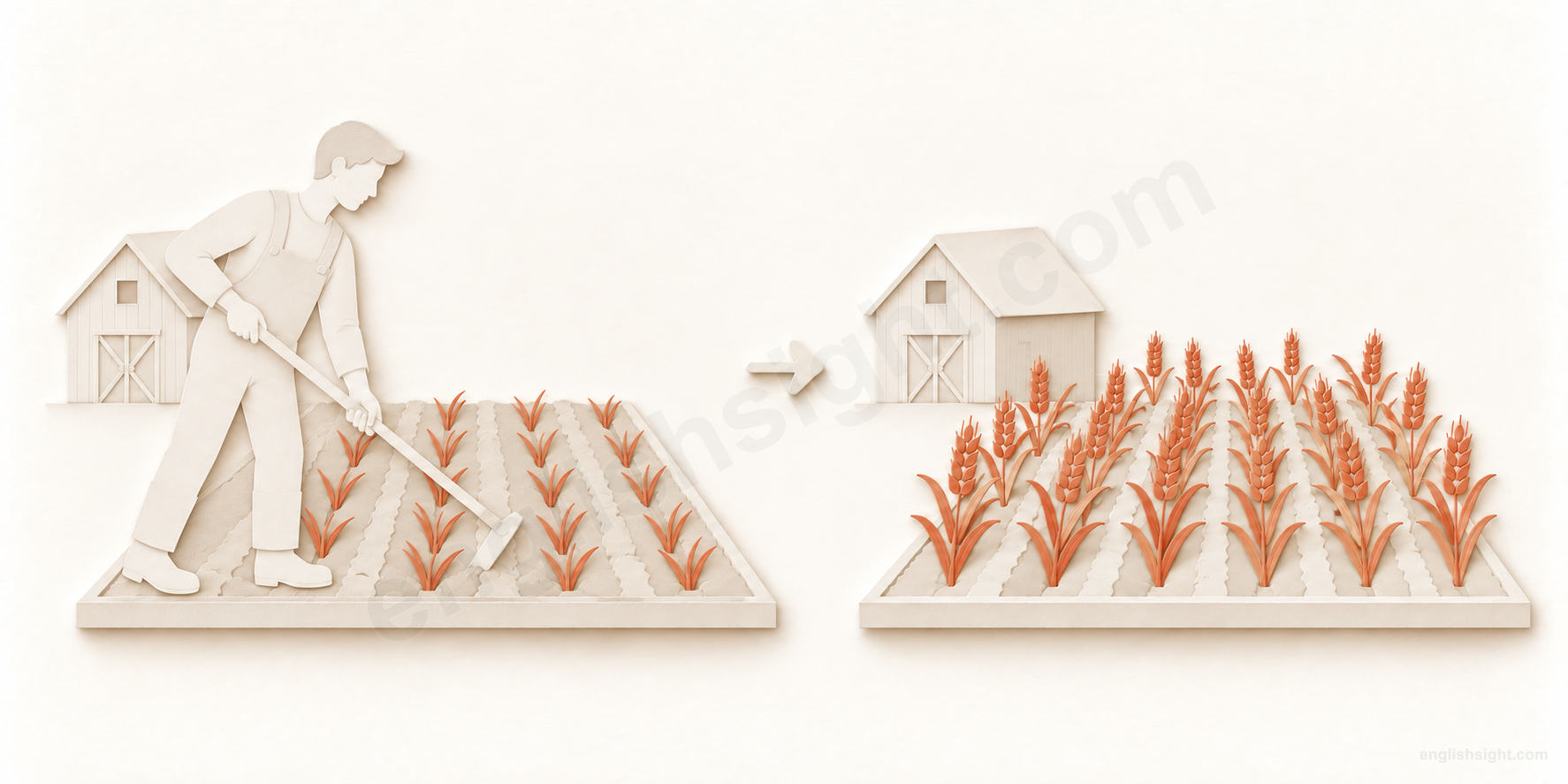
A worker hoes the soil between rows of young wheat.
farm
The same plot now holds taller wheat with grain ears.
Cultivation continues as time passes.
A farm is the managed place; farming is the agricultural work.
A farm is a place managed to grow crops or raise animals; to farm is to do that work.
The sketch uses crops to show managed production over time. Farms can raise animals instead, and successful harvests are not guaranteed. Farm out and fixed idioms need separate explanations.
Think of land that people work and manage so that crops grow or animals are raised. Farm can name that place or the activity carried on there.
This connection explains the agricultural uses. Other compounds and idioms have established meanings of their own; the picture is a learning aid, not a universal image in every English speaker’s mind.
01
The place and the people connected with it
Begin with the agricultural place. Then choose the location phrase, role, or compound that says what you need.
01
a / the + farm; describing word or noun + farm
a farm / dairy farm / family farm
a managed place for growing crops or raising animals
Situation / starting point
You see fields and buildings used together to produce food.
Meaning / result
You describe the whole place as a farm.
Farm names the working place, not just a field or a building.
A farm may grow plants, keep animals, or do both. It is a countable noun: a farm, two farms. A dairy farm produces milk; a family farm is owned or operated by a family.
The first word narrows the kind of farm. A sheep farm identifies the animals; an organic farm describes its production methods. These are useful combinations, not separate meanings of farm.
In a sentence
Our neighbours keep cows on a small dairy farm.
Watch the difference A field is one area of land; a farm can contain several fields. Farm does not require both crops and animals.
02
live / work / grow up + on a farm; meet / arrive + at the farm
live / work on a farm; meet at the farm
locate life, work, or a visit at a farm
Situation / starting point
Someone asks where you grew up or where to meet.
Meaning / result
You identify the farm as the setting or meeting point.
On is the usual choice for farm life; at can identify a location.
Use on a farm for living or working there: I grew up on a farm. At the farm is also natural when treating it as a place to visit or meet.
In the barn refers to being inside a building. Neither on nor at is part of a phrasal verb here; the preposition belongs to the location phrase.
In a sentence
I grew up on a farm, and I still visit it every summer.
Watch the difference For the ordinary place meaning, say on a farm rather than in a farm. At the farm is not inherently wrong.
03
own / run / manage + a farm; work on + a farm
own / run / work on a farm
distinguish ownership, management, and employment
Situation / starting point
Several people have different roles in the same business.
Meaning / result
You say who owns it, who manages it, and who works there.
The preceding verb supplies the person’s relationship to the farm.
Own a farm concerns possession. Run or manage a farm concerns responsibility for its operation. Work on a farm says where someone works and does not imply ownership.
These are ordinary verb–noun combinations. Run here means manage, not move quickly. A person may run a farm on rented land.
In a sentence
Jo runs the farm, but her aunt owns the land.
Watch the difference Working on a farm does not automatically make someone its owner.
04
farm + noun; farm + plural noun
farm animals / farm workers / farm produce
use farm before a noun to show an agricultural connection
Situation / starting point
You need to identify the animals, people, or goods you mean.
Meaning / result
Farm specifies their connection with agricultural work.
The second noun tells us what kind of thing we are naming.
Farm animals are animals kept for agricultural purposes. Farm workers are people employed in that work. Farm produce means agricultural goods, especially food.
Farm stays singular in these combinations: farm workers, not farms workers. A farmhouse is specifically a house; farmland is the land. Neither word necessarily refers to the whole operation.
In a sentence
The children learned how to feed the farm animals.
Watch the difference A farmer is a person; a farm is a place or business. Farm is not the name of the worker.
05
a fish / trout + farm
a fish farm
a business where fish are bred or raised
Situation / starting point
Fish are kept and fed in managed ponds or enclosures.
Meaning / result
You identify the operation as a fish farm.
A farm need not consist of dry fields.
Fish farm is an established compound for managed fish production. Fish names what is raised; farm names the operation. It is not simply any pond containing fish.
Compare catching fish in the wild: that does not involve raising them. The farm model extends naturally from managed land to managed water.
In a sentence
The restaurant buys trout from a fish farm nearby.
Watch the difference A fish market sells fish; a fish farm raises them. The two businesses need not be in the same place.
06
a factory farm; factory farming
a factory farm
a farm using intensive methods to produce animal products
Situation / starting point
Many animals are kept indoors in limited space for high output.
Meaning / result
A report calls the operation a factory farm.
Factory describes an intensive production system, not a building that makes farms.
This established compound usually concerns animals kept in confined indoor conditions for efficient production of meat, eggs, or milk. Learn its specific meaning rather than substituting any large farm.
Factory farming names the method or activity; a factory farm is one operation. The term often appears in discussions of food production and animal welfare.
In a sentence
The documentary examines conditions on factory farms.
Watch the difference A family farm describes who owns or runs it; factory farm describes production methods. The terms do not form a simple opposite pair.
02
Working land and raising animals
As a verb, farm describes managed agricultural production. Its object can be land or what is raised.
07
farm + land / an area; farm + location / manner; be farmed
farm the land / farm organically
use land to grow crops or keep animals
Situation / starting point
A family works an area of land for agricultural production.
Meaning / result
You say they farm that land or simply that they farm.
Farm can describe an activity with or without a direct object.
In They farm this land, land is the direct object. In They farm near the river, the verb has no object and the phrase tells us where. Farm organically adds how they do the work.
The passive changes the viewpoint: This land is farmed by a local family. They are farming more land this year describes an ongoing situation. Farming can also name the activity: Farming is hard work.
In a sentence
They farm twenty hectares and grow most of their own vegetables.
Watch the difference Say They farm the land without on before the direct object. They work on the land uses a different verb pattern.
The fish are described as farmed rather than wild-caught.
The object can name what is raised, not only the land used.
Farm salmon means raise salmon as a managed operation. Salmon are farmed is passive; farmed salmon uses the past participle before the noun to identify how the fish were produced.
Farm also occurs with livestock, as in farm cattle. In ordinary descriptions, raise or keep cattle is another useful choice. Growing vegetables and raising animals both fit the agricultural model.
In a sentence
The menu tells you whether the salmon is farmed or wild-caught.
Watch the difference Farmed describes the production method, not the act of catching or cooking the fish.
03
Established meanings beyond agriculture
Energy, computing, and North American sport use specific compounds. Their meanings need to be learned with the complete expression.
09
a wind / solar farm; wind / solar farms
a wind farm / a solar farm
an area with many units producing electricity
Situation / starting point
Turbines or solar panels operate together across a site.
Meaning / result
You name the installation a wind farm or solar farm.
The compound extends farm to an organized production site.
A wind farm uses multiple turbines to produce electricity. A solar farm uses many solar panels. Nothing is being bred or harvested as a crop; these are established names for energy installations.
The shared teaching connection is organized production in one area. Do not use that connection as permission to invent any noun + farm combination. The complete compound identifies what the installation does.
In a sentence
A solar farm supplies electricity to the nearby town.
Watch the difference Wind farm does not mean a farm that happens to have windy weather.
10
a server farm; operate / build + a server farm
a server farm
a large network of computer servers
Situation / starting point
Many servers work together to handle data.
Meaning / result
A technology report refers to the system as a server farm.
The connection is coordinated operation, not biological growth.
A server farm stores, processes, or shares data using many connected servers. Farm here belongs to a fixed technical compound, rather than the ordinary agricultural noun.
The agricultural picture can help you remember a collection managed for output. It does not explain how the computers work or mean that each server is literally cultivated.
In a sentence
The company moved its data processing to a larger server farm.
Watch the difference A server farm is a computing system, not a website about farming.
11
a farm team / farm club
a farm team
a lower-league team that supplies players to an associated major-league team
Situation / starting point
A player gains experience with a minor-league baseball team.
Meaning / result
The player may later move to its associated major-league team.
This North American sports expression concerns player development.
A farm team, also called a farm club, develops or supplies players for a major-league team, especially in baseball. The word farm alone can also have this sports meaning in context.
The possible memory connection is developing talent for another team. Learn the sports convention separately: no agricultural property or animals are involved.
In a sentence
The pitcher spent a season with the club’s farm team.
Watch the difference This is a regional sports term, not a general name for every amateur team.
04
Handing work over, taking risks, and recognizing idioms
Farm out and fixed idioms have meanings the agricultural sketch cannot predict. Read the object and the complete construction.
12
farm + work + out + to somebody; farm out + work; farm it out
farm out work / farm it out
give work to another person or company to do
Situation / starting point
Your team has a task it could do itself.
Meaning / result
Another business receives the task and does the work.
Responsibility for doing the task moves outside the original team.
This phrasal verb often concerns outsourcing: We farm out the printing to a local company. Out is the particle, and to identifies who will do the task. It has no necessary connection with agriculture.
A noun can go on either side of out: farm out the work or farm the work out. A personal pronoun goes between: farm it out. Passive wording is possible too: The work was farmed out to a specialist.
In a sentence
We designed the labels ourselves but farmed out the printing.
Watch the difference Say farm it out, not farm out it. Sending a document to a colleague does not by itself mean outsourcing the task.
13
farm + somebody + out + to somebody; be farmed out to somebody
farm the children out to relatives
arrange for others to look after people
Situation / starting point
A speaker thinks someone keeps passing childcare to other people.
Meaning / result
The speaker describes the children as being farmed out.
With people, this expression often conveys disapproval.
Farm somebody out to somebody can mean arrange for other people to care for them. It can suggest treating that responsibility casually, so it is not a neutral synonym for every childcare arrangement.
For a neutral statement, say The children stayed with their grandparents. The person needing care is the object; the person providing care follows to. Passive wording is also possible.
In a sentence
She complained that the children were always being farmed out to relatives.
Watch the difference The critical tone belongs to this established use. Do not automatically use it when thanking someone for babysitting.
14
bet the farm / ranch + on + noun or -ing form
bet the farm on something
risk everything on one decision or possibility
Situation / starting point
A proposal could succeed, but failure would cost everything.
Meaning / result
Someone warns against committing all available resources.
The farm represents everything at stake in this informal idiom.
In North American informal English, bet the farm on something describes an extreme risk, including business decisions. It need not involve a real farm or an actual gambling bet.
The subject takes the risk; on introduces what the gamble depends on. Bet the ranch is a variant. The literal value of a farm offers a memory aid, not a rule for interpreting every farm expression.
In a sentence
We should test the idea before we bet the farm on it.
Watch the difference The idiom concerns what could be lost. It does not guarantee confidence, success, or an actual sale of land.
15
buy the farm; bought the farm
buy the farm
die, in a North American informal idiom
Situation / starting point
A speaker tells a story about a fatal accident.
Meaning / result
The speaker says that someone bought the farm.
The whole expression has an idiomatic meaning unrelated to buying land.
Bought the farm can mean died or was killed. This North American informal expression is useful to recognize in films and stories, but its casual tone can sound insensitive in a real conversation about bereavement.
He bought a farm usually describes a property purchase. He bought the farm may also be literal if the conversation already identifies a particular farm. Context determines whether the idiom is intended.
In a sentence
In the final scene, the villain buys the farm.
Watch the difference Keep the whole idiom and read the context. Do not translate it as a real purchase when death is intended.
Keep the place, the activity, and the fixed expression distinct
Forms and related words
The noun has the plural farms. Verb forms are farm, farms, farmed, farming; both past forms are farmed. The person is a farmer, and the activity is farming. British /fɑːm/ usually has no pronounced r; American /fɑːrm/ includes it.
Choose how specific to be
Farm usually refers to the agricultural place or operation. Oxford also records farm for its main house; farmhouse is the clearer choice when the building itself matters. Farmland identifies agricultural land, not the worker or necessarily the whole business.
The verb is not a general instruction to make things grow
Use grow vegetables and raise or keep animals when those actions are your focus. Farm describes the agricultural operation. There is no ordinary farm somebody to do something causative pattern; use have somebody farm the land if you mean arrange that work.
Scope and register
This is a selection of modern uses, not a frequency ranking. Historical tax and rent senses, specialist land-leasing uses, and the baseball or soil-exhaustion senses of farm out are not expanded. Other regional idioms and specialist compounds are noted in the coverage record rather than presented as everyday beginner targets.
Choose the meaning that fits
Use the full construction and the situation, rather than one translation of farm.
1. You describe your childhood home among fields and farm buildings. Which is the usual wording?
2. Your company hires a specialist to do the printing. Replace the printing with it.
3. A food label says farmed salmon. What does farmed identify?
4. A news report describes a solar farm. What should you expect?
5. A manager says, “Do not bet the farm on this one product.” What is the warning?
Sources and teaching notes
The sources below support the meanings and usage patterns. The explanations, examples, and sketch are original teaching material; the visual connection is a learning model.
The sketch illustrates managed agricultural production, not an image shared by every native speaker.