Distinguish fat as a substance from fat as a description—and read the whole idiom.
Fullness and thickness
Fullness and thickness
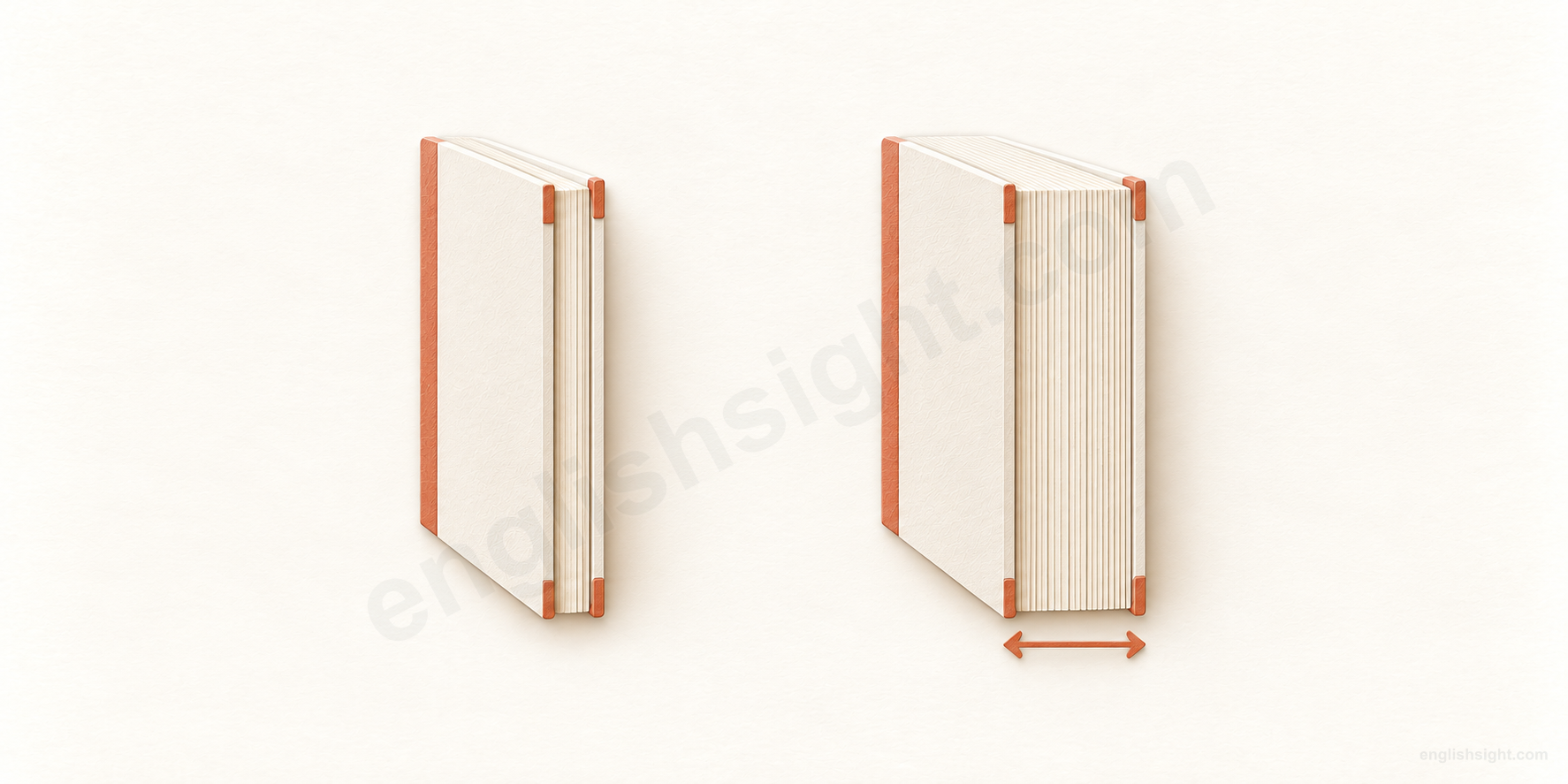
A thin book
fat
A fat book
Compare the page-block thickness of two equally tall books.
Same height, more pages: a fat book is thick. This illustrates the adjective, not the substance called fat.
Fat can describe substantial flesh, thickness, or bulk; figuratively, it can emphasize an abundant amount.
The book comparison illustrates physical thickness. The noun fat names a substance; a thick book contains no bodily fat. Fixed idioms need their own explanations.
As an adjective, fat can describe a body with a lot of flesh, a thick object, or an unusually large financial amount. Fullness is a useful connection between these uses, not a rule that predicts every expression.
As a noun, fat names a substance in bodies and foods. Fat chance and chew the fat must be learned as complete expressions. The comparison sketch is a teaching aid, not a claim that everyone imagines the word alike.
01
A substance in bodies, food, and cooking
As a noun, fat names material. Choose uncountable fat for an amount and plural fats for kinds; read compound food descriptions as whole units.
01
body / belly fat; gain / lose / store / burn fat
body fat
fat as material in the body
Situation
A discussion distinguishes muscle from other body tissue.
Meaning in context
Fat is named as a substance, not a description of the whole person.
Having fat and being described as fat are different claims.
Body fat refers to fatty tissue. Here fat is uncountable: some fat, less fat, or a layer of fat. Belly fat specifies a location; it does not create a separate grammatical meaning.
Gain fat, lose fat, store fat, and burn fat combine this noun with verbs describing a change or process. Burn is figurative here, not a claim that the body contains a flame.
In a sentence
The report lists body fat separately from muscle.
Watch the difference Say a layer of fat, not a fat, when you mean an amount of body tissue.
02
cook / fry in fat; trim / skim the fat off something
cook in fat
use animal or plant fat in cooking
Situation
You choose a cooking ingredient.
Meaning in context
The ingredient heats in the pan.
Cooking fat can come from an animal or a plant.
Cooking fat names the substance used for frying or other preparation. Duck fat and vegetable fat identify its source. Fat can be solid or liquid in this broad use; oil is not automatically outside the category.
Use a little fat for an amount and different fats for different kinds. Trim the fat off the meat means remove visible fatty tissue; skim the fat off the soup means remove it from the surface.
In a sentence
We roasted the potatoes in a little duck fat.
Watch the difference A fat potato would describe its shape; a potato cooked in fat describes its preparation.
03
be high / low in fat; fat content / intake; saturated / unsaturated fats
high / low in fat
describe how much fat food contains
Situation
You compare two food labels.
Meaning in context
You describe the relative fat content.
In links a food to the substance it contains.
Fat content is the amount of fat present; fat intake is the amount a person consumes. High in fat and low in fat describe composition, not the size of the food.
Fats can name categories: saturated fats and unsaturated fats. The plural distinguishes kinds, not separate spoonfuls. These are vocabulary distinctions, not a diet plan.
In a sentence
This sauce is lower in fat than the original recipe.
Watch the difference Low in fat does not mean small, and low fat content is not the same expression as low body weight.
A shop offers several versions of the same dairy food.
Meaning in context
You identify the version by its fat content.
The word before or after fat changes the description.
Low-fat describes a version with little fat or less than the usual version. Reduced-fat describes a reduction relative to a reference version. Neither expression by itself means no fat.
Full-fat, especially in British English, describes dairy food with its usual fat retained; it does not mean the food is entirely fat. Fat-free and nonfat describe food as containing no fat in ordinary language. This lesson does not specify legal labeling thresholds.
Hyphens join these compound adjectives: low-fat yogurt, a fat-free dressing. Compare The dressing is low in fat, where in introduces the substance.
In a sentence
I bought full-fat yogurt instead of the low-fat version.
Watch the difference Full-fat does not mean 100% fat, and reduced-fat does not mean fat-free.
02
Flesh, thickness, swelling, and large amounts
As an adjective, fat describes the subject or modifies a noun. What counts as fat depends on whether you are discussing a body, a physical object, or money.
05
a fat + person / animal noun; be / get / look + fat; make + object + fat
be / get / look fat
describe abundant bodily flesh
Situation
You describe an animal’s build or interpret a remark about size.
Meaning in context
Fat functions as an adjective, not a noun.
Be states a condition; get marks change; look describes appearance.
A fat dog and The dog is fat describe a body with a lot of flesh or body fat, commonly implying more than is wanted. Get fat means become fat. Look fat concerns appearance, not a measured amount.
Make the dog fat uses make + object + adjective: make contributes causation, and fat describes the resulting state. Fat is still an adjective, not the verb in that construction.
Calling another person fat can be hurtful. Overweight is often more neutral when weight is relevant, but unsolicited comments can still be unwelcome. Do not use fat as an automatic judgment about a person’s health or character.
In a sentence
The story describes a fat cat sleeping beside the stove.
Watch the difference An actual fat cat is an animal; the figurative expression a fat cat can refer critically to a wealthy person.
Fat is an adjective in fat meat but a noun in fat on the meat.
Fat meat means meat with plenty of fatty tissue. Lean meat contrasts with it. For a general description of food containing much fat, fatty is often the natural adjective: fatty foods.
Do not generalize the adjective freely to every food name: high-fat milk or full-fat milk describes composition more clearly than fat milk. A fat sausage may also be understood as a thick sausage, so context matters.
In a sentence
The recipe calls for lean meat rather than fat meat.
Watch the difference Fattening describes a tendency to cause weight gain; it does not simply mean containing visible fat.
07
a fat + object noun; fatter than; the fattest
a fat book / envelope
describe substantial thickness or width
Situation
Two closed books have similar height.
Meaning in context
One has a much thicker block of pages.
Fat concerns bulk across the object, not simply height or length.
A fat book is thick; a fat envelope is bulky, often because of its contents. The object has no body fat: the adjective extends a sense of fullness to physical shape.
Thick is the straightforward alternative for a book. Big is broader and might mean a tall, wide, or otherwise large book. Fatter and fattest double the final t: this book is fatter than that one.
In a sentence
She pulled a fat notebook from the drawer.
Watch the difference Do not use fat for every large measurement: a tall building is not ordinarily a fat building.
08
have / get a fat lip
a fat lip
a swollen lip
Situation
Someone bumps their mouth.
Meaning in context
Their lip is swollen.
Fat describes temporary swelling in this familiar combination.
A fat lip is an enlarged, swollen lip, often after an injury or a blow. It does not mean fat has accumulated there. This is a specific everyday extension of the thickness meaning.
The phrase can appear in threats, but it can also simply describe an injury. Other medical descriptions usually need swollen rather than a mechanically substituted fat.
In a sentence
He had a fat lip after bumping into the cupboard door.
Watch the difference A fat lip is not a description of someone’s overall body size.
09
a fat + profit / fee / cheque / check / bonus
a fat profit / fee / cheque
describe a large financial amount
Situation
A successful sale produces a substantial return.
Meaning in context
The speaker emphasizes the size of the gain.
Financial fat suggests abundance rather than physical width.
A fat profit, a fat fee, and a fat cheque are informal ways of emphasizing a large amount of money. In American spelling, cheque is check. A fat cheque need not be printed on unusually thick paper.
This financial sense normally comes before a noun. Say a fat profit, or The profit was large. Big fat can add emphatic force, as in a big fat bonus.
In a sentence
The agency charged a fat fee for a short consultation.
Watch the difference Fat is informal here; large or substantial is safer in neutral financial writing.
03
Abundance and removable excess
Some figurative uses connect physical fullness with wealth or surplus. Their tone and grammar matter as much as the connection.
10
trim the fat from something; cut the fat out of something
trim / cut the fat
remove unnecessary material or spending
Situation
A budget includes items that are not needed.
Meaning in context
The unnecessary part is removed.
Fat stands for surplus that can be removed.
Trim the fat from a budget or cut the fat out of a report means remove waste or unnecessary material. This figurative use resembles removing visible fat from meat, but the judgment about what is unnecessary comes from the context.
It does not mean all cuts are wise or all removed material lacks value. In editing, specify what you mean if other people may disagree about what counts as fat.
In a sentence
We trimmed the fat from the proposal by removing repeated sections.
Watch the difference Trim the fat is the usual fixed wording for removing identified surplus. Fat can also be uncountable without the when discussing excess in general; do not treat the article as compulsory in every sentence.
11
person / organization + grow fat on + source of wealth
grow fat on something
become rich through something
Situation
A company benefits repeatedly from high charges.
Meaning in context
Its wealth increases.
On introduces the source of the wealth.
Grow fat on fees or profits means become wealthy through them, often with criticism of how the money is obtained. Fat does not describe the company’s physical shape.
Grow carries the change over time; on names what supports the enrichment. Compare The dog grew fat, which can describe a literal bodily change.
In a sentence
The article accused the company of growing fat on hidden charges.
Watch the difference This is critical figurative wording, not a neutral synonym for every case of business growth.
12
a fat cat; fat cats; fat-cat + noun
a fat cat
a wealthy person described critically
Situation
A headline criticizes executive rewards.
Meaning in context
Rich people are labeled as benefiting disproportionately.
The compound names a person, not a body shape.
A fat cat is an informal, disapproving label for a very rich person, often a powerful business figure. The criticism concerns wealth and privilege, not necessarily physical size.
Use the plural fat cats for several people. Before another noun, fat-cat can act as a compound modifier: fat-cat executives.
In a sentence
The headline called the directors fat cats after their bonuses doubled.
Watch the difference This is a critical label; do not introduce a colleague as a fat cat in a neutral description.
13
live off / on the fat of the land
live off the fat of the land
enjoy plentiful resources and comforts
Situation
A character has access to abundant good things.
Meaning in context
They live comfortably or luxuriously.
The fat of the land represents the richest available resources.
Live off the fat of the land, also live on the fat of the land, means enjoy abundance and the good things available. Fat here represents richness, not literal grease in the soil.
Compare live off the land, which can mean obtain food directly from the land. Adding the fat of changes the expression to an emphasis on plenty and comfort.
In a sentence
The novel’s wealthy uncle lives off the fat of the land while his tenants struggle.
Watch the difference Do not read this as a recommendation to eat a high-fat diet.
04
Expressions to learn as complete phrases
These expressions have established meanings. The large-amount meaning of fat will not let you predict them reliably; some use irony, and others preserve an older image.
14
Fat chance!; (a) fat chance of + noun / -ing
Fat chance!
express strong disbelief that something will happen
Situation
Someone predicts an outcome you consider very unlikely.
Meaning in context
You reject that prediction bluntly.
The expression signals little or no chance, despite fat.
Fat chance! is an informal, often sarcastic response. Fat chance of getting a seat says you do not expect to get one. A fat chance is also possible inside a sentence.
This is established irony, not a productive rule that fat always means small. A good chance normally expresses genuine likelihood; a slim chance also expresses low likelihood without the same sarcastic force.
In a sentence
“Will they refund us after six months?” “Fat chance!”
Watch the difference Do not use Fat chance! to encourage someone by saying their chances are excellent.
15
a fat lot of good / use / help; a fat lot of good + something + does
a fat lot of good / use / help
say something is useless
Situation
Advice arrives after the problem has already caused damage.
Meaning in context
The speaker dismisses its usefulness.
The apparent large amount is used sarcastically.
A fat lot of good that does means it does no good. A fat lot of use and a fat lot of help work similarly. These are informal, pointed expressions and can sound rude.
Compare That was a lot of help, which may be sincere in a suitable context. The fixed addition fat strongly signals the negative, sarcastic meaning here.
In a sentence
A fat lot of use this map is—it doesn’t show our street.
Watch the difference The sentence expresses dissatisfaction, not praise for the map.
16
chew the fat with someone about something
chew the fat
chat in a relaxed, informal way
Situation
Friends have time to talk without a pressing task.
Meaning in context
They enjoy casual conversation.
The whole phrase means chatting, not eating.
Chew the fat describes relaxed conversation, often about ordinary shared interests. With names the other person; about can introduce the topic.
Chew changes normally with tense: chewed the fat, chewing the fat. The phrase retains the fat; it is not a separable particle verb.
In a sentence
We sat outside chewing the fat about our school days.
Watch the difference Do not say chew someone the fat; use chew the fat with someone.
17
it’s not / it isn’t over until the fat lady sings
It’s not over until the fat lady sings.
say that the outcome is not settled yet
Situation
A team is behind while the match is still running.
Meaning in context
A speaker reminds others that a reversal is possible.
The saying warns against deciding the result too early.
This saying means the situation has not reached its final conclusion. You may hear till instead of until, or ain’t instead of isn’t in an informal version.
It does not normally predict an actual singer. A plain alternative is It’s not over yet. Recognize the traditional wording without using it to comment on a real person’s body.
In a sentence
We’re behind, but it’s not over until the fat lady sings.
Watch the difference The saying leaves room for change; it does not guarantee that the losing side will win.
18
the fat is / was in the fire
the fat is in the fire
trouble has been set in motion
Situation
A damaging message has already been sent.
Meaning in context
People expect trouble from an action that cannot be undone.
This traditional expression emphasizes consequences already triggered.
The fat is in the fire means that something has happened or been done that is likely to cause serious trouble. The point is that the situation has been set in motion, not that someone has successfully solved it.
This is a traditional idiom to recognize; Now we’re in trouble is a plainer everyday alternative. It is not a literal description of a cooking fire in the example.
In a sentence
Once the private email reached the whole office, the fat was in the fire.
Watch the difference Do not infer that fat alone means trouble; that meaning belongs to the complete expression.
Choose the grammar and the tone
Adjective and noun
Fat / fatter / fattest are adjective forms, pronounced /fæt/, /ˈfætə(r)/, and /ˈfætɪst/. The noun is normally uncountable for material; fats names kinds. Do not add -s to the adjective: fat books, not fats books.
Respectful body descriptions
Fat can be a blunt or insulting description of another person. Some people choose it for themselves, but that does not make it welcome from everyone. Describe size only when relevant and follow the person’s preferred wording.
Related words and scope
Fatten is the usual modern verb for making or becoming fat; fattening and fatty have their own uses. The verb fat, with fatted / fatting, occurs in older or specialized wording and is not taught here as a productive everyday verb. Passive and causative patterns for that rare verb are outside this lesson.
A connection is not a prediction
A fat fee is large; fat chance expresses disbelief. Chew the fat means chat. Learn the noun, adjective, and fixed phrase together with the sentence around them rather than substituting a single translation everywhere.
Read the whole expression
Choose the interpretation that fits the situation and construction.
1. A recipe says to cook the onions in a little fat. What does fat mean?
2. Two books have the same height, but one has far more pages. What does a fat book describe?
3. You suggest arriving without tickets. A friend replies “Fat chance!” What do they mean?
4. How should you understand full-fat yogurt?
5. Friends spend an hour chewing the fat about old holidays. What are they doing?
6. An editor trims the fat from a report. What is being removed?
Sources and teaching notes
Definitions and usage were checked against the sources below. Explanations, example sentences, and the diagram were written for this lesson; the visual connection is a teaching interpretation.
This diagram helps explain a connection; it is not a picture shared by every native speaker.