Understand the family role, then recognize guidance, origins, and established titles.
A parent-child relationship
A parent-child relationship
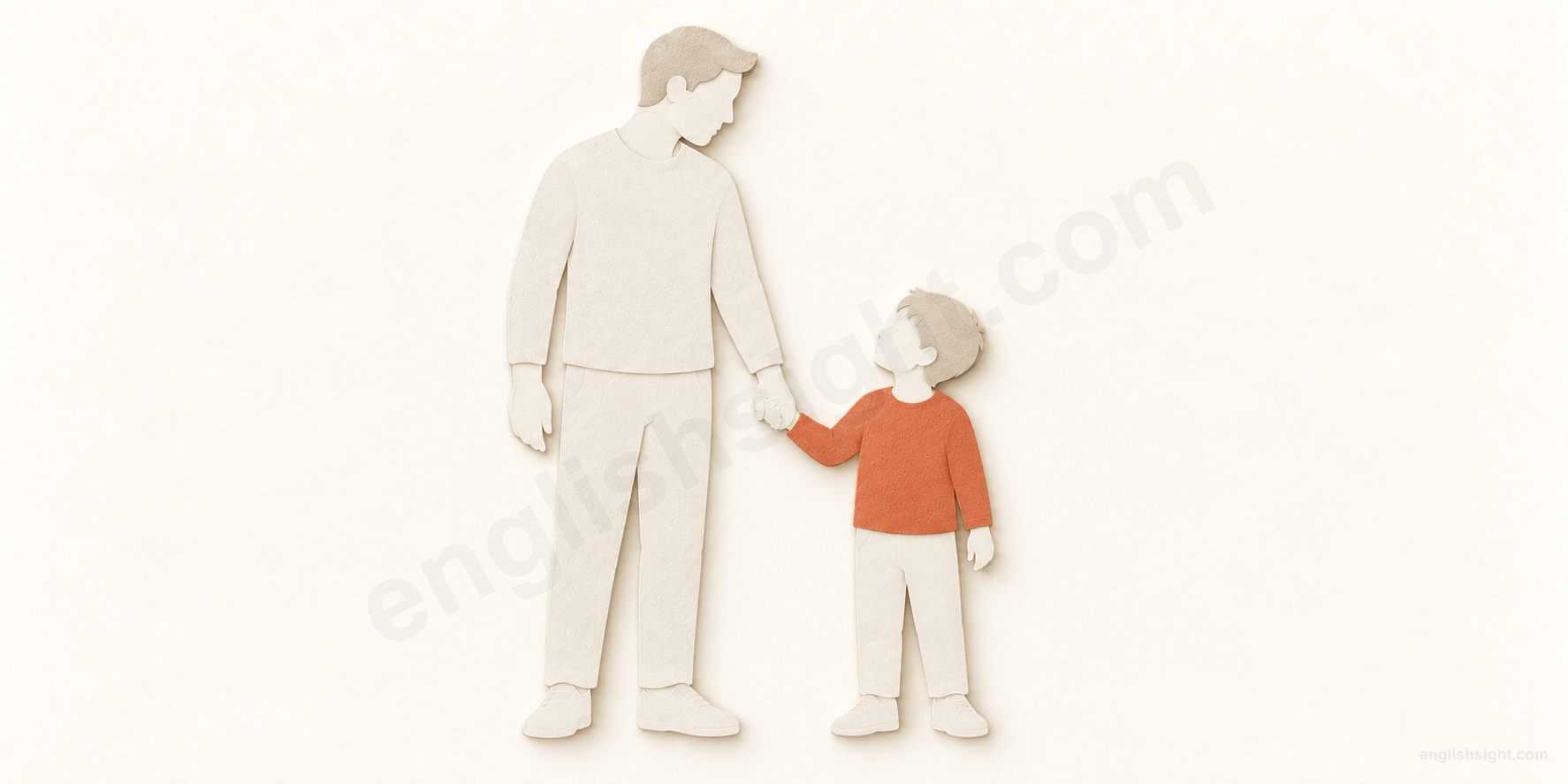
The father stands on the left.
father
His child stands on the right.
He and his child hold hands.
A father is understood in relation to his child; holding hands illustrates the parental role without establishing biology.
A father is a male parent, or a man who fills that parental role, in relation to a child.
The central meaning is a relationship, not a movement or a required change of state. The caring interaction in the sketch illustrates a parental role; it does not mean every father is caring or that a father and child must look alike. The originator metaphor and religious titles are explained separately.
Father usually names a male parent. It is a relationship word: whose father is he? A father can be a biological or adoptive parent, and the word can also describe a man who fills a parental role.
From that family relationship, English also uses father for guidance and beginnings. Religious titles and sayings have their own established uses. This lesson groups those uses without treating them as one automatic rule.
01
Family identity and everyday grammar
Start with whose father someone is. Modifiers can specify biology, adoption, family connections, or circumstances; they do not all describe the same relationship.
01
my / your / somebody’s father; a father; fathers
my father
a male parent, identified in relation to a child
Situation / person
You introduce the man who is your parent.
Relationship / interpretation
The listener knows his relationship to you.
Father names a family relationship, not simply an adult man.
Use father for a male parent. It can refer to a biological or adoptive father, and to a man who brings a child up in that role. The word alone does not tell us how the family was formed.
My father, her father, and Maya’s father identify whose parent you mean. A father is a countable person: a father, two fathers. A person remains your father when you are an adult; the child in this relationship need not be young.
My father’s phone has singular possessive ’s. The fathers’ meeting has a plural possessive after fathers. The ordinary plural fathers has no apostrophe. The same parent word can also be used for a male animal.
In a sentence
My father calls me every Sunday, even though I live abroad.
Watch the difference Normally say My father is here, with no extra the before my. Parent can refer to a father or a mother.
02
a father of + number / children; the father of + child
a father of two
a father with a stated number of children
Situation / person
You give a short description of a colleague’s family.
Relationship / interpretation
The listener learns that he has two children.
Of introduces the children or their number.
A father of two means a man who has two children. Children is understood after the number. A father of two young children spells it out.
The father of this child identifies a particular relationship. Compare a father to this child, which can emphasize how he acts toward the child. Of itself does not say whether he is caring or involved.
In a sentence
Our new neighbour is a father of two.
Watch the difference Do not say a father of two childs: the plural is children. Use an article in He is a father of two.
03
become a father; make a good father; an expectant father; a father-to-be
become a father
enter the role of a father
Situation / person
A man has not previously been a parent.
Relationship / interpretation
He is now a father.
Become supplies the change; father names the new role.
Become a father describes starting to be a father, for example when a child is born or a man becomes an adoptive parent. Be a father describes the relationship once it exists.
He would make a good father means he seems likely to be good in that role. Make here means prove suitable as, not manufacture a person.
An expectant father is waiting for a child to be born. A father-to-be is a man expecting to become a father: to-be adds future meaning. Its plural is fathers-to-be. These expressions specify timing; father by itself does not say that the child is still expected.
In a sentence
Leo became a father when he and his husband adopted a little girl.
Watch the difference Keep a in become a father. Father does not itself mean give birth; that is a different expression.
04
somebody’s biological / birth / adoptive / foster father
biological / birth / adoptive / foster father
distinguish biological parenthood, adoption, and foster care
Situation / person
A family conversation needs a more precise relationship term.
Relationship / interpretation
The modifier identifies which relationship is meant.
Biology and adoption are different ways of specifying a father.
Biological father identifies the male biological parent. Birth father is especially used when discussing someone who was adopted. Neither expression, by itself, says who raised the child.
An adoptive father becomes a parent through adoption. An adoptive father is a father; you do not have to add adoptive unless the distinction matters in the conversation.
A foster father cares for a child in place of a birth or adoptive father. Fostering and adoption are different arrangements; foster father does not itself mean adoptive father. For example: His foster father helped him settle into a new school.
Avoid using real father when you mean biological father. Real can suggest that an adoptive parent is somehow less of a parent; biological is more precise.
In a sentence
Her adoptive father helped her find information about her birth father.
Watch the difference An adoptive father adopts a child; an adopted child is the child who has been adopted. The endings are not interchangeable.
05
somebody’s stepfather; stepfathers
my stepfather
a mother’s husband or partner who is not the child’s birth father
Situation / person
Your mother has a partner who is not your biological father.
Relationship / interpretation
You identify that man’s relationship to you.
Step- marks a family connection through a parent’s relationship.
Stepfather refers to your mother’s husband or partner when he is not your birth father. He may help raise you, but the word does not tell us how close the relationship is.
A stepfather is not automatically an adoptive father: adoption is a separate relationship. In personal conversation, families choose their own names, including Dad or a first name.
In a sentence
My stepfather taught me to cook when I was a teenager.
Watch the difference Do not confuse stepfather with father-in-law: the latter is your spouse’s father.
06
somebody’s father-in-law; fathers-in-law
my father-in-law
the father of your husband or wife
Situation / person
You speak about your spouse’s family.
Relationship / interpretation
The listener understands the connection through marriage.
In-law identifies a relationship through marriage.
Your father-in-law is your husband’s or wife’s father. Father still names the parent; the compound tells us how that parent is related to you.
The plural is fathers-in-law. Add the plural ending to father, not law. In My father-in-law’s car, the possessive ending goes at the end of the whole compound.
In a sentence
My wife and I are having lunch with my father-in-law.
Watch the difference Your mother’s new husband is your stepfather, not your father-in-law.
07
a single father; a lone father
a single father
a father raising children without a spouse or partner
Situation / person
A man cares for his children without a partner.
Relationship / interpretation
You describe his family circumstances.
Single concerns the parenting situation, not the number of children.
A single father is a single parent who is a father. He may have one child or several. The expression does not say why he has no partner.
Compare a father of one: this counts children and says nothing about whether he has a partner. Single father does not necessarily mean he receives no help from friends, relatives, or the other parent.
In a sentence
As a single father of three, Ben plans his work around the school day.
Watch the difference Single does not mean only one child here. Lone father is also used, especially in British English.
08
Father, + request; Dad, + request; my father / my dad
Father / Dad
use a family name when speaking to or about your father
Situation / person
You speak directly to your father.
Relationship / interpretation
The family name functions like his name.
Capitalization and choice of word depend on use and tone.
Father can replace a personal name in Father, can you help me? It is capitalized in that use. My father uses a normal relationship noun and normally has a small f.
Dad and Daddy are informal family words. Father as a direct form of address can sound formal or old-fashioned; families differ in what they normally say. In I asked Dad, Dad also stands in place of a name.
Father is not a general way to address any older man in ordinary everyday English. Religious Father is a separate established title.
In a sentence
“Dad, could you help me fix this zip?” Maya asked.
Watch the difference Use the family’s preferred form of address. Do not capitalize father everywhere just because the person is important to you.
02
Filling a father’s role
A man can offer parental care or guidance without being someone’s biological father. These expressions describe a role or a comparison.
09
be a father to + person; be like a father to + person
be like a father to someone
give someone care or support associated with a father
Situation / person
An uncle provides steady help while a child grows up.
Relationship / interpretation
The person describes him as filling a parental role.
To identifies the person receiving the parental care.
Be a father to someone can describe actually carrying out a father’s role. Be like a father to someone makes the comparison explicit and need not claim a biological or legal relationship.
A good father to his children evaluates how a father treats them. The words good and to his children add that judgment and its recipient; father alone does not guarantee kindness or good parenting.
In a sentence
My uncle has been like a father to me since I was small.
Watch the difference Use to me in this relationship pattern, not of me. Father of the child identifies a parent; father to the child can emphasize the role he performs.
10
a father figure; see / regard somebody as a father figure
a father figure
a respected older man who offers father-like guidance
Situation / person
A younger person relies on an older man for advice.
Relationship / interpretation
The younger person sees him in a father-like role.
Figure names a role in someone’s life, not a physical shape.
A father figure is someone a person respects and turns to for advice or help in a way associated with a father. He need not be a relative, and the person receiving guidance can be an adult.
Compare her father, which identifies a family relationship, with a father figure for her, which describes how someone matters to her. The expression can overlap with be like a father to someone.
In a sentence
During his first year away from home, Amir saw his coach as a father figure.
Watch the difference A father figure is not necessarily a legal guardian or a biological parent.
03
Resemblance and connections across generations
Learn the whole expression: a family resemblance, a tradition, a career choice, and an age comparison make different claims.
11
Like father, like son.
like father, like son
say that a son resembles his father in character or behaviour
Situation / person
A son displays a familiar habit of his father’s.
Relationship / interpretation
Someone comments on the resemblance.
The saying compares behaviour or character; it does not prove inheritance.
Like father, like son is a fixed saying used when a son behaves in a way that reminds people of his father. It may be affectionate, amused, or critical, depending on the context.
The resemblance is the point. It is not a rule that all sons must resemble their fathers, and it does not explain whether a habit was learned or inherited.
In a sentence
“You both spend hours repairing old radios—like father, like son!”
Watch the difference This particular saying mentions a son. For a daughter, a direct description such as She takes after her father may fit the situation more naturally.
12
pass / be passed (down) from father to son
from father to son
pass something from one generation of a family to the next
Situation / person
A family preserves a craft or possession over time.
Relationship / interpretation
It passes from an older generation to a younger one.
From and to identify the generations in the transfer.
From father to son is used for traditions, knowledge, property, or a business passed through generations. It often describes a repeated family pattern, not just one delivery.
The fixed wording highlights a male line. From one generation to the next is a broader alternative when you do not mean specifically fathers and sons.
In a sentence
The boat-building skills were passed down from father to son.
Watch the difference This expression describes transmission across generations, unlike like father, like son, which comments on resemblance.
13
follow in + somebody’s footsteps
follow in your father’s footsteps
choose a similar career or way of life to your father’s
Situation / person
A daughter considers the same profession as her father.
Relationship / interpretation
She makes a similar career choice.
The whole footsteps expression supplies the career or life-path meaning.
Follow in someone’s footsteps means to take a similar route through life, especially by doing the same kind of work. Father identifies the person whose example is followed.
This is not a special verb meaning of father and it does not require physically walking behind him. The pattern also works with mother, teacher, or another person.
In a sentence
Nina followed in her father’s footsteps and trained as a nurse.
Watch the difference Keep the possessive and plural: her father’s footsteps. Simply follow her father can describe physically going after him.
14
be old enough to be + somebody’s father
old enough to be your father
emphasize a large difference in age
Situation / person
Someone notices that a man is much older than another person.
Relationship / interpretation
They compare his age with a possible parent’s age.
Enough to be creates an age comparison, not an actual family relationship.
He is old enough to be your father says that his age would make it possible for him to belong to your parents’ generation. It does not say that he really is your father.
The expression often carries disapproval when someone discusses a romantic relationship. In another context, it can simply emphasize age. Tone and context matter.
In a sentence
“He’s old enough to be your father,” her friend said, questioning the relationship.
Watch the difference This can sound judgmental. Use He is much older than you for a more direct age comparison without the family metaphor.
04
Origins, ancestors, and the verb
Some uses look back to a source or beginning. Distinguish a founder, earlier generations, and the specific biological meaning of father as a verb.
15
be considered / regarded as the father of + field / idea
the father of something
a man credited with starting an important idea, field, or method
Situation / person
A historical account discusses how a field developed.
Relationship / interpretation
It credits a man with an influential beginning.
The parent-child relation is extended to a creator and what develops from his work.
The father of a field is a metaphorical title for a man regarded as its originator or a major early pioneer. The object of of is now an idea, practice, or field, rather than a child.
Considered or regarded as is useful because such titles express a historical judgment. The expression does not necessarily mean that one person worked alone or that nobody came before him.
Compare the father of two children with the father of a new movement. The noun following of and the wider context tell you which relationship is intended.
In a sentence
The exhibition describes the engineer as the father of a new approach to bridge design.
Watch the difference This is a conventional metaphor, not a biological claim. Founder or pioneer is often a plainer choice.
16
a founding father of + organization / movement; the Founding Fathers
a founding father
one of the people who establish a movement, institution, or country
Situation / person
A group helps establish an organization.
Relationship / interpretation
One of its early builders is recognized as a founder.
Founding specifies an establishing role, rather than a family relationship.
A founding father is a person credited with helping start or develop an institution, movement, or idea. The expression is formal and often appears in historical accounts.
The capitalized Founding Fathers is used in US history for leaders associated with the country’s founding, including the framing of its Constitution. It is a historical group name in that context.
A founding member or founder is often a useful neutral alternative when you simply want to identify who started an organization.
In a sentence
The museum celebrates one of the founding fathers of the conservation movement.
Watch the difference Not every use refers to US history. Read the words after of and notice whether the phrase is being used as a historical name.
17
our / their fathers; the land of our fathers
the land of our fathers
earlier generations or ancestors, in literary language
Situation / person
A poem recalls a community’s family history.
Relationship / interpretation
Fathers points to generations before the present one.
The plural can reach beyond people’s immediate fathers.
In literary or ceremonial language, our fathers may refer to ancestors, rather than only the fathers of the people speaking. The land of our fathers evokes an inherited homeland.
In We invited our fathers to dinner, the ordinary immediate-parent meaning is more likely. Style and context determine how far back the plural looks.
In a sentence
The poem calls the valley “the land of our fathers.”
Watch the difference Use ancestors if you want to make the broad family-history meaning explicit in ordinary prose.
18
father + a child / children; be fathered by + person
father a child
be the biological father of a child
Situation / person
A report identifies a child’s biological parent.
Relationship / interpretation
The verb attributes biological fatherhood to a man.
The child is the object of the verb; raising the child is not asserted.
As a verb, father a child means to be the man who is the child’s biological father. It occurs in reports and biographical writing. It does not by itself say that the man raised or supported the child.
Compare He fathered a child with He brought up a child. The second concerns raising a child and does not establish a biological relationship. He became a father is a more neutral way to describe entering parenthood.
The regular verb forms are father, fathers, fathered, and fathering. A passive is possible: The child was fathered by him. With in He fathered a child with his partner identifies the other parent; it is not a separable phrasal verb.
In other contexts, the verb can describe caring for someone in a father’s role. For example, He was learning how to father his children focuses on parenting skills. Use raise or bring up when you want to make the everyday care meaning explicit.
In a sentence
The biography says he fathered a son but never met him.
Watch the difference Do not use fathered as a simple synonym for adopted or raised. The biological meaning needs to fit what you intend.
05
Titles, belief, and celebrations
Capitalized Father also occurs in particular religious traditions and established cultural names. Context identifies the intended meaning.
19
Father + name; address somebody as Father; Fr
Father Daniel
a title for a priest in some Christian churches
Situation / person
A visitor speaks to a priest in a church that uses this title.
Relationship / interpretation
Father functions as a religious title.
A religious title does not identify a biological parent.
Father is used before a priest’s name, or alone when addressing him, especially in Roman Catholic and Orthodox contexts. It is capitalized as a title: Father Daniel or Thank you, Father.
The usual title abbreviation is Fr. This use belongs to particular church traditions; not every Christian minister is addressed as Father. The Holy Father is a title for the pope.
In a sentence
“Father Daniel, could I speak to you after the service?”
Watch the difference My father Daniel normally identifies your parent named Daniel. Father Daniel can identify a priest; the title and context matter.
20
God the Father; our Father; Father in prayer
God the Father / our Father
a Christian way of referring to or addressing God
Situation / person
A Christian text or prayer refers to God.
Relationship / interpretation
Father expresses a religious relationship.
The capitalized term has a specific religious use.
In Christian usage, Father can refer to God, including God the Father in language about the Trinity. Our Father can address God in prayer.
This is a religious use, not a statement about someone’s human family. An isolated Father may mean a parent, a priest, or God; the surrounding text identifies which one.
In a sentence
The prayer begins by addressing God as “our Father.”
Watch the difference Do not assume that Father in every capitalized occurrence means a priest. Read the religious and grammatical context.
21
Father’s Day; on Father’s Day; Happy Father’s Day!
Father’s Day
an annual occasion for celebrating fathers
Situation / person
A child prepares a greeting for a father.
Relationship / interpretation
The greeting marks the named celebration.
The whole name denotes a celebration, not any day belonging to a father.
Father’s Day is the conventional name of a celebration of fathers. People may give cards, spend time together, or offer gifts.
Write the name with capitals and the apostrophe before s: Father’s Day. Use on for the occasion: on Father’s Day. Its date and customs vary by country; the name does not specify a universal date.
In a sentence
The children made their dad a card for Father’s Day.
Watch the difference The established name is Father’s Day, even though the celebration is for many fathers. Fathers is the ordinary plural in other contexts.
22
Father Christmas; play Father Christmas
Father Christmas
the British name for Santa Claus
Situation / person
A British Christmas story names the gift-giving character.
Relationship / interpretation
The name identifies Santa Claus.
This is a cultural name, not a family relationship with Christmas.
Father Christmas is a British English name for the imaginary character also called Santa Claus. In Christmas stories, he brings presents to children.
Use the whole capitalized name. In a school play, someone can play Father Christmas, meaning take the part of that character.
In a sentence
Grandpa played Father Christmas in the school play.
Watch the difference Father Christmas is a character name. It does not mean someone’s father at Christmas or God the Father.
Keep the relationship and the whole expression clear
Father, parent, and Dad
Father identifies a male parental relationship. Parent is broader. Dad is an informal family word. Choosing father does not mean that someone is stricter, older, or more caring than someone called Dad.
Biology and care are different claims
A biological father, an adoptive father, and a stepfather specify different relationships. Father a child as a verb normally concerns biology; bring up or raise concerns care. Do not infer either claim from the other.
Read grammar before assigning a new meaning
Father of two counts children; like a father to me compares a supportive role. Like father, like son and follow in somebody’s footsteps are whole expressions. They are not phrasal verbs made from father.
Less usual extensions
Fathers meaning ancestors is literary. The saying The wish is father to the thought means that wanting something can lead us to believe it; learn the saying as a whole. The verb father can also mean originate an idea, but this is less usual and is marked dated by Merriam-Webster; create or develop is clearer in everyday speech. Older city fathers, Church Fathers, father on/upon attribution, and specialist historical uses are outside the main practice here.
What the picture explains
The sketch gives one visible example of a father-child relationship. It does not define a family by appearance, show every kind of family, or establish biological parenthood from a gesture. It is a teaching model, not a claim about an image shared by all English speakers.
Choose the relationship or meaning
Use the context, modifier, and complete expression to make your choice.
1. A colleague is a father of three. What does three count?
2. A biography says that a man fathered a child but never met the child. What does fathered mean here?
3. An uncle has always cared for you and advised you. Which sentence expresses the comparison without claiming biological fatherhood?
4. You introduce your husband’s father. Who is he in relation to you?
5. A museum calls a man the father of a design movement. What does the title mean?
6. A visitor says, “Father Daniel, may I ask you a question?” in a church. What is Father doing here?
7. Nina follows in her father’s footsteps and becomes a nurse. What is the relevant connection?
Sources and teaching notes
The dictionary entries below support the meanings and patterns. Explanations, examples, and the relationship sketch are original teaching material. Recognition-only and excluded uses are recorded in the coverage notes.
The sketch illustrates one parental relationship; it does not show a picture shared by every English speaker.