From one feather to lightness, feather-like edges, and familiar expressions.
One light structure within a covering
One light structure within a covering
Many feathers form a bird’s covering.
feather
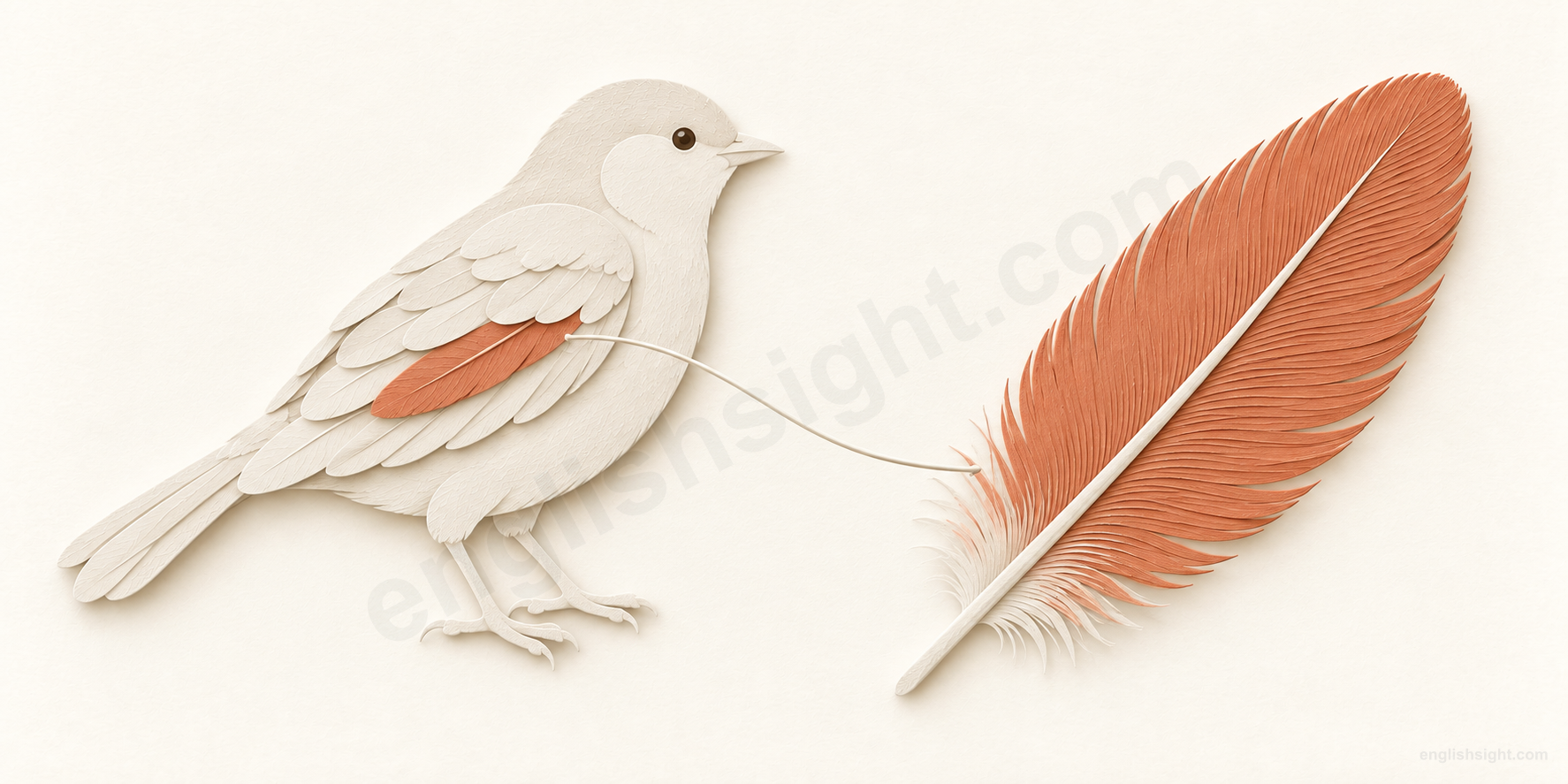
One feather has a central shaft with fine branches on both sides.
The line links one highlighted wing feather to an enlarged detail.
One feather is part of a bird’s covering; the line shows a close-up, not movement.
A feather is one light structure growing from a bird’s skin; many feathers together form its outer covering.
The sketch isolates one typical large feather. It is a teaching reference for the object, not a single formula that generates every idiom or a picture shared by every English speaker.
Start with the concrete object: a feather grows from a bird’s skin and forms part of its covering. One feather is not a wing, and not all feathers have the same shape.
Lightness and fine edges help connect some later uses. Other expressions are established idioms: learn the whole phrase and its tone rather than trying to translate feather alone.
01
Birds, objects, and materials
Start with the countable object, then notice how it names a filling or a covering.
01
a / one + feather; number + feathers; wing / tail feathers
a feather / feathers
one of the light structures covering a bird
Situation / starting point
A bird has many feathers on its body and wings.
Meaning / result
You identify one small part of that covering.
A feather is a part of a bird’s covering, not the whole wing.
Feather is countable: one feather, two feathers, a few feathers. A bird has feathers; a loose feather is still a feather after it falls out. Wing and tail feathers identify where the feathers grow.
The large feather in the sketch has a central shaft with fine branches on either side. Small down feathers are fluffier, so the outline is a recognizable example rather than a diagram of every feather type. Birds have feathers; ordinary human body hair is not called feathers.
In a sentence
A small grey feather lay beside the bird’s nest.
Watch the difference Say a feather for one item, not a feathers. A wing has many feathers; feather does not mean wing.
02
feather + noun; be filled with feathers
a feather pillow
a pillow filled with feathers
Situation / starting point
You choose a pillow for a hotel bed.
Meaning / result
You specify the material used inside it.
Feather before pillow identifies a filling; it does not mean one feather.
In a feather pillow, feather modifies pillow as a noun. The pillow contains feathers, even though the modifier is singular. Compare a pillow filled with feathers, where feathers is plural.
The phrase feather pillows counts pillows, not individual feathers. The same material connection helps with feather filling. This is an ordinary noun combination, not a new verb or a phrasal verb.
In a sentence
Could I have a pillow without feather filling?
Watch the difference Use feather pillows, not feathers pillows. The plural ending belongs to the main noun.
03
feathered + noun; be covered / decorated with feathers
a feathered hat
a hat decorated with feathers
Situation / starting point
A hat is decorated with real feathers.
Meaning / result
You describe what is on its outside.
Feathered describes a covering or decoration; feather filling is inside.
Feathered can describe something that has feathers on it: a feathered hat or a feathered bird. The -ed form can function as an adjective, so it does not always narrate an action.
Compare a feathered hat with a feather pillow. The first has feathers on it; the second has feathers inside. The surrounding noun and the full description tell you the relationship.
Our feathered friends is a friendly expression for birds: We left water out for our feathered friends. It does not mean that human friends are wearing feathers.
In a sentence
The dancer wore a feathered hat.
Watch the difference Feathered does not simply mean very light. A feathered object can still be heavy.
02
Lightness, people, and reactions
Learn these comparisons and idioms as complete expressions. Their grammar and tone matter as much as the bird image.
04
(as) light as a feather
(as) light as a feather
very light in weight
Situation / starting point
You lift a bag and expect it to be heavy.
Meaning / result
It feels surprisingly easy to lift.
The comparison selects lightness, not a bird’s shape or ability to fly.
As light as a feather is a familiar way to emphasize low weight. The first as can be omitted: This bag is light as a feather. It is usually an expressive comparison, not a measured claim about equal weights.
Light supplies the quality; as a feather supplies the comparison. Other contexts give light other meanings, but this expression concerns weight, not brightness or color.
In a sentence
My new walking shoes are as light as a feather.
Watch the difference Keep a before singular feather. The phrase does not mean the shoes contain feathers.
05
be + a / another feather in + possessive + cap
a feather in someone’s cap
an achievement that brings credit or admiration
Situation / starting point
A student’s design wins an award.
Meaning / result
The success gives the student something to be proud of.
The whole idiom marks an achievement, not an actual hat decoration.
Use a feather in her cap to call attention to a success that reflects well on her. Another feather in her cap adds this success to earlier ones. The possessive identifies who receives the credit.
The image of a visible decoration is a useful memory aid, but the modern meaning belongs to the fixed phrase. A feather in the cap of the team is another possible arrangement.
In a sentence
Winning the design prize was another feather in her cap.
Watch the difference Keep in and cap in the idiom. A feather on her hat is normally a literal decoration.
06
be birds of a feather; birds of a feather flock together
birds of a feather (flock together)
similar people who tend to spend time together
Situation / starting point
Two friends share the same interests.
Meaning / result
You comment on their similarity and friendship.
Of a feather means of a similar kind within this established expression.
Birds of a feather refers to people who resemble each other in interests or character. The full saying Birds of a feather flock together adds the idea that such people tend to associate.
It can sound friendly, teasing, or critical depending on which similarity you mean. It does not say every member of a group is identical, and it is not a rule that predicts all friendships.
In a sentence
Those two are birds of a feather: they both spend every weekend fixing old bikes.
Watch the difference Keep feather singular in of a feather. Do not change the saying to birds of feathers.
07
ruffle + possessive + feathers; ruffle a few feathers
ruffle someone’s feathers
annoy, upset, or unsettle someone
Situation / starting point
A colleague hears a blunt criticism.
Meaning / result
The colleague feels offended or disturbed.
A person’s feathers represent their composure in this idiom.
Ruffle her feathers means disturb her emotionally, often by irritating or offending her. Ruffle a few feathers leaves the people unnamed: the action will upset some of them.
Here ruffle is the verb and feathers is its noun object. It is not a phrasal verb built from feather. Literal ruffled feathers are disturbed bird feathers; the human reaction is the idiomatic extension.
The reverse image appears in smooth one’s ruffled feathers, meaning regain one’s calm: After the argument, I needed a moment to smooth my ruffled feathers. Here my refers to the speaker’s own composure.
In a sentence
My question about the missing money ruffled a few feathers at the meeting.
Watch the difference Use plural feathers in this idiom. It need not mean extreme rage; the context determines the strength of the reaction.
08
feather + possessive + (own) nest
feather your (own) nest
use your position to enrich yourself
Situation / starting point
An official controls public contracts.
Meaning / result
The official uses that power for personal financial gain.
The nest is the person’s own comfort; the phrase often criticizes selfish gain.
Someone who feathers their own nest builds up money for themselves, especially through the advantages of a position. In accusations about officials or managers, the expression has a disapproving tone.
Feather is the verb here, with nest as its object. The subject and possessive match: she feathers her nest; they feather their nests. The phrase does not itself prove a specific crime, and it is unsuitable as neutral praise for ordinary saving.
In a sentence
The director used the charity’s contracts to feather his own nest.
Watch the difference Do not confuse this with nest egg, which names savings. Feather your nest is a verb phrase about gaining wealth.
09
could have knocked + person + down with a feather
You could have knocked me down with a feather.
I was extremely surprised
Situation / starting point
You hear news you never expected.
Meaning / result
You describe how astonished you were.
An impossibly weak blow expresses surprise through exaggeration.
This old-fashioned expression means that the news left you astonished. The imagined feather blow is not a real injury or a claim about physical weakness.
Could have knocked looks back to the surprising event. With a feather names the imagined instrument; down belongs to knock down, not to a supposed phrasal verb feather down. A plain alternative is I was amazed.
In a sentence
When they said I had won, you could have knocked me down with a feather.
Watch the difference This is an expressive, old-fashioned idiom. Do not use it as a literal description of someone being struck.
03
Feather as a verb
In particular activities, feather can describe shaping, spreading, or covering. The object and situation select the meaning.
10
feather + hair / the ends; have + hair + feathered
feather the ends of someone’s hair
cut or style hair into light, feather-like ends
Situation / starting point
Hair ends look blunt and heavy.
Meaning / result
A stylist gives them a softer, feather-like shape.
The resemblance is in the shape and texture, not in adding real feathers.
In hairdressing, feather takes hair or the ends as its object. A stylist can feather your hair; you can ask to have the ends feathered. Feathered hair describes the resulting style.
This is a domain-specific extension from a feather’s appearance. It does not mean pluck hair out. The exact cut should be discussed with the stylist rather than inferred from the word alone.
In a sentence
Could you feather the ends so they look less blunt?
Watch the difference A feathered haircut has no real feathers in it. In have the ends feathered, the stylist normally performs the action.
11
feather + the edge / edges
feather an edge
make an edge taper to a very thin boundary
Situation / starting point
A layer of filler has a raised edge.
Meaning / result
The edge is worked down into a thin transition.
The edge becomes progressively thinner rather than remaining a distinct step.
In practical work, feather can mean taper an edge very thin. With paint or filler, the purpose can be to let the worked area meet the surrounding surface more gradually.
Feather the edge is transitive: someone changes the edge. The link to the object is a fine, tapering boundary, but you must still learn which materials and tools a particular task requires.
In a sentence
Feather the edge of the filler before repainting the wall.
Watch the difference This does not mean attach feathers. Nor does feather guarantee that a repair will become completely invisible.
12
ink + feathers / feathered / is feathering
the ink feathers
ink spreads into fine, blurred edges
Situation / starting point
You write a line on absorbent paper.
Meaning / result
The ink spreads beyond the intended line.
Here feather describes an unwanted spreading pattern, with no person as agent.
Ink can feather when it soaks into paper and spreads, making the edge of a line less sharp. The ink is the subject: The ink feathered. This is useful when discussing pens and paper.
Compare feather the edge, where someone deliberately changes an object, with the ink feathers, where the spreading happens to the ink. They share an edge-related visual association, but differ in grammar and purpose.
In a sentence
The ink feathered on this cheap paper.
Watch the difference This use is intransitive: do not add an object unless you intend a different verb sense.
13
tar and feather + person; be tarred and feathered
tar and feather someone
cover someone with tar and feathers as a punishment
Situation / starting point
A historical account describes public violence against a person.
Meaning / result
The account says the person was coated with tar and feathers.
Feather here means cover with feathers as part of a fixed paired expression.
Tar and feather names a humiliating punishment. Tar and feather are both verbs, sharing the person as their object. In a history text, was tarred and feathered gives the passive version.
This illustrates the covering sense of feather. It belongs to accounts of punishment and humiliation, not to ordinary clothing or a harmless bird-care activity.
In a sentence
The history book describes a man who was tarred and feathered.
Watch the difference Keep both -ed endings in the passive: tarred and feathered. The person is the object, not the feather.
Choose the object and the whole expression
Forms and pronunciation
The noun has the regular plural feathers. The verb forms are feather, feathers, feathered, feathering. The th is voiced, as in this; keep the two syllables in feather.
Feather, down, and wing
Feather names an individual structure. Down names soft, fluffy feather material and is normally uncountable in that use; a wing is a bird’s body part. A feather pillow and a down pillow are related product descriptions, not automatically identical fillings.
Grammar belongs to the selected use
The stylist feathered the ends can become The ends were feathered. The ink feathered describes a process without an object. Neither pattern lets you predict the meaning of a feather in her cap. A material noun combination is not a phrasal verb.
Recognition beyond this lesson
Rowing and aviation use feather for a particular turning of a blade to reduce resistance. Other specialist meanings occur in carpentry, archery, and descriptions of stones. Learn their exact definitions within those activities; this lesson does not teach equipment operation.
Choose the meaning that fits
Use the sentence pattern and the situation, not just the image of a bird.
1. You find one loose item from a bird’s covering. Which phrase counts it correctly?
2. An award brings admiration for a student’s achievement. Which expression fits?
3. A pillow has feathers inside. Which description is natural?
4. A direct question upsets several people at a meeting. What did it do?
5. A pen’s ink spreads into the paper, blurring the line. Which sentence describes that process?
Sources and teaching notes
The sources below support the meanings and usage distinctions. Explanations, examples, and the visual teaching model were written for this lesson.
The diagram is a teaching aid, not an image shared by every native speaker.