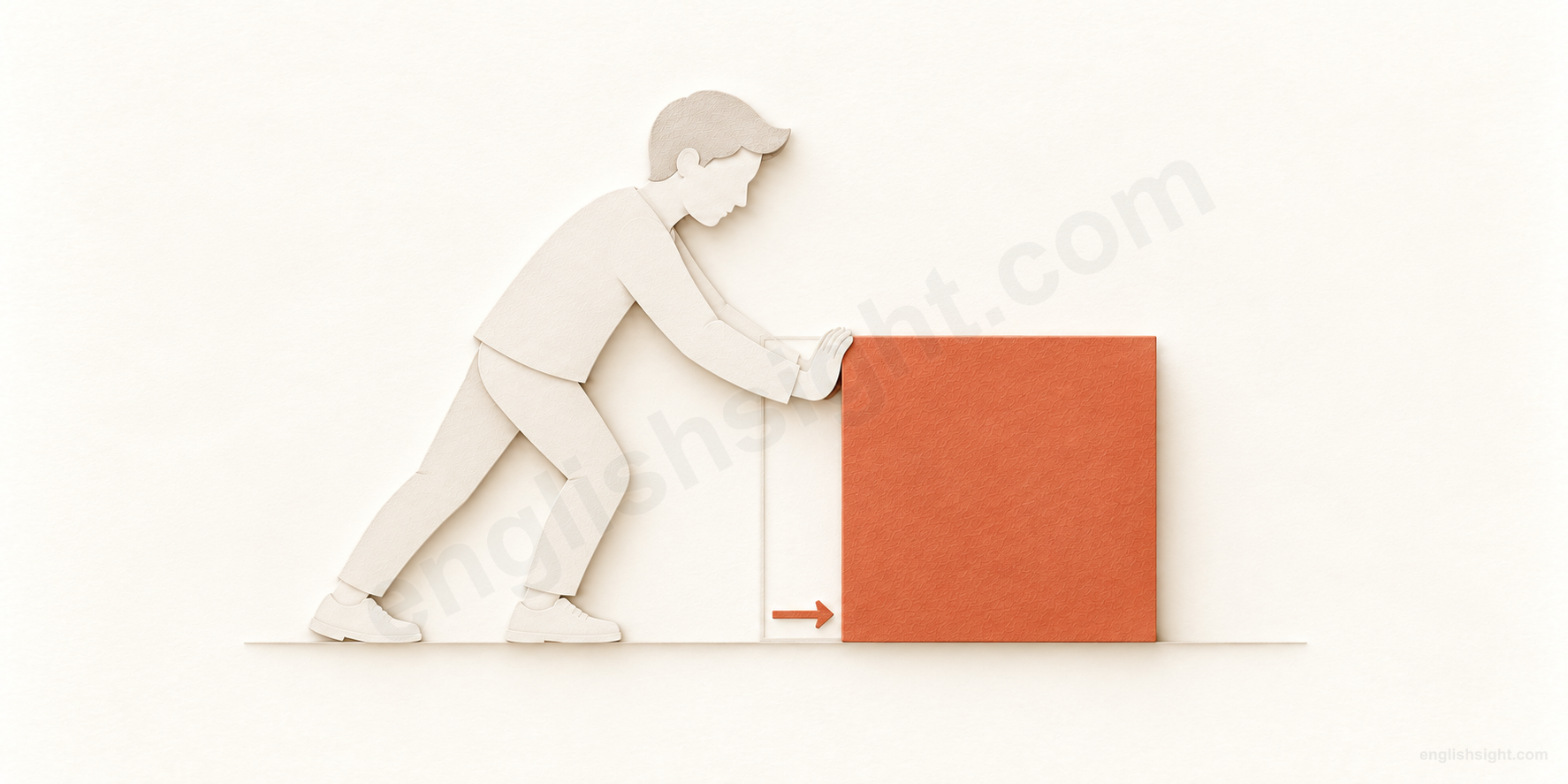
Use feeble for weakness in a body, a sound, an action, or a reason.
Strength that falls short
Strength that falls short
Little strength available
feeble
Only a small movement
A weak push shifts the box a short distance to the right.
A weak push has a small effect here. Feeble can also describe a weak sound, light, effort, or reason; it does not always mean total failure.
Feeble describes someone or something with noticeably little strength, intensity, or effective force.
The push in the sketch illustrates weak force and a small effect. This is a teaching connection, not an origin story or a rule that every feeble action must fail.
A person may lack physical strength; a light may give little illumination; an excuse may have little power to convince. Feeble connects these situations through a noticeable lack of strength or effect.
The noun and the situation tell you what kind of weakness matters. With actions and explanations, feeble often expresses a negative judgment rather than a neutral measurement.
01
Bodies, sounds, and light
Identify what is weak: physical strength, loudness, or illumination. These are related qualities, but they call for different everyday comparisons.
01
feeble + noun; be / feel / look + feeble; too feeble to + verb
feel feeble / a feeble grip
have very little physical strength
Situation
After several days in bed, carrying a bag feels difficult.
What falls short?
You describe your reduced strength.
Feeble describes a condition or a sign of weakness, not necessarily a permanent trait.
Use feeble before a noun or after a linking verb: a feeble grip; I feel feeble. A grip, step, or movement can show the person’s lack of strength.
Feeble is stronger and more evaluative than the more general word weak in many contexts. I feel weak is often an easier, more neutral everyday report; calling another person feeble can sound unkind.
Too feeble to carry it adds a consequence through too + adjective + to-infinitive. The adjective itself does not specify which task is impossible. Frail emphasizes a delicate condition; feeble emphasizes lack of strength.
In a sentence
I still feel feeble after the flu, so could you carry this bag?
Watch the difference Do not treat old age as part of the definition: people can be feeble for other reasons, and an older person need not be feeble.
02
a feeble voice / cry; someone’s voice sounds feeble
a feeble voice / cry
a sound with little strength or volume
Situation
Someone tries to call from another room.
What falls short?
The call comes out weakly.
The sound lacks strength; the words may still be clear.
A feeble voice or cry suggests a weak sound. The surrounding situation may suggest exhaustion or illness, but the adjective alone does not identify its cause.
A faint voice is difficult to hear and may simply be far away. A feeble voice draws attention to its lack of strength. Quiet describes low volume without necessarily suggesting weakness.
In a sentence
Her voice sounded feeble, but we could understand every word.
Watch the difference A feeble voice does not mean a bad argument: distinguish the sound from what the speaker says.
03
a feeble light; the light is feeble
a feeble light
light that provides little illumination
Situation
You switch on a lamp in a dark shed.
What falls short?
Only the nearest objects become visible.
The light has little intensity or practical illuminating power.
Feeble can describe a light that seems weak for its surroundings. It need not be flickering, and the adjective does not tell you why it is weak.
Dim is a straightforward choice for low brightness. Feeble light places more emphasis on how weak the illumination is; pale describes color and does not necessarily mean insufficient brightness.
In a sentence
The lamp gave a feeble light, leaving most of the shed in darkness.
Watch the difference Do not use feeble as a general replacement for small: a small lamp can produce a strong light.
02
Effort, resistance, and resolve
Feeble can judge how little force or effectiveness an action has. Applied to someone’s decisions, it can become a sharp criticism.
04
make a feeble attempt / effort to + verb
a feeble attempt / effort
an attempt that shows little energy or effectiveness
Situation
Someone briefly tries to solve a problem.
What falls short?
You judge the effort as inadequate.
The adjective evaluates the attempt, while the following infinitive names its purpose.
In make a feeble attempt to help, make supplies the action, attempt names the try, and to help tells us its aim. Feeble adds the judgment that the attempt lacks force, energy, or effectiveness.
A failed attempt reports the outcome. A feeble attempt judges the quality of the attempt and may suggest too little effort; failure by itself does not show that the effort was feeble.
In a sentence
He made a feeble attempt to clear the snow, then went back inside.
Watch the difference The pattern is attempt to do something. Feeble is an adjective modifying attempt, not a verb meaning try.
05
offer / put up feeble resistance; make a feeble protest
feeble resistance / a feeble protest
opposition with little force or effect
Situation
A group objects to a proposal.
What falls short?
Its objection does little to challenge the decision.
There is opposition, but it is weak.
Resistance and protest name ways of opposing something. Feeble describes their limited force, determination, or effect. It does not mean that nobody objected.
A feeble protest may be spoken softly, but it may instead lack conviction. Context decides whether the weakness is physical, vocal, or practical.
In a sentence
The committee approved the plan despite a feeble protest from two members.
Watch the difference Do not infer agreement from feeble resistance: weak opposition is still opposition.
06
be feeble; don’t be so feeble
Don’t be so feeble.
criticize someone for lacking determination or strong action
Situation
A person repeatedly avoids expressing a decision.
What falls short?
Someone criticizes their unwillingness to act firmly.
This is a judgment about conduct, not a claim about muscle strength.
Applied to a person or a government in this sense, feeble criticizes a lack of decisiveness or effective action. Read the context before assuming illness or physical weakness.
Don’t be so feeble is a blunt criticism. In a supportive conversation, state the action you want instead, such as Please tell them what you need. The imperative comes from don’t be; feeble remains an adjective.
In a sentence
“Don’t be so feeble,” he said. “Tell them you disagree.”
Watch the difference This wording can insult the listener. It is not a neutral way to encourage someone who feels unwell.
03
Reasons and responses that fall short
An argument may fail to persuade, an excuse may fail to justify, and a joke may fail to amuse. The weakness is in the expression’s effect.
07
a feeble argument for / against + noun or -ing
a feeble argument
reasoning with little power to persuade
Situation
Someone gives reasons for changing a rule.
What falls short?
The reasons do not provide convincing support.
The argument is weak as reasoning, regardless of how loudly it is delivered.
An argument here is a set of reasons, not necessarily a quarrel. Feeble evaluates how poorly those reasons support a conclusion.
A loud, confident speech can contain a feeble argument. Conversely, someone with a feeble voice may present strong evidence. Keep delivery and reasoning separate.
In too feeble a word, the same idea of insufficient force applies to language. The sentence “Annoyed” is too feeble a word for her reaction means that annoyed does not express the feeling strongly enough. The order is too + adjective + a + singular noun.
In a sentence
Saving one minute is a feeble argument for removing the safety check.
Watch the difference An unconvincing argument is not automatically a false conclusion; the problem is the support offered for it.
08
give / offer a feeble excuse for + noun or -ing
a feeble excuse
a poor or unconvincing justification
Situation
Someone explains why they missed a responsibility.
What falls short?
You find the explanation inadequate.
The speaker doubts the justification’s adequacy, without necessarily proving a lie.
An excuse tries to explain or justify a fault, absence, or failure. Calling it feeble expresses dissatisfaction with how little it justifies what happened.
An argument supports a claim; an excuse explains away a problem or responsibility. Both can be feeble, but they do different conversational jobs. This is a familiar adjective–noun combination, not an idiom with an unrelated meaning.
In a sentence
She offered a feeble excuse for missing the meeting: she had not checked the time.
Watch the difference Feeble expresses the evaluator’s judgment. It does not itself establish whether the explanation is true.
09
tell / make a feeble joke
a feeble joke
a joke judged poor or unamusing
Situation
Someone tries to make a tense group laugh.
What falls short?
The attempt at humor falls flat.
The weakness is in the humor’s effect, not necessarily its volume or subject matter.
A feeble joke is a poor attempt at humor. The listener judges it as lacking the effect a joke is meant to have.
A quiet joke concerns how it is told; a feeble joke concerns its quality. A weak smile can also be called a feeble smile: the expression has little strength, perhaps because the person is tired or unsure, rather than because the smile is a bad joke.
In a sentence
I made a feeble joke about the weather, but nobody laughed.
Watch the difference Feeble is not a synonym for offensive. A joke can be harmless yet unfunny.
Choose the strength, the grammar, and the tone
Adjective and adverb
Feeble /ˈfiːbl/ is an adjective: a feeble wave; the wave was feeble. Feebly is the adverb: she waved feebly. Feebleness is the related noun. Do not write she waved feeble in standard English.
Comparison and degree
The comparative and superlative are feebler and feeblest. Degree words such as very, rather, and so can modify feeble. These forms express degree of weakness rather than separate meanings.
Weakness is not always failure
Feeble describes little strength, intensity, or effectiveness. Something feeble can still be heard, seen, or partly successful. The sketch’s small movement is one illustration, not a prediction for every use.
Scope and word families
This lesson covers the modern adjective and useful related forms. It does not develop historical labels for intellectual ability, rare compounds, or specialist scientific applications. As an adjective, feeble has no tense, passive, or phrasal-verb system; the surrounding verbs supply those grammatical features.
Find the kind of weakness
Read the situation before deciding what feeble describes.
1. A speaker talks softly but gives excellent evidence. What can reasonably be feeble?
2. A team worked energetically, but its plan failed. Does the failure alone make its effort feeble?
3. You want to say that someone’s wave showed little strength. Which sentence uses an adverb correctly?
4. A manager calls a reason for being late “a feeble excuse.” What does that tell us?
Sources and teaching notes
The dictionary entries below support the senses, forms, and usage distinctions. The explanations and examples are original; the visual connection is a teaching interpretation.
The diagram illustrates a connection; it does not represent an image shared by every native speaker.