Use female for people, animals, plants, and a separate technical kind of fitting.
Category, then connection
Category, then connection
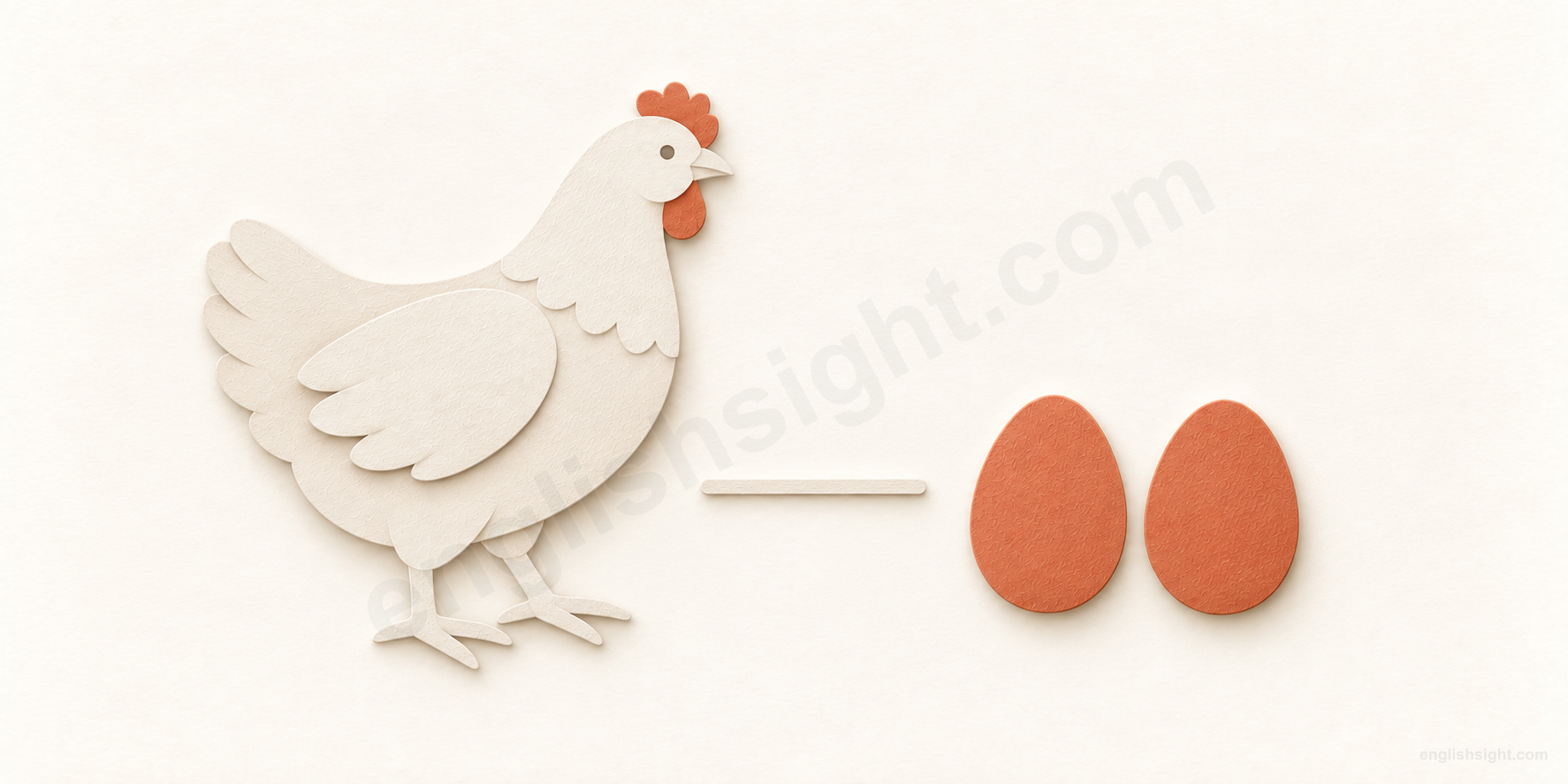
A hen stands beside two eggs.
female
The hen illustrates one biological use of female.
Egg production illustrates a reproductive sex category.
A hen and eggs illustrate one biological use of female.
Female identifies the female category of a person or living thing, or describes something associated with that category. In biology, the category is typically linked with producing eggs or bearing young.
The hen and eggs illustrate one biological case, not a rule that every female reproduces. People’s identities and descriptions need their own context. The connector sense is a separate technical convention.
Female /ˈfiːmeɪl/ is an adjective and a countable noun. It can identify a woman or girl, classify an animal or plant by reproductive sex, or describe something associated with that category. Read the following noun and the situation before choosing the meaning.
The central teaching link is classification and association, not an action or a personality trait. The biological diagram illustrates one part of that link; technical female connectors need their own explanation.
01
Describing people and groups
Female can describe a woman or girl, a group’s membership, or something associated with women and girls. The noun that follows tells you which relationship is meant.
01
a / the + female + person or role noun; female + plural noun
a female engineer
an engineer who is a woman
Context
You are identifying a person by occupation.
What female identifies
You add that the engineer is a woman.
Female describes the person named by the following noun.
Put female before a noun such as engineer, student, colleague, athlete, or character. Female covers women and girls; the noun and context establish age and role. A female student may be a girl or an adult woman.
The job or role comes from engineer, not from female. A female engineer is not a special kind of engineering, and the phrase does not imply anything about ability, appearance, or manner.
Use the description when it helps the message, for example when discussing representation. Engineer alone is sufficient when gender is irrelevant. Woman engineer is also possible; in the plural, women engineers and female engineers are both used.
In a film discussion, the female lead can mean the main female role or the performer playing it. Lead supplies the meaning of a principal role; this is a collocation, not an idiom with a new meaning of female.
In a sentence
Maya was the first female engineer to join our small team.
Watch the difference Female is unchanged before a plural noun: female engineers, not females engineers.
02
subject + be + female
be female
be a woman or girl, or belong to the female sex
Context
Someone asks about the membership of a group.
What female identifies
You give a description after be.
Female can be an adjective after a linking verb, without an article.
In Two of the applicants are female, female is an adjective describing the applicants. The same grammar works for an animal: The kitten is female. Male is the corresponding adjective in a comparison.
She is female uses an adjective; she is a female uses a countable noun and sounds more like classification. For ordinary introductions, She is a woman or simply the person’s name and role is usually more natural.
Female describes a category here, not a degree of elegance or a style. Very feminine can describe a culturally associated appearance or manner; very female is not the ordinary way to state someone’s sex or gender.
In a sentence
Three of the five finalists are female.
Watch the difference No article is needed before the adjective: They are female. With a countable noun, use a female or females.
03
a predominantly / mainly female + group noun; an all-female + group noun
a predominantly female audience
a group made up mostly of women or girls
Context
You describe who attended an event.
What female identifies
You specify the group’s composition.
A group noun shifts the description from one person to the people making up the group.
A female audience or female workforce refers to the people in that audience or workforce. Predominantly female and mainly female mean mostly women or girls, not necessarily everyone.
All-female makes the stronger claim that all members are female. An all-female choir is a choir whose members are women or girls. Keep the hyphen when all-female is used together before a noun.
Female does not mean a group belongs to one woman. A female audience concerns membership; a woman’s audience concerns that woman’s listeners. The surrounding words determine the relationship.
In a sentence
The workshop attracted a predominantly female audience.
Watch the difference Predominantly female means mostly female; it does not mean all-female.
04
female + voice / health / education / other associated noun
female voices / female health
voices of women or girls; health matters concerning them
Context
You are describing a sound or an area of concern.
What female identifies
Female identifies the people connected with it.
With a thing or topic, female expresses an association rather than making that thing a person.
Female voices are voices of women or girls, as in music written for female voices. The word identifies the singers, not one compulsory pitch or vocal style.
Female health and female education refer to matters affecting or involving women and girls. In many everyday contexts, women’s health and girls’ education are useful more specific alternatives. Choose the age group and subject you actually mean.
Female can also identify the intended users of something. Female undergarments means underwear intended for women; women’s underwear is an everyday alternative. Here the word identifies the wearers rather than the object’s sex.
Some uses describe what a culture traditionally associates with women, such as a traditionally female occupation. Traditionally is important: it describes a social pattern, not a rule about who can do the work.
Compare a female character with a feminine character. The first identifies the character as a woman or girl; the second can describe qualities the speaker associates with women. These meanings can overlap in some contexts, but the words are not freely interchangeable.
In a sentence
The new arrangement includes a part for female voices.
Watch the difference Female does not automatically mean feminine, gentle, high-pitched, or suitable only for women.
02
Naming a category and reading records
As a noun, female has a more classificatory tone. Distinguish a person’s description now from an expression about what was recorded at birth.
05
a female; two / several females; males and females
a female / females
a woman or girl considered as a member of a category
Context
A report compares categories of participants.
What female identifies
Females names one category without a following person noun.
The countable noun is established in formal classification but needs care in personal conversation.
A female and two females are countable noun forms. In a statistical, medical, or official description, females can group women and girls together. The context must make clear that people are being discussed; the same noun also names animals.
For talking about adult people in everyday conversation, women is usually more natural. Calling a woman a female can sound impersonal or disparaging, especially where other people are called men. It is not a universal ban: register and context matter.
Compare female participants with females. The first keeps participants as the head noun and uses female as an adjective; the second uses female itself to name the people. Do not assume the tone is identical.
The plural is females, without an apostrophe. In the phrase the female of the species, female is also a noun; the species supplies the biological context.
In a sentence
The survey report gives separate totals for males and females.
Watch the difference For a casual introduction, This is a woman from my class is usually more natural than This is a female from my class.
06
be assigned female at birth; AFAB
assigned female at birth
recorded as female when born
Context
A discussion distinguishes a birth record from present gender identity.
What female identifies
The expression refers specifically to the assignment made at birth.
The full expression adds a time and a recording decision; female alone does not express those details.
Assigned female at birth, often abbreviated AFAB, refers to being recorded as female at birth. You may encounter it in discussions of gender identity, including descriptions of people whose identity differs from that record.
Was assigned is passive: somebody made that assignment. At birth tells when. The phrase does not by itself tell you the person’s present gender identity, so it is not a substitute for woman in every context.
This is a recognition item for reading and discussion, not a label to guess from someone’s appearance. The ordinary adjective female remains much broader than this particular expression.
In a sentence
Alex is non-binary and was assigned female at birth.
Watch the difference Do not read assigned female at birth as a statement that the person currently identifies as a woman.
03
Animals, flowers, and plants
Biological uses concern reproductive sex. A particular female does not have to be reproducing now, and the details vary between species.
07
female + animal noun; animal + be + female
a female cat
a cat belonging to the female sex
Context
You need to specify an animal’s sex.
What female identifies
Female classifies the animal while cat names its species.
The biological category is associated with producing eggs or bearing young, not with a particular look.
Female works with species nouns such as cat, rabbit, and butterfly. Some animals also have a familiar sex-specific word: a hen is a female chicken. Female cat is useful when you want a general, clear description.
The reproductive distinction concerns the sex category typically associated with producing eggs or bearing young. It does not assert that this particular animal is fertile, pregnant, adult, or currently producing eggs.
The hen and eggs in the diagram illustrate one familiar species. They are not a test for every female animal, and they do not explain the separate connector meaning.
The female sex and female reproductive organs are biological expressions using the same adjective. Detailed anatomy varies by species and is outside this vocabulary lesson.
In a sentence
We adopted a female cat from the shelter.
Watch the difference Female is broader than mother: a female animal need not have had offspring.
08
a / the female; adult females; females of this species
the female / adult females
a female animal, with the species understood
Context
A wildlife account has already named the species.
What female identifies
The female identifies an animal by sex without repeating its species.
Female is a neutral countable noun in animal descriptions.
After the species has been established, the female or a female can stand for a female animal of that species. Adult females adds age; nesting females adds behavior or condition. Those extra meanings come from adult and nesting.
The female laid an egg is grammatical because female is the subject noun. The female bird laid an egg uses female as an adjective and bird as the subject noun. These constructions can describe the same event.
Use females for more than one. In a generic description, females of this species means female members of the species in general; the sentence still needs a verb and context to state what they do.
In a sentence
The keeper counted the ducks, then watched two adult females return to the pond.
Watch the difference The female is not automatically the mother of every young animal nearby; it simply identifies sex in the relevant context.
09
female + flower / plant / species noun; a female (in a plant context)
female flowers / a female plant
flowers or plants with the female reproductive role
Context
A gardening guide describes how a plant produces fruit.
What female identifies
Female identifies the reproductive role of the plant or flower.
The biological use also applies to plants, although their structures differ from animals.
A female flower has the reproductive structures that can develop into fruit after fertilization. A female plant is described by its female reproductive structures or flowers, for example a female holly.
A species may have male and female flowers on the same plant or on different plants. Do not assume all plants divide into separate male and female individuals. The term can describe a flower even when the whole plant has both kinds.
In an established botanical context, a female can also mean a female plant. For a beginner, a female plant or a female holly is often clearer because it names the thing being classified.
The category indicates reproductive role, not a guarantee that this plant will produce fruit now. The hen model gives an analogy of sex classification, not a picture of plant anatomy.
In a sentence
The guide marks this holly as a female plant.
Watch the difference Female flower does not mean a flower intended as a gift for a woman.
04
A separate technical use
On connectors and fittings, female names a receiving shape. This established technical extension does not classify the object as a living thing.
10
female + connector / coupling / plug / thread
a female connector
a connector with a recess that receives a matching projecting part
Context
You compare the shapes of two matching fittings.
What female identifies
Female identifies the receiving part.
This technical convention concerns shape and fit, not biological sex.
A female connector has a hollow, hole, socket, or groove into which the matching male part fits. You can meet female with connector, coupling, plug, or thread. Female thread is inside a fitting; male thread is on the outside of the mating part.
The words describe the relevant mating feature, not necessarily the whole object’s overall shape. A female plug is therefore not a contradiction: plug can be the device name while female specifies its contacts or receiving form.
This is an established technical extension. Learn it as a separate branch rather than treating the biological illustration as a complete explanation. Female alone does not guarantee compatibility; the particular size and design still matter.
In a sentence
This cable ends in a female connector with two recessed contacts.
Watch the difference Female connector describes the fitting, not the sex of the person using it.
Choose the form and the context
Female, woman, and feminine
Woman is the everyday noun for an adult female person; female can apply to girls, women, animals, and plants. Feminine often describes qualities or appearance culturally associated with women. For grammatical gender in a language, use feminine noun, not female noun: a table can have feminine grammatical gender without being female.
Adjective or countable noun?
The adjective has no plural ending: female students, the students are female. The noun has a plural: one female, two females. Female is not an ordinary verb, and it has no everyday phrasal-verb family. These category uses do not normally take comparative or superlative forms.
A category is not a fertility test
Biological definitions describe a reproductive category, not a promise about an individual’s age, fertility, or current activity. Descriptions of people can also involve gender identity; context matters. Clothes, interests, and behavior do not determine the meaning of female.
Scope of this lesson
The lesson covers everyday adjective and noun uses, common descriptive combinations, the modern birth-assignment expression, and a practical connector sense. It does not teach medical diagnosis, detailed botanical anatomy, or the specialist poetic term female rhyme. Those need their own subject knowledge.
Choose the meaning and form
Use the noun, the context, and the tone to decide.
1. You are writing about several engineers who are women. Which phrase has the correct adjective form?
2. Most of the audience are women, but some are men. Which description fits?
3. A shelter says a kitten is female. What does that tell you?
4. You are casually introducing an adult classmate. Which is usually more natural?
5. A parts list calls a connector female. Which feature is being described?
6. A profile says Alex was assigned female at birth. What does that expression itself specify?
Sources and teaching notes
Publisher dictionary entries and usage notes were read for the meanings, forms, and register below. Explanations, examples, and the diagram are original teaching material. Coverage details distinguish dictionary evidence from the teaching model.
The diagram illustrates a biological example; it is not a mental picture shared by every English speaker.