From soil and reproduction to imagination and conditions for development.
The capacity for new growth
The capacity for new growth
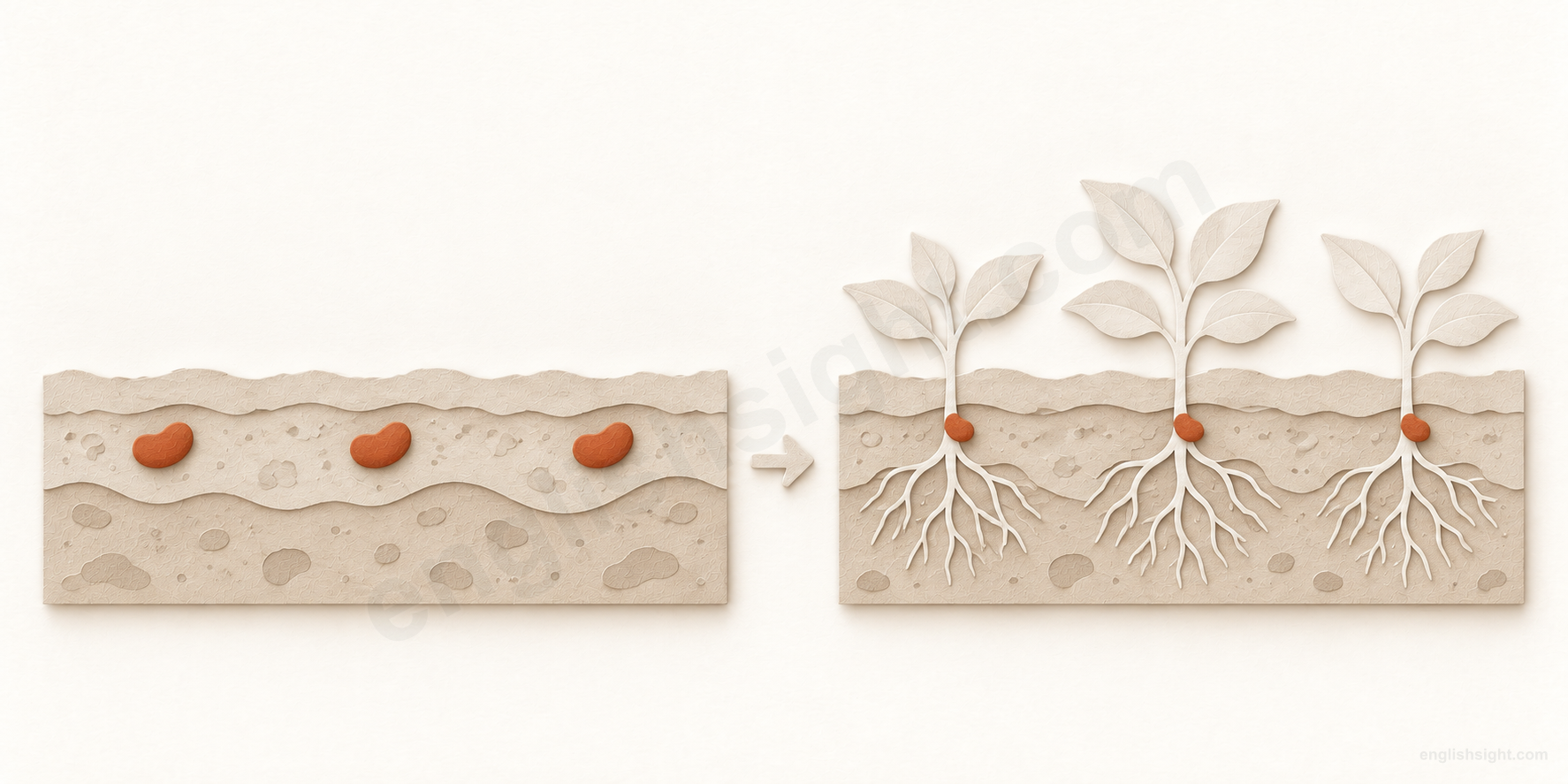
Three seeds lie in soil that can support growth; no plants are visible yet.
fertile
Three leafy plants grow above the same soil, with branching roots below.
With suitable growing conditions, the seeds develop roots and shoots.
Fertile soil can support new growth before any plants appear.
Fertile describes a capacity to produce new life or ideas, or conditions that support growth and development.
The soil sketch illustrates support for growth. Reproductive ability and creative thinking are related branches, not literal soil inside a body or mind. Fertile can describe a capacity before any result appears.
Fertile is an adjective. It can describe land that supports plant growth, living things that can reproduce, and minds that generate ideas. In figurative expressions, it can describe conditions that allow something to develop.
The useful connection is productive capacity: something can grow, be produced, or develop. Read the noun to find out what kind of capacity is meant. A fertile valley and a fertile imagination are related uses, but they are not interchangeable descriptions.
01
Soil, reproduction, and development
Distinguish the ground that supports life, the organism that can reproduce, and the seed or egg that can develop.
01
fertile + soil / land / region; soil / land + be / become + fertile
fertile soil / land
ground that can support strong plant growth
Situation / capacity
You choose a place for a vegetable garden.
Possible or actual development
The soil can support healthy crops.
The soil supports the plants; it does not reproduce like an animal.
Use fertile before soil, land, farmland, or the name of a growing region: a fertile valley. You can also put it after be or become: The soil is fertile; The land became more fertile.
Fertile describes the ground’s capacity to sustain growth. It does not say a crop is already present or that every crop will succeed. Water, light, and other growing conditions still matter.
Very fertile and more or less fertile express degree. Fertility is the related noun: soil fertility. Fertilizer is a substance added to help plants grow; it is not the adjective for the land.
In a sentence
We planted beans in the fertile soil behind the house.
Watch the difference Fertile and fertilized are different: fertilized soil has had fertilizer added; fertile soil has the capacity to support growth.
02
a fertile + person / animal / plant; person / animal / plant + be + fertile
a fertile animal / plant / person
a living thing able to reproduce
Situation / capacity
A breeder needs an animal that can have offspring.
Possible or actual development
The animal has reproductive ability.
Here fertile describes the organism’s ability to produce new life.
A fertile animal or person is capable of reproduction. A fertile plant can produce fruit, seeds, or new plants, depending on the plant and context. The subject is the living organism, rather than the soil around it.
The description can concern ability, not proof that offspring have already been produced. A fertile animal need not have had young yet. In some descriptions, fertile instead emphasizes producing many offspring. Read the context to distinguish capacity from abundant output; the word does not simply mean healthy or physically strong.
Fertile is used of both male and female reproductive ability, not only pregnancy. This is biological or medical language when used about people; it does not describe someone’s value or imply a wish to have children.
In a sentence
The young bull is fertile, but it has not yet fathered any calves.
Watch the difference Do not replace fertile with pregnant: pregnant describes an existing pregnancy, while fertile describes reproductive ability.
03
fertile + egg / seed
fertile eggs / seeds
eggs or seeds capable of developing into new life
Situation / capacity
A farmer selects eggs for an incubator.
Possible or actual development
The selected eggs have the capacity to develop into chicks.
The egg or seed itself can develop; it is not the surrounding ground.
With an egg or seed, fertile can mean capable of growth and development. In poultry keeping, fertile eggs are fertilized eggs that can develop into chicks under appropriate conditions.
The noun changes the relationship. Fertile soil supports a plant; a fertile seed can become a plant; a fertile plant can reproduce. These are connected but distinct claims.
Fertile does not guarantee successful hatching or germination. The example describes the farmer’s selection for possible development, not a certainty about every egg.
In a sentence
The farmer put the fertile eggs in the incubator.
Watch the difference A fertile egg is not an egg that produces lots of eggs; the relevant ability is development into a new organism.
02
A mind that generates ideas
The growth connection becomes figurative when we describe imagination and invention.
04
a fertile imagination / mind / brain; the product of + possessive + fertile imagination
a fertile imagination / mind
an imagination or mind that produces many original ideas
Situation / capacity
A writer needs possibilities for a new story.
Possible or actual development
Many inventive possibilities come to mind.
Ideas are the figurative new growth.
A fertile imagination generates many ideas, stories, or possibilities. Fertile mind and fertile brain express a similar creative capacity. These combinations commonly place fertile before the noun.
In the pattern the product of someone’s fertile imagination, product means something the person has imagined or invented. It may be a creative achievement, or the context may suggest that an alleged event was invented.
This is about inventiveness, not simply having knowledge or scoring highly on a test. Compare a fruitful discussion, which emphasizes useful results from a discussion rather than the mind’s ability to generate ideas.
In a sentence
Her fertile imagination turned a broken clock into the starting point for three stories.
Watch the difference A fertile imagination does not guarantee that its ideas are true, sensible, or useful in every context.
03
Conditions, topics, and productive connections
Learn the noun and its following preposition: ground for an activity, an area for research, or a source of something.
05
be / provide + fertile ground for + noun; a fertile breeding ground for + noun
fertile ground for…
conditions in which something can develop or spread easily
Situation / capacity
Rumors can spread when reliable information is missing.
Possible or actual development
The lack of information encourages rumors to develop.
Ground is a metaphor for favorable conditions, including conditions for harmful developments.
Fertile ground for something describes a setting that helps that thing develop. The noun after for names the development: ideas, innovation, rumors, or conflict. There need not be any literal earth.
The related expression a fertile breeding ground for something strengthens the image of production or multiplication. It often appears with problems, as in a fertile breeding ground for resentment, but its meaning is not restricted to harmful things.
Favorable conditions are favorable to the named activity, not necessarily good for everyone. The expression does not say development is inevitable or that the conditions are its only cause.
In a sentence
The lack of clear information provided fertile ground for rumors.
Watch the difference Use for to name what can develop. The usual figurative expression is fertile ground for rumors, with ground uncountable.
06
a fertile area / field for + research / investigation
a fertile area / field for research
a topic offering many possibilities for investigation or development
Situation / capacity
Researchers choose a topic with many unanswered questions.
Possible or actual development
The topic offers promising lines of investigation.
Here the field is a subject to explore, rather than a physical place.
A fertile area or field for research offers many possibilities for investigation. The noun may name a topic or intellectual territory; it does not have to name a laboratory or geographical region.
Compare fertile ground for research, which can emphasize the conditions supporting research. A fertile field for research often emphasizes what there is to investigate. Context can allow the two images to overlap.
This is a figurative extension of opportunities for growth. The preposition for introduces the activity, and further can specify that more work remains: a fertile field for further research.
In a sentence
The newly discovered letters opened up a fertile field for further research.
Watch the difference Fertile does not mean the research is already finished or its conclusions are correct.
07
a fertile source of + plural or uncountable noun
a fertile source of…
a source that produces or supplies much of something
Situation / capacity
A shared kitchen brings neighbors together.
Possible or actual development
It repeatedly gives them subjects to disagree about.
Source identifies where something comes from; of names what is supplied.
A fertile source of something supplies plenty of it. A fertile source of ideas gives many possibilities; a fertile source of argument repeatedly gives people reasons to argue.
The expression focuses on output or supply. In fertile ground for ideas, the setting encourages ideas to develop; in a fertile source of ideas, the source supplies ideas. The situations may overlap, but the noun and preposition organize the meaning differently.
The result need not be positive. Learn the collocation together with of, rather than treating fertile as a word that always praises everything following it.
In a sentence
The shared kitchen became a fertile source of disputes between the neighbors.
Watch the difference Use source of to name the output. For belongs to patterns such as ground for, not automatically to every noun following fertile.
08
a fertile partnership / collaboration
a fertile partnership
a working relationship that produces useful or creative results
Situation / capacity
Two designers bring different skills to a project.
Possible or actual development
Their collaboration produces new designs.
The relationship is productive; the meaning is figurative, not reproductive.
A fertile partnership is one that produces results, often creative or intellectual ones. This extends the productive-capacity connection to a relationship between people or organizations.
The phrase describes the collaboration rather than saying either person is biologically fertile. It is more characteristic of descriptions of creative or professional work than an ordinary request to work together.
Productive partnership is a straightforward alternative. A fertile imagination describes a person’s creative capacity; a fertile partnership describes what the collaboration makes possible or produces.
In a sentence
Their fertile partnership produced a series of unusual furniture designs.
Watch the difference Do not assume fertile means reproductive whenever people are involved; read the noun it describes.
Keep the noun and the limits in view
Capacity and results are connected, but different
Fertile may describe an ability or favorable conditions before anything is produced. It can also describe something already producing abundantly. The sentence tells you which emphasis matters.
Adjective grammar and pronunciation
Use fertile before a noun or, where natural, after a linking verb: fertile land; the land is fertile. More fertile and most fertile are the usual comparison forms. Common pronunciations are British /ˈfɜːtaɪl/ and American /ˈfɜːrtl/. It is not an everyday verb, so passive, causative, and phrasal-verb inventories do not apply to fertile itself.
Related words and opposites
Fertility is the usual related noun. Infertile contrasts with fertile in land and reproductive contexts; barren also occurs with land, and sterile has its own biological and figurative uses. These words have different ranges: do not treat every dictionary antonym as interchangeable in every sentence.
Scope of this lesson
These are common modern uses, not a frequency ranking or every technical sense. Detailed botanical terminology and the nuclear-physics use in fertile material are outside this introductory lesson.
What kind of capacity?
Use the noun and the whole expression to choose the meaning.
1. The field is fertile, but nothing has been planted yet. Is the description possible?
2. Complete the figurative expression: The confusion provided fertile ground ___ rumors.
3. A novelist has a fertile imagination. What does this description emphasize?
4. Why might a farmer select fertile eggs for an incubator?
Sources and teaching notes
The dictionary sources below support the meanings and usage notes. The explanations and examples are original; the soil sketch is a teaching illustration of support for growth.
The sketch illustrates one connection between the uses; it does not represent a shared mental picture for every English speaker.