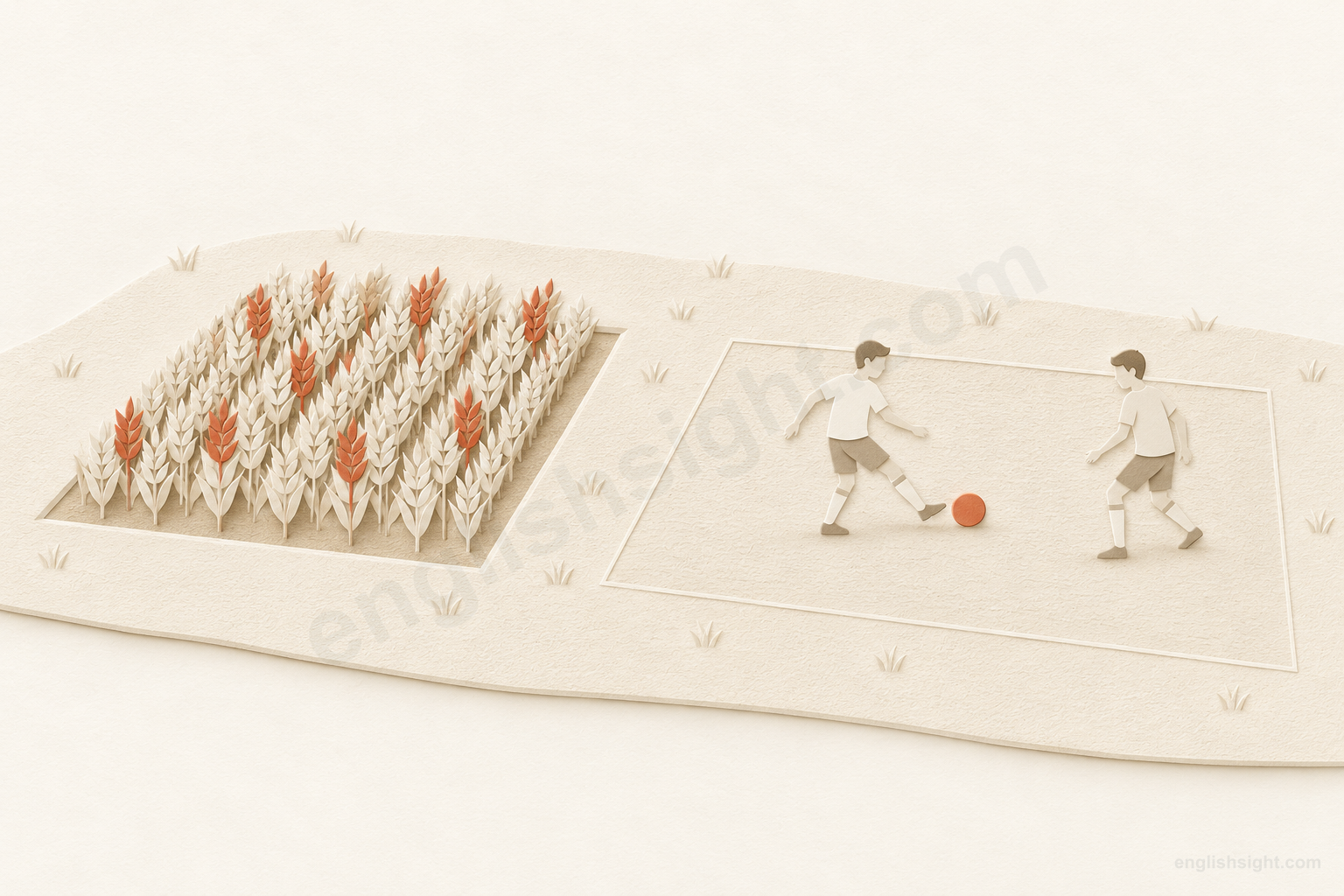
From a piece of land to a subject, a real working setting, a data item, and a group of competitors.
An area with an identity
An area distinguished from its surroundings
A wider stretch of land.
field
A wheat field and a playing field.
Crops and play give two areas their identity.
Contents or activity can distinguish an area as a field.
A field is often an area or domain identified by what occupies it or what happens within it.
The outline is a teaching model. A field need not have a fence or a sharp edge. Competitor-group senses, verb uses, and idioms require their own explanations; they are not all literal areas.
Field often invites us to treat a stretch or domain as a distinct area, identified by its contents, purpose, or activity. A wheat field is literal land; a field of research is an area of knowledge. This is a useful connection for learning, not a rule that predicts every meaning.
The noun and verb have several established branches. We will read the surrounding words carefully: on the field, in her field, field a team, and field questions do different jobs.
01
Land and places with a purpose
Start with a piece of land, then notice how crops, games, resources, or military activity identify different kinds of field.
01
a field; fields; a field of + crop; in / across a field
a field of wheat
a piece of open land used for crops or animals
Situation / context
A farm contains several separate areas.
Meaning in this context
One area is identified by the wheat growing there.
Field names the land; wheat names its contents.
A field can contain grass, crops, or grazing animals. A field of wheat identifies what grows there; a wheat field puts the crop before the noun. A field need not be a whole farm, and it need not be planted at this moment.
Say in a field when locating something within the area, and across a field when describing a route from one side to another: We walked across the empty field. These are ordinary prepositional phrases, not phrasal verbs. Land is a broader, usually uncountable word; a field is one countable area.
In a sentence
We grow wheat in the field behind the house.
Watch the difference Use a field or some fields. For a general quantity of land, say some land, not some lands in this farming sense.
02
on / off the field; take the field
on the field / take the field
on the playing area, or entering it to play
Situation / context
The teams are waiting beside the playing area.
Meaning in this context
They enter it and begin the match.
The activity identifies the area; on is the usual sporting preposition.
A football field and a baseball field are places set aside for a game. Pitch is another word used for several sports, especially in British English. The natural term depends on the sport: a tennis court is not normally called a tennis field.
On the field locates players during play; off the field can mean away from the playing area or in life outside matches. Take the field means go out to play, not remove or acquire the land. The players took the field at noon is a sporting expression with take.
In a sentence
The captain stayed calm both on and off the field.
Watch the difference Playing on the field concerns location. Playing the field, with no on, has a separate idiomatic meaning.
03
a field of + covering; an ice / snow field
a field of snow
an extensive area covered with something
Situation / context
You look over a broad stretch of ground.
Meaning in this context
Snow gives the whole stretch its appearance.
The covering can define a field without crops or a fence.
In a field of snow or an ice field, field presents a stretch as one expanse. It is not necessarily a cultivated plot. The same area-like teaching connection remains, while what covers the area has changed.
Of introduces the covering; it does not mean that snow owns the land. These are established descriptive combinations, not permission to replace every use of area with field.
In a sentence
Beyond the rocks lay a wide field of snow.
Watch the difference For an ordinary patch on a wall, use an area or patch of paint rather than assuming field is always natural.
04
an oil / gas field; oil and gas fields
an oil / gas field
an area containing a deposit of a natural resource
Situation / context
A survey identifies oil beneath a region.
Meaning in this context
The region is treated as an oil-producing area.
A resource below the surface can identify the field.
An oil field or gas field is a resource-bearing area. It may be under land or beneath the sea; field here does not require grass or a visible enclosure.
The first noun names the resource. Compare a wheat field: wheat grows on the surface, whereas an oil field is identified by the deposit below it. Some related compounds are also written as single words, such as oilfield and coalfield.
In a sentence
The company discovered a gas field beneath the seabed.
Watch the difference A field is the resource area; a well is a particular place drilled to reach it.
05
in the field; on the field of battle; a field hospital
in the field / field of battle
where military operations are taking place
Situation / context
Some staff remain at headquarters.
Meaning in this context
Other personnel work where operations are underway.
Military activity supplies the sense of the field.
In military contexts, in the field refers to active operations away from a base or headquarters. On the field of battle refers more directly to the place of fighting and can sound formal or historical.
Field can also modify equipment used under these conditions: a field hospital provides medical care near operations. It does not mean a hospital for farmers. The context distinguishes military operations from ordinary research in the field.
In a sentence
The medics set up a field hospital near the border.
Watch the difference In the field does not by itself mean that someone is fighting at that exact moment.
02
Knowledge, real settings, and defined ranges
A field can organize an activity, a view, a physical effect, or a piece of information. These uses share an area-like idea, but each has its own conventions.
06
in the field of + subject; in / outside someone’s field
in the field of education
a particular area of study or professional activity
Situation / context
Many kinds of work and knowledge are available.
Meaning in this context
Education is selected as the relevant area.
The boundary is a subject boundary, not a fence.
A field of study, research, or work organizes related activity into an area. Someone can enter a field, change fields, or be an expert in a field without moving to a different physical place.
In the field of education names the subject. In her field uses a possessive to refer to her professional or academic area. That is outside my field and That is not my field politely signal that a question is beyond your expertise. Field is broader than a particular job title.
In a sentence
Maya works in the field of early childhood education.
Watch the difference Say an expert in this field. On this field normally suggests a physical playing surface instead.
07
in the field; field + research / study / test; do fieldwork
work / test something in the field
work in the actual setting of an activity
Situation / context
A device has passed indoor laboratory tests.
Meaning in this context
Researchers now test it under real operating conditions.
The field contrasts with the office, laboratory, or other controlled setting.
In the field can mean where the relevant activity actually happens. A researcher may collect observations there; a technician may test equipment there. The setting could be a village or a workplace, and need not be a grassy field.
Field research, a field study, a field test, and field conditions all use field before another noun. Fieldwork is commonly written as one word and is usually uncountable: We did fieldwork. Compare work in the field of medicine, which names a subject rather than necessarily describing a location.
In a sentence
We tested the recorder in the field before ordering fifty more.
Watch the difference In the field does not guarantee an uncontrolled experiment; it identifies the setting rather than every detail of the method.
08
go on a field trip; take a group on a field trip
go on a field trip
make an educational visit to observe things directly
Situation / context
Students have studied a river in class.
Meaning in this context
They visit it to examine its features.
The visit takes learning into the relevant setting.
A field trip is an organized visit for learning through direct observation. The educational purpose matters; field does not limit the trip to farmland.
Use go on a field trip or take students on a field trip. The whole compound names the visit, so it can be plural: two field trips. A field trip and fieldwork can overlap, but fieldwork names the practical work, while a field trip names a visit.
In a sentence
Our class went on a field trip to study the riverbank.
Watch the difference An ordinary holiday is not automatically a field trip.
09
someone’s field of vision; a camera’s field of view
a field of vision / view
the range visible from a position or through an instrument
Situation / context
A camera points toward the garden.
Meaning in this context
Only part of the garden appears through its lens.
The area is selected by what can be seen.
Your field of vision is the extent you can see without turning your head. A camera or other optical instrument has a field of view. These expressions concern a visible range, not a field that you happen to be looking at.
Wide and narrow describe the extent. Come into someone’s field of vision means become visible within that range. View has other meanings too, so learn field of view as a combination rather than substituting view into every use of field.
In a sentence
The bird disappeared beyond the camera’s field of view.
Watch the difference Field of vision concerns visible extent; a point of view can mean someone’s opinion.
10
a magnetic / electric / gravitational field; field strength
a magnetic / electric field
a region in which a physical influence is present
Situation / context
A magnet is near a small compass.
Meaning in this context
The compass responds even without touching the magnet.
A physical effect can extend across space.
Physics uses field for an influence distributed through a region of space, as in magnetic field, electric field, and gravitational field. The accompanying adjective tells you which kind of physical influence is meant.
This is a technical use worth recognizing in everyday science. Unlike the outline in the teaching sketch, a physical field need not have a sharp edge. Strength can vary from place to place; the sketch is not a scientific diagram of a magnetic field.
In a sentence
The compass needle responds to the Earth’s magnetic field.
Watch the difference A physical field is not just the visible object producing it, and its existence does not require direct contact.
11
enter something in / into a field; fill in a field; leave a field blank
fill in a required field
a separate place or item for a particular kind of data
Situation / context
A form asks for several kinds of information.
Meaning in this context
Each item goes into its own allocated place.
One part of the information is kept distinct from the rest.
An online form may have a name field, a search field, and a required field. A field can be the place where you type. In a data record, it can instead mean one separately defined item, whether or not a visible box is shown.
Enter a value in a field or fill in a field. Required tells you that it cannot be left empty; it is not part of the meaning of field itself. Compare a record containing separate name and address fields: each field holds one kind of information.
In a sentence
Enter your email address in the required field.
Watch the difference The field is the designated item or input area; the email address is its value.
03
Competitors and sporting expressions
The field can name the participants rather than the ground. Other fixed sporting combinations need to be learned as whole expressions.
12
a strong / large field; a field of + number / competitors
a strong field of competitors
the participants in a contest, treated as a group
Situation / context
Many runners have entered a race.
Meaning in this context
You assess the group that will compete.
Field now names the people in the contest rather than the ground.
A strong field means the competition includes capable participants. A field of twenty runners counts the entrants; it does not measure the size of the sports ground. The field can also refer to competing businesses or products.
The field is strong treats the group as a unit. British English can also use plural agreement when focusing on its members. In cricket and baseball, the field can additionally mean the fielding side: the players trying to stop the ball rather than the batting side.
In a sentence
The race attracted a strong field of forty runners.
Watch the difference Do not confuse a large field of runners with a large running area. Context determines whether field means participants or land.
13
lead the field in + activity; be ahead of the field
lead the field
be ahead of competitors or the best in an activity
Situation / context
Several firms are developing similar batteries.
Meaning in this context
One firm performs better than the others.
The field supplies the competitors; lead supplies superiority.
In a race, leading the field can describe being in front of the other entrants. In business or research, lead the field in something presents someone as outstanding compared with others working in that area.
Compare work in the field of battery research, which only identifies a subject. Lead the field in battery research adds a comparison of performance. Ahead of the field similarly describes an advantage over rivals.
In a sentence
Their team leads the field in low-cost water testing.
Watch the difference This is a claim of comparative success, not simply a claim to work in a subject area.
14
compete in track and field; track events; field events
track and field
the group of sports that includes running, jumping, and throwing
Situation / context
An athlete can enter different kinds of events.
Meaning in this context
Running and jumping belong to the same sporting category.
The whole phrase names a collection of sports.
Track and field is especially associated with North American usage; athletics is the usual British term for this category. The combination includes running events as well as jumping and throwing events.
Field events are the jumping and throwing side of this distinction, while track events involve racing on a track. This sporting division is a conventional use; it does not say that every sport played outdoors is track and field.
In a sentence
Nina competes in track and field, mainly in the long jump.
Watch the difference A football match uses a field but is not a track-and-field event.
04
Field as an action
Read the object: a ball, a team, a candidate, and a question call for different actions. The verb is regular: field, fields, fielded, fielding.
15
field + the ball; field without an object; be fielding
field the ball / field first
stop or catch a hit ball, or take the fielding role
Situation / context
A batter hits the ball toward a defending player.
Meaning in this context
The player stops it and returns it.
The subject handles the ball; the verb can also name the team’s role.
In cricket and baseball, field the ball describes dealing with the ball after it is hit, usually stopping or catching it and returning it. She fielded the ball gives the verb an object.
The team chose to field first uses field without an object: the team takes the catching and returning role rather than batting. We are fielding describes that role in progress. A fielder is a player doing this job.
In a sentence
Sam fielded the ball cleanly and threw it back.
Watch the difference Fielding is not the same as batting: the batter hits the ball, while the fielding side tries to stop and return it.
16
field + team / player / candidate; be fielded by + organization
field a team / candidate
put forward participants to represent a group
Situation / context
A club or party must choose its representatives.
Meaning in this context
Its selected people enter the contest.
The organization is the subject; the representatives are the object.
A club fields a team when it selects and puts that team into a match. A political party fields a candidate when it puts that person forward for election. The settings differ, but both involve representation in a contest.
A party can field candidates in several districts; a club can field its strongest side. These uses are transitive and can be passive: Three candidates were fielded by the party. Fielding someone does not mean that they won.
In a sentence
The party will field a candidate in every district.
Watch the difference A voter votes for a candidate; a party fields one. The actions are different.
17
field + questions / calls / comments; field questions from + person
field questions / calls
receive and deal with incoming questions or requests
Situation / context
Reporters have questions after a presentation.
Meaning in this context
The speaker handles them as they arrive.
The object is an incoming demand for attention, not a physical ball.
Field questions means handle the questions put to you. Field calls or comments similarly emphasizes receiving and dealing with them. It often occurs in reporting and workplace discussion; answer questions is a plainer alternative.
The ball-handling use offers a useful analogy for dealing with things coming at you, but the nonliteral meaning is established usage. Field questions from reporters identifies their source. A speaker can be fielding questions right now, so this is an ordinary action verb that allows the progressive.
In a sentence
After the talk, Leila fielded questions from the audience.
Watch the difference Fielding questions does not necessarily mean giving every question a complete or satisfactory answer.
05
Established expressions beyond the literal field
These expressions concern fairness, opportunity, relationships, and surprise. A picture of land can support memory, but cannot supply their complete meanings.
18
a level playing field for + participants; level the playing field
a level playing field
a situation offering equal opportunities to compete
Situation / context
Some applicants have access to help that others lack.
Meaning in this context
The rules are changed to reduce that disadvantage.
Level describes fairness in the conditions, not equal results.
A level playing field is a metaphorical fair setting for competition. Level the playing field means change conditions so that participants have comparable opportunities. No actual ground has to be flattened.
The whole phrase is conventional. A free training course might help create a level playing field for applicants. That does not promise that everyone will perform equally or be selected.
In a sentence
Free preparation classes help create a level playing field for applicants.
Watch the difference Equal opportunities are different from identical outcomes. Keep playing in the phrase.
19
have a field day (with + situation); a school field day
have a field day
have a rich opportunity to enjoy an activity, often at someone else’s expense
Situation / context
A public mistake gives commentators plenty to discuss.
Meaning in this context
They eagerly use the opportunity.
The idiom emphasizes opportunity and enjoyment, not a particular place.
Have a field day often describes critics, reporters, or other people enjoying an unusually good opportunity. With introduces what gives them that opportunity. It may sound disapproving when their enjoyment causes trouble for someone else.
The literal noun field day has a different use in North American English: a school sports day. The school held a field day on Friday can name that event. The critics had a field day with the mistake is the idiom and does not describe a sporting visit.
In a sentence
The reviewers had a field day with the film’s glaring mistakes.
Watch the difference It need not last a full day, happen outdoors, or refer to a school event.
20
play the field; be playing the field
play the field
have different romantic or sexual partners rather than one exclusive relationship
Situation / context
Someone is dating without committing to one partner.
Meaning in this context
They continue seeing different people.
The whole informal expression describes relationship behavior.
Play the field is an informal expression about having different romantic or sexual relationships. It can describe someone who does not want to settle into an exclusive relationship.
Compare play on the field, which can simply describe taking part in sport on a playing area. The missing on changes the construction. The relationship meaning cannot be calculated just from the usual meanings of play and field.
In a sentence
Jo says she is happy playing the field for now.
Watch the difference The expression alone does not tell you whether anyone is deceiving a partner; that depends on the situation.
21
come out of left field; be (out) in left field
come out of left field
be unexpected or strikingly unusual
Situation / context
A discussion seems to be following a familiar direction.
Meaning in this context
A surprising suggestion changes it.
An unfamiliar direction becomes a metaphor for surprise.
In baseball, left field names one part of the playing area and the position there. Informally, a question or suggestion that comes out of left field is unexpected. The listener did not see that topic coming.
Be out in left field can instead judge a person or idea as far from normal or reasonable thinking. Compare Her suggestion came out of left field, which stresses surprise, with That explanation is out in left field, which can criticize its plausibility. Neither says that the person has left-wing political views.
In a sentence
His suggestion to turn the office into a studio came out of left field.
Watch the difference Unexpected does not automatically mean wrong. Read whether the speaker is expressing surprise or criticizing the idea.
22
leave the field clear for + person / group (to + verb)
leave the field clear for someone
remove competition so that someone can proceed more easily
Situation / context
Two groups are competing for the same opportunity.
Meaning in this context
One withdraws, leaving the other with less opposition.
The metaphorical field is a competitive situation.
Leave the field clear for someone means make it easier for that person or group to succeed because rivals are no longer competing. It is a more advanced expression useful for recognizing political or business reporting.
The withdrawing competitor can be the subject: Their withdrawal left the field clear for our team. Clear describes the absence of opposition; it does not guarantee success. The expression is distinct from clear the field when someone literally removes things from land.
In a sentence
The rival bidder withdrew, leaving the field clear for our company.
Watch the difference This expression concerns reduced competition, not necessarily permission or a guaranteed victory.
Choose the meaning from the whole construction
Countable areas and collective groups
The ordinary area senses are countable: a field, two fields, several fields of study. The field can instead name a group of competitors. A field of wheat identifies contents; a field of forty runners identifies participants.
Prepositions signal different relationships
Use in a field for a rural location or professional area, and commonly on the field for a playing surface. In the field can describe actual working conditions. These are context-dependent choices, not a universal in-versus-on formula.
Noun modifiers and verb forms
Field research and field hospitals use field before another noun; Collins treats some such uses as adjective uses, while Oxford often includes them under the noun. The verb is regular: field, fields, fielded, fielding. Transitive uses allow passives when useful; field first is an intransitive sports use. There is no everyday particle-verb family to memorize here.
Scope of this lesson
This selection covers common modern uses and a few useful recognition expressions. Algebraic fields, heraldic backgrounds, television scanning fields, specialist military equipment, and detailed sporting positions or rules are not developed. A shared area-like connection is a teaching aid, not a claim about every speaker’s mental picture.
Read the context and the object
Choose the sentence or meaning that fits each situation.
1. A doctor is explaining her area of expertise, without saying where she is physically working. Which fits?
2. The team tested equipment at the actual work site rather than only in the laboratory. Which fits?
3. During a press conference, the minister fielded questions. What happened?
4. New rules create a level playing field for small businesses. What is the claim?
5. A proposal came out of left field. What does that tell you?
Sources and teaching notes
Definitions and usage were checked against the sources below. Explanations, example sentences, and the diagram were written for this lesson; the visual connection is a teaching interpretation.
The sketch connects an area with its contents or activity; it is a learning aid.