From physical struggle to defending a cause, resisting a feeling, and trying again.
Active effort meets opposition
Active effort meets opposition
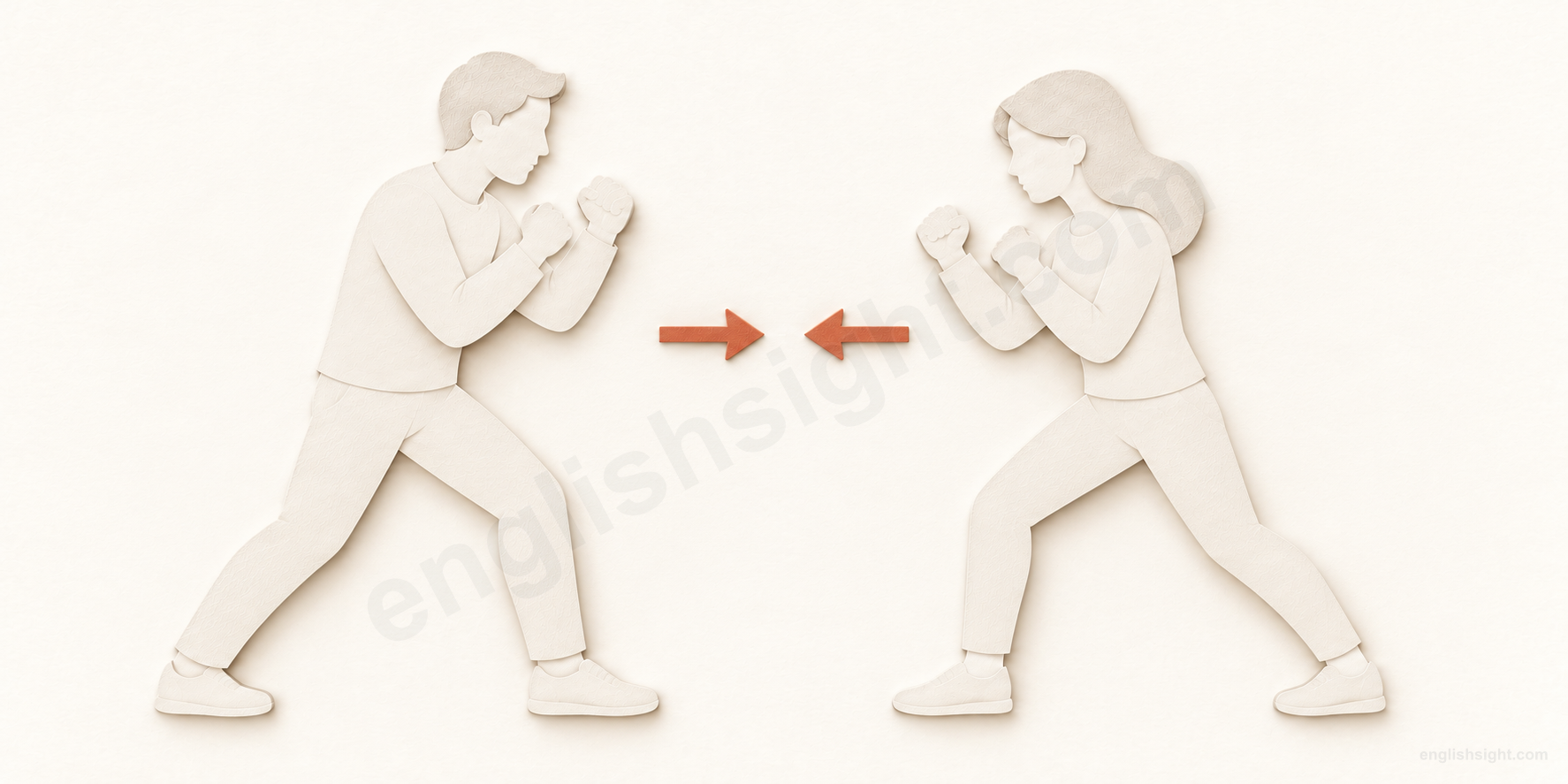
Two people face one another.
fight
The opposition remains unresolved; neither is shown winning.
Each braces and raises their fists against the other.
Effort meets opposition. This physical example illustrates the relation; many uses involve no violence, and fight alone does not imply victory.
To fight is to use force or determined effort against someone or something, or toward a goal that meets resistance.
Opposition can be physical, social, or internal. Fighting does not by itself imply starting a conflict, using violence, winning, or even reaching a final result.
Fight can name physical conflict, but it also describes determined effort when something opposes you. Ask who or what is resisted, what is sought, and how the sentence identifies each side.
The core model connects many uses; it is a teaching interpretation, not a claim about a picture shared by every English speaker. Fixed expressions still need their own explanations.
01
People in conflict
First distinguish physical struggle, war, sport, and angry disagreement. Fight alone does not specify the type or winner.
01
fight; fight + opponent; fight with / against + opponent
fight somebody / fight with somebody
use physical force against another person
Situation / obstacle
Two people confront each other.
Effort / result
They struggle against each other; the outcome is unknown.
Fight describes the contest, not who wins.
The opponent can follow fight directly: He fought the attacker. Fight with someone can also identify an opponent. With does not automatically mean cooperation.
Fight can stand alone when the participants are clear: The two men were fighting. Unlike hit, which can name one blow, fight describes conflict or resistance. Neither form tells us who started it.
Fight or flight is a conventional label for confronting a threat or escaping it. Flight here means escape, not necessarily travel in an aircraft. The label describes a danger response, rather than a guarantee that someone will attack.
In a sentence
The two men were fighting outside the station.
Watch the difference Do not use win as a synonym: someone can fight hard and still lose.
02
fight + war / battle / enemy; fight in + war; fight for + side; fight alongside + ally
fight in a war / fight for a country
take part in armed conflict
Situation / obstacle
A conflict involves opposing forces.
Effort / result
Soldiers participate on particular sides.
In names the conflict; for can name the side supported.
Fight a war or battle names the conflict as an object. Fight the enemy names the opponent. Fight in a war places someone within that conflict.
Compare She fought against the invading army with She fought for her country. Fight alongside an ally makes the shared side explicit. In They fought with the army, context must tell us whether the army was their own side or their opponent.
A passive is possible when there is an object: The battle was fought near the river. Fight is not restricted to an active subject that names one individual.
As a countable noun, a fight can also name a battle for a place or position: The fight for the hill lasted all morning. Here fight names the battle itself, rather than the determination of the soldiers.
In a sentence
Their grandfather fought in the war alongside his brother.
Watch the difference Fight with is context-dependent; use against or alongside when the side needs to be clear.
03
fight + opponent; fight for + title; a / the + fight
fight a boxer / a title fight
compete in a combat sport
Situation / obstacle
Two boxers enter an organized contest.
Effort / result
They compete under the sport’s rules.
A fight can be a scheduled sporting event.
A boxer can fight an opponent or fight for a title. Here for identifies the prize, rather than an ally. The verb also works without an object: She fights professionally.
As a countable noun, a fight can mean a boxing match: a title fight, three fights. Compare watch a fight with fight an opponent: watch describes being a spectator.
In a sentence
Her next fight is against a boxer from Leeds.
Watch the difference Fight does not mean win the match, and a sporting fight is not necessarily an angry quarrel.
04
fight with + person + about / over + topic
fight about / over something
have an angry disagreement
Situation / obstacle
Housemates disagree about a shared responsibility.
Effort / result
They argue, without necessarily using force.
The topic follows about or over; the other person can follow with.
Fight with someone about something identifies both participant and topic. A conversation such as We keep fighting about the bills normally concerns angry arguments, not boxing.
Argue is often clearer if you need to rule out physical violence. Fight is stronger than simply disagree: you can disagree calmly without fighting.
In a sentence
We keep fighting over whose turn it is to clean the kitchen.
Watch the difference The sentence They fought is ambiguous without context; it need not mean they hit each other.
02
Effort against resistance
The same language of opposition extends to problems, goals, feelings, difficult progress, elections, and court cases. Read the object and preposition carefully.
05
fight + problem / decision; fight against + unwanted thing
fight a problem / fight against a decision
work actively to stop or resist something
Situation / obstacle
A problem or unwanted change threatens people.
Effort / result
They take action to oppose it.
The object or against-phrase identifies what is resisted.
Fight pollution, fight a fire, and fight against discrimination describe active opposition without requiring a human enemy. A group can fight a decision through petitions, negotiations, or legal action.
Fight against a rule means oppose it; fight for a rule means try to obtain or preserve it. The preposition changes the side you take. Fight a fire does not mean cause one.
In a sentence
The residents are fighting the plan to close the park.
Watch the difference Do not infer violence from fight when its object is a policy, disease, or social problem.
06
fight for + goal / right / person
fight for something / somebody
work determinedly to obtain, protect, or support
Situation / obstacle
People need better access to a service.
Effort / result
A group works to secure it for them.
For points toward a desired result or the people supported.
Fight for fair pay describes an objective. Fight for the workers describes the people whose interests you defend. Neither requires hitting anyone.
Contrast fight the workers, which normally makes the workers opponents. A noun after for is not the direct object of fight. The same goal pattern can describe competitors seeking a place on a team.
In a sentence
Our union is fighting for safer working conditions.
Watch the difference Wanting something is not enough: fight for suggests active effort or resistance.
07
fight to + base verb
fight to do something
try very hard to make an action or outcome possible
Situation / obstacle
A shop is in danger of closing.
Effort / result
The owners make a determined effort to keep it open.
The to-infinitive states what the effort aims to achieve.
Fight to keep the shop open presents an intended result. Compare fight against closing it, which presents closure as the thing opposed. Fight to stay awake is another goal pattern, with sleep as an implicit difficulty.
To is followed by a base verb: fight to keep, not fight to keeping. Fighting to achieve a result does not entail achieving it.
In a sentence
The owners fought to keep the bookshop open.
Watch the difference Do not treat the to-infinitive as a second opponent or as proof of success.
08
fight + feeling; fight the urge / temptation to + verb
fight the urge to…
resist an impulse or feeling
Situation / obstacle
You strongly want to interrupt.
Effort / result
You try to stop yourself acting on the impulse.
The urge is the thing resisted; the infinitive explains the urge.
In fight the urge to interrupt, to interrupt belongs with urge: it tells us what you feel like doing. Compare fight to interrupt, where interrupting itself is your goal.
Fight a feeling or desire can mean trying not to feel it, show it, or act on it. Context specifies the kind of control; the expression does not guarantee that the feeling disappears.
In a sentence
I fought the urge to check my phone during dinner.
Watch the difference Fight the urge to laugh means resist laughing; fight to laugh would make laughing the goal.
09
fight + possessive + way + through / into / out of / to + place or goal
fight your way through / into / to…
make progress despite obstacles or opposition
Situation / obstacle
A crowded exit makes movement difficult.
Effort / result
You work your way past the obstruction.
Your way combines effort with a route or destination.
Fight your way through a crowd describes difficult movement and need not involve punches. Through gives the route; into marks entry; to marks a destination.
The pattern also extends to achievement: She fought her way to the final. The possessive follows the subject: I fought my way, they fought their way. The construction supplies the progress meaning; fight alone does not mean go.
In a sentence
We fought our way through the crowd to the exit.
Watch the difference Do not say We fought our way the exit: a route or destination expression is needed.
10
fight + election / campaign; a closely fought + contest
fight an election / a closely fought contest
compete determinedly in an organized contest
Situation / obstacle
Candidates enter an election.
Effort / result
They compete for votes rather than oppose holding the election.
The object can name the contest being conducted.
Especially in British political reporting, fight an election means take part as a candidate or party and try to win. It does not mean campaign against the existence of elections.
A closely fought contest has competitors of similar strength. A fight to the finish can describe a competition that remains intense until the end. Fight to the death is a much stronger expression: literally until someone dies, or dramatically for uncompromising resistance.
In a sentence
Three parties will fight the election in this district.
Watch the difference Read the object: fight an election names participation; fight a decision normally means opposition.
11
fight + case / legal action; fight + opponent + for + legal outcome
fight a case / fight for custody
pursue or defend a position in court
Situation / obstacle
A legal claim is disputed.
Effort / result
A party argues its position through the courts.
Fight names determined legal opposition, not courtroom violence.
Fight a case can refer to pursuing a claim or defending against one. The surrounding details tell us which side a person occupies.
Fight someone for custody names the opposing party and the desired legal outcome. Challenge or contest may sound more neutral in formal legal writing; fight emphasizes determination.
In a sentence
The tenants decided to fight the eviction case in court.
Watch the difference Fight the case does not tell you who will win or even which party originally brought it.
03
Back, down, off, and out
These established particle combinations contribute response, control, repelling, or settlement. Some have more than one use.
12
fight back; fight back against + opponent / threat
fight back
respond actively to an attack, pressure, or setback
Situation / obstacle
A team falls behind in a match.
Effort / result
It responds with renewed effort.
Back adds the idea of a response.
Fight back can describe resistance to a physical attack, a response to unfair treatment, or a recovery in a competition. The sports example does not describe a brawl.
The response use is normally intransitive: They fought back, or They fought back against the cuts. Compare fight off the attackers, which focuses on repelling them, and fight back tears, which has a separate emotional-control pattern.
In a sentence
Two goals down, the team fought back to draw the match.
Watch the difference Fight back does not by itself imply victory; a team can fight back and still lose.
13
fight back / down + emotion; fight + emotion + back / down
fight back tears / fight down panic
try to prevent an emotion from showing or taking over
Situation / obstacle
You feel tears coming during a speech.
Effort / result
You try to keep speaking without crying.
An emotion is the object, rather than the attacker answered.
Fight back tears and fight down panic mean trying to control a response. Back and down are particles in these established combinations; no literal backward or downward movement is required.
Both fight back the tears and fight the tears back are possible. An object pronoun goes between verb and particle: I tried to fight them back. For down, a full emotion noun is often clearest: fight down the panic.
In a sentence
She paused, fighting back tears, then thanked the volunteers.
Watch the difference Do not read fight back tears as retaliating against another person.
14
fight off + attacker; fight + attacker / pronoun + off
fight an attacker off
repel an attacker through resistance
Situation / obstacle
Someone is attacked.
Effort / result
The attacker is driven away or prevented from continuing.
Off focuses on keeping the threat away.
Fight off an attacker and fight an attacker off have the same basic meaning. With a pronoun, use fight them off, not fight off them.
A completed report such as She fought them off normally presents successful resistance. She tried to fight them off reports an attempt and does not guarantee that it worked. Fight back focuses on responding; fight off focuses on repelling.
In a sentence
The guard fought the intruders off until help arrived.
Watch the difference Particle placement matters with pronouns: fought them off.
15
fight off + illness / feeling / competition
fight off an infection / sleep
resist something that threatens to affect or overwhelm you
Situation / obstacle
Sleepiness makes it hard to remain alert.
Effort / result
You struggle to stop it taking over.
The threat can be internal, rather than a person outside.
Fight off an infection describes the body resisting illness; fight off sleep describes resisting sleepiness. Fight off competition extends the pattern to keeping rivals from taking an advantage.
He is fighting off a cold describes an ongoing effort or process. It does not guarantee future recovery. Compare He fought off the cold, which normally presents a successful outcome. These are language patterns, not medical advice.
In a sentence
I was fighting off sleep during the late train journey.
Watch the difference Do not assume every use of off means a person physically moves away.
16
fight it out (for + prize); fight out + dispute
fight it out / fight out a dispute
continue arguing or competing until a matter is decided
Situation / obstacle
Two teams reach the final.
Effort / result
They compete for the remaining title.
Out presents a contest or dispute as something to settle.
Fight it out can refer to sport, argument, or other competition; it does not necessarily call for physical violence. The teams will fight it out for the trophy means the contest will determine the winner.
Fight out their differences is a related transitive pattern. The passive The dispute is being fought out in court is possible. Keep the pronoun inside fight it out, not fight out it.
In a sentence
The two finalists will fight it out for the championship on Sunday.
Watch the difference Do not confuse fight it out, settle by contest, with fight your way out, make a difficult exit.
04
A conflict, a campaign, or determination
A fight can count an event, name a sustained effort, or describe fighting spirit. Familiar noun combinations add useful meanings.
17
have / get into + a fight + with + person; a fight between + people
have / get into a fight
take part in a particular conflict or argument
Situation / obstacle
An argument becomes heated.
Effort / result
The people have a fight.
A fight counts an episode; context tells us whether it is verbal or physical.
Have a fight with someone can mean have an angry argument, especially in North American usage. Get into a fight often describes becoming involved in physical conflict. Neither wording alone provides every detail.
A fight broke out means the conflict began; break up a fight means stop it. A pillow fight or water fight is a playful contest identified by its modifier, not necessarily serious anger.
In a sentence
I had a fight with my flatmate over the heating bill.
Watch the difference A fight is countable in this event meaning: a fight, two fights.
18
the fight for / against + noun; the fight to + verb
the fight for / against something
an ongoing effort to achieve or prevent something
Situation / obstacle
A community needs a lasting improvement.
Effort / result
Its organized effort continues over time.
The noun can name a long struggle, not a single clash.
The fight for clean water names the desired result; the fight against pollution names what must be opposed. The fight to save the library identifies an action sought.
A fight for survival can concern a person, an organization, or a business. This use often appears in the singular because the speaker treats the activity as one sustained effort.
In a sentence
The fight to save the local library brought neighbours together.
Watch the difference For and against remain different; a fight for pollution would normally support the unwanted thing.
19
some / plenty of / no + fight + left in + person
have some fight left in you
still have determination to continue
Situation / obstacle
A team has suffered several defeats.
Effort / result
It still wants to compete and resist.
Here fight is a quality, not a countable event.
There is still some fight left in them means they have not lost their determination. Full of fight also describes an energetic willingness to resist or compete.
Compare They had three fights, which counts events, with They had plenty of fight, which describes spirit. Take the fight out of someone means weaken that determination.
In a sentence
Even after that setback, there was plenty of fight left in the team.
Watch the difference Do not add a for this quality meaning: plenty of fight, not plenty of a fight.
20
put up a (good) fight; without a fight; have a fight on your hands
put up a fight / without a fight
offer determined resistance or competition
Situation / obstacle
A small team faces a stronger opponent.
Effort / result
It resists strongly instead of yielding easily.
A fight here measures resistance rather than proving success.
Put up a good fight can praise a team that eventually loses. Without a fight means without offering resistance; it need not concern physical violence.
Have a fight on your hands means face a difficult contest or struggle: We have a fight on our hands to keep this service open. It describes the difficulty ahead, not something held in your hands.
In a sentence
We lost, but we put up a good fight.
Watch the difference A good fight does not mean an enjoyable quarrel or a guaranteed win.
21
pick a fight with + person; be spoiling for a fight
pick a fight / be spoiling for a fight
deliberately seek a conflict
Situation / obstacle
Someone makes a provocative remark.
Effort / result
They try to start an argument.
These expressions describe wanting or provoking conflict.
Pick a fight with someone means deliberately provoke an argument or physical conflict. Pick does not mean choose an existing fight from a list.
Be spoiling for a fight describes being very eager to quarrel or fight. A person can be spoiling for a fight even before anyone responds.
In a sentence
He kept insulting the referee as if he wanted to pick a fight.
Watch the difference Picking a fight concerns starting trouble; putting up a fight concerns resistance.
05
Familiar figurative expressions
Learn these expressions as wholes. Their conventional meanings cannot all be calculated from the core sketch.
22
fight tooth and nail + for / against + noun; fight tooth and nail to + verb
fight tooth and nail
resist or strive with great determination
Situation / obstacle
A school faces closure.
Effort / result
Parents use every available argument to oppose it.
The idiom intensifies effort, usually without literal biting or scratching.
Tooth and nail describes the intensity of resistance. You can fight tooth and nail for a goal, against a proposal, or to prevent a change.
Compare fight hard, a more neutral description. Tooth and nail is vivid and emphatic; a routine discussion may not warrant it.
In a sentence
Parents fought tooth and nail to keep the school open.
Watch the difference Do not infer physical injury from this idiom in a policy discussion.
23
fight fire with fire
fight fire with fire
answer an opponent using similar methods
Situation / obstacle
A rival uses aggressive price cuts.
Effort / result
A business responds with similar cuts.
With introduces the answering method; the whole expression is an idiom.
The idiom compares your response with the other side’s tactics. It can refer to arguments, business competition, or other conflicts.
We fought fire with fire by cutting our prices means we matched that method. Fight a fire with water, by contrast, can literally describe extinguishing flames; the repeated fire is what marks the familiar idiom.
In a sentence
When the rival cut its prices, we fought fire with fire.
Watch the difference The idiom describes a tactic; it does not say the tactic is wise or will work.
24
fight a losing battle against + problem; fight a losing battle to + verb
fight a losing battle
keep trying when success seems very unlikely
Situation / obstacle
New weeds appear as quickly as you remove them.
Effort / result
Your efforts seem unable to solve the problem.
The expression evaluates the chances, not a literal battlefield.
You can fight a losing battle against something or to do something. The phrase often expresses frustration at continuing effort that is not enough.
Compare lose a battle, which reports an outcome, with be fighting a losing battle, which assesses an ongoing situation as unlikely to succeed.
In a sentence
I’m fighting a losing battle to keep sand out of the car.
Watch the difference Losing is part of the established phrase, not a claim that every effort described with fight must fail.
25
fight + possessive + corner
fight your / somebody’s corner
defend a position or someone’s interests
Situation / obstacle
A proposal is challenged at a meeting.
Effort / result
Someone speaks strongly in its defence.
A corner represents a side or position in this British idiom.
Fight your corner means state and defend your position firmly. Fight someone’s corner means support that person’s position or interests.
The possessive identifies whose case is defended: She fought my corner means she defended me. It does not mean she argued against me.
In a sentence
My colleague fought my corner when the budget was discussed.
Watch the difference This is chiefly British usage; defend my position is a plainer alternative.
26
fight + possessive + own battles
fight your own battles
deal with your own conflicts without relying on others
Situation / obstacle
A student wants a friend to settle a disagreement for them.
Effort / result
The student is encouraged to handle it personally.
Own emphasizes who takes responsibility for the conflict.
You need to fight your own battles asks someone to defend their interests or solve their disputes themselves. It does not require physical violence.
Compare I’ll fight your corner, an offer of support, with You must fight your own battles, which places responsibility on you. Depending on tone, the latter may sound encouraging or unsympathetic.
In a sentence
I can help you prepare, but you need to fight your own battles.
Watch the difference Do not treat this expression as a rule that asking for help is always wrong.
27
fight shy of + noun / -ing
fight shy of something
avoid accepting or doing something
Situation / obstacle
A firm is offered a risky project.
Effort / result
It is reluctant to commit to it.
The whole idiom expresses avoidance, not an attack.
Fight shy of a commitment means be unwilling to accept it and try to avoid it. This is a less everyday, often written expression; avoid or be reluctant to is simpler.
Of is a preposition: fight shy of taking risks. This idiom cannot be reliably predicted from fight plus the ordinary adjective shy.
In a sentence
The firm fought shy of making a long-term promise.
Watch the difference Use making after of, not to make.
28
be fighting for + possessive + life; fight for breath
fight for your life / fight for breath
struggle to stay alive or to breathe
Situation / obstacle
A person is seriously injured.
Effort / result
Their survival remains uncertain.
Life is the outcome being preserved; breath is what is urgently needed.
In news reports, be fighting for your life commonly describes being critically ill or injured and in danger of dying. It does not claim that a person consciously controls every bodily response.
Fight for breath means struggle to get enough air. Compare fight to save someone’s life: the subject may be a rescuer, while the endangered person is someone else.
In a sentence
The injured climber was fighting for her life in hospital.
Watch the difference The expression does not predict recovery or assign blame if the person dies.
29
fight like cat and dog; fight like cats and dogs
fight like cat and dog / cats and dogs
argue frequently and fiercely
Situation / obstacle
Two siblings repeatedly quarrel.
Effort / result
Their relationship is full of arguments.
The comparison characterizes repeated human conflict.
British English uses fight like cat and dog; North American English commonly uses fight like cats and dogs. Both can describe people who argue a great deal.
They fight like cats and dogs over the smallest things describes recurring quarrels, not necessarily violence or a disagreement involving real pets.
In a sentence
The twins care about each other, but they fight like cats and dogs.
Watch the difference This is an idiomatic comparison, not a claim about how all cats or dogs behave.
30
live to fight another day
live to fight another day
get through a setback and retain the chance to try again
Situation / obstacle
A team loses this contest.
Effort / result
It can recover and attempt another one.
The saying values the possibility of a later attempt.
We’ll live to fight another day is often figurative after a defeat or withdrawal. It means this failure has not removed every future opportunity.
Compare fight to the finish, which stresses continuing the present contest. Live to fight another day can support stopping now so that another attempt remains possible.
In a sentence
We didn’t win this contract, but we’ll live to fight another day.
Watch the difference In everyday setbacks, live need not imply that anyone was literally close to death.
31
have / give + a fighting chance + of + noun / -ing
a fighting chance
a real possibility of success despite difficulty
Situation / obstacle
A project is difficult but receives essential support.
Effort / result
Success becomes possible, though uncertain.
Fighting modifies chance; it does not name a physical attack.
Give someone a fighting chance means give them a real opportunity to succeed through determined effort, even though success remains uncertain. Have a fighting chance of finishing means completion is possible with effort.
Compare no chance, which rules success out, with a good chance, which sounds more optimistic. A fighting chance emphasizes that the task remains difficult.
In a sentence
The extra week gives us a fighting chance of finishing.
Watch the difference Use of finishing, not of finish; the phrase does not guarantee completion.
32
be / feel + fighting fit
fighting fit
very healthy and ready for activity
Situation / obstacle
Someone has rested after a tiring week.
Effort / result
They feel strong and energetic again.
This British expression describes condition, not quarrelling.
Feel fighting fit or be fighting fit emphasizes good health or physical readiness. The phrase can be used cheerfully after rest or recovery.
Compare a fighting chance, which describes a possibility. Neither expression is simply a progressive verb: in I am fighting fit, fighting fit describes how well I am.
In a sentence
After a quiet weekend, I felt fighting fit again.
Watch the difference Do not interpret fit here as a sudden attack of illness or anger.
Read the whole construction
Forms and grammar
Fight /faɪt/ has fights, fought, fought, fighting. Fought is both past tense and past participle; fighted is not standard. Progressive forms are ordinary: They are fighting. Passive forms require an appropriate object: The case is being fought in court. There is no general fight someone to do something causative pattern; ask, persuade, or make may be needed.
For, against, with, and over
Fight for a cause supports it; fight against it opposes it. Fight with a person can name an opponent or, in an appropriate military context, an ally. Fight with a sword names a weapon used. Fight over or about something identifies the issue in dispute. These are prepositional patterns, not all phrasal verbs.
Effort and outcome are different
Fight stresses force or determination, while win and defeat state results. Trying, continuing, and completed events have different implications: tried to fight off a threat leaves the outcome open. Describing illness through fight is a language metaphor, not a measure of someone’s willpower or responsibility.
Scope of this lesson
This selection covers the modern verb and noun, major particle combinations, and useful idioms. It includes two familiar expressions with fighting, but does not attempt a full course on every derivative, military term, compound, or historical sense.
Choose the intended relationship
Look for the opponent, goal, topic, or result before answering.
1. Residents want the library to remain open. Which sentence expresses their goal?
2. You want to laugh but try to stay serious. Which sentence fits?
3. Replace the attackers with them. Which form is standard?
4. The team lost, but played with determination. Which sentence can still be true?
5. A history text says a soldier fought with an army. What should you check?
6. Extra funding makes a difficult project possible. Which expression fits?
Sources and teaching notes
Dictionary senses and constructions were checked against the sources below. Explanations, examples, and the visual connection are original teaching material; the sketch is a model, not evidence for a universal mental picture.
The diagram illustrates opposition; particular expressions add their own meanings.