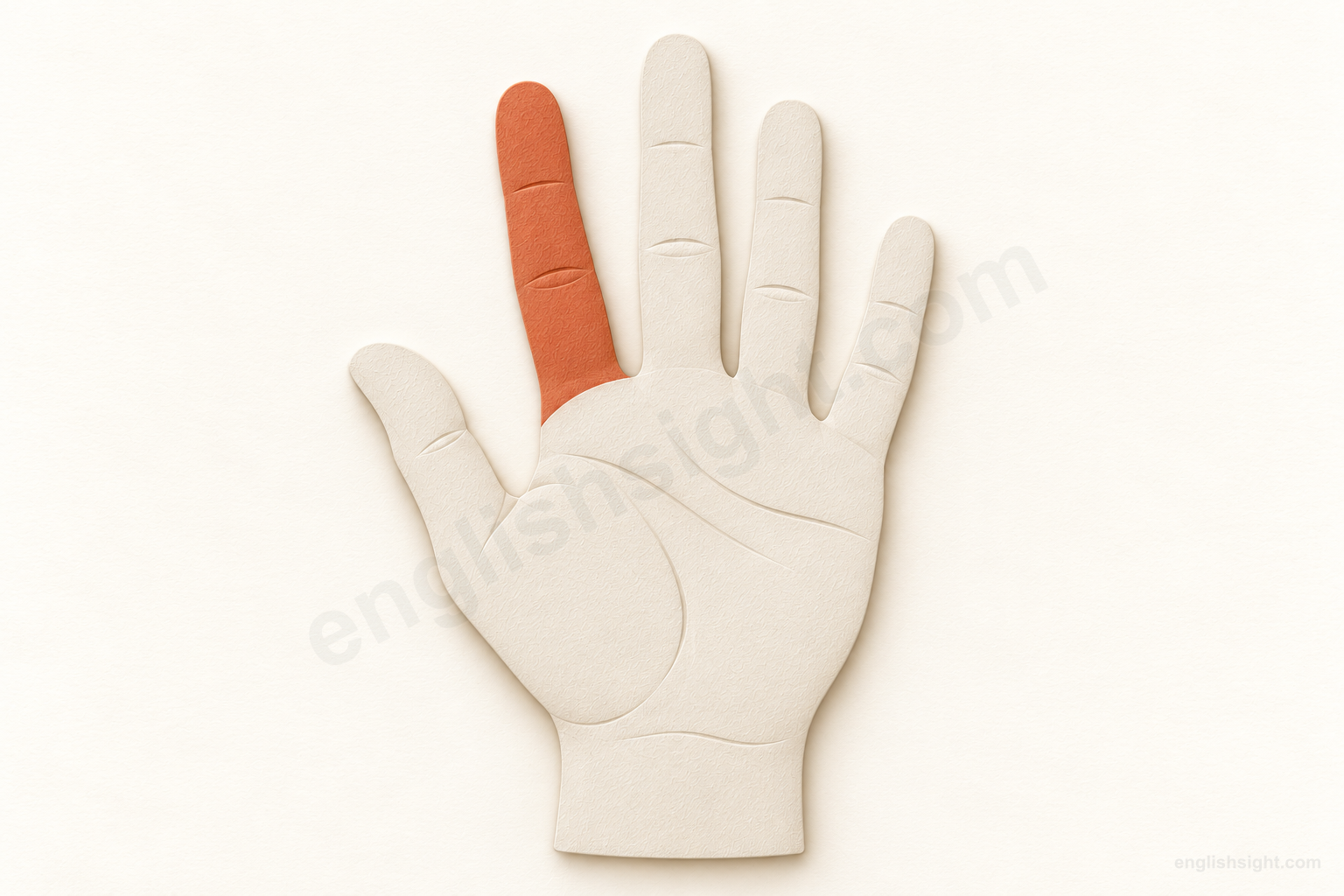
A small part of the hand, many familiar expressions.
Name fingers, describe what they do, and read the whole phrase when the meaning changes.
A distinct, movable part of the hand
A distinct, movable part of the hand
An open hand has four fingers and a separate thumb.
finger
This finger is a distinct, jointed part of the hand.
Notice the highlighted index finger next to the thumb.
The orange index finger shows one movable part of the hand.
A finger is one of the long, jointed parts extending from the hand, used in touching and handling things.
This body-part model supports the touch verb and shape comparisons. Idioms need their full wording: crossing fingers expresses hope, while putting your finger on a problem means identifying it. The sketch does not derive every expression.
A finger is a movable part of the hand. Its shape, precise movements, and familiar gestures help connect several uses, but finger is not a hidden instruction to point in every expression.
Start with the body part, then follow three branches: actions with fingers, things named for their shape, and established expressions about effort, hope, knowledge, and influence.
01
The hand, its movements, and familiar shapes
Begin with a body part. Then distinguish actions performed with it, a covering for it, things shaped like it, and food eaten with it.
01
a / my / your + finger; fingers; index / middle / ring / little finger; long-fingered / nimble-fingered
a finger; fingers
a movable part extending from the hand
Situation / starting point
You need to name a particular part of a hand.
Meaning / outcome
You distinguish a finger from the palm and the thumb.
Finger is a countable noun: one finger, two fingers.
In ordinary descriptions, a hand has four fingers and a thumb. In a broader use, finger can include the thumb, so five fingers is also possible. Neither convention makes a toe a finger: toes belong to the feet.
The index finger, also called the forefinger or first finger, is next to the thumb. Next come the middle finger, ring finger, and little finger, also called the pinky. Ring finger names a position even when no ring is worn.
Use a determiner for a singular body part: my finger, her finger, or a finger. I cut my finger and My fingers are cold are ordinary ways to describe injury and sensation.
In compound adjectives, -fingered describes fingers or their use: long-fingered means having long fingers, and nimble-fingered means able to move the fingers quickly and skilfully. These adjectives differ from fingered as the past tense of the verb.
In a sentence
I cut my index finger while opening the box.
Watch the difference A finger is part of a hand, not the whole hand or a toe.
02
with + possessive + fingers; run + a finger / fingers + along / through + noun
with your fingers; run your fingers through…
use the fingers to touch or handle something
Situation / starting point
A small object or surface is within reach.
Meaning / outcome
Your fingers hold it, feel it, or move across it.
With names the body parts used; the main verb supplies the action.
Hold something between your finger and thumb describes a small grip. Eat with your fingers describes using your hands instead of cutlery. These are ordinary combinations, not new senses of finger.
Run your fingers through your hair means move them through it, often like a comb. Run a finger along a shelf follows its surface. Through and along describe different paths; finger itself does not contain either path.
You can point a finger at an object or raise a finger to your lips to ask for quiet. These gestures depend on the verb and situation; not every raised finger conveys the same message.
Wag your finger means move it from side to side, often in warning or disapproval. Drum your fingers means tap them repeatedly, for example while waiting impatiently. In each case, the verb supplies the distinctive movement.
In a sentence
Maya ran her fingers through her hair before the photo.
Watch the difference Say point at the label or point a finger at it; finger the label would normally mean touch it.
03
snap / click + possessive + fingers
snap your fingers
make a short clicking sound with the fingers
Situation / starting point
You hear the rhythm of a song.
Meaning / outcome
You make clicks in time with it.
Snap names the movement and sound, not a new body part.
Snap your fingers, also click your fingers, describes producing a sharp sound by a quick movement against the thumb. The phrase can describe keeping time or attracting attention.
She only has to snap her fingers and he comes running suggests that he obeys immediately. The implication comes from the whole situation. Snapping at a server to summon them can sound or seem disrespectful.
In a sentence
We snapped our fingers in time with the chorus.
Watch the difference This is different from crossing your fingers to express hope.
04
the fingers of + a glove; glove fingers
the fingers of a glove
the separate sections that cover the fingers
Situation / starting point
You try on a glove.
Meaning / outcome
You check how its long sections fit.
A covering takes the name of the body part it covers.
The fingers of a glove are its separate tubes for your fingers. Here finger refers to part of the garment, not a body part inside it.
This use is countable and often plural: The fingers are too short. The context makes it clear that the glove needs a different fit.
In a sentence
The glove fits my palm, but its fingers are too short.
Watch the difference Do not assume that fingers always refers directly to a person’s body.
05
a finger of + noun; fingers of + noun
a finger of land; fingers of toast
a narrow projecting part or long thin piece
Situation / starting point
A piece or projection has a long, narrow outline.
Meaning / outcome
You compare that outline to a finger.
This is a shape comparison, not a claim about touch.
A finger of land is a narrow stretch projecting into another area, such as water. Similar descriptive uses can refer to smoke or light spreading in narrow strips.
Fingers of toast or sponge fingers are long narrow food pieces. The form a finger of something names one piece; fingers names several. The material need not be solid in every descriptive use.
In a sentence
A narrow finger of land separates the two bays.
Watch the difference Do not use finger as a general word for every piece of an object. The shape matters here.
06
finger food; a fish finger / fish fingers; chicken fingers
finger food; fish fingers
food named for how it is eaten or for its shape
Situation / starting point
You are planning snacks or reading a menu.
Meaning / outcome
You distinguish eating with fingers from a particular food item.
Finger food describes easy handling; fish fingers names a food.
Finger food consists of small items you can pick up and eat without cutlery, such as tiny sandwiches. The items do not have to look like fingers.
British fish fingers are narrow pieces of fish coated in breadcrumbs or batter, ready to be cooked; American English commonly calls them fish sticks. Chicken fingers are strips of chicken that are breaded and fried. These established food names are not literal body parts.
In a sentence
We served finger food so that guests could eat while standing.
Watch the difference Do not infer that all finger food is long and thin.
07
a finger / two fingers of + spirit
two fingers of whisky
an approximate amount based on finger-width
Situation / starting point
Someone describes a drink informally.
Meaning / outcome
The depth is compared with the width of fingers.
Finger can supply a rough measure rather than count body parts.
A finger or two fingers of a strong drink refers to a shallow depth in a glass, judged roughly by finger-width. It does not specify a fixed number of millilitres.
The glass’s shape affects how much liquid this represents. Use an actual volume if precision matters; do not treat this conversational measure as a universal serving size.
In a sentence
He poured two fingers of whisky into a small glass.
Watch the difference This is approximate depth, not two glasses or two fingers placed in the drink.
02
Using finger as a verb
The object tells you whether someone is handling an object, choosing movements in music, or identifying a suspect. These uses do not all mean pointing.
08
finger + object
finger a coin
touch or handle something using the fingers
Situation / starting point
You hold a small object.
Meaning / outcome
You move your fingers over it.
The object of the verb is the thing being handled.
Finger something can suggest feeling, turning, or playing with it, sometimes repeatedly or absent-mindedly. It is more specific than a brief touch and does not automatically mean pressing a button.
This is a regular verb: finger, fingers, fingered, fingering. An action in progress is possible: She was fingering the edge of her scarf. For ordinary instructions, touch the screen or press the button is often clearer.
In a sentence
While waiting, Noor fingered the loose coin in her pocket.
Watch the difference Finger a person is not a neutral substitute for touch a person; it can have other meanings.
09
finger + passage / chord / score; the fingering for + music
finger a passage; fingering
choose or mark finger movements for playing music
Situation / starting point
A musician studies a difficult sequence of notes.
Meaning / outcome
A particular sequence of finger positions is chosen.
The musical use concerns technique and the fingers used.
In music, finger a passage or chord means play it with particular finger positions, or mark how the fingers should be used. Fingering is also a noun for that arrangement.
This is useful specialist vocabulary for learners of instruments. It does not mean merely touching the printed page. The object and music context distinguish it from handling a coin.
In a sentence
The teacher fingered the passage differently to make the jump easier.
Watch the difference Play the piano is the neutral expression for performing; finger highlights technique.
10
finger + person + as + role; finger + person + for + wrongdoing; finger + thing + as + cause; be fingered as…
finger someone as the culprit
identify a person as responsible, or a thing as a cause
Situation / starting point
Investigators do not know who committed a theft.
Meaning / outcome
A witness names a particular person.
The direct object is what is identified; as introduces a role or cause, while for can introduce wrongdoing.
Finger someone for a crime or as the thief is informal, especially in North American usage. It often refers to giving information to the police. The passive is natural: He was fingered as a suspect.
This wording reports identification or accusation; it does not prove guilt. Unlike point a finger at, the noun finger has become the verb itself, with no a or the before it.
The identifying use can extend beyond crime reports to causes: The investigation fingered a faulty valve as the cause. Here the object is a thing rather than a suspect, and nobody is being accused of a crime. Identify remains a more neutral alternative.
In a sentence
A witness fingered the driver as an accomplice.
Watch the difference Use identify or name for a more neutral report. An allegation is not a conviction.
03
Hope, recognition, blame, and protection
Learn each complete expression. A finger can be part of a familiar gesture or an image for precise attention, but the surrounding words determine the message.
This familiar gesture and expression signal hope, not certainty.
Cross your fingers can mean make the gesture of placing one finger across another, or simply hope for a good result. Keep your fingers crossed continues that hope; fingers remains plural.
Fingers crossed! can stand alone as a short supportive response. You can add for someone or that plus a clause: Keep your fingers crossed for me; I’m crossing my fingers that it works. Use crossed after keep, but not after cross: cross your fingers, keep your fingers crossed. The expression does not guarantee success.
In a sentence
Fingers crossed that the train arrives before our connection leaves.
Watch the difference Do not confuse this with snapping your fingers or promising a definite result.
12
put + possessive + finger on + problem / reason / it
put your finger on something
identify exactly what a problem or difference is
Situation / starting point
Something seems wrong, but its cause is unclear.
Meaning / outcome
You identify the specific feature or reason.
Your finger picks out an exact point in a teaching comparison.
The idiom often follows cannot or could not: I can’t put my finger on it. You notice something but cannot yet say exactly what it is.
Positive uses are possible too: You’ve put your finger on the problem. Nothing needs to be touched. Put your finger on the map can instead be literal, so use the object and situation to decide.
In a sentence
The room felt different, but I couldn’t put my finger on why.
Watch the difference Put your finger on a problem identifies it; point the finger at a person assigns blame.
13
point a / the finger at + person; point an accusing finger at + person
point the finger at someone
blame or accuse someone
Situation / starting point
Something has gone wrong.
Meaning / outcome
A person is named as responsible.
The established expression assigns responsibility, not just direction.
Point a finger at someone can describe a physical action or assign blame. Point the finger at someone also commonly means blame them. The choice of a or the does not by itself separate literal pointing from accusation; the context matters. Point an accusing finger at makes the accusation explicit.
The finger of blame or suspicion can also point at a person. These expressions do not establish the truth of the accusation and do not require an actual pointing gesture.
In a sentence
Before checking the records, everyone pointed the finger at the new manager.
Watch the difference Use at for the target of blame. Put your finger on something has a different meaning.
14
not / never lay a finger on + person; don’t lay a finger on + person / thing
not lay a finger on someone
deny or forbid even the slightest harmful touch
Situation / starting point
Someone is accused of violence or told to keep away.
Meaning / outcome
The speaker denies or forbids physical harm.
A single finger emphasizes the smallest possible contact.
I never laid a finger on him strongly denies touching or hurting him. Don’t lay a finger on her warns against harmful contact; If you lay a finger on… can introduce a warning too.
The phrase can also protect a thing from being touched. It is not a general expression for failing to help. The forms here are lay, laid, laid; laid is not the past of lie meaning recline.
In a sentence
She warned them not to lay a finger on her brother.
Watch the difference Not lift a finger means make no effort; not lay a finger on concerns contact or harm.
04
Helping, starting work, and working hard
These expressions use a small body movement to talk about effort. Negation and tone matter as much as the noun.
15
not / never lift a finger + (to + verb); without lifting a finger
not lift a finger
make no effort to help or do a task
Situation / starting point
Other people are doing the work.
Meaning / outcome
One person does nothing to assist.
Negation turns a tiny movement into an image of no effort at all.
Not lift a finger, also not raise a finger, usually criticizes a failure to help. Add to plus a verb to specify the task: He didn’t lift a finger to help pack.
Without lifting a finger can instead emphasize ease or convenience: The machine did it without my lifting a finger. The person need not be physically unable to move; the expression concerns effort.
In a sentence
Leo watched us carry the boxes and never lifted a finger.
Watch the difference Keep the negative or equivalent context for the no-effort meaning.
16
pull / get + possessive + finger out
pull your finger out
start making an effort or work faster
Situation / starting point
Work is delayed because someone is not trying enough.
Meaning / outcome
A blunt speaker urges them to act.
This British informal idiom is an impatient demand.
Pull your finger out, also get your finger out, tells someone to stop being lazy or slow and begin working properly. It is blunt and can be rude.
Learn this as a complete idiom. It has no necessary physical pulling action, and it is unsuitable for a polite request to a stranger. Please get started or We need to work faster gives the message more neutrally.
In a sentence
We’ll miss the deadline unless we pull our finger out.
Watch the difference Finger stays singular here; do not confuse it with fingers crossed.
17
work + possessive + fingers to the bone
work your fingers to the bone
work extremely hard
Situation / starting point
A large amount of work needs doing.
Meaning / outcome
Someone puts in exhausting effort.
The extreme bodily image intensifies work.
This is an emphatic idiom for very hard work, often over a long period. It need not involve literal hand work or any injury.
The possessive follows the worker: I worked my fingers to the bone; they worked their fingers to the bone. Use it when you want to emphasize effort, not as a technical description of a work schedule.
In a sentence
They worked their fingers to the bone to get the café ready.
Watch the difference Fingers is plural; the expression does not report damaged bones.
05
Loss, involvement, and influence
Holding, reaching into, and sensing something provide useful comparisons. They are memory aids for established expressions, not rules for inventing new ones.
18
something slips through + possessive + fingers; let + object + slip through + possessive + fingers
slip through your fingers
lose or fail to obtain something within reach
Situation / starting point
You have a possible chance or something you might keep.
Meaning / outcome
It escapes your possession or control.
The grip image can describe a real object or an abstract opportunity.
A wet object can literally slip through your fingers. An opportunity can do so figuratively when you fail to take it. Money can slip through your fingers when you spend it instead of keeping it.
In let the chance slip through my fingers, the chance is what is lost, while my identifies the person who misses it. The phrase describes the loss, not necessarily deliberate rejection.
In a sentence
I waited too long to apply and let the chance slip through my fingers.
Watch the difference The subject is what escapes; use let plus an object when describing the person allowing the loss.
19
burn + possessive + fingers; get / have + possessive + fingers burned / burnt
get your fingers burned
suffer a loss after involvement in something risky or mistaken
Situation / starting point
Someone enters a deal without appreciating the risk.
Meaning / outcome
The experience ends badly and causes a loss.
The physical injury image represents an unwelcome consequence.
Burn your fingers or get your fingers burned often concerns a failed deal, investment, or other involvement. Actual burns are not required.
Burnt is another past participle, especially in British English: get your fingers burnt. The get plus past-participle pattern presents the person as affected by the result. A literal hot-pan context can still describe a real injury.
In a sentence
She got her fingers burned in a deal and now checks every contract carefully.
Watch the difference The figurative use is broader than touching something hot and does not promise that every risk fails.
20
have a finger in + the pie / every pie; have fingers in many pies
have a finger in every pie
be involved in many different activities
Situation / starting point
Several projects are underway.
Meaning / outcome
The same person has a role in many of them.
The pie image represents involvement or a share, not eating.
Have a finger in the pie describes involvement in one matter. Have a finger in every pie or fingers in many pies broadens this to numerous activities.
The expression can imply influence or interference and may be disapproving, especially with every. Context decides whether the involvement is admired or seen as annoying; it does not automatically mean the person owns all the projects.
In a sentence
From the school fair to the library appeal, Raj has a finger in every pie.
Watch the difference This is an established involvement idiom, not a rule that finger in always means participate.
21
have / keep + possessive + finger on the pulse + (of + noun)
keep your finger on the pulse
stay informed about current developments
Situation / starting point
Opinions or conditions are changing.
Meaning / outcome
You remain aware of what is happening now.
The pulse comparison suggests ongoing awareness, not control.
Have or keep your finger on the pulse of an industry, community, or situation means understand its latest developments or opinions. Reading, listening, and regular contact can provide that awareness.
The image resembles sensing a heartbeat, but in the idiom no body needs to be touched. Knowing what is happening is different from deciding what will happen.
In a sentence
By talking to customers daily, she keeps her finger on the pulse of the market.
Watch the difference Do not confuse awareness with having complete control over the market.
22
wrap / twist / wind + person + around + possessive + little finger; have + person + wrapped around…
have someone wrapped around your little finger
influence someone so easily that they do what you want
Situation / starting point
One person makes a request.
Meaning / outcome
The other readily agrees because of that person’s influence.
The little-finger image emphasizes how easy the influence seems.
Wrap or twist someone around your little finger means make them do what you want with little difficulty. Wind is another form of the expression. The person doing the influencing owns the little finger in the phrase.
In She has her uncle wrapped around her little finger, she influences him, not the other way round. It can sound affectionate or critical, depending on context; no literal wrapping is involved.
In a sentence
Ella has her grandfather wrapped around her little finger; he agrees to every extra story.
Watch the difference Track whose finger it is: the possessor is the person with influence.
23
have sticky fingers; have + possessive + fingers in the till
have sticky fingers; fingers in the till
be inclined to steal, or steal money at work
Situation / starting point
Things or workplace cash go missing.
Meaning / outcome
The speaker suggests theft.
The idiomatic accusation is separate from physically sticky skin.
Have sticky fingers is an informal, disapproving way to suggest a tendency to steal. After eating jam, I have sticky fingers can simply describe your hands, so check the context.
Have your fingers in the till is British informal wording for stealing money from your workplace. A till is a cash register. These are serious accusations when applied to real people, even though the wording is informal.
In a sentence
After cash went missing, staff suspected that someone had their fingers in the till.
Watch the difference The idiom reports a suspicion in this example; missing money alone is not proof.
06
Skill, small numbers, and offensive gestures
Some phrases praise a skill, others describe awkwardness or scarcity. Recognize offensive expressions so that you understand their tone.
24
have green fingers; have a green thumb
have green fingers
be good at growing plants
Situation / starting point
Someone’s plants grow successfully.
Meaning / outcome
You describe their gardening skill.
Green belongs to an established gardening expression.
Have green fingers is particularly British English. Have a green thumb is the usual American counterpart. Both refer to success with plants rather than the actual colour of the skin.
This is a skill expression, not a general claim that the person is inexperienced. Changing green to another colour does not produce a predictable new gardening idiom.
In a sentence
My aunt has green fingers; even her tiny balcony is full of healthy plants.
Watch the difference Use plural fingers in green fingers, but singular a green thumb.
25
be all fingers and thumbs; be all thumbs
be all fingers and thumbs
be awkward when using the hands
Situation / starting point
A small task requires careful hand movements.
Meaning / outcome
You fumble or drop things.
This idiom describes clumsiness, not having extra fingers.
Be all fingers and thumbs, also be all thumbs, means struggle to handle things neatly. It can describe temporary awkwardness caused by nerves as well as a more usual tendency.
The expression does not mean that someone lacks intelligence or cannot learn a skill. It focuses on handling objects at that moment or in that activity.
In a sentence
I was all fingers and thumbs while trying to fasten the tiny button.
Watch the difference This describes awkward handling, not a literal change in the number of body parts.
26
can count + people / things / occasions + on (the fingers of) one hand
count on the fingers of one hand
emphasize that there are very few
Situation / starting point
You consider how many times something happened.
Meaning / outcome
You stress that the total is small.
One hand provides a small limit for a counting comparison.
You can literally count with your fingers. In I can count the occasions on the fingers of one hand, the whole expression emphasizes scarcity, rather than teaching a counting method.
The shorter on one hand also occurs in this pattern. It suggests very few, often no more than five, but the conversational point is the small number rather than a precise mathematical report.
In a sentence
I can count the times we have eaten out this year on the fingers of one hand.
Watch the difference Do not confuse this counting pattern with count on someone, meaning rely on them.
27
give + person + the finger; put / stick two fingers up at + person / thing
give someone the finger
make an offensive gesture with the middle finger
Situation / starting point
Someone reacts angrily to another person.
Meaning / outcome
They make a vulgar gesture directed at that person.
The expression names an insult; it is not offering help.
Give someone the finger is especially North American and refers to an offensive raised-middle-finger gesture. It is useful to recognize in dialogue or reports, but it is insulting rather than friendly.
British put or stick two fingers up at someone refers to a different offensive gesture: the index and middle fingers form a V with the back of the hand facing the other person. It can also figuratively express defiance toward a rule or convention. Neither expression means lend someone a hand.
In a sentence
The driver gave him the finger and drove away.
Watch the difference Keep the fixed the in the finger; giving someone a finger is not the same idiom.
Keep the body part and the full expression distinct
Noun, verb, and small grammar words
The noun is countable: a finger, fingers. The verb is regular: fingers, fingered, fingering. The body part can be used with with, while finger as a verb normally takes an object in the uses taught here. Point a finger at, put your finger on, and finger someone as have different grammar and meanings.
What the picture can explain
The hand gives a concrete starting point for touch, shape, and some comparisons. Hope, gardening skill, blame, and easy influence belong to learned expressions. No single diagram predicts all of them or represents an identical mental picture for all English speakers.
Related words and scope
Fingernail names the nail on a finger; fingertip names its end, and fingerprint names its distinctive skin pattern or the mark it leaves. These are related words, not extra senses of the noun in every context. This lesson emphasizes contemporary general uses, with one music unit; it does not teach anatomy, engineering parts, historical measures, or every slang use.
Register and ordinary alternatives
Finger someone as a suspect is informal; identify is more neutral. Pull your finger out is blunt. Give someone the finger is offensive. For ordinary screen use, choose tap, touch, or press according to the action rather than substituting finger for all three.
Choose the meaning from the situation
Check the object, the small grammar words, and whether the expression is literal or established.
1. You sense a problem but cannot identify its cause. Which sentence fits?
2. Sam watched while everyone else packed and made no effort. Which phrase fits?
3. A friend is waiting for an exam result. Which response expresses hope?
4. The snacks are round and easy to pick up. Can they be called finger food?
5. A report says a witness fingered Jo as the thief. What does this establish?
6. “Nina has her dad wrapped around her little finger.” Who easily influences whom?
7. Which American expression usually matches British “have green fingers”?
Sources and teaching notes
Publisher definitions and usage notes informed the coverage. Explanations, examples, and the teaching diagram are original; the visual model is a learning aid.
The diagram is a teaching aid, not a mental picture shared by every English speaker.