Start with real burning, then learn the separate patterns for shots, jobs, energy, and everyday idioms.
Fuel begins to burn
Fuel begins to burn
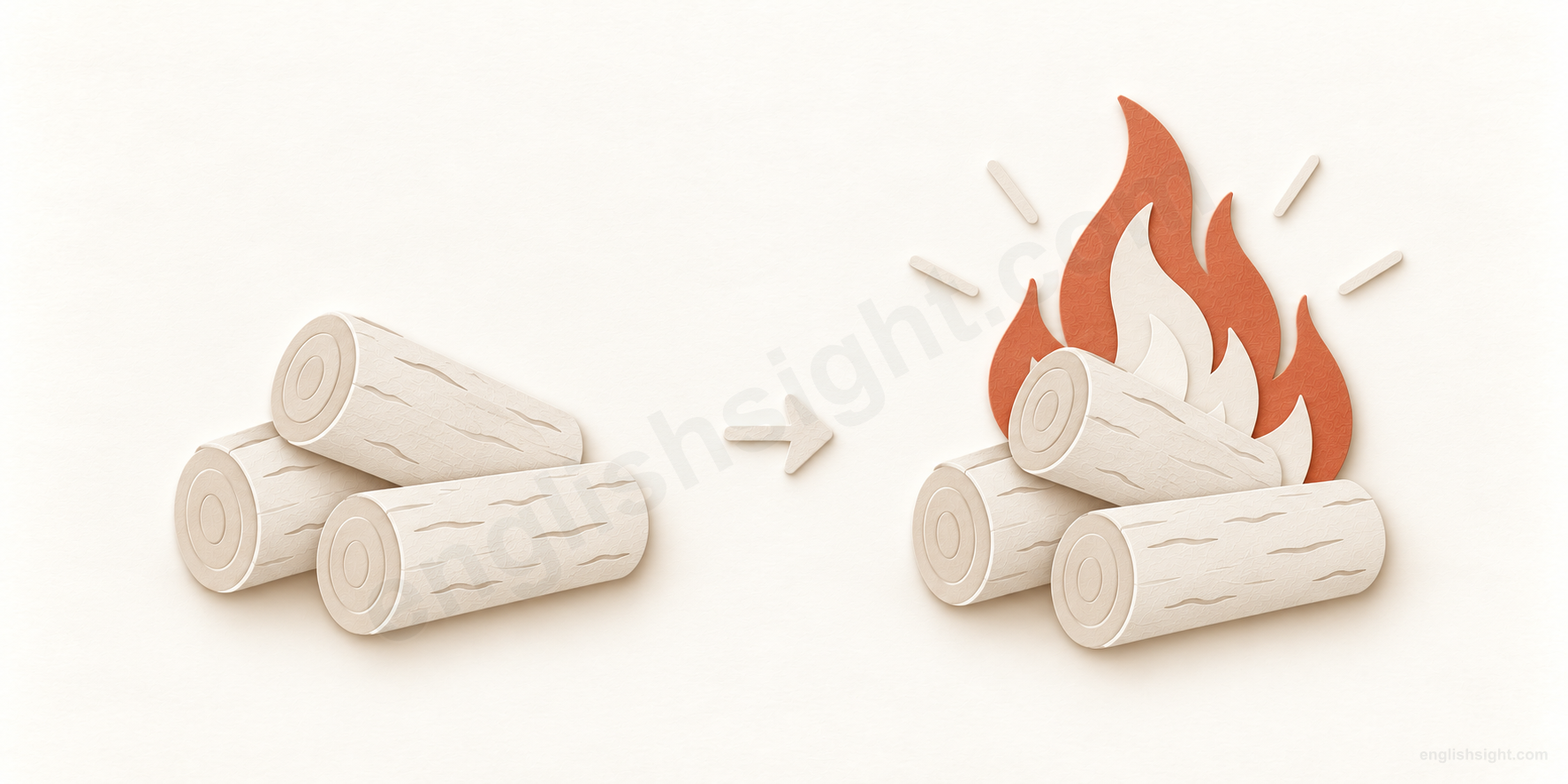
Three logs lie in a small pile without flames.
fire
Flames rise from the same log pile, with short rays suggesting heat and light.
Ignition changes the unlit fuel into burning fuel.
The same fuel before and during burning.
A material changes from fuel that is not burning to burning fuel that gives off heat and light.
The two states show the literal burning branch. Strong feeling and energetic action can be compared with this intensity; shooting, dismissal, and fixed idioms retain separate established meanings.
Fire can name burning, one particular blaze, gunfire, criticism, or strong feeling. As a verb it can describe shooting, ending employment, inspiring someone, starting equipment, or heating clay. The subject, object, and whole construction guide the meaning.
A useful teaching starting point is a change from unburnt fuel to fuel giving off heat and light. This supports comparisons involving activity and intensity, but it does not mechanically explain every use. Dismissal and fixed idioms need to be learned in their own settings.
Begin with the real-fire group, then compare the expressions you meet in conversation, work, and reading. The examples use ordinary modern English; they are not restricted to the historical 850-word list.
01
Burning, starting, and stopping
Start with real burning. Articles, other verbs, and prepositions tell us whether we mean the phenomenon, one fire, its beginning, or its end.
01
fire as an uncountable noun; with / by fire
fire
burning that gives off heat and light
Situation / starting point
You are talking about burning in general.
Meaning / result
You name the phenomenon rather than count separate events.
Fire names burning; a flame is a visible part of a fire.
Fire is a noun for burning and the heat, light, and often smoke it produces. In cooking with fire or damage caused by fire, no article is needed because we are not counting individual fires.
Burn is usually the verb for what a material does: The wood is burning. For ordinary descriptions, do not replace that with The wood is firing. Fire has verb uses, but they do not simply substitute for burn in every sentence.
In a sentence
People cooked with fire long before they had electric ovens.
Watch the difference Use fire for burning as a whole; flame names a tongue or body of burning gas, not every part of the event.
02
make / build / light + a fire; sit by + the fire
make / build / light a fire
prepare or start one fire for heat or cooking
Situation / starting point
There is fuel available for a particular fire.
Meaning / result
The fuel is arranged or lit, and people can gather near it.
A fire is one identifiable burning pile or place, so it can be counted.
Build or make a fire presents preparing a particular fire, including arranging the fuel. Light a fire focuses on making it begin to burn. Once it has been introduced, the fire refers back to it.
By the fire means near it; over an open fire describes cooking above exposed burning fuel. The preposition describes the relationship to the fire, not a new meaning of the word. A log fire and a coal fire specify the fuel.
In a sentence
We lit a small fire and sat by it while the soup cooked.
Watch the difference Say light a fire to start burning. Burn a fire is not the usual equivalent.
03
a fire + break out / start / spread; a house / forest fire
a fire breaks out
an unwanted fire starts
Situation / starting point
A building or area is not on fire.
Meaning / result
An unwanted fire begins and may spread.
The fire is the subject; break out reports its beginning without naming a cause.
A fire can mean one destructive burning event: a kitchen fire, two forest fires, or a fire at a factory. Fire broke out reports that burning started; it does not say who caused it.
Compare A fire broke out with A worker started a fire. The second sentence names a cause or actor. Spread describes reaching new places, while bring the fire under control means limiting it, not necessarily putting it out completely.
A shouted Fire! can warn people about real burning. In a weapons context, Fire! can instead order shooting. The situation supplies the difference between the warning cry and the verb command.
In a sentence
A fire broke out in the empty shop during the night.
Watch the difference Use a fire broke out, not a fire was broken out: break out is intransitive in this use.
04
something + catch fire; catch on fire (especially American English)
catch fire
begin to burn
Situation / starting point
The material is not burning.
Meaning / result
It begins to burn.
The subject is the thing that starts burning, not the person who starts it.
Catch fire describes the change into burning. The past tense is caught fire: The dry grass caught fire. Catch on fire is also used, especially in American English.
In The grass caught fire, the whole expression catch fire takes no additional object: the grass is what begins to burn. In The grass is on fire, burning is already a state. Neither sentence by itself tells you whether someone deliberately caused it.
In a sentence
The paper caught fire when it touched the candle.
Watch the difference Keep the fixed noun without an article: caught fire, not caught a fire.
05
be + on fire
be on fire
be burning
Situation / starting point
You notice that something is burning.
Meaning / result
You report its current condition.
On fire names the burning state; it does not itself describe how that state began.
The roof is on fire describes what is happening now. The roof caught fire describes the beginning. A fire is burning on the roof instead makes the fire the subject and names its location.
The fire is on can mean that a room heater is operating, especially in British English. The heater is on fire means the heater itself is burning. Word order changes the relationship, so the two are not interchangeable.
In a sentence
The roof was on fire when the crew arrived.
Watch the difference Say on fire, without a: on a fire normally describes a position on or above a particular fire.
06
set fire to + object; set + object + on fire
set fire to / set … on fire
cause something to start burning
Situation / starting point
An object is not burning.
Meaning / result
An actor or another cause makes it start burning.
The cause is the subject; the affected object follows to or comes before on fire.
Set fire to the paper and set the paper on fire describe the same basic result with different word order. A person can be the subject, but so can a candle, spark, or electrical fault.
A report about someone setting fire to a building often concerns deliberate action, yet the construction itself also allows accidents: A spark accidentally set the cloth on fire. The diagram’s change from fuel to burning fuel supports the result, not an assumption about intention.
In a sentence
A spark set fire to the dry leaves beside the fence.
Watch the difference Use set fire to it or set it on fire. Do not mix the patterns into set fire it.
07
put + a fire / it + out; a fire + go out / die down
put out a fire / the fire goes out
stop burning, or make burning stop
Situation / starting point
A fire is burning.
Meaning / result
It stops burning, or becomes less intense.
Put out names an action on the fire; go out names its end without an object.
Put out a fire means make it stop burning. This is a use of put out, with fire as its object; it is not a phrasal verb formed from fire. The fire went out reports the end without naming an agent.
Die down means become less strong, so a fire that has died down may still be burning. A fire that is under control may also still burn. These phrases describe different stages.
In workplace language, firefighting means handling problems as they arise. The related metaphor of putting out fires treats urgent problems as little fires demanding immediate attention; it does not describe careful long-term planning.
In a sentence
The crew put the fire out, but smoke remained in the room.
Watch the difference With a pronoun, say put it out. Put out it has the wrong order. Go out takes no object in this meaning.
08
a gas / electric fire; put / switch / turn + the fire + on / off
a gas / electric fire
a heater for a room, especially in British English
Situation / starting point
The room is cold and the heater is off.
Meaning / result
Someone turns the heater on.
Here a fire is an appliance, even if it has no real flame.
In British English, a gas fire or electric fire can be a room heater. An electric fire can be called a fire without any material burning. In American English, heater or space heater is usually clearer for this appliance.
Put the fire on, turn the fire on, and switch the fire on can mean start that heater. Compare the wood-fire meaning of light the fire: choose the verb that fits the equipment or fuel.
In a sentence
The room felt cold, so Nina switched the electric fire on.
Watch the difference This is a regional appliance meaning, not evidence that electricity is literally a flame.
09
fire + noun; a fire alarm goes off; have a fire drill; use a fire escape
fire alarm / fire drill / fire escape
name warning, practice, or escape arrangements connected with fire
Situation / starting point
A building has equipment and procedures for a possible fire.
Meaning / result
The phrase identifies what the equipment or activity is for.
Fire modifies another noun; the second noun names the thing or activity.
A fire alarm is a warning device, and its sounding can also be called a fire alarm. It goes off when it sounds; off here does not mean the warning is being switched off.
A fire drill is practice for leaving a building during a fire. A fire escape is an outside stairway or ladder for escape, not simply any door. Fire safety and fire damage likewise mean safety relating to fires and damage caused by them.
These are compound nouns, not phrasal verbs. Their meanings come from the whole compound; knowing fire alone does not tell you the precise design or function of every item.
In a sentence
We were halfway through lunch when the fire alarm went off.
Watch the difference A fire drill does not require a real fire. A fire alarm going off does not by itself prove that a fire exists.
02
Shots, targets, and attacks
Fire also names shooting or the act of sending something out with force. Follow the subject and object: a person, a weapon, a shot, and a target have different roles.
10
fire + gun / shot / bullet / arrow / rocket; a gun + fire
fire a gun / a shot
make a weapon discharge, or send a projectile from it
Situation / starting point
A weapon has not discharged.
Meaning / result
It discharges, or a projectile is sent out.
The object can name the weapon or what leaves it; the weapon can also be the subject.
Someone can fire a pistol, fire a shot, or fire an arrow from a bow. The object changes what is highlighted: the equipment, the shooting event, or the projectile. Fire is also possible without an object when shooting is already understood.
The gun fired makes the weapon the subject. A shot was fired is passive and leaves the person unnamed. These are established shooting uses; there need not be a visible flame, and firing does not guarantee that a target is hit.
In a sentence
A blank was fired to mark the beginning of the race.
Watch the difference Fire someone normally means dismiss them from work. For shooting toward a person, the preposition at or on matters.
11
fire (something) at + target; fire on + target; fire (something) into + space
fire at / on / into
specify the target or direction of shooting
Situation / starting point
A report mentions shooting but has not specified its direction.
Meaning / result
A preposition identifies a target or the space the shot enters.
At and on identify a target; into identifies a direction into a space.
Fire at the target names what the shot is aimed toward. Fire on a vehicle or group is another established way to describe directing gunfire at it, especially in reports of attacks. The target follows a preposition, rather than becoming a dismissal object.
Fire into the air or into a wall highlights direction or entry into a space. A weapon or projectile may also be an object: fire a shot into the air. These patterns describe direction, not necessarily a successful hit.
In a sentence
The report said that someone had fired at the empty vehicle.
Watch the difference Fired at the driver and fired the driver have different meanings: shooting toward someone versus ending their employment.
12
open fire on + target; return fire; exchange fire with + other side
open / return / exchange fire
begin shooting, shoot back, or shoot at each other
Situation / starting point
The report needs to distinguish who starts or responds.
Meaning / result
The verb before fire identifies the relationship between shots.
Fire is an uncountable noun here, not the main verb.
Open fire means begin shooting. Return fire means respond to being shot at by shooting back. Exchange fire describes shooting between opposing sides; it does not by itself say who began.
Heavy fire means a large amount of shooting, not physically heavy flames. A burst of fire is a short series of shots. These noun phrases belong to the gunfire branch rather than the diagram’s burning logs.
In a sentence
The patrol returned fire after its vehicle was hit.
Watch the difference Say open fire, not open a fire. An open fire, with an article, usually means exposed burning fuel used for heat or cooking.
13
hold + possessive + fire; cease fire
hold your fire / cease fire
refrain from shooting, or stop shooting
Situation / starting point
Shooting is possible or already happening.
Meaning / result
An order delays it or stops it.
Hold your fire means refrain from shooting; cease fire explicitly orders shooting to stop.
Hold your fire tells a person or group not to shoot, often until a further signal; it can delay the start or suspend shooting already underway. Cease fire explicitly tells them to stop shooting. The normal phrases contain fire as a noun, even though Fire! alone can be an order using the verb.
Hold your fire can also ask someone to wait before criticizing or reacting. The separate expression hold fire can mean delay action more generally. Context must decide whether any weapons are involved.
In a sentence
The commander told the guards to hold their fire.
Watch the difference A ceasefire is a noun for an agreed or actual pause in fighting. Cease fire is the two-word command or verb phrase.
14
be / come under fire; under fire from + source; under fire for / over + issue
come under fire
be shot at, or receive strong criticism
Situation / starting point
A person, group, or plan becomes a target.
Meaning / result
Shots or criticism are directed at that target.
The gunfire meaning and the criticism meaning share a target relationship, but the context separates them.
A vehicle came under fire can mean it was shot at. A company came under fire for its prices normally means people strongly criticized it. Come under highlights the beginning of the attack; be under describes the situation.
From names the source of the criticism, while for or over names its reason or subject. Draw fire means attract criticism or gunfire; the sentence must make clear which kind of attack is involved.
In a sentence
The company came under fire from customers over the extra charge.
Watch the difference Under fire does not mean dismissed from a job. Fired and under fire belong to different constructions.
15
in the line of fire; draw + person’s + fire
in the line of fire / draw someone’s fire
be exposed to an attack, or redirect it toward yourself
Situation / starting point
An attack is directed toward someone or something.
Meaning / result
Another person is exposed to it, or deliberately attracts it.
The line identifies exposure; draw identifies attracting an attack.
In the line of fire literally places someone where shots may hit them. Figuratively, an employee caught in the line of fire during an argument is exposed to other people’s anger or blame.
Draw someone’s fire can describe taking their criticism or anger yourself so that someone else is spared. This is more specific than draw fire, which can simply mean attract criticism. The relationship is about attack and exposure, not about making a material burn.
In a sentence
Maya answered the hostile questions to draw the audience’s fire away from the trainees.
Watch the difference Being in the line of fire describes risk or exposure; it does not guarantee injury or imply that the person caused the conflict.
16
fire + ball / shot + direction
fire the ball / a shot
send a ball or shot quickly and forcefully
Situation / starting point
A player has the ball or an opportunity to shoot.
Meaning / result
The player sends it sharply toward another place.
Sports reporting borrows the speed and force of sending something out.
Fire can describe a powerful throw, pass, or shot in sports. The ball and a direction make this different from firing a weapon, even though the sense of forceful sending is comparable.
Fire the ball to a teammate can describe a hard, quick throw or pass. A player fired a shot toward goal describes an attempt; it does not tell you that the player scored. This is vivid sports wording rather than the neutral verb for every pass.
In a sentence
The defender fired the ball across the court to Jo.
Watch the difference Do not infer a goal or a successful catch from fire alone. The result needs its own wording.
03
Jobs, questions, and quick messages
Some everyday uses are established meanings of the verb or the whole expression. Losing a job, inviting a question, and sending a message are different situations.
17
fire + person; be / get fired; fire someone from + job; fire someone for + reason
fire someone / get fired
make someone leave their job
Situation / starting point
A person has a job.
Meaning / result
The employer ends that person’s employment.
The person is the object of fire, or the subject of a passive construction.
The manager fired Ben means the manager ended Ben’s employment. Ben was fired and Ben got fired put Ben first; got fired is particularly natural in conversation when describing what happened to him.
For introduces a reason, as in fired for repeated lateness. From can identify the job. Fire is direct, everyday wording; dismiss is a more formal alternative, and sack is common informal British wording.
Compare Ben resigned: he chose to leave. Ben was laid off usually suggests a business or staffing reason. Fired does not by itself prove misconduct, and it is not the employee’s voluntary decision. Learn this job meaning as an established branch, not as literal burning.
In a sentence
The company fired its manager after the investigation.
Watch the difference Do not say He fired from his job when you mean he lost it. Say He was fired or He got fired from his job.
18
fire + questions / comments / insults + at + person
fire questions at someone
ask many questions rapidly
Situation / starting point
Someone is available to answer or receive comments.
Meaning / result
Questions or remarks arrive rapidly, one after another.
The questions are the object; at names the person receiving them.
Fire questions at someone presents questions as a quick series directed toward that person. The subject asks them; the person after at receives them. It often sounds intense, demanding, or difficult to answer.
Comments, orders, or insults can also be delivered with force and speed. This figurative sending is related to the shooting branch, but the noun object makes clear that it is speech. An ordinary single polite question is more neutrally asked.
In a sentence
The students fired questions at the guide before she had finished her introduction.
Watch the difference Use at for the recipient in this pattern: fire questions at her. Fire her would normally mean dismiss her.
19
fire away as an informal invitation
Fire away!
invite someone to start speaking or asking
Situation / starting point
Someone wants to ask you something.
Meaning / result
You invite the person to begin.
The listener is given the conversational turn; away does not mean leave.
Fire away! is a friendly, informal response when someone has a question or something to say. It can invite one question or several, so it does not require the rapid questioning of fire questions at someone.
The invitation is a learned conversational use of the whole expression. It is not a literal shooting instruction in this setting, and you do not insert the person as an object: Fire away, not Fire me away.
In a sentence
“Can I ask about the timetable?” “Sure—fire away.”
Watch the difference Use this in relaxed conversation. In a formal message, Please go ahead or Please ask your question may fit better.
20
fire off + noun; fire + noun / pronoun + off
fire off a message / a shot
send or say something quickly; discharge a shot
Situation / starting point
Someone is ready to send a message or discharge a weapon.
Meaning / result
The message or shot is sent out.
The object selects a communication meaning or a literal shooting meaning.
Fire off an email means write and send it quickly, often with irritation or without much delay. The expression can also refer to quick spoken remarks. Anger is common, but it is not required in every use.
The literal meaning remains: The guards fired off several shots means they discharged shots. Off contributes to the established expression of sending something out; it does not mean turning a device off.
The phrasal verb is separable: fire off the reply or fire the reply off. A pronoun goes between the parts: fire it off. The speed is highlighted; successful delivery or a successful hit is not guaranteed.
In a sentence
I fired off a quick reply before boarding the train.
Watch the difference Do not confuse fire it off with fire it up: send it quickly versus start it operating.
21
a plan + hang fire; hold fire on + action / decision
hang fire / hold fire
be delayed, or wait before acting
Situation / starting point
An action or decision is possible.
Meaning / result
It is postponed or remains pending.
These idioms concern delay, not a flame hanging from something.
A plan that hangs fire has not moved ahead, often because something needed for it is missing. We’ll hold fire means we will wait before acting. Hold fire on the announcement specifies what is being delayed.
Compare hold your fire in a shooting report, where the order is not to shoot. In conversation the same family of expressions can ask someone to delay criticism or a reaction. Learn hang fire and hold fire as fixed combinations, not as a general rule for hang or hold plus any noun.
In a sentence
Let’s hold fire on the booking until everyone has replied.
Watch the difference The usual idiom is hang fire, not hang a fire. Its past tense is hung fire.
04
Enthusiasm, intensity, and success
Heat and flame offer a useful comparison for strong feeling and energetic action. These expressions still have their own grammar, tone, and limits.
22
be full of fire; have fire in + possessive + belly
full of fire / fire in your belly
strong energy, feeling, or determination
Situation / starting point
You describe how strongly someone feels or wants to succeed.
Meaning / result
Fire presents their energy as intense and active.
This uncountable noun can refer to emotion or drive, not a physical fire inside a person.
A performance full of fire has passion and energy. Depending on context, fire can also suggest anger or a strong competitive spirit. It is expressive language rather than a medical description.
Fire in your belly is a fixed idiom for a strong determination to achieve something. A quiet person may still have it: the idiom concerns drive, not necessarily loud or visibly excited behavior.
A ball of fire is another informal description of a very energetic person. These expressions share an intensity comparison with burning, but belly and ball are parts of learned phrases rather than literal locations or shapes.
In a sentence
You can hear the fire in her voice when she talks about the project.
Watch the difference Do not treat fire in your belly as an explanation of stomach pain. Literal pain requires its own context and wording.
23
fire + imagination; fire + person + with + feeling; be fired with + feeling
fire someone’s imagination / fire someone with enthusiasm
make imagination or strong interest become active
Situation / starting point
A person has not yet developed a strong interest or set of ideas.
Meaning / result
A story, event, or other influence stimulates that response.
The cause is the subject; the imagination or the person is what is stimulated.
An account of a journey can fire a child’s imagination: it stimulates ideas and excitement. Fire someone with enthusiasm names the person and then the feeling through with. In the passive, someone can be fired with determination or enthusiasm.
This is a more vivid, sometimes literary use than interest someone or give someone ideas. Burning becoming active is a teaching comparison for the feeling; it is not a claim about a physical process in the person.
Notice the object: fire the imagination stimulates it; fire the employee ends employment. The surrounding nouns and complements decide which established meaning applies.
In a sentence
The photographs fired Eva’s imagination and made her want to explore the coast.
Watch the difference He was fired with enthusiasm means he was inspired, whereas He was fired normally means he lost his job.
24
fire up + person; fire + person / pronoun + up; be fired up about + topic / for + event
fire someone up / be fired up
make someone excited, interested, or eager to act
Situation / starting point
A person or group needs motivation or becomes strongly interested.
Meaning / result
They feel energized and ready to take part.
With a person as object, fire up concerns emotion rather than starting equipment.
The coach fired the team up means the coach energized the players. The team was fired up describes their excited state; a person can also get fired up as that state develops.
About can name the topic, as in fired up about the trip, and for can name the coming event, as in fired up for the final. Strong excitement can include anger in context; it is not always cheerful.
Fire up the team and fire the team up are possible. With a pronoun, use fire them up. Compare fire up the projector: the same particle verb has a separate equipment meaning selected by its object.
In a sentence
The coach’s short speech fired them up for the final.
Watch the difference Keep up when you mean energize: She fired them and She fired them up tell very different stories.
25
person / team + be on fire; body part + be on fire
on fire: performing well / feeling a burning sensation
be exceptionally effective, or feel as if burning
Situation / starting point
Context concerns a performance or an intense sensation.
Meaning / result
On fire compares the intensity with burning.
A team’s success and a body’s burning feeling are separate figurative uses.
When a commentator says The goalkeeper is on fire, the informal praise means the player is performing extremely well. It does not just mean excited: the context is exceptional performance.
My legs were on fire after the climb describes an intense burning feeling. This is a sensation comparison, not a claim that the legs have flames. By contrast, The shed is on fire normally reports real burning.
The words alone do not select one interpretation. Look at the subject and the situation; never assume that every use of on fire is praise.
In a sentence
Our goalkeeper was on fire, stopping shot after shot.
Watch the difference Distinguish be fired up, which describes excitement, from be on fire in a performance context, which praises how well someone is doing.
26
something + be + fire (slang adjective)
That is fire.
informal slang praise meaning excellent
Situation / starting point
Friends are giving an enthusiastic opinion.
Meaning / result
Fire gives strong approval.
Here fire functions as a slang adjective, without on or an article.
That track is fire is slang praise for a very good piece of music. An outfit, a performance, or something else can receive the same enthusiastic approval. This is a modern adjective use, not a countable burning event.
Compare The singer is on fire, which praises how the singer is performing, and The singer is fired up, which describes excitement. The shorter slang expression is especially at home in casual conversation and online comments.
In a sentence
“What do you think of the new track?” “It’s fire.”
Watch the difference In neutral or formal writing, excellent or impressive is usually clearer. This is slang, not the default meaning of every isolated fire.
27
set the world on fire; often in a negative clause
set the world on fire
be extraordinarily successful and admired
Situation / starting point
You judge whether an achievement will impress many people.
Meaning / result
The idiom predicts or denies exceptional success.
The world is part of a fixed exaggeration, not a literal target.
A product that will not set the world on fire is unlikely to cause great excitement or win exceptional admiration. The phrase is often negative and can be a mild, humorous way to say that something is ordinary.
It need not mean total failure: an ordinary product may still be useful. British English also has set the world alight. Learn the whole expression rather than interpreting set fire to the world as an interchangeable idiom.
In a sentence
The design is useful, but it probably won’t set the world on fire.
Watch the difference Do not confuse this fixed success idiom with a literal report that a place has been set on fire.
28
idea / activity / audience + catch fire
an idea / audience catches fire
gain strong interest or popularity; become enthusiastic
Situation / starting point
An idea has little attention, or an audience is not yet excited.
Meaning / result
Interest, enthusiasm, or the activity’s success grows strongly.
A change into burning supplies a comparison for something becoming intensely active.
An idea that catches fire begins to attract much more interest or support. A campaign or activity can catch fire as it gains momentum. The subject is the thing that becomes more successful or widely interesting.
An audience that catches fire becomes enthusiastic. This use keeps the idea of a change, unlike on fire in The band is on fire, which describes an already impressive performance. Context must distinguish both from actual burning.
In a sentence
The idea caught fire after local groups began sharing their results.
Watch the difference This is figurative, but catch still has the past form caught. Do not add an object as if fire were something someone had grabbed.
29
build / light a fire under + person
build / light a fire under someone
push or motivate someone into energetic action
Situation / starting point
Someone is moving too slowly or lacks motivation.
Meaning / result
An influence encourages or pressures them to act.
The imagined heat is a memory aid for urgency, not a literal action on a person.
Build a fire under someone is an idiom for stimulating them to act with more energy. Light a fire under someone is a US informal version that emphasizes making them work faster and more effectively: The reminder lit a fire under us. The past tense of light here is lit.
A deadline or a demanding request can supply the push. Compare fire someone up, which emphasizes excitement or motivation. Build or light a fire under someone often presents added urgency to get action moving. Under is part of the whole idiom, not a physical location in this use.
In a sentence
The approaching deadline built a fire under the whole team.
Watch the difference Treat the expression as figurative informal language, not a suggestion to use real fire or a synonym for dismissing the team.
05
Engines, equipment, and heated materials
Literal heat explains some uses; starting a computer extends the idea of starting an engine. The object tells you which process is involved.
30
engine + fire; be firing on all cylinders
the engine fires / firing on all cylinders
fuel ignites in an engine; figuratively, operate at full effectiveness
Situation / starting point
An engine needs ignition to work, or a person needs to work effectively.
Meaning / result
The engine begins working, or the person performs at full capacity.
The literal engine process supplies the comparison for an established performance idiom.
When an engine fires, ignition makes fuel burn so the engine can work. The engine is the subject, with no object needed. The engine would not fire reports an ignition or starting problem; it does not say that the outside of the engine was on fire.
Firing on all cylinders figuratively describes using all your energy or working as well as possible. After a poor night’s sleep, I’m not firing on all cylinders means I am not thinking or functioning at my best.
Literal cylinders belong to an engine. The idiom does not require a person to have any, and it does not simply mean someone has been dismissed.
In a sentence
After a full night’s sleep, I was firing on all cylinders again.
Watch the difference The engine fired and the engine caught fire describe different events: operating ignition versus an unwanted blaze.
31
fire up + thing; fire + thing / pronoun + up
fire up a machine / program
start equipment or software operating
Situation / starting point
A machine or program is not running.
Meaning / result
Someone starts it so it can be used.
The object is equipment or software rather than a person needing motivation.
Fire up the engine is informal wording for starting it. The expression extends naturally to a computer, projector, or program; no literal burning is needed in the computer or software use.
Up belongs to the established particle verb. Fire up the laptop and fire the laptop up have the same basic meaning. With it, use fire it up. Starting is the focus; the expression does not promise that the device will work successfully afterward.
In a sentence
Let me fire up the projector so we can look at the maps.
Watch the difference Fire it up starts it. Fire it off sends it out. A pronoun belongs between fire and the particle in both expressions.
32
fire + clay object; clay object + be fired + in a kiln
fire clay / pottery
heat a clay object in a kiln as part of making it
Situation / starting point
A clay object has been shaped but still needs heat treatment.
Meaning / result
It is heated in a kiln to develop the required hardness or finish.
The object receives controlled heat; the meaning is not destroying it in a blaze.
A potter fires a bowl by heating it in a kiln, a special oven. The purpose is to make or finish the object, not to burn it away. Clay may be fired to harden it, and a later firing can be part of fixing a glaze.
The bowl was fired places the clay object first and leaves the potter unnamed. Fired is the regular past participle. The kiln and clay object identify this craft meaning, which differs from firing a weapon or an employee.
In a sentence
The bowls were fired in the kiln after they had dried.
Watch the difference Use fired for this heat-treatment process. Burned the bowls suggests damage rather than the intended pottery stage.
33
fuel name + -fired + noun; be fired with + fuel
gas-fired / coal-fired
powered or heated by burning a named fuel
Situation / starting point
A boiler or plant needs a heat or energy source.
Meaning / result
The expression identifies the fuel it burns.
The fuel before -fired tells us what supplies energy, not what is being dismissed or shot.
A gas-fired boiler burns gas to supply heat. A coal-fired power station uses coal. These are compound adjectives before a noun, normally written with a hyphen.
The older boiler was fired with coal uses a passive-looking construction to describe the fuel supplied to it. Fire a furnace can also mean supply or tend its fire. These are equipment and fuel uses; they do not make -fired a productive ending for every kind of energy source.
In a sentence
The old coal-fired boiler was replaced by a newer heating system.
Watch the difference An electric heater is not normally called electricity-fired: -fired in this use identifies a fuel burned for heat.
06
Risk, relationships, and difficult situations
Learn these as complete expressions. A useful comparison may help you remember them, but it does not let you invent their wording or predict their meaning word by word.
34
play with fire; be playing with fire
play with fire
take a risk likely to lead to serious trouble
Situation / starting point
Someone chooses an action with dangerous possible consequences.
Meaning / result
The speaker warns that the risk may bring trouble.
Danger is the comparison; no literal flame is needed.
You’re playing with fire can warn that an action is dangerously unwise. The present progressive is common when the risky behavior is happening or continuing.
The phrase does not guarantee a bad result, and play does not make the risk harmless. The warning belongs to the whole idiom; ordinary play with a toy has no such automatic implication.
In a sentence
You’re playing with fire if you keep sharing that account password.
Watch the difference The idiom is play with fire, without a. It describes taking a risk, not feeling enthusiastic.
35
add fuel to + the fire / flames
add fuel to the fire
make an argument or difficult situation worse
Situation / starting point
An argument, anger, or other problem already exists.
Meaning / result
A comment or action increases it.
Fuel feeds real burning; the idiom compares that with feeding a conflict.
Add fuel to the fire means make an existing disagreement, anger, or troublesome situation more intense. The subject can be a person or something said or done.
The fire is an established problem, not automatically enthusiasm. Add fuel to the flames is a familiar variation. Fuel the debate is a related construction, but you should not replace the words of this idiom freely.
In a sentence
His sarcastic reply only added fuel to the fire.
Watch the difference This usually presents the added intensity negatively. Use encourage or inspire for neutral or positive support when that is your meaning.
36
fight fire with fire
fight fire with fire
respond using the same kind of methods as an opponent
Situation / starting point
An opponent uses a particular tactic.
Meaning / result
Someone chooses a similar tactic in response.
The comparison concerns matching methods, not simply responding more strongly.
Fight fire with fire means use methods like those being used against you. In an argument, someone might answer ridicule with ridicule rather than switch to calm explanation.
The idiom describes a strategy; it does not say the strategy is fair, wise, or successful. With identifies the matching means in this fixed expression. The lesson’s burning diagram is only a memory connection, not advice about fighting a real fire.
In a sentence
When the rival shop cut its prices, they decided to fight fire with fire.
Watch the difference The essential idea is a similar method, not any strong response or any attempt to solve a problem.
37
go / jump + out of the frying pan into the fire
out of the frying pan into the fire
leave a bad situation for an even worse one
Situation / starting point
Someone wants to escape an unpleasant situation.
Meaning / result
The alternative turns out worse.
The two hot places provide an ordered comparison: bad, then worse.
The saying describes an attempted escape that leads to greater difficulty. The first problem does not disappear into a good solution; the new situation is worse than the old one.
A speaker may use it as a warning before a decision or as a judgment afterward. Pan and fire are fixed parts of the saying, and no actual cooking is involved.
In a sentence
Moving from a noisy room to one beside the building work meant jumping out of the frying pan into the fire.
Watch the difference Use the order pan then fire: the worsening relationship is part of the expression.
38
people + get on / get along + like a house on fire
get on / along like a house on fire
quickly develop a very friendly relationship
Situation / starting point
Two people meet or begin spending time together.
Meaning / result
They connect quickly and comfortably.
The whole comparison is an informal positive description of a relationship.
In British English, We got on like a house on fire means we quickly became very friendly. Get along is the North American form used in this relationship expression.
This is a learned idiom, not an instruction to picture a house burning and calculate a meaning. Although a real house fire is dangerous, the relationship idiom is positive. It does not mean the two people argued.
In a sentence
My cousin and my new roommate got on like a house on fire.
Watch the difference Keep the complete comparison, including a house. Got on fire alone would suggest burning rather than friendship.
39
have + several / a few / too many + irons in the fire
have several irons in the fire
keep several activities or possibilities going at once
Situation / starting point
Someone wants options rather than relying on one possible result.
Meaning / result
Several projects or opportunities are being pursued.
The number of irons compares with the number of active possibilities.
I have a few irons in the fire means I am involved in several activities or possible plans, hoping that something will succeed. A job seeker may have several applications or conversations underway without having several jobs.
Too many irons in the fire adds a judgment that the person has taken on too much. A few irons may be sensible; the idiom itself does not always criticize being busy.
The remembered picture of several pieces of iron being heated can help explain keeping things ready, but it does not determine which real projects the speaker means.
In a sentence
I haven’t chosen a new job yet, but I have a few irons in the fire.
Watch the difference Use the plural irons for the separate possibilities. The expression does not mean that success is already secured.
40
(there is) no smoke without fire; where there’s smoke, there’s fire
no smoke without fire
a saying suggesting that a rumor probably has some basis
Situation / starting point
People have heard an allegation or rumor.
Meaning / result
The speaker suggests that something real may lie behind it.
Smoke is a comparison for a sign; the saying expresses a judgment rather than proving it.
There’s no smoke without fire is a British form of the saying. Where there’s smoke, there’s fire is the usual North American version. Both suggest that talk about something bad may have a real cause.
This is what the speaker implies, not a guarantee that the rumor is true. Repeating an accusation does not supply evidence. The relationship between smoke and a source is used rhetorically, so keep the saying separate from a verified conclusion.
In a sentence
“Those rumors could be invented.” “Maybe, but there’s no smoke without fire.”
Watch the difference Do not turn a familiar saying into a factual rule that every allegation must be true.
41
a baptism of fire; baptism by fire (also used)
a baptism of fire
a difficult first experience of a new role or activity
Situation / starting point
Someone is new to a job or activity.
Meaning / result
Their introduction immediately involves a severe challenge.
Fire is part of an established expression for a testing introduction.
A baptism of fire describes a demanding first experience, such as handling a major problem on your first day at work. Baptism by fire is also used. The emphasis is on an introduction under pressure.
It is not simply any difficulty at any time: the experience introduces someone to the activity. In this figurative use it does not describe a religious ceremony or a real fire, and it does not guarantee that the newcomer succeeds.
In a sentence
Running the busy desk on her first morning was a baptism of fire.
Watch the difference Keep the idea of a challenging beginning. An experienced worker’s ordinary busy day is not automatically a baptism of fire.
Read the whole expression
Noun, verb, or slang adjective?
Fire is usually a noun or verb. Fires counts particular blazes, burning piles, or heaters, and is also the third-person verb form. Fire in general, gunfire, and emotional fire are normally uncountable. The slang adjective in That song is fire is a separate informal use.
Forms and voice
The verb forms are fire, fires, fired, fired, firing: drop the final e before -ing. Active events can be progressive: They were firing questions at us. Transitive uses allow passives: a shot was fired, an employee was fired, and a bowl was fired. The complement and context distinguish them. Fired up can describe an excited state as well as the result of someone’s motivating action.
Particles, prepositions, and other verbs
Fire up and fire off are separable with an object: fire it up, fire it off. Fire away is an invitation with no ordinary object in that conversational use. At in fire at a target introduces the target. In catch fire, set fire to, put out a fire, and open fire, another verb does the grammatical work and fire is a noun. These are not all phrasal verbs of fire.
A picture connects only what it can explain
Burning is a useful starting point for intensity and activation. It does not prove a historical origin for every expression or describe an identical mental picture shared by all speakers. In particular, firing an employee has to be learned as an employment meaning; a diagram of flames cannot predict it.
Scope of this lesson
The lesson covers common modern senses, useful constructions, selected safety compounds, and established everyday idioms. It is not a frequency ranking or an inventory of every fire compound. Specialist uses such as neurons firing, gemstone fire, veterinary procedures, and technical sports scores are outside the main course. The uppercase acronym FIRE and names are separate topics.
Choose the meaning and construction
Use the subject, object, and surrounding words to choose. Some options are grammatical but express different events.
1. The grass began to burn when a spark reached it. Which sentence focuses on the beginning?
2. A spark caused a cloth to start burning. Which sentence has the right causative word order?
3. The owner ended Ben’s employment. Which sentence expresses that?
4. A speech made the team excited and ready to play. Which expression fits?
5. You want to start the projector. Which sentence uses the correct particle and pronoun order?
6. Customers strongly criticized a company’s fees. What does The company came under fire mean here?
7. The fire is weaker but is still burning. Which description says exactly that?
8. Two new neighbors immediately became very friendly. Which expression fits?
Sources and teaching notes
The sources below were read to check senses, constructions, idioms, and regional or register notes. Explanations and examples were written for this lesson. The burning model is a teaching comparison, not a claim that every sense follows from one picture.
The diagram shows fuel before and during burning. Other senses have their own usage patterns.