Use fish for animals and food, then follow the verb into searching and familiar expressions.
The animal and the attempt
The animal and the attempt
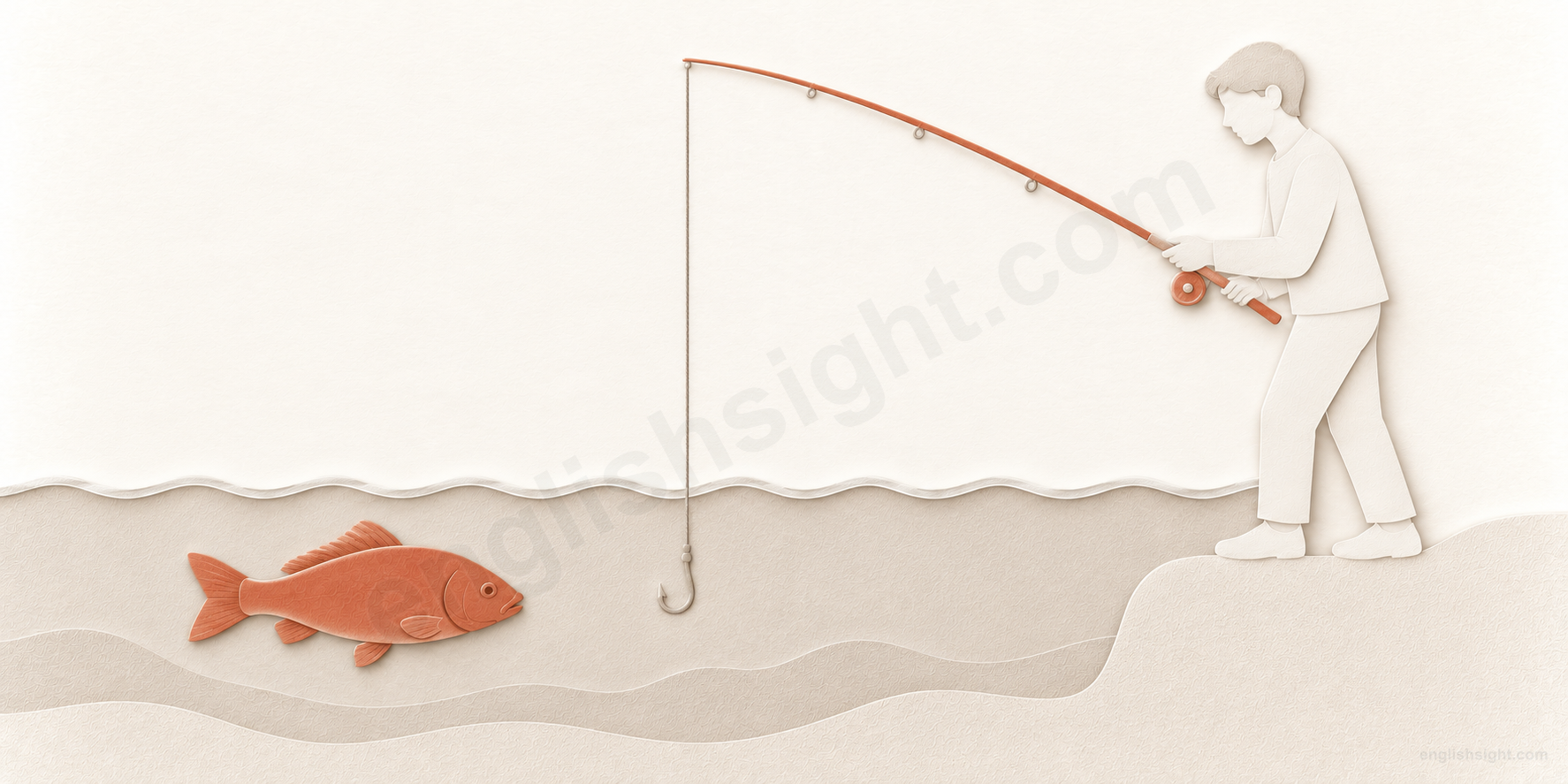
A fish swims freely below the water surface.
fish
The hook remains empty; the fish is still separate from it.
A person on the bank holds a rod and line, trying to catch fish.
The animal is a fish; the person is fishing. Trying does not guarantee catching.
Fish names an animal that lives in water; to fish is to try to catch such animals. The verb also extends to seeking something that is not immediately available.
The animal remains separate from the hook: an attempt is shown, not a guaranteed catch. Food and fixed idioms are explained in their own branches.
Fish /fɪʃ/ is both a noun and a verb. As a noun it can name an animal or food; as a verb it can describe an attempt to catch fish. An attempt may fail.
Searching for something hidden and trying to draw information from someone are useful extensions. Fixed expressions about people and situations must also be learned as expressions; one picture cannot predict them all.
01
Animals, food, and noun forms
First decide whether fish identifies animals, an amount of food, or the connection in a noun combination.
01
a fish + singular verb; number + fish + plural verb
a fish / three fish
a water-living animal with gills and fins
Situation / starting point
You look below a bridge.
Meaning / outcome
You identify individual animals in the water.
Count the animals, even though the ordinary plural has no added ending.
Use a fish for one animal and fish for several: one fish is, three fish are. The noun can name a living animal or a whole animal already caught.
A dolphin lives in water but is a mammal, not a fish. Words such as jellyfish and shellfish have their own meanings; their endings do not make them biological fish.
In a sentence
Three fish are swimming under the bridge.
Watch the difference Match the verb to the number: the fish is can mean one; the fish are means more than one.
02
one fish → two fish; different fishes / kinds of fish
fish or fishes
choose the ordinary plural or a plural emphasizing kinds
Situation / starting point
You count animals, or describe a scientific collection.
Meaning / outcome
Your wording shows individuals or kinds without inventing a new singular.
Fish is the everyday plural; fishes is possible, especially for species.
I saw ten fish is the natural everyday choice. Fishes is also a plural, especially when discussing different species in biological writing. Different kinds of fish remains an ordinary alternative.
Fishes can also be a verb: She fishes on Sundays. Grammar, not the ending alone, tells you which word you are reading.
In a sentence
The guide describes the freshwater fishes of the region.
Watch the difference Do not teach fishes as always wrong, or as required whenever several species are present.
03
some / much fish; a piece / fillet of fish
some fish / a piece of fish
fish considered as food
Situation / starting point
You choose what to cook.
Meaning / outcome
You refer to the food rather than count whole animals.
The food use is normally uncountable.
Have some fish or eat fish speaks about the food. Use a piece of fish or two fish fillets to count portions. A whole fish on a plate can still be counted as an animal: We ordered two whole fish.
Fresh, frozen, grilled, and smoked describe its condition or preparation. Fish and chips names a familiar meal; fish is still the food noun, not a plural ending.
In a sentence
We had grilled fish and rice for lunch.
Watch the difference Say How much fish do we need? for an amount of food; How many fish? asks for a number of animals.
04
fish + noun; adjective + fish
fish tank / fish soup
use fish before another noun
Situation / starting point
You name a container or dish.
Meaning / outcome
The second noun identifies the thing; fish specifies its connection.
The same noun can describe a home for fish or food made with fish.
A fish tank holds fish; fish soup contains fish. Fish is a noun used before another noun, and the relationship comes from the whole combination.
The head noun takes the ordinary plural: two fish tanks, three fish dishes. Compare freshwater fish, where freshwater instead describes the animal’s habitat.
In a sentence
We cleaned both fish tanks before feeding the fish.
Watch the difference Do not add a plural ending to the first noun: fish tanks, not fishes tanks.
02
Trying to catch fish
Separate the activity from a successful catch, then specify the place and intended species.
05
fish; go fishing; be fishing
fish / go fishing
spend time trying to catch fish
Situation / starting point
You take a rod to the river.
Meaning / outcome
You spend the afternoon trying, whether or not you catch anything.
Fishing names the activity; catching a fish states a successful result.
The verb fish can stand without an object: We fished all afternoon. Go fishing is the familiar leisure expression. A line, a net, or other equipment may be involved; fish does not specifically mean using a rod.
We were fishing describes an activity in progress. Compare We caught two fish, which reports what we actually obtained. A day’s fishing can end with no catch.
In a sentence
We went fishing, but we did not catch anything.
Watch the difference Use go fishing, not go to fishing. Fish does not promise success.
06
fish in + water/place; fish for + species; fish + water/place (+ for + species)
fish in a lake / fish for trout
identify the place and intended catch
Situation / starting point
You explain where you fish and what you hope to catch.
Meaning / outcome
The listener distinguishes the fishing water from the target species.
In names the location; for names the desired catch.
Fish in the lake gives a location; fish for trout gives the target. Fish the lake is also possible: the water itself is the object, understood as the area being worked.
These patterns can combine: fish the lake for trout. The lake is not an animal being caught. Because this use is transitive, a passive is possible: This stretch of river is heavily fished.
In a sentence
We fished the lake for trout until noon.
Watch the difference Fish for trout is literal here; fish for compliments uses the same preposition with an abstract target.
03
Searching, retrieving, and drawing out a response
The verb extends to feeling for hidden objects and seeking responses indirectly. The construction determines whether a result is reached.
07
fish (around) in + container + for + object
fish around in a bag for something
search by moving your hand around
Situation / starting point
You cannot see your keys among other things.
Meaning / outcome
You feel around for them; finding them is still uncertain.
A hidden object is sought by touch, as a fish may be sought out of sight.
Fish around in a bag suggests feeling or rummaging with your hand. Around adds the sense of searching in different places; in introduces the container and for introduces the wanted object.
This is an extended verb use, not a claim that the bag contains water. Compare look in your bag, which does not specifically suggest searching by touch. Fish around can describe searching even if nothing is found.
In a sentence
Mina fished around in her bag for a pen.
Watch the difference Keep the container and target distinct: in her bag, for a pen.
08
fish + something/somebody + out (of + place); fish out + noun; fish + object + from + place
fish something/somebody out (of somewhere)
pull something or someone out, often after searching
Situation / starting point
A receipt is buried in your pocket.
Meaning / outcome
You extract it and can show it.
Out adds a result: the object comes out of its former place.
Fish out commonly presents an effort of finding or reaching before removal. It may describe retrieving something from water or taking something from a pocket, bag, or drawer. It can also have a person as its object: The boat crew fished him out of the water. The person or object need not have been hidden.
A noun can go on either side of out: fish out the receipt or fish the receipt out. A personal pronoun goes between them: fish it out. Fish the receipt from your pocket is another possible retrieval pattern.
A passive is possible: The keys were fished out of the drain. Do not confuse this action with a fish out of water, the noun idiom for feeling out of place.
In a sentence
He fished the receipt out of his coat pocket.
Watch the difference Say fish it out, not fish out it. Out can be followed by of plus the source.
09
fish for + compliment / praise / information; be fishing
fish for compliments / information
try to draw a response out of someone indirectly
Situation / starting point
You hint instead of asking openly.
Meaning / outcome
You hope someone supplies praise or private details.
The target is a response rather than an animal.
Someone fishing for compliments may criticize their own work in the hope that others will praise it. Fishing for information means trying to get details without stating the real question openly.
The wording often implies disapproval or suspicion about the method. She’s fishing can leave the target unstated when the conversation makes it clear. This is not simply any request for information.
In a sentence
When he asked whether the team had been “very busy,” I suspected he was fishing for information.
Watch the difference In fish for it, for stays before its object. It does not behave like the movable out in fish it out.
04
People and their surroundings
Learn these fixed descriptions with their social meaning and tone. Fish is not freely interchangeable with person.
10
be a fish out of water; feel like a fish out of water
a fish out of water
someone uncomfortable in an unfamiliar setting
Situation / starting point
Everyone else understands the local customs.
Meaning / outcome
You feel that you do not belong in the situation.
The idiom compares unfamiliar surroundings to an animal outside its natural environment.
You can be a fish out of water or feel like a fish out of water. The expression describes discomfort or being out of your element; no physical water is involved.
A new workplace, a formal party, or a subject outside your experience can create this feeling. It need not mean that other people have rejected you.
In a sentence
At the formal dinner, I felt like a fish out of water.
Watch the difference Keep the full image out of water; fish out by itself is the retrieval verb.
11
be / seem + a cold fish; call someone + a cold fish
a cold fish
someone who seems emotionally distant
Situation / starting point
You try to have a warm conversation.
Meaning / outcome
The other person shows little feeling or friendliness.
Cold describes a perceived lack of emotional warmth.
Calling someone a cold fish judges how they relate to other people. They seem unemotional, unfriendly, or unsympathetic; the phrase is informal and can sound insulting.
It reports an impression rather than proving what a person feels privately. A quiet or shy person is not automatically a cold fish.
In a sentence
I thought he was a cold fish until he began talking warmly about his family.
Watch the difference This describes a person’s manner, not their body temperature.
12
be a big fish; be a big fish in a small pond
a big fish (in a small pond)
an important person, especially within a limited group
Situation / starting point
A local club has one influential member.
Meaning / outcome
That person’s importance is assessed relative to the group.
Big is about influence, while the pond is the social setting.
A big fish can mean an important or influential person. In a small pond narrows the comparison: the person stands out in a small community or organization.
The full expression can sound critical when it suggests that someone’s status would be much smaller elsewhere. It does not refer to their physical size.
In a sentence
As captain of a tiny club, he was a big fish in a small pond.
Watch the difference Retain in a small pond when the contrast between local and wider importance matters.
13
be an odd fish
an odd fish
a person regarded as unusual
Situation / starting point
Someone has habits that others find hard to understand.
Meaning / outcome
A speaker gives them an informal, dated label.
Fish can refer to a person in a few fixed descriptions.
An odd fish is someone whose behavior seems strange. This is chiefly British and old-fashioned; an unusual person is a more neutral modern choice.
You may encounter the older variant a queer fish in books. Learn to recognize it as a fixed expression; the adjective has other modern meanings, so the phrase is not a safe general label to copy.
In a sentence
The narrator calls the solitary inventor “an odd fish.”
Watch the difference Fish is not a neutral replacement for person in every sentence.
05
Priorities, alternatives, and comparisons
These expressions have established meanings. Recognize their whole wording rather than predicting them from the animal alone.
14
have bigger / other fish to fry
have bigger / other fish to fry
have other matters that deserve your attention
Situation / starting point
Someone wants you to argue over a small issue.
Meaning / outcome
You choose a more important task instead.
The whole expression expresses priorities; it is not about cooking.
I have bigger fish to fry means I have more important things to do. Other fish to fry can point to other, often more interesting or pressing, business.
The phrase can explain why you will not pursue something. Said directly to someone asking for help, it can sound dismissive; I have another urgent task is more neutral.
In a sentence
We can discuss the poster later; we have bigger fish to fry before opening day.
Watch the difference Use the plural fish in this fixed expression; bigger describes the relative importance of the tasks.
15
there are plenty (more) fish in the sea
there are plenty more fish in the sea
other possible romantic partners exist
Situation / starting point
A romantic relationship has ended.
Meaning / outcome
Someone tries to offer hope about future relationships.
Many fish stand metaphorically for other possible partners.
This informal saying is used to comfort someone after romantic disappointment. There are plenty of fish in the sea is a familiar variant; more emphasizes alternatives to the person who has gone.
Its intended encouragement may feel too casual when someone is upset. The expression does not promise that a new relationship will be easy or immediate.
In a sentence
“There are plenty more fish in the sea,” her friend said after the breakup.
Watch the difference The usual reference is romantic partners, not a literal supply of food.
16
drink like a fish
drink like a fish
drink a great deal of alcohol
Situation / starting point
Someone describes a person’s drinking habits.
Meaning / outcome
The amount is presented as excessive.
The meaning belongs to a conventional comparison.
This informal expression normally refers to heavy alcohol consumption. It can describe a habitual pattern, as in used to drink like a fish.
Compare swim like a fish, a straightforward comparison about being a very good swimmer. The verb changes what the comparison communicates; fish alone does not mean excess.
In a sentence
He used to drink like a fish, but now he rarely has alcohol.
Watch the difference Do not use this as a neutral way to say someone drinks plenty of water.
17
be a (completely / entirely) different kettle of fish
a different kettle of fish
a substantially different matter or situation
Situation / starting point
You compare two related challenges.
Meaning / outcome
You stress that the second requires a different assessment.
The idiom makes a contrast; no actual kettle is involved.
Something can be a different kettle of fish even if it belongs to the same broad activity. For example, organizing a small meeting and managing a public festival involve very different demands.
The expression is informal. You may add entirely or completely to strengthen the contrast. A different matter is a neutral alternative.
In a sentence
Teaching one child is one thing; teaching a class of thirty is a different kettle of fish.
Watch the difference Do not reduce it to a different kind of fish; it refers to the whole situation.
18
be neither fish nor fowl
neither fish nor fowl
not fitting clearly into either of two categories
Situation / starting point
A product combines features without a clear identity.
Meaning / outcome
A speaker finds it hard to classify.
Fish and fowl supply contrasting categories in a fixed expression.
This idiom is useful for recognizing a critical description of something that is neither clearly one thing nor the other. It can imply that a mixture lacks a clear purpose or identity.
A successful hybrid need not be described this way. Use it when the uncertain classification is the point, rather than for every object with two functions.
In a sentence
The app is neither fish nor fowl: too complex for beginners and too limited for experts.
Watch the difference Keep neither…nor; fowl here means a bird, not foul meaning unpleasant.
19
be like shooting fish in a barrel
like shooting fish in a barrel
so easy that there is little real challenge
Situation / starting point
One side has a huge advantage.
Meaning / outcome
Success seems almost effortless or the contest unfair.
The imagined confined targets explain the comparison, not a literal activity.
This informal idiom emphasizes extreme ease. In a contest it can suggest that the weaker side has virtually no chance; more broadly it can describe a task with almost no difficulty.
The comparison has a violent literal image and may sound mocking when applied to defeating people. Very easy or an unequal contest states the point more neutrally.
In a sentence
With all the answers printed beside the questions, the quiz was like shooting fish in a barrel.
Watch the difference It means very easy, not difficult fishing or careful aim.
Follow the grammar and the whole expression
One spelling, several grammatical jobs
The ordinary noun plural is fish; fishes is also possible, especially for kinds. Food fish is normally uncountable. Verb forms are fish, fishes, fished, fished, fishing. Fished is pronounced /fɪʃt/.
Activity, target, and result
Fish and fish for can describe attempts. Fish out describes extraction. A transitive water object is possible in fish the river, but fish for praise has a prepositional object. There is no special everyday causative or adjective-complement family to add here.
A picture is a limited teaching aid
The diagram links the animal and the fishing activity. Searching is an extension; food is a noun use; idioms have conventional meanings. This is not a universal mental image or a rule for guessing every phrase.
Scope and recognition
The lesson includes common literal uses and a practical set of expressions, with dated or less conversational items marked for recognition. Specialist fishing equipment, nautical repairs, oil-well retrieval, poker slang, historical money or prisoner senses, proper names, and the medical acronym FISH are outside its scope.
Read the noun, the target, and the result
Choose the sentence or interpretation that fits the situation.
1. You see four individual animals in an aquarium. Which is the ordinary everyday wording?
2. You want to ask about an amount of fish for dinner, rather than count whole animals. Which fits?
3. They went fishing all morning. Must they have caught a fish?
4. Replace the receipt with it: She fished the receipt out. Which keeps the correct order?
5. Someone hints about their painting because they want you to praise it. What are they doing?
6. A colleague says, We have bigger fish to fry. What do they mean?
Sources and teaching notes
Noun and verb uses were checked against Oxford, Collins, and Merriam-Webster; individual idiom sources are listed too. Explanations and examples are original. The diagram is a teaching interpretation, not evidence for an etymological claim.
The diagram is a teaching aid, not an image shared by every native speaker.