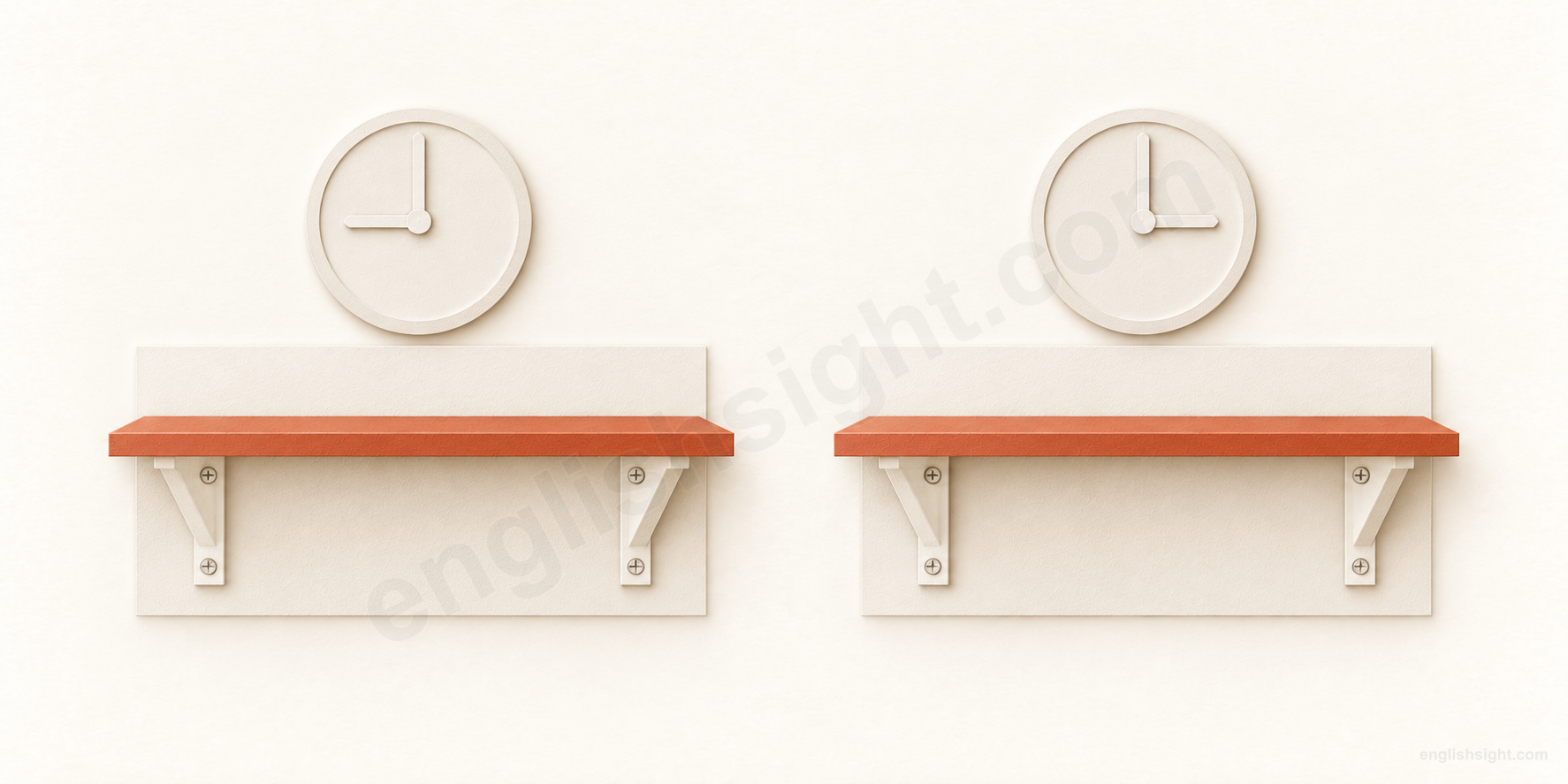
See what stays in place, what does not vary, and when fixed comes from a different sense of fix.
Held in a set position or condition
Held in a set position or condition
The shelf is fixed to the wall.
fixed
Later, the shelf is still in place.
Time passes; its attachment and position stay the same.
Fixed: staying in a set position or condition. This shelf illustrates attachment, not repair.
Something stays in a set position or condition rather than moving or varying.
The shelf makes a stable physical relation visible. Other uses concern amounts, time, attention, or beliefs; repair, dishonest manipulation, and informal fixed for need their own context.
Something fixed commonly stays where it has been placed or remains as set. A shelf, a price, and an opinion can each be fixed, but what remains unchanged is different in each case.
Use this connection as a learning aid. It is not a claim that all English speakers picture the word alike, and it cannot predict established expressions such as fixed for cash or every meaning of the verb fix.
01
Staying in place and holding attention
A physical object can remain attached; eyes or attention can remain directed at one target. Read the subject and the following preposition.
01
fixed + noun; be/remain fixed + in/to + noun
fixed in place / fixed to the wall
held in a position rather than free to move
Situation or starting context
The wall and shelf are checked at one time.
State or result in context
The shelf remains securely attached later.
Fixed describes the shelf’s relation to its support.
The diagram shows an unchanged attachment, not a broken shelf becoming usable. In a fixed position, the relevant position stays the same. A fixed point can also serve as a stable reference while something else moves.
Fixed to the wall names the support; fixed in place emphasizes the resulting position. Compare an adjustable shelf, which you can move to another height. A shelf can be fixed firmly without being impossible to remove with tools.
In They fixed the shelf to the wall, fixed is an action in the past. In The shelf is securely fixed to the wall, the sentence may emphasize either the attachment process or its continuing result. The surrounding context resolves the emphasis.
In a sentence
The rail is fixed to the wall at both ends.
Watch the difference Use fixed to for attachment. Fixed on a target often concerns attention instead.
02
eyes/gaze/attention + be/keep + fixed on + target
keep your eyes fixed on something
continue looking at the same target
Situation or starting context
The rider chooses a point ahead.
State or result in context
Her eyes stay directed at that point.
The target of attention stays the same; no physical fastening is involved.
With eyes, gaze, or attention, fixed on means directed steadily at a target. Keep + object + fixed on emphasizes maintaining that focus: keep your attention fixed on the speaker.
She fixed her gaze on the doorway describes directing it there; Her gaze was fixed on the doorway describes the resulting focus. A fixed stare is sustained looking. Do not confuse She fixed him with a stare, where the person receives the look, with eyes fixed on him.
In a sentence
She kept her eyes fixed on the path ahead.
Watch the difference On introduces the target of the look; it does not mean that the eyes are attached to it.
02
Amounts, schedules, and agreed limits
Ask what stays unchanged: a price, a percentage, an income, a date, or the length of an agreement. Fixed does not automatically mean permanent.
03
a fixed price/amount/number; be fixed at + amount; a fixed-price + noun
a fixed price / a fixed amount
a specified amount that is not varied in the relevant arrangement
Situation or starting context
You ask whether the charge depends on how long the task takes.
State or result in context
The agreed charge stays the same.
Fixed identifies the amount being held constant.
For a fixed price, the price is set rather than left to negotiation or allowed to vary under the stated conditions. Ask what the agreement covers: a fixed price need not include every possible extra service.
The same pattern works with a fixed amount, a fixed number of places, or a fixed penalty. These tell you that a quantity has been specified. They do not tell you that it is small, fair, or fixed forever.
Compare The price is fixed with They fixed the price at eighty pounds. The first presents a state; the second reports setting the amount. At introduces an amount. Before another noun, a compound such as a fixed-price menu uses hyphens.
In a sentence
We agreed on a fixed price for painting the room.
Watch the difference Fixed does not mean free, cheap, or already paid.
04
a fixed rate of interest; a fixed-rate + loan/account
a fixed rate / a fixed-rate loan
a percentage that stays the same for an agreed period
Situation or starting context
You compare an unchanging interest rate with a variable one.
State or result in context
The chosen percentage stays the same during the agreed period.
The rate is fixed; that fact alone does not describe every payment or fee.
A fixed-rate loan or account has an interest percentage that does not change during the agreed period. Contrast a variable rate, which can change. This is vocabulary for identifying the type of arrangement, not a recommendation about which to choose.
Write a fixed rate when rate is the noun. Write a fixed-rate loan when fixed-rate together describes loan. An agreed period can end, so fixed-rate does not mean the percentage must remain unchanged for the rest of your life.
In a sentence
The leaflet compares fixed-rate loans with variable-rate loans.
Watch the difference Do not infer from fixed rate alone that every charge is fixed too.
05
live on + a fixed income
live on a fixed income
rely on income that does not readily increase
Situation or starting context
Daily prices rise.
State or result in context
The household still receives much the same income.
The contrast is between available income and changing expenses.
Live on introduces the money used for everyday needs. Fixed income often appears when discussing people whose regular income, such as a pension, cannot easily rise as their costs rise.
In this everyday expression, fixed does not simply mean paid regularly: a regular wage might increase or vary. It also does not mean the person is wealthy. The broader financial category fixed-income investments is a separate specialist use.
In a sentence
Rising food prices are difficult for people living on a fixed income.
Watch the difference On belongs to live on; fixed describes income, not a physical location.
06
fixed costs; a fixed cost
fixed costs
business costs that do not vary with output
Situation or starting context
A workshop produces fewer items this month.
State or result in context
It still owes the same rent under its current agreement.
The comparison concerns output, not an eternal promise never to change.
Fixed costs is a business term. The cost remains payable even when the business makes fewer products or does less work. Rent is a useful example within an unchanged rental arrangement.
Contrast variable costs, such as materials used for each item produced. A fixed cost may change after a new agreement or when capacity changes; fixed describes its relation to output within the situation being discussed.
In a sentence
Rent is one of the workshop’s fixed costs.
Watch the difference A fixed cost is not the same as a cost that has been repaired or a bill that has already been paid.
07
a fixed time/date; be fixed for + day/date; at a fixed time
a fixed time / fixed for Friday
a time that is set or does not vary
Situation or starting context
The group needs to know when to arrive.
State or result in context
There is a definite scheduled time.
For introduces the scheduled occasion; at can introduce the clock time.
A fixed starting time is definite rather than flexible. We eat at a fixed time each day describes an unvarying routine. The noun tells you which part of the schedule is fixed.
The meeting is fixed for Friday means Friday has been selected for it. Nothing has been repaired. Compare The meeting starts at ten, where at gives the time. No fixed date means a definite date has not been set; it does not necessarily mean the event is cancelled.
In a sentence
The interview has been fixed for Friday morning.
Watch the difference Fixed for Friday describes the interview’s scheduling; How are you fixed for Friday? asks about a person’s arrangements.
08
for a fixed period; a fixed-term + contract
a fixed period / a fixed-term contract
a duration agreed in advance
Situation or starting context
An employer offers a contract with an agreed duration.
State or result in context
The contract lasts for that period.
Fixed can describe a limited duration rather than permanence.
For a fixed period means for a specified length of time. A fixed-term contract has an agreed duration. The focus is the term, not a claim that every other condition is unchangeable.
Contrast an open-ended arrangement, which has no specified end in its description. Write a fixed term as a noun phrase and a fixed-term contract with a hyphen before contract.
In a sentence
She accepted a fixed-term contract lasting six months.
Watch the difference A fixed-term job is not automatically a permanent job.
09
fixed assets; a fixed asset
fixed assets
land, buildings, and equipment a business owns and uses
Situation or starting context
A bakery lists resources used to run its business.
State or result in context
Its building and ovens belong in the fixed-assets category.
This business category is not a test of whether an object can physically move.
Fixed assets names property and equipment used by a business, such as premises and machinery. Learn the phrase as a business term rather than deriving its entire meaning from the shelf image.
A delivery vehicle can be a fixed asset even though it moves. Contrast goods bought or made for sale: the bakery’s ovens serve the business, while its loaves are stock for customers.
In a sentence
The bakery lists its ovens among its fixed assets.
Watch the difference Fixed assets does not mean assets whose market value can never change.
03
Opinions, beliefs, and expressions
A position can be held in the mind as well as in space. These uses can suggest resistance to change or an expression being deliberately maintained.
10
have fixed ideas/views about + topic; a fixed mindset
fixed ideas about something
opinions held so firmly that they are hard to revise
Situation or starting context
Someone hears an alternative view.
State or result in context
They continue holding their original opinion.
The mental position resists change; this can sound critical.
Fixed ideas or fixed views often suggest that someone is unwilling to reconsider. About introduces the subject of the opinion. This is not simply a synonym for clear ideas: clear concerns understanding; fixed concerns resistance to change.
A related phrase, a fixed mindset, has a specific meaning in discussion of learning: the belief that abilities cannot be developed through effort or guidance. It is not a name for every strong opinion. Compare a growth mindset. These phrases describe beliefs about ability, not a diagnosis of a person.
In a sentence
He has fixed ideas about how children should learn.
Watch the difference Fixed ideas can be disapproving; do not use it as an automatic compliment for confidence.
11
a fixed smile; with a fixed smile on one’s face
a fixed smile
a smile held in place without natural warmth
Situation or starting context
The host feels awkward.
State or result in context
The host continues to display the same smile.
The face holds an expression that may not match the feeling.
A fixed smile commonly suggests a smile maintained deliberately, perhaps from politeness, strain, or discomfort. It does not describe a smile that was broken and then repaired.
This expression normally appears before the noun: a fixed smile on her face. The unchanged expression connects to the core idea, but its suggestion of insincerity belongs to the established use. A fixed expression can refer to an unchanging facial expression; in language study, a fixed expression instead refers to an established wording.
In a sentence
She answered the awkward question with a fixed smile.
Watch the difference A fixed smile is not necessarily a happy smile.
04
Established expressions and special readings
Some combinations add meanings that the shelf image cannot supply. Learn the whole wording, its context, and its register.
12
have no fixed address; be of no fixed abode
of no fixed abode / no fixed address
without a permanent place of residence
Situation or starting context
A form asks for a permanent home address.
State or result in context
The person has no settled address to give.
Fixed concerns a stable residence, not a repaired house.
No fixed address means there is no permanent residential address. Of no fixed abode is a formal expression especially associated with British official or legal writing. Abode means a place where someone lives.
Use has no fixed address or is of no fixed abode. A conversational alternative is has no permanent place to live. The formal wording by itself does not explain the person’s circumstances or imply wrongdoing.
In a sentence
The form has an option for applicants with no fixed address.
Watch the difference Do not interpret no fixed abode as a home awaiting repairs.
13
a fixed match/race; a match/race + be fixed
the match was fixed
the outcome was dishonestly arranged
Situation or starting context
Spectators expect a fair contest.
State or result in context
Someone has secretly arranged how it will turn out.
This informal accusation adds dishonesty; the core image alone cannot supply that.
A fixed match or race has a result that has been manipulated. This often appears in the passive: The match was fixed. The subject is the contest, not the person doing the arranging.
Contrast The match was fixed for Sunday, which can simply concern its scheduled date. A trial or election described as fixed likewise suggests improper manipulation. Context is essential: fixed does not always accuse someone of cheating.
In a sentence
Fans suspected that the match had been fixed.
Watch the difference Fixed for a date can be neutral scheduling; fixed as an accusation concerns unfair control.
14
how + be + person + fixed for + resource; be well fixed
How are you fixed for cash?
ask whether someone has enough of a resource
Situation or starting context
You need to know whether a friend has money available.
State or result in context
Their answer tells you how well supplied they are.
Learn fixed for as an informal expression about resources.
How are you fixed for cash? asks about available money. The question does not ask whether any money has been repaired or physically attached. For introduces what is needed.
The pattern can extend to supplies: How are we fixed for food? Well fixed can mean comfortably provided for, particularly financially. In neutral or formal wording, ask Do you have enough cash? rather than assuming fixed alone has this meaning everywhere.
In a sentence
How are we fixed for cash for the trip?
Watch the difference This is informal. For cash names the resource; for Saturday can instead concern arrangements.
15
how + be + person + fixed for + day/occasion?
How are you fixed for Saturday?
ask about someone’s arrangements or availability
Situation or starting context
You want to plan an activity together.
State or result in context
You learn whether Saturday could fit the person’s plans.
The whole question asks about arrangements, not a fixed appointment already agreed.
With a day or occasion, How are you fixed for…? can ask what arrangements someone has or whether they are free. It is an informal way to open a planning conversation.
Compare The appointment is fixed for Saturday. There the subject is the appointment and the sentence says when it has been scheduled. In How are you fixed for Saturday?, the subject is the person and you are asking about their situation.
In a sentence
How are you fixed for Saturday evening?
Watch the difference The question does not itself establish an appointment; wait for the other person’s answer.
05
Fixed as a form of fix
Fixed is also the past tense and past participle of fix. Here the underlying verb sense and the sentence structure determine the meaning.
Here fixed comes from the repair sense of fix, not the meaning immovable.
I fixed the bike reports what I did in the past. The bike has been fixed reports a completed repair in the passive. It is fixed now can emphasize the usable result. This is a different reading from a bike fixed to a rack.
Get or have + object + fixed commonly means arrange for a repair: I got my bike fixed. The bike is the thing repaired; the subject need not do the repair personally. With a pronoun, say get it fixed, not get fixed it.
The same repair/correction sense works with a fault, an error, or a software bug. I have fixed it uses have + participle for the perfect; I have had it fixed uses have had + object + participle and often describes arranging the work.
In a sentence
I got my bike fixed before the weekend.
Watch the difference Get fixed is not one inseparable phrase with only one meaning. Read the object and the underlying sense of fix.
17
have/get + animal + fixed; an animal + be fixed
have a pet fixed
have an animal neutered, in informal North American English
Situation or starting context
The conversation concerns an operation on a pet.
State or result in context
The pet can no longer reproduce.
This is a regional informal sense of fix, not a claim that the animal was defective.
In informal North American usage, a pet that has been fixed has been neutered. A female animal may be described more specifically as spayed. The expression concerns preventing reproduction, not mending an injury.
Have the cat fixed uses the same have + object + past participle structure as have the bike fixed, but the noun and context select a different verb sense. Neutered is clearer when speaking across regions or in formal writing.
In a sentence
They said their cat had already been fixed.
Watch the difference This reading concerns animals in an informal North American context; do not transfer it to a person needing help.
Identify the state, then read the whole construction
Pronunciation and grammar
Fixed is pronounced /fɪkst/, one syllable; the ending sounds like /t/, not an extra “ed” syllable. As an adjective it has no plural ending: fixed prices. It is also both the past tense and past participle of fix: fixes, fixed, fixing. The spelling does not tell you which grammatical role it has.
Fixed is not always permanent, regular, or stationary
A fixed period can be short. Regular describes recurrence or a pattern; fixed emphasizes an unchanged setting. Stationary concerns not moving at a particular time; fixed can suggest attachment or a set arrangement. A fixed asset can physically move. Ask which property is being described.
Choose the preposition by the relationship
A shelf is fixed to a wall; eyes are fixed on a target; an amount is fixed at a number; an appointment is fixed for a day. Informal fixed for supplies and fixed for a day also occur with a person as subject, with different meanings. These are not all one phrasal verb.
Read fix in its context
The repair reading is common, but I fixed dinner can mean I prepared dinner, especially in North American English; I fixed my hair can mean I made it neat. Those are past-tense verb uses, not proof that the adjective fixed means prepared in every context. Fix up, fix on in the sense choose, and specialist chemical or photographic uses are outside the detailed scope here.
Choose what fixed contributes
Look at the subject, the noun, and any following preposition.
1. A shelf is fixed to the wall. What relation does this describe?
2. A job has a fixed-term contract lasting three months. What is fixed?
3. “The race was fixed,” a reporter says, alleging cheating. What is the claim?
4. A friend asks, “How are you fixed for Saturday?” What are they asking about?
5. You took a broken bike to a repair shop and got it fixed. Which interpretation fits?
6. Someone answers an awkward question with a fixed smile. What does fixed suggest?
Sources and teaching notes
Definitions and usage were checked against the sources below. Explanations, example sentences, and the diagram were written for this lesson; the visual connection is a teaching interpretation.
This diagram helps explain a connection; it is not a picture shared by every native speaker.