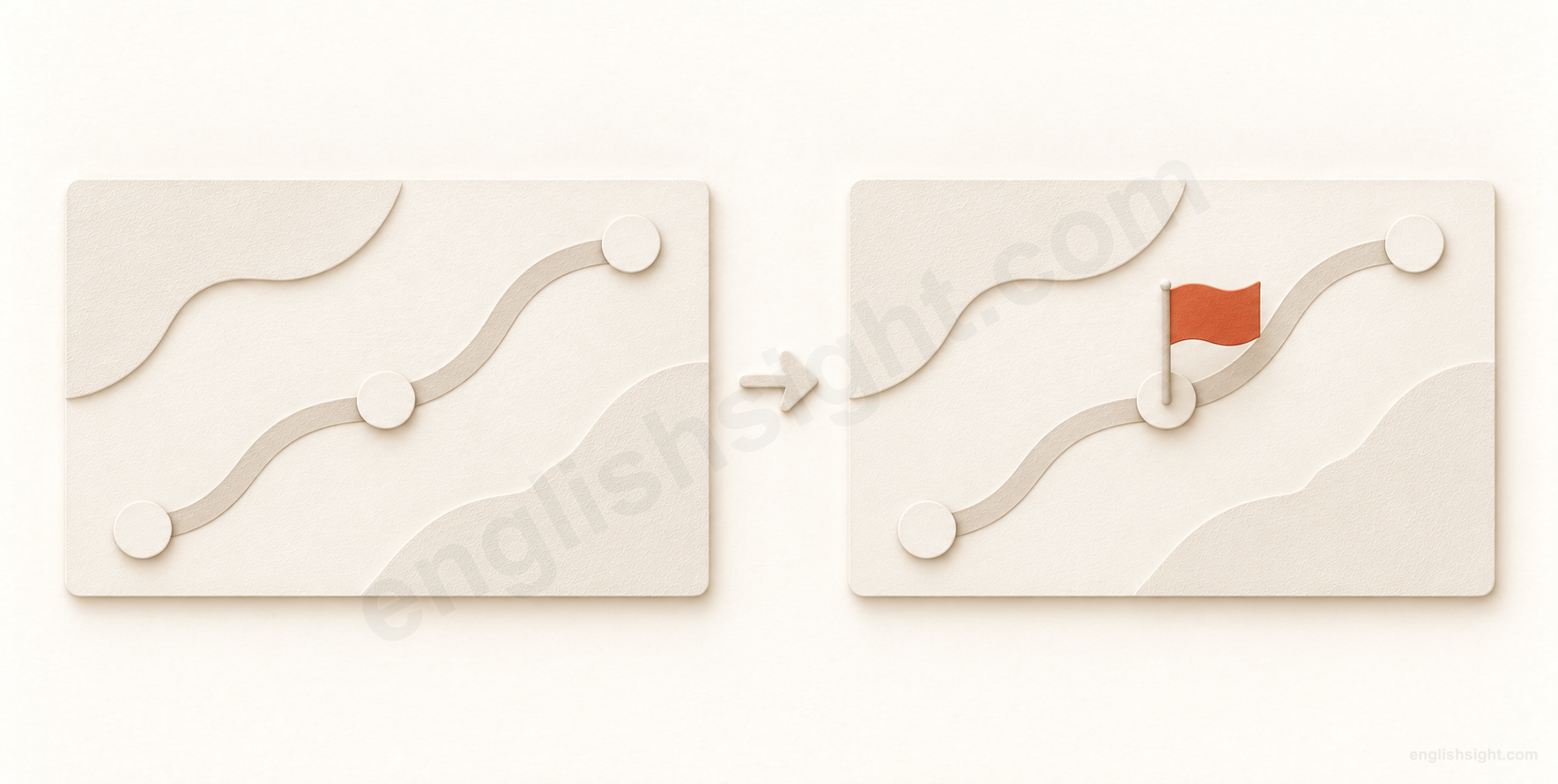
Recognize a symbol, draw attention to an item, and keep the separate weakening sense apart.
From an unmarked place to a recognizable marker
A sign people can recognize
Three places lie along the same route, with no flag marking any one of them.
flag
The flagged place stands out while the other two places stay unchanged.
A visible flag is added at the middle place.
A visible flag singles out a place; its message depends on the situation.
A flag is a visible sign that identifies something or signals information people should notice.
The picture uses a location marker to show recognition and attention. It does not derive every fixed expression or the independent weakening and stone meanings.
A flag can identify a country, mark a place, or carry a signal. As a verb, flag often means make an item noticeable so that someone can consider it or act on it.
This visible-sign model connects many useful expressions. Colours and complete phrases supply more specific meanings, while flag meaning lose energy and flags meaning paving stones need separate branches.
01
Flags you can see
Name a flag, describe how it is displayed, and understand the identity it represents. A location marker and a national symbol share visibility, but communicate different messages.
01
a flag; flags; the + national adjective + flag; the flag of + country
a flag; the national flag
a visible object used as a symbol, signal, or marker
Situation before
A group or place needs to be recognizable.
Meaning or result
A flag gives people a visible sign to recognize.
The object carries a message; the cloth alone does not determine that message.
A flag is often a designed piece of cloth on a pole. A national flag identifies a country; a club flag can identify an organization. Say a flag for one unspecified object, or the flag of a country when the identity is known.
Small flags can also mark places: There is a flag beside each hole on the golf course. A marker need not be a national emblem. A flagpole is the pole supporting a flag; a flag bearer is the person carrying one.
In a sentence
The children carried small flags at the parade.
Watch the difference Flag is countable in these uses: a flag or two flags, not two flag.
02
raise / lower / fly / wave + a flag; a flag + flies / flutters
raise / lower / fly / wave a flag
put a flag up, bring it down, display it, or move it by hand
Situation before
A flag is ready to be displayed, moved, or taken down.
Meaning or result
Its height, display, or movement changes according to the chosen verb.
Use raise a flag or put up a flag for bringing it into position, and lower a flag or take it down for the reverse. Fly a flag means display it, often on a pole: The school flies its own flag.
The flag is flying makes the flag the subject; it does not mean that the cloth has flown away. Wave a flag describes moving it in the hand. These are ordinary verb–noun combinations, not phrasal verbs built from flag.
In a sentence
We raised the flag before the ceremony and lowered it afterwards.
Watch the difference Flag is the noun here. Flagging a problem uses flag as a verb and means something different.
03
flags + be / fly + at half-mast / half-staff; lower flags to half-mast
at half-mast / at half-staff
displayed below the top of the pole as a sign of mourning
Situation before
A community is remembering someone who has died.
Meaning or result
Flags are displayed in a lowered position.
The position is a conventional sign of mourning.
A flag at half-mast is displayed partway down the pole to show mourning or respect after a death. You can describe the state with be at half-mast or the action with lower the flag to half-mast.
Half-staff is another established term, especially familiar in American usage. The expression names a symbolic position; it does not mean that the flag itself is half its usual size.
In a sentence
The flags outside the town hall were at half-mast.
Watch the difference Use at for the displayed position: at half-mast, not in half-mast.
04
under + a / the + flag; under the flag of + organization
under the flag of…
acting with the identity or authority represented by a flag
Situation before
People take part in an international event or mission.
Meaning or result
A country or organization is identified as their affiliation.
Under describes affiliation here, rather than only physical position.
Competing under a flag connects a team with a country or organization. Working under the flag of an organization can similarly identify whose mission or authority is involved.
The flag stands for the group and what it represents. A sentence about acting under a flag may therefore describe affiliation even when no physical flag appears in the immediate scene.
In a sentence
The athletes competed under the flag of their new country.
Watch the difference Compare They stood under the flag: in a description of a room, under may simply mean beneath the object.
02
Read the particular signal
The design, colour, and complete expression supply the message. A warning, surrender, a race finish, and a misleading identity are different established uses.
05
a red flag; a red flag for + person / problem; raise red flags
a red flag; raise a red flag
a warning sign that something may be wrong
Situation before
A detail makes you doubt a situation.
Meaning or result
You notice a reason to investigate further.
A warning invites attention; it is not by itself proof.
A literal red flag can signal danger, for example beside unsafe water. Figuratively, a red flag is a detail that suggests a possible problem: A seller’s refusal to answer questions is a red flag.
Raise a red flag means cause or express concern. The phrase is useful for purchases, work, and relationships; no actual coloured object is required. Read the context: red flags can also be political symbols.
In a sentence
The missing contact details raised a red flag for me.
Watch the difference A red flag is a warning; flag a problem is the action of drawing attention to it.
06
raise / show / wave + the white flag
raise / wave the white flag
signal surrender or admit that you are giving up
Situation before
A struggle or difficult task continues.
Meaning or result
Someone signals that they will stop resisting or trying.
White supplies the established surrender meaning.
A white flag signals accepting defeat and wanting to stop fighting. In conversation, waving the white flag can be a playful way to admit that a task or disagreement has defeated you.
In I finally waved the white flag and asked for help, the speaker gives up trying alone. This is a figurative extension, not a report that the speaker found a piece of cloth.
In a sentence
After three failed attempts to fix the printer, I waved the white flag and called support.
Watch the difference The surrender meaning belongs to white flag; an ordinary flag does not automatically mean giving up.
07
the chequered flag; the checkered flag
the chequered / checkered flag
the black-and-white flag signalling a motor-race finish
Situation before
A driver is completing a race.
Meaning or result
The finish signal is shown.
The particular pattern and sporting context supply the message.
The chequered flag is the black-and-white squared flag waved when a driver finishes a motor race. It belongs to racing vocabulary rather than general directions for every sport.
Chequered is the usual British spelling; checkered is the usual American spelling. Both forms refer to the same patterned flag. Seeing the flag is about a finish, not automatically about every driver winning.
In a sentence
The crowd cheered as the driver passed the chequered flag.
Watch the difference Do not assume that any black-and-white flag means the start of a race. Learn this named signal as a unit.
08
a false flag; a false-flag + operation / attack
a false-flag operation
an action arranged to make another group appear responsible
Situation before
One group plans an action while concealing its responsibility.
Meaning or result
The action is presented as if a different group carried it out.
The misleading identity is central; an inaccurate statement alone is not enough.
In political and military reporting, a false-flag operation is arranged to give a false impression of who carried it out. It is a specialized expression worth recognizing in news.
The flag connection is identity or apparent allegiance, rather than simply an attention marker. Before another noun, write false-flag: a false-flag attack. Calling an event a false flag makes a claim about concealed responsibility.
In a sentence
In the novel, the officer uncovers a false-flag operation designed to blame a rival group.
Watch the difference False flag does not mean any mistaken report, ordinary hoax, or flag with an incorrect design.
03
Bring something to attention
Flag can be a verb for marking information, selecting an item for action, or signalling to a driver. Read its object and any following particle.
09
flag + page / issue / error; flag something for someone; something is flagged
flag a page / an issue
mark or mention something so that people notice it
Situation before
An important item could be overlooked.
Meaning or result
The item is singled out for attention.
The object is what needs attention, not the person being informed.
You can flag a paragraph by adding a tab or a digital mark. You can also flag an issue by mentioning it in a meeting. Both make an item easier to notice; neither guarantees that it has been resolved.
I flagged the mistake for the editor identifies the issue as the object and the editor as the intended reader. A passive is natural too: Several errors were flagged during the check. Highlight may mean colouring text; flag is broader and can mean simply bringing something to notice.
In a sentence
I flagged the unclear sentence for the editor.
Watch the difference Do not use flag someone a problem as a substitute for flag a problem for someone.
10
flag + item + as + category; flag + item + for + noun / -ing; set / clear + a flag
flag something as… / for…; a flag
mark an item with a category or a purpose for later action
Situation before
A system or user finds an item requiring special handling.
Meaning or result
The item receives a label or an attention marker.
As gives the category; for gives the intended handling.
Flag an email as spam classifies it; flag an email for follow-up selects it for later attention. The passive, The email was flagged as spam, describes the same classification without naming who or what applied it.
An email app may let you add or remove a flag. In programming, a flag can also be a stored indicator of a condition, which software can set or clear. These technical uses extend the marker idea; they do not require a little cloth icon.
In a sentence
The system flagged the message as spam, but I marked it as safe.
Watch the difference Flagged means selected or labelled, not necessarily deleted, blocked, or proved harmful.
11
flag up + noun; flag + noun / pronoun + up
flag something up
draw attention to a matter people should notice
Situation before
A concern has not received enough attention.
Meaning or result
Someone explicitly points it out.
Up belongs to the established attention expression, not to a physical upward movement.
Flag up a concern and flag a concern up mean bring it to attention. This phrasal verb is particularly associated with British English and often appears in work discussions.
With a noun, either position is possible: flag up the delay or flag the delay up. Put a pronoun between the parts: flag it up. Flag the delay without up often expresses the same basic action.
In a sentence
Please flag it up at tomorrow’s meeting so that we can discuss it.
Watch the difference Say flag it up, not flag up it. Flag up does not mean that the problem has already been fixed.
12
flag down + vehicle / driver; flag + vehicle / pronoun + down
flag down a taxi
signal to a driver to stop, usually by waving
Situation before
A vehicle is passing.
Meaning or result
Someone waves to attract the driver’s attention and request a stop.
Down is part of a stopping expression, not a command to lower a flag.
You can flag down a taxi, a passing car, or its driver. An actual flag is not needed: a hand gesture can supply the signal. This connects with the visible-signal model, but the whole phrasal verb specifies stopping.
Both flag down a taxi and flag a taxi down are possible. With a pronoun, say flag it down or flag them down. Flag someone down is more specific than call someone: it normally involves signalling to stop a passing vehicle or its driver.
In a sentence
We waved from the roadside and flagged down a passing taxi.
Watch the difference Say flag it down, not flag down it. Lower the flag describes a different physical action.
04
Support and provocation
These expressions use flag imagery for social actions. Their full meanings belong to the expressions, rather than to flag alone.
13
fly / show / wave the flag (for + group / cause); keep the flag flying
fly / show / wave the flag; keep the flag flying
represent or publicly support a country, group, or cause
Situation before
A country, group, or cause needs visible representation.
Meaning or result
Someone represents it or shows support for it.
The flag stands for an affiliation; a real flag may be absent.
Fly the flag for a group can mean represent or support it publicly: Our team is flying the flag for the local college. Show the flag and wave the flag can also express public support, depending on context.
Keep the flag flying means continue to represent a country or organization. These idioms differ from literally flying a flag outside a building: participation, work, or speech can provide the representation.
In a sentence
Our small theatre company is flying the flag for local drama at the festival.
Watch the difference Context decides whether a physical flag is being displayed or someone is showing support figuratively.
14
be like waving a red flag in front of a bull; be like a red rag to a bull
like waving a red flag in front of a bull
likely to provoke a strongly angry reaction
Situation before
Someone already dislikes a subject or behaviour.
Meaning or result
A remark or action is likely to make them very angry.
This longer expression concerns provocation, rather than a warning sign.
Saying that a remark is like waving a red flag in front of a bull presents it as a predictable provocation. The comparison is figurative; it does not describe a literal bull.
This wording is associated with North American English. British English commonly uses like a red rag to a bull. Learn the whole comparison: a red flag by itself normally suggests a warning, not someone’s anger.
In a sentence
Mentioning another unpaid bill was like waving a red flag in front of a bull.
Watch the difference Do not shorten the expression to a red flag if you intend the specific meaning of provoking anger.
05
Separate meanings to recognize
Losing energy and paving stones need their own explanations. Do not force every occurrence of the spelling flag into the signal model.
15
person / energy / enthusiasm + flag; begin to flag; flagging + interest / support
begin to flag; flagging enthusiasm
become tired, weaker, or less enthusiastic
Situation before
Someone has energy or interest at the start.
Meaning or result
Their energy, strength, or interest decreases.
This intransitive verb describes weakening, not marking something.
People can flag after a long effort; their energy, confidence, or enthusiasm can flag too. The subject undergoes the decline. In My enthusiasm is flagging, no one is putting a marker on enthusiasm.
Flagging can describe a current process, and it can appear before a noun: flagging interest. Compare We flagged the errors, which has an object and means marked them. Both verbs use flagged and flagging, with double g.
In a sentence
By the end of the long walk, our energy was flagging.
Watch the difference The weakening sense normally has no object: My energy flagged, not I flagged my energy.
16
stone flags; lay flags / flagstones; a flagstone path
flags / flagstones
large flat stones used for paving
Situation before
A path or floor needs a hard surface.
Meaning or result
Flat stone slabs form that surface.
These flags are stones, not signals.
In a description of a garden or old building, flags can mean paving stones: The path was laid with stone flags. Flagstone is a clearer full form when the context does not already establish paving.
This is a separate noun meaning, not a figurative warning or national symbol. The phrase wet flags in a courtyard may describe slippery stones underfoot; it need not describe damp cloth.
In a sentence
Rain made the stone flags in the courtyard slippery.
Watch the difference Use the surrounding words to distinguish the material sense from cloth flags.
Read the role and the whole expression
Forms and grammar
The noun is countable: a flag, flags. Verb forms are flag, flags, flagged, flagging. The attention verb takes an object and allows a passive; the weakening verb normally does not. The particle verbs flag up and flag down are separable: flag it up, flag it down.
A signal does not guarantee a result
Flagging a problem brings it to attention; it does not fix it. Flagging an item as spam labels it; the label can be wrong. A red flag is a reason for concern, not a complete investigation.
Learn what the complete phrase supplies
White flag supplies surrender, red flag supplies a warning, and the longer bull comparison supplies provocation. The core sign model helps connect these expressions but cannot predict every colour or idiom.
Scope
This lesson includes everyday objects, attention verbs, transport, familiar expressions, and recognition notes for news, computing, and paving. Botanical flags, specialist musical and animal senses, detailed military terminology, and regional particle verbs are not expanded.
Choose the intended meaning
Check the object, particle, and situation before choosing.
1. You wave from the roadside to ask a passing taxi driver to stop. Which expression fits?
2. A system flags a message as spam. What has definitely happened?
3. After hours of work, her enthusiasm was flagging. What does flagging mean here?
4. You want a colleague to mention a concern at a meeting. Which pronoun position is natural?
5. A seller refuses to provide any contact details. You call that a red flag. What do you mean?
Sources and teaching notes
Usage and coverage were checked against these dictionary pages. The explanations, examples, and visual model were created for this lesson; the model is a teaching interpretation.
The diagram explains a useful connection; English speakers do not all share one mental picture.