Recognize real flames, then read the whole expression when fire becomes a comparison.
Burning made visible
Burning made visible
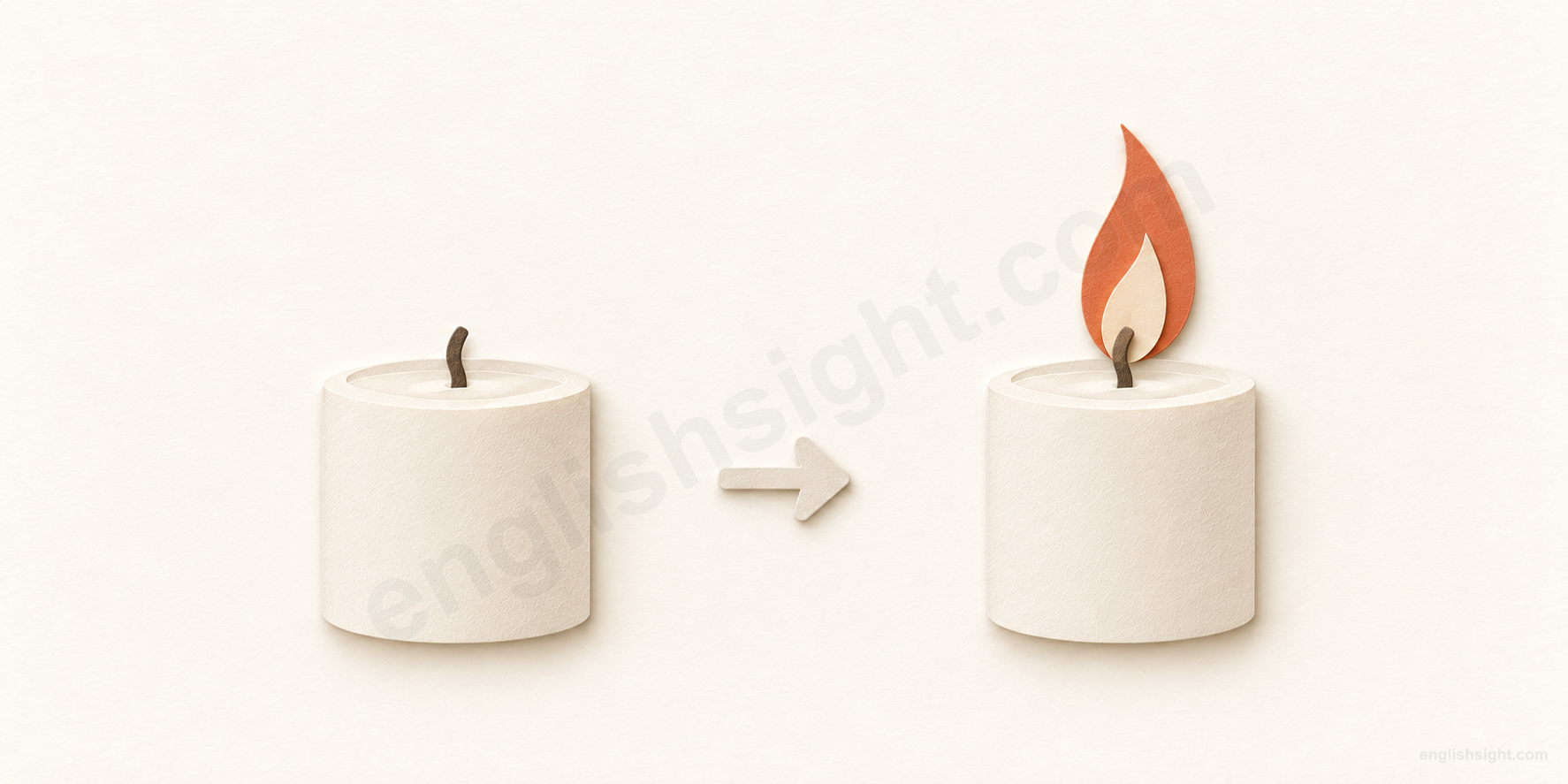
The candle has an unlit wick.
flame
A bright flame is visible above the candle.
Once lit, gas from the fuel burns above the wick.
The flame is the visible burning above the wick; figurative expressions need their own context.
A flame is the bright, hot part of a fire where gas is burning.
The wick and candle locate a fuel source; the flame is the visible burning above it. Figurative expressions borrow selected qualities of fire, but each has its own grammar and meaning.
Flame /fleɪm/ most directly names the hot, bright part of a fire where gas is burning. A tiny candle flame and the flames of a large fire differ in size, but both make burning visible.
English also uses flame for strong feelings, vivid colour, former partners, and hostile online messages. These uses draw on different associations with fire; they cannot all be predicted from a single picture.
01
Visible fire and changes in burning
Name the visible flame, describe the heat used for cooking, or distinguish being on fire from beginning to burn and being destroyed.
01
a / the + flame; plural flames; a wall / sheet of flame
a flame / flames
the visible, hot part of a fire
Situation
A candle wick is burning.
What happens / what it means
A small bright flame flickers above it.
Flame names visible burning; fire can name the whole burning event.
A flame is the bright, hot region of burning gas. A candle flame and a gas flame have different fuel sources, but both are flames. Flame does not mean smoke, a flying spark, or the glowing solid remains of a fire.
Use a flame for one visible tongue or body of fire and flames for several or for a mass of visible fire: Flames rose above the roof. Uncountable flame is possible when treating it as material or an expanse: a wall of flame.
Common descriptions include a flickering flame, flames spreading, and flames dying down. Flicker describes irregular movement or changes in brightness; die down means become less strong. The candle flame went out means it stopped burning.
In a sentence
The candle’s flame flickered when the window opened.
Watch the difference A spark is a small burning particle; smoke is gas and particles from burning. Neither word is interchangeable with flame.
02
cook / heat + object + over a low flame; an open / a naked flame
over a low flame / an open flame
a cooking heat source or an exposed flame
Situation
A gas burner is heating a pan.
What happens / what it means
The cook chooses a gentle flame.
Over relates the pan to the source; low describes the heat level.
Cook over a low, medium, or high flame describes the gas flame beneath the food or pan. A low flame gives gentler heat. The word over supplies the spatial relationship; flame names the burning heat source.
An open flame is exposed burning, as in a candle or gas burner. Naked flame is a familiar British equivalent; open flame is especially usual in North American wording. A sign reading Keep away from open flames refers to actual exposed fire.
Compare on low heat, which also works for an electric cooker. Over a low flame specifically evokes a flame; it is not the only way to describe gentle cooking.
In a sentence
Let the sauce simmer over a low flame.
Watch the difference Use a low flame, not a short fire, for this cooking instruction. Open here means exposed, not newly lit.
03
be + in flames; be engulfed in flames
be in flames
be burning strongly
Situation
A shed catches fire.
What happens / what it means
Visible fire covers much of the shed.
Be in flames describes an ongoing state, not the moment it starts.
The shed is in flames means it is on fire, usually with substantial visible flames. The subject is the burning thing. In flames is a prepositional phrase after be, not a passive verb.
Compare The shed burst into flames, which focuses on a sudden beginning. Be engulfed in flames stresses being surrounded or covered by fire; engulfed is a participle, while flames remains a noun.
In a sentence
By the time they reached the road, the shed was in flames.
Watch the difference Learn in flames as the fixed phrase; in a flame is not the usual equivalent of on fire.
04
subject + burst / bursts / burst into flame(s)
burst into flame(s)
suddenly start burning strongly
Situation
A motor is smoking.
What happens / what it means
It suddenly produces bright fire.
Into marks entry into a burning state; burst supplies suddenness.
Burst into flames describes the onset of strong visible burning. The singular uncountable form burst into flame is also standard. Burst is the verb; into flames is its complement, so flame is not being used as a verb here.
Compare catch fire, a broader expression for beginning to burn. Burst into flames puts more emphasis on a sudden, visible outbreak; was in flames simply states the condition. The past of burst is burst, not bursted in standard usage.
In a sentence
The damaged motor burst into flames a few seconds later.
Watch the difference Do not replace into with in when naming the sudden change: burst into flames, but be in flames.
05
something + go / goes / went up in flames
go up in flames
burn and be destroyed
Situation
Old stored materials are still intact.
What happens / what it means
A fire destroys them.
The whole expression emphasizes destruction by fire.
When something goes up in flames, it burns strongly and is destroyed. The subject is what is lost, not a person deliberately lighting it. Went up in flames does not require the object itself to move upward.
This expression differs from be in flames, which describes a burning state without by itself stating the final outcome. Go up in smoke is another established expression, but smoke and flames are different parts of a real fire.
In a sentence
The old wooden stage went up in flames overnight.
Watch the difference The idiom is intransitive: The stage went up in flames. For an agent’s action, use set the stage on fire.
06
something + flame; something + flame up
flame / flame up
burn brightly or begin to burn more strongly
Situation
The logs are burning quietly.
What happens / what it means
The fire suddenly becomes brighter.
As a verb, flame can describe the burning itself; up can emphasize a burst.
The logs flamed uses flame without an object to mean burned brightly. This literal verb often sounds literary or descriptive; The logs burned is a plainer everyday choice.
Flame up can describe a sudden increase or outbreak of burning. It is intransitive in The fire flamed up; there is no object to put between flame and up. The noun phrase the flames went up uses different grammar: flames is the subject, not the verb.
The forms are flame, flames, flamed, flaming. Drop the final e before -ing. Flaming logs are logs that are burning; this participial use describes an actual fire.
In a sentence
The logs flamed up as the wind grew stronger.
Watch the difference For ordinary instructions, light the candle means make it start burning; flame the candle is not the normal equivalent.
02
Fire-like colour and a red face
Colour and literary descriptions borrow the appearance of fire without requiring anything to burn.
07
flame-red + noun; the colour flame
flame-red
a vivid red or reddish-orange colour
Situation
You see a bright red-orange coat.
What happens / what it means
You describe its colour by comparison with fire.
The colour comes from resemblance, not actual burning.
Flame can name a bright red or orange colour. Flame-red is a useful compound adjective: a flame-red coat. It compares the colour with the familiar appearance of fire.
This colour use does not define every real flame: real flames can have other colours, such as blue. A flame-red coat is red; a flaming coat would normally suggest a coat that is actually on fire.
In a sentence
She chose a flame-red coat for the performance.
Watch the difference Flame-red describes colour; it does not mean fireproof or resistant to heat.
08
face / cheeks + flame (red) (with + emotion)
someone’s cheeks flame
a face becomes red with strong emotion
Situation
A remark embarrasses Maya.
What happens / what it means
Her cheeks turn very red.
The face resembles fire in redness; it is not literally burning.
Her cheeks flamed is a literary way to describe sudden or intense redness. With anger, with shame, or with embarrassment can identify the emotion behind the change.
Flamed red adds a colour complement: Her face flamed red. The cheeks or face are the subject; there is no object receiving an attack here. In conversation, Her face went red is more neutral.
In a sentence
Maya’s cheeks flamed with embarrassment when she noticed the mistake.
Watch the difference Her cheeks flamed describes redness. She flamed a commenter uses a different, online sense.
03
Feelings, relationships, and what stays alive
Fire supplies several useful comparisons. Some are flexible metaphors; others, such as old flame, are expressions whose whole meaning must be learned.
09
a flame of + feeling; feeling + flame in + person
a flame of hope / passion
a powerful feeling imagined as burning
Situation
A difficult season has weakened the team’s confidence.
What happens / what it means
A small hope remains.
Heat and continued burning provide a metaphor for emotional intensity.
A flame of passion, anger, or hope presents a feeling as something that burns. This is often literary or expressive wording, rather than the most neutral way to name a feeling. Of names the feeling; it does not mean physical fuel.
Writers can extend the comparison: a feeling may be kindled, rekindled, or allowed to die. Rekindle suggests starting it again after it has weakened or ended. The relationship is a teaching connection, not a rule that makes any flame combination idiomatic.
The verb also occurs figuratively in literary descriptions such as Hope flamed in him. The emotion is active or intense; nothing is physically on fire.
In a sentence
Even after the defeat, a small flame of hope remained.
Watch the difference A flame of hope is expressive. Simply say some hope when you want neutral wording.
10
someone / something + fan the flames (of + feeling / conflict)
fan the flames (of something)
make an already bad feeling or situation more intense
Situation
An argument is already tense.
What happens / what it means
A new accusation makes it worse.
The idiom compares worsening hostility with feeding an existing fire.
Literally, moving air can fan flames and strengthen a fire. Figuratively, fan the flames often means intensify anger, hatred, conflict, or another harmful situation. The subject is the person or action that makes things worse.
Of can name what intensifies: fan the flames of resentment. You can also say The comment only fanned the flames when the conflict is already clear. Fuel the flames uses the related image of supplying a fire with fuel.
Fan is the verb and the flames is its object. This is an idiom, not a phrasal verb made from flame plus a particle. For a pronoun, fan them is ordinary object grammar, but the figurative meaning depends on context.
In a sentence
Repeating the rumour only fanned the flames of resentment.
Watch the difference The idiom usually implies worsening tension, not kindly helping someone feel enthusiastic.
11
keep the flame alive; a keeper of the flame
keep the flame alive / keeper of the flame
preserve a memory, belief, or tradition
Situation
A tradition could be forgotten.
What happens / what it means
People continue to practise and remember it.
Continuing to burn becomes a metaphor for continuing to matter.
Keeping the flame alive can mean sustaining commitment, a tradition, or someone’s memory. The flame stands for what people are preserving, and alive presents it as continuing rather than fading away.
A keeper of the flame is someone who preserves that memory or those beliefs. This is often respectful, expressive language. It does not necessarily mean the person tends a real memorial flame; context decides whether the use is literal or figurative.
Compare fan the flames: that often intensifies something harmful, while keeping the flame alive commonly emphasizes preserving something valued. The evaluative meaning comes from the whole expression and context.
In a sentence
The annual concert keeps the flame of her music alive.
Watch the difference Keep the flame alive does not necessarily mean revive a romance; specify what is being preserved.
12
an old flame; someone’s old flame; an old flame of + possessive pronoun
an old flame
a former romantic partner
Situation
Two people were once in a relationship.
What happens / what it means
Years later they meet again.
Old points to a past relationship, not the person’s age.
An old flame is someone a person used to be romantically involved with. The noun refers to the person, not just the feeling: an old flame of mine means a former partner of mine.
The expression is informal and can sound affectionate or nostalgic. It does not prove that either person is still in love. Flame can also refer to a sweetheart in some contexts, but old flame is the especially useful expression to learn as a unit.
In a sentence
I ran into an old flame of mine at the station.
Watch the difference An old flame is not simply an old friend, and old does not tell you their age.
13
be drawn / attracted to something + like a moth to a flame
like a moth to a flame
drawn strongly to something
Situation
A person finds bright city nightlife irresistible.
What happens / what it means
They are repeatedly drawn back to it.
The comparison highlights a powerful attraction.
Like a moth to a flame describes someone being strongly drawn to a person, activity, or place. Drawn and attracted often occur with it. Like introduces a comparison; to names the target of attraction.
The image can suggest that the attraction is unwise or dangerous, but context supplies that warning. Do not insist that every use predicts harm or death. It is a conventional comparison, not an explanation of insect behaviour.
In a sentence
Even after a tiring week, he was drawn to the city’s nightlife like a moth to a flame.
Watch the difference The phrase is not restricted to romantic attraction and does not always mean the attraction is harmful.
04
Dramatic failure
These established expressions use the loss or destruction of fire-related imagery to describe failure. Their meanings come from the whole expression.
14
plans / hopes / a project + go up in flames
plans go up in flames
plans or hopes are completely ruined
Situation
The organisers have a workable plan.
What happens / what it means
A major setback destroys the plan.
Destruction by fire becomes a comparison for total loss.
Go up in flames can also describe the destruction of hopes, plans, or a project without any literal fire. The context identifies what is lost: a wooden stage may really burn, while plans can be ruined by a cancelled agreement.
Go up in smoke has a similar figurative use. Go down in flames also describes failure, often stressing how dramatic it is. The expressions overlap; up does not automatically make a sentence literal, and down does not describe every kind of failure.
Learn the whole expression. In flames does not independently mean unsuccessful in every construction, and up does not carry the meaning of success here.
In a sentence
Our plans for a joint exhibition went up in flames when the venue cancelled our booking.
Watch the difference Check the subject and context: real materials can burn; a plan can be ruined without any fire.
15
plan / proposal / campaign + go down in flames
go down in flames
fail in a conspicuous or dramatic way
Situation
A proposal is confidently presented.
What happens / what it means
It suffers an overwhelming public defeat.
The full idiom transfers a disastrous fall to failure.
Go down in flames describes a dramatic failure: a proposal, campaign, performance, or plan can fail this way. It is informal and vivid; no physical fire is required.
Down is part of the established expression. Go down in flames overlaps with figurative go up in flames, but stresses a dramatic defeat or failure. The subject undergoes the failure; the phrase does not take a direct object.
In a sentence
The proposal went down in flames when almost everyone voted against it.
Watch the difference This is stronger and more dramatic than simply did not succeed; it can sound mocking in a sensitive conversation.
16
someone / something + flame out; a flameout
flame out
fail suddenly, dramatically, or before fulfilling promise
Situation
A new venture attracts early attention.
What happens / what it means
It fails before developing as expected.
Out belongs to a failure expression, not simply a description of a candle.
In informal usage, a project, career, or person can flame out: fail conspicuously, often prematurely. The verb is intransitive: The venture flamed out. A sudden failure can also be called a flameout, written as one word.
There is also a technical aviation use: a jet engine flames out when combustion stops and the engine fails. That is not the same as an engine bursting into flames, which means it starts burning visibly.
For an ordinary candle, say The flame went out. Here flame is a noun and went out means stopped burning. Do not mechanically replace that sentence with The candle flamed out.
In a sentence
The venture flamed out before it launched its first product.
Watch the difference Flamed out can report failure without any fire. Burst into flames reports the start of fire, not its extinction.
05
Hostile messages online
In informal internet language, a flame is an abusive message, and to flame someone is to attack them through such messages.
17
a flame; flame + person; be flamed (for + noun / -ing); a flame war
a flame / flame someone / a flame war
a hostile online message, the act of sending one, or an exchange of them
Situation
A discussion contains a disagreement.
What happens / what it means
One participant posts a personal, abusive attack.
Online flame is an established sense involving hostile communication.
In informal internet language, a flame is an angry or abusive message. To flame someone means attack them through hostile online comments or messages. The person attacked is the object: They flamed me. Passive forms are possible: I was flamed for my reply.
Flaming can name the activity: The moderator banned flaming. A flame war is an exchange of hostile messages, rather than a single critical comment. These terms concern the aggressive manner of communication; calm disagreement is not automatically flaming.
The connection with fire can help you remember the sense, but the digital meaning is conventional. It is not a rule that every angry spoken remark is a flame. In this online sense, flame someone does not mean physically burn the person.
In a sentence
The moderator removed the post because it flamed another member instead of discussing the idea.
Watch the difference Say They flamed him, not They flamed to him. The ordinary noun fire cannot replace flame in a flame war.
Keep the word and the whole expression in view
Flame, fire, spark, and smoke
Fire can name the overall burning process, a destructive event, or a controlled fire. Flame focuses on its visible burning gas. A spark is a small burning particle; smoke is different again. A fire may continue to smoulder without visible flames.
Countability and grammar
The noun has a countable singular flame and plural flames, and an uncountable use in phrases such as a sheet of flame. In be in flames and burst into flames, flames is a noun. In the logs flamed, flamed is a verb. The forms are flame, flames, flamed, flaming.
A literal picture has limits
A real flame need not be orange or have a fixed pointed shape. The candle is a clear example, not a definition of every fire. Colour, emotion, old flame, and internet senses select different associations; the picture cannot calculate their meanings.
Learn compounds separately
Flaming can mean burning, or appear in expressive literary descriptions. Separate words such as flameproof and flame-retardant concern resistance to fire, not the colour flame-red. Specialist treatment by flame, flambéing food, and historical uses are outside the practical focus here.
Choose the intended meaning
Use the situation and grammar to distinguish real burning from established expressions.
1. A report says the shed suddenly began burning strongly. Which wording focuses on that beginning?
2. Leah introduces someone as an old flame of hers. What does she mean?
3. A promising project flamed out before releasing anything. What happened?
4. A user sent you an abusive online reply. Which sentence uses the internet verb naturally?
5. A comment fanned the flames of an argument. What did it do?
Sources and teaching notes
The sources below support the meanings and constructions. Explanations and examples are original; connections drawn between senses are teaching interpretations.
The picture supports a teaching connection; it does not represent an image shared by every native speaker.