Explore flat surfaces, flat batteries, a flat in London, and expressions such as work flat out.
From raised folds to a flat surface
A surface without raised parts
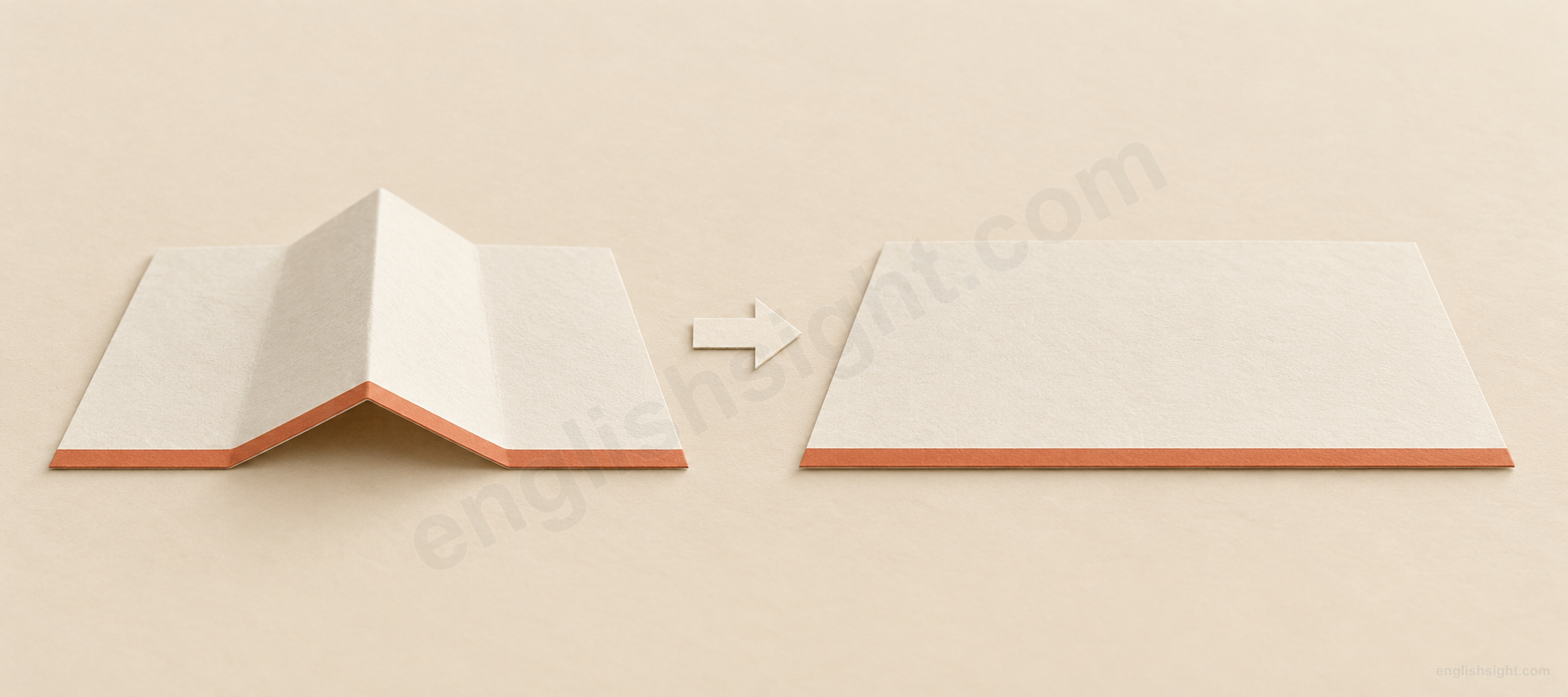
A thin sheet has a raised central fold.
flat
The same sheet lies flat.
The raised fold is opened out.
The raised fold is opened out and the sheet lies flat. Flat names the shape or position; the arrow shows one possible change.
A flat surface has no noticeable bumps, dips, or curves. Something can already be flat, or become flat when its raised parts are pressed down.
The sketch shows one possible change, not a required action: a surface can be flat without anyone pressing it. The other uses are explained separately; a flat battery does not have to change shape.
Start with a surface without noticeable bumps, dips, or curves. Flat can describe a shape, a position, or the result of pressing something down. Other uses concern a missing quality: air in a tyre, bubbles in a drink, or liveliness in a voice.
Some connections are useful for learning, but they are not a rule for inventing meanings. A home called a flat, a musical flat, and fixed expressions need their own context. This lesson offers a teaching model, not a claim that every English speaker imagines the same picture.
01
Surfaces, shapes, and positions
Ask which feature is flat: the surface, the thickness, the ground, or the way something is placed. Flat does not always mean horizontal.
01
a flat + noun; subject + be / look + flat
a flat surface
a surface without noticeable bumps or curves
Situation / starting point
The worktop has a raised ridge.
Meaning / result
An even area supports the tray.
Flat describes the overall surface shape.
Use flat before a noun or after be: a flat surface; this surface is flat. Unlike the sheet in the sketch, a surface may have been flat all along.
Flat and smooth answer different questions. A flat stone can have a rough texture, and a smooth ball is curved. A flat screen describes its shape, while a flat-screen television uses the compound before another noun.
In a sentence
Put the tray on a flat surface so it does not rock.
Watch the difference A flat surface need not be polished or horizontal.
02
flat land / water; on the flat; (as) flat as a pancake
flat land / a flat sea
ground without hills, or water without waves
Situation / starting point
A route crosses hills; wind makes waves.
Meaning / result
The ground has little rise, or the water is calm.
The noun tells you which kind of rise is absent.
For land, flat contrasts with hilly or sloping. For water, it contrasts with rough or wavy. A sea can look flat because its surface is calm, not because the water is shallow.
On the flat is a British expression for travel on level ground: Cycling is easier on the flat. As flat as a pancake is an informal comparison emphasizing how flat an area or object is; it does not mean the ground is literally food.
In a sentence
We chose a flat route beside the river instead of the steep hill.
Watch the difference Flat land is about changes in height; flat water is about the absence of waves.
03
a flat box / piece / object
a flat box
an object with little height or depth compared with its width
Situation / starting point
You compare a tall carton and a shallow box.
Meaning / result
The shallow box fits under the bed.
Flat can describe proportions rather than perfect smoothness.
A flat box or a flat piece of bread spreads across more width than height. The object is still three-dimensional; flat does not mean it has no thickness at all.
A flat stomach has little outward bulge. The shared connection is limited projection, but the relevant dimension depends on the object. Thin emphasizes small thickness; flat can also emphasize a broad, uncurved shape.
In a sentence
The prints arrived in a flat box that slid under my bed.
Watch the difference A tall box can have a flat top without being a flat box.
04
lie flat; lie flat on your back; lay + object + flat
lie flat
be stretched out or rest in a level position
Situation / starting point
A person is sitting up.
Meaning / result
The person lies with the body extended.
Flat describes position; lie does not take an object.
Lie flat can describe a person or material: Lie flat on your back; the sheet will not lie flat. The person may be face up or face down, so add on your back, on your stomach, or face down when that matters.
Compare lay the sheet flat: lay takes an object and means put it in that position. Lie has past lay and participle lain; lay has laid and laid. In the informal expression flat on your back, context can mean confined to bed by illness: He was flat on his back with flu.
In a sentence
The photographer asked me to lie flat on the mat.
Watch the difference Use lie flat for your own position, and lay something flat when placing an object.
05
press / smooth / spread / knock + object + flat
press / spread something flat
put something into a flat shape or position
Situation / starting point
A map has folds standing up.
Meaning / result
The opened map rests against the table.
Flat is the result; the preceding verb supplies the action.
In press the map flat, the map is the object affected by pressing, and flat describes its final shape. Spread the cloth flat similarly combines opening it out with a resulting position. This is the relation shown in the sketch.
A different verb changes the action: smooth the paper flat removes wrinkles; knock the fence flat brings it down. The object can become the subject of a passive: The paper was pressed flat. These are result constructions, not one phrasal verb flat.
In a sentence
I spread the map flat and marked our route.
Watch the difference Do not replace flat with flatly here: flat names the result, while flatly usually describes manner.
06
hold / press + object + flat against + surface
flat against the wall
with a broad side closely against another surface
Situation / starting point
A panel leans away from the wall.
Meaning / result
Its broad side touches the wall closely.
Against gives the contact surface; flat is not restricted to horizontal.
Hold the panel flat against the wall asks for broad contact rather than contact along just one edge. Against identifies what it touches. A vertical panel can be flat against a vertical wall.
The wording also occurs with a body: She pressed her back flat against the wall. Flat describes how closely the broad surface lies against something; it does not turn the wall into a floor.
In a sentence
Hold the template flat against the wall while I mark the holes.
Watch the difference Flat against a wall does not mean lying horizontally on the ground.
07
flat shoes; a pair of flats
flat shoes / flats
shoes with no heel or only a very low heel
Situation / starting point
You choose between high heels and low shoes.
Meaning / result
You choose shoes with very little heel height.
Flat describes the heel; flats names the shoes.
Flat shoes describes a style with no raised heel or a very low one. Flats is a plural noun for that footwear: a pair of flats. The connection is small height, not a claim that the whole shoe has no curves.
Use flat shoes when the noun needs to be explicit. A flat on its own can mean a home or a deflated tyre; a pair of flats provides a clear footwear context.
In a sentence
I packed a pair of flats for the long walk between meetings.
Watch the difference Flats as footwear is normally plural; do not use it as the name of a single home.
08
have flat feet; a flat foot
flat feet
feet with low or absent arches
Situation / starting point
An ordinary description of feet mentions a raised arch.
Meaning / result
The speaker describes an arch that is low or absent.
This fixed body description concerns the arch, not the length.
Have flat feet describes the shape under the foot: the usual raised arch is low or absent. It is a specific body description, not a way to say that shoes have low heels.
A person can have flat feet and wear high heels, or have raised arches and wear flats. The adjective selects a different physical feature in each combination.
In a sentence
He has flat feet and mentioned them when choosing new shoes.
Watch the difference Flat feet and flat shoes refer to different shapes.
02
When an expected quality is missing
The noun identifies what is missing: air, charge, bubbles, energy, or expression. These uses have specific limits.
09
a flat tyre / tire; go flat; have / get a flat
a flat tyre / a flat
a tyre without enough air
Situation / starting point
An inflated tyre holds its shape under the bicycle.
Meaning / result
Too little air leaves the tyre soft or collapsed.
A flat tyre lacks air; the noun a flat names that problem.
The tyre is flat describes its condition; it has gone flat describes a change. Flat can also describe an underinflated ball or balloon. A hole is a common cause, but flat states the lack of air rather than proving how it happened.
Have a flat or get a flat uses the countable noun, especially in North American English. Write tyre in British English and tire in American English. A flat tyre need not be perfectly flattened into a sheet.
In a sentence
We had a flat on the way to the station and had to change the wheel.
Watch the difference A puncture names a hole; a flat describes the tyre that has too little air.
10
the battery is / has gone flat
a flat battery
a battery with too little usable charge
Situation / starting point
The battery could supply electrical power.
Meaning / result
It no longer has enough charge for the device.
The missing quality is electrical charge, not physical height.
In British English, the battery is flat or the battery has gone flat means it has run down. A dead battery is the usual American expression. Context can describe a rechargeable battery needing charge, not necessarily one that is permanently unusable.
A flat battery can also literally be thin, so use the situation to distinguish shape from charge. The charge meaning is an established combination; the sheet diagram cannot explain electricity by itself.
In a sentence
The torch would not turn on because its battery was flat.
Watch the difference Flat does not by itself mean the battery is physically damaged or permanently broken.
11
a drink goes flat; food tastes flat
flat soda / flat-tasting food
a drink without its expected bubbles, or food lacking flavor
Situation / starting point
A fizzy drink has bubbles; a dish should have a lively taste.
Meaning / result
The drink loses its fizz, or the taste seems dull.
The expected quality depends on the food or drink.
Soda or beer goes flat when it loses its bubbles. Flat describes that loss, not how deep the drink is in the glass. Water sold without carbonation is normally called still water, rather than treated as soda that has gone flat.
Flat can also criticize taste: The soup tastes flat means its flavor lacks interest. That is a separate food use; it does not mean the soup should be fizzy. These are established ways to describe food and drink, not literal flattening.
In a sentence
The lemonade had gone flat after sitting open all afternoon.
Watch the difference Flat soda has lost fizz; flat-tasting soup lacks flavor.
12
feel flat; a flat performance / evening
feel flat / a flat performance
lack energy, enthusiasm, or interest
Situation / starting point
A lively occasion creates excitement.
Meaning / result
Afterward a person feels low, or an event lacks life.
The missing rise is a useful metaphor for enthusiasm, not a definition of every use.
Feel flat describes a low or unenthusiastic mood, often after excitement has ended. A flat performance or a flat evening lacks the interest or energy someone expected.
The subject matters: I feel flat reports my state; the play was flat evaluates the play. Flat here can suggest anticlimax or dullness, but it is not a technical diagnosis and need not mean physical exhaustion.
In a sentence
I felt flat after the visitors left and the house grew quiet.
Watch the difference A flat performance need not contain musical notes that are too low.
13
in a flat voice / tone; say + words + flatly
a flat voice / say something flatly
speak with little audible emotion or variation
Situation / starting point
A message could sound excited or upset.
Meaning / result
The delivery gives little sign of either emotion.
Tone of voice differs from whether a musical pitch is correct.
A flat voice or flat tone has little expressive variation. He said it flatly can similarly describe an unemotional delivery. The words themselves might announce good or bad news; flat concerns the way they sound.
Flatly can also mean firmly and categorically, especially with refuse or deny. Compare a flat voice with a flat refusal: one concerns expression, the other how definite the answer is. They can occur together, but neither guarantees the other.
In a sentence
“The meeting is over,” she said in a flat voice.
Watch the difference Do not infer dishonesty, low musical pitch, or a definite refusal from flat voice alone.
03
Uniform, unchanged, or definite
Read the whole noun phrase. A flat fee, flat sales, and a flat refusal express a uniform charge, little change, and a definite answer respectively.
14
charge a flat fee of + amount; at a flat rate of + rate
a flat fee / a flat rate
a charge or rate that stays the same within the stated arrangement
Situation / starting point
A service could charge different amounts for different cases.
Meaning / result
The advertised arrangement uses one fixed charge or rate.
Check what stays fixed: the amount, the rate, or the charge per unit.
A flat fee is a fixed amount for a defined service. A flat rate applies a uniform rate, such as the same charge per hour or the same percentage. The absence of variation links this use to the physical model, but the pricing terms decide its actual scope.
A flat rate of twelve dollars per hour still gives a larger total for more hours. A flat fee of twelve dollars for the entire job does not. Neither expression means cheap, and neither promises that unrelated services or later contracts cost the same.
In a sentence
The workshop charges a flat fee of twenty dollars for each bicycle check.
Watch the difference A fixed hourly rate is not necessarily a fixed total bill.
15
sales / prices remain flat; a flat market
sales remain flat / a flat market
little change, growth, or business activity
Situation / starting point
You compare sales with the previous month.
Meaning / result
The figures show little movement, or trade is quiet.
Unchanged figures and weak activity are related but distinct readings.
Sales remained flat means they changed little during the comparison period. A flat market can mean that trading is quiet or demand is weak. Read the measured quantity and time period before deciding which is meant.
The link to a level line is a teaching analogy. A flat line at a high level is still unchanged, so flat sales does not automatically mean zero sales or a loss. A slow market is an evaluation of activity, not a precise percentage.
In a sentence
Online sales rose, but shop sales remained flat compared with last month.
Watch the difference Flat figures need not be low; state the comparison when precision matters.
16
give a flat refusal / denial; flatly refuse / deny; turn someone down flat
a flat refusal / flatly refuse
a definite answer that leaves no room for negotiation
Situation / starting point
Someone asks for permission.
Meaning / result
The answer is an unqualified no.
Flat makes a familiar refusal or denial categorical.
A flat refusal and a flat denial are established noun combinations. In this meaning flat normally comes before the noun: She gave a flat refusal. With a verb, flatly is an ordinary choice: She flatly refused to sign. In the more formal phrase in flat contradiction to, flat emphasizes complete conflict: Her account is in flat contradiction to the video evidence.
Informal turned me down flat also means refused directly. The British informal expression and that’s flat! marks a final decision: We are leaving now, and that’s flat! These forms concern firmness, not the volume or emotional tone of the voice.
In a sentence
The owner gave a flat refusal when we asked to keep a dog.
Watch the difference Use flatly refused for the ordinary verb pattern; refusal was flat is not the usual way to express this sense.
17
a flat organization / structure
a flat organization
an organization with few levels of management
Situation / starting point
Decisions could pass through many ranks.
Meaning / result
Only a few layers separate workers and leaders.
Here flat describes limited vertical hierarchy metaphorically.
A flat organization has relatively few management levels. The picture is a comparison with a tall hierarchy, not a claim about the height of its office building.
Flat does not guarantee that everyone has the same job, salary, or authority. It describes the number of organizational layers; other details need separate explanation.
In a sentence
The team chose a flat structure with only two management levels.
Watch the difference A flat structure is not the same as having no leadership or rules.
visual appearance without depth or contrast, or paint without shine
Situation / starting point
Shading can suggest depth, and glossy paint reflects light.
Meaning / result
A colour area looks uniform, or a paint finish has little shine.
Lack of modeled depth and lack of gloss are different visual properties.
Flat blocks of colour have little shading or tonal variation, so they do not strongly suggest three-dimensional depth. A photograph described as flat may lack contrast. Flat lighting is diffuse, with little contrast between light and shadow. Whether that is desirable depends on the intended style.
Flat paint means paint with a non-shiny finish, also called matt or matte. It does not mean that the wall was made level. A surface can be physically flat but glossy, or have a flat finish on a curved object.
In a sentence
We chose flat paint for the wall because we wanted very little shine.
Watch the difference Flat in a paint description concerns finish, not necessarily the smoothness or direction of the wall.
04
Homes, broad sides, and areas of land
As a noun, flat can name a home or a physical part or place. Articles, plurals, and regional usage help identify the meaning.
19
a / the flat; live in / rent / share a flat; a block of flats
a flat
a self-contained home within a building
Situation / starting point
A building contains separate living spaces.
Meaning / result
One household occupies one of those homes.
This is a countable housing noun, especially British English.
A flat is a self-contained home, usually occupying one floor within a larger building. American English normally uses apartment. Say rent a flat, share a flat, or live in a flat; a block of flats is a building containing several such homes.
The housing noun is a conventional word to learn separately, not a description of how smooth someone’s home is. It can refer to an owned home as well as a rented one. A two-bedroom flat identifies the home by its bedrooms, not by the number of all its rooms.
In a sentence
We share a small flat above the bakery.
Watch the difference A flat is a whole dwelling, not simply one room in a shared house.
20
the flat of + hand / blade / object
the flat of your hand / a knife
the broad flat side of something
Situation / starting point
A hand or blade has edges and broad surfaces.
Meaning / result
You choose the broad side for contact.
The noun names a part; of identifies what it belongs to.
The flat of your hand is its broad open surface, rather than the fingertips or a clenched fist. The flat of a knife is the broad side of the blade, rather than its cutting edge.
This noun use is closely connected to a flat surface. The usual pattern is the flat of something. It does not mean that the whole object has no thickness, and the noun after of tells you which object is involved.
In a sentence
She tapped the door with the flat of her hand.
Watch the difference The flat of a knife is its side, not its sharp edge.
21
mud / salt / coastal flats
mud flats / salt flats
broad areas of low, level land
Situation / starting point
The landscape contains a wide low area.
Meaning / result
The area is named by its terrain and surface.
Plural flats can name land rather than homes or shoes.
Mud flats are low flat areas of mud, often exposed when the tide is out. Salt flats are broad level areas with salt at the surface. A singular flat can occur, but these landscape names are often plural.
The surrounding words prevent confusion: birds on the mud flats are in a landscape; people in the new flats are in homes. This is the land noun, whereas on the flat is the separate expression for movement on level ground.
In a sentence
At low tide, birds gathered on the mud flats beyond the harbour.
Watch the difference Flats alone needs context; it can mean homes, footwear, or low land.
05
Two uses in music
A named flat note and a performance that sounds flat are different judgments. One may be correct; the other is below the intended pitch.
22
note name + flat; a flat / two flats
B flat / a flat
a named note lowered by a semitone, or the sign ♭
Situation / starting point
The notation starts from the letter name B.
Meaning / result
A flat sign specifies the note one semitone lower.
A written flat can be exactly what the music requires.
B flat names a note a semitone below B natural. Flat follows the note name: B flat, written B♭. A flat can also be the written sign ♭; flats is its plural. A sharp raises a named note by a semitone instead.
This is a conventional musical use, not a prediction from the sheet sketch. Playing B flat when B flat is written is correct. It is different from playing flat when the intended pitch is something else.
In a sentence
The score asks for B flat here, not B natural.
Watch the difference A flat sign is not an instruction to perform out of tune.
23
a note is flat; sing / play flat
sing / play flat
produce a pitch lower than intended
Situation / starting point
The intended note provides a pitch reference.
Meaning / result
The actual sound is below that reference.
Flat evaluates tuning relative to the intended note.
The note is flat uses the adjective; sing flat or play flat uses flat after the action. It means the pitch is too low relative to the intended sound, not that the voice lacks emotion.
Sharp is the opposite tuning judgment: too high. Someone can sing a written B flat accurately, or sing that same B flat slightly flat. The written name and the tuning judgment answer different questions.
In a sentence
The last note sounded slightly flat, so the singer tried it again.
Watch the difference Slightly flat does not mean a semitone lower; the error can be much smaller.
06
Time, effort, and familiar expressions
Learn these expressions as units. Flat out has several meanings, while fall flat describes an unsuccessful effect.
24
in + time amount + flat; a flat + time amount
in five minutes flat
in only the stated amount of time, with emphasis on speed
Situation / starting point
A task looks as if it will take longer.
Meaning / result
It is completed in the short time stated.
Flat follows the time expression and emphasizes how quickly it was done.
In five minutes flat emphasizes that the task took only five minutes or no more than that. It may suggest a precise time, but in ordinary conversation it often highlights speed rather than reporting stopwatch accuracy.
In this pattern, flat comes after the time amount: in an hour flat; ten seconds flat. You may also see a flat ten seconds, with flat before the amount emphasizing exactness. These are established patterns. They do not mean that the minutes have a shape, nor that someone worked without enthusiasm.
In a sentence
She found the missing file in two minutes flat.
Watch the difference The everyday expression emphasizes a short duration; do not assume a laboratory measurement.
25
work / run / go flat out; a flat-out + noun
work / run flat out
use maximum effort or speed
Situation / starting point
A deadline requires intense work.
Meaning / result
Everyone works as hard as possible.
The whole expression describes intensity rather than low energy.
Work flat out means work as hard as you can; run flat out means run as fast as you can. It is informal. Out belongs to the expression, and flat out follows the activity rather than naming an object.
A flat-out sprint or flat-out effort puts the expression before a noun, commonly with a hyphen. Flat out does not mean badly or without enthusiasm here. Compare I feel flat, which describes a low mood.
In a sentence
We worked flat out all morning to finish the orders.
Watch the difference Working flat out can leave you tired, but the expression describes maximum activity, not the tired result.
26
be flat out after + activity; lie flat out on + surface
be flat out / lie flat out
be exhausted, or lie fully stretched out
Situation / starting point
Hard work has used up someone’s energy.
Meaning / result
The person is exhausted and may lie down.
Context separates exhaustion from working at full speed.
In informal British usage, I’m flat out can mean I am completely exhausted. Because flat out also describes maximum effort, a sentence about being busy may invite a different reading. Add context, or use exhausted when you need to be unambiguous.
Lie flat out on the sofa describes a fully stretched-out position. It can suggest rest or exhaustion in context, but posture alone does not prove someone is asleep or unconscious. Working flat out and lying flat out are different situations.
In a sentence
After carrying boxes upstairs all day, I was flat out and needed a rest.
Watch the difference Be flat out is informal and context-dependent; do not treat every occurrence as a statement about sleep.
refuse directly, or emphasize that something is completely the case
Situation / starting point
A question might receive a hesitant answer.
Meaning / result
The answer is direct, or the judgment is strongly emphasized.
This informal use is especially associated with North American English.
He flat out refused means he refused directly and categorically. It does not mean he refused at high speed. Flat out can also intensify a judgment: That answer is flat-out wrong means it is simply or completely wrong.
Spelling varies for the adverb, including flat out and flat-out. Before a noun, flat-out is usual: a flat-out lie. Compare the full-effort use in work flat out; the following verb, adjective, or noun tells you which established use applies.
In a sentence
She flat out refused to share the password.
Watch the difference Flat out refused concerns certainty and directness; worked flat out concerns effort.
28
be / go flat broke
flat broke
without any money, with emphatic informal wording
Situation / starting point
Someone needs money for a purchase.
Meaning / result
They say they have none available.
Flat strengthens the established adjective broke.
I’m flat broke is an informal way to emphasize having no money. Broke already carries the money meaning; flat strengthens it. A speaker may use it loosely about having no spending money, rather than providing a complete financial statement.
Learn flat broke as a fixed combination. It is not a general rule that flat can intensify any adjective: flat tired is not the ordinary counterpart of very tired. Broke here is an adjective, not a claim that an object has snapped.
In a sentence
I can’t buy a ticket today; I’m flat broke until payday.
Watch the difference Flat broke is informal and emphatic; it does not mean physically broken or simply short in height.
29
a joke / story / event + falls / fell / has fallen flat
fall flat
fail to produce the intended response or effect
Situation / starting point
A speaker expects a joke to make people laugh.
Meaning / result
The audience does not laugh as the speaker had hoped.
The expression describes the failure of an intended effect.
A joke falls flat when it fails to amuse people. A story, event, or attempt can also fall flat if the intended effect does not happen. This is an established expression; nothing has to fall to the floor.
The subject is commonly the joke or event, not an object someone flattens. Fall changes to fell and fallen: The opening joke fell flat. Compare a flat performance, which describes its dull quality; fell flat emphasizes the unsuccessful effect.
In a sentence
His opening joke fell flat, and he quickly changed the subject.
Watch the difference Fell flat need not mean people became angry; a lack of the hoped-for effect is enough.
30
fall flat on + possessive + face
fall flat on your face
fall forward onto your front, or fail embarrassingly
Situation / starting point
A person trips, or a project is launched with confidence.
Meaning / result
The person falls forward, or the project fails badly.
The same expression has a literal event and a figurative failure reading.
Literally, someone falls flat on their face when they fall forward onto their front. In a figurative use, a person, plan, or venture falls flat on its face when it fails completely, often embarrassingly.
Compare I tripped and fell flat on my face with Our advertising plan fell flat on its face: the second sentence describes failure, not a physical injury. The possessive follows the subject: you…your face; the plan…its face.
In a sentence
The new sales plan fell flat on its face when no shops placed an order.
Watch the difference A failed plan has no literal face; use the subject and situation to identify the figurative reading.
31
be in / get into a (flat) spin about / over + situation
in a flat spin
confused or worried enough to struggle to act sensibly
Situation / starting point
Unexpected news disrupts a plan.
Meaning / result
The person becomes flustered and cannot think clearly.
This British informal expression has its own conventional meaning.
Be in a flat spin or get into a flat spin describes being very worried, confused, or excited. A shorter version is in a spin. It does not describe a calm or flat mood.
The full phrase carries the meaning; do not try to derive it from a smooth sheet. It is useful to recognize in British conversation. Use worried or flustered when you want a more neutral description.
In a sentence
The last-minute room change sent us into a flat spin.
Watch the difference Flat does not mean unemotional in this fixed expression.
Keep the noun, grammar, and context in view
Flat, smooth, and level
Flat concerns the overall shape of a surface. Smooth concerns texture; a smooth ball is curved. Level concerns horizontal position; a flat panel can lean against a wall. Ordinary descriptions allow small imperfections, so perfectly flat is stronger than fairly flat.
Forms and word classes
Say flat /flæt/, flatter, flattest; the adjective doubles t in its comparative and superlative. The countable noun has plural flats. Flat also works without -ly in expressions such as lie flat and sing flat. Flatly is useful for direct refusals or an expressionless manner, but it cannot replace every flat.
An adjective after an action
In press the paper flat, paper is the object and flat describes its resulting state. The action comes from press, not from flat. It can be made passive: The paper was pressed flat. For an everyday verb meaning make flat, use flatten; the regional verb flat meaning live in or share a flat and specialist verb senses are outside the main course.
Where the model stops
A flat battery has too little usable charge, not necessarily a flat outline. A flat refusal is definite, and a flat fee stays the same under the stated conditions. Learn these combinations rather than treating every flat as a literal sheet or every flat out as a phrasal verb.
Choose the meaning in context
Use the surrounding words to decide what is flat and what the whole expression means.
1. A polished ball is smooth but curved. Which word says that a board has no overall bumps or curves?
2. In a British conversation, the torch will not light and its battery is flat. What is missing?
3. A service charges a flat rate of ten dollars per hour. You use it for three hours. Which interpretation fits?
4. A score requires B flat and the musician plays it accurately. Is the performance necessarily out of tune?
5. The kitchen team is working flat out to serve everyone. What are they doing?
6. The joke fell flat. Which result fits?
7. A friend in London says, “We rent a flat above a shop.” What does flat name?
8. You want someone to put a sheet in a flat position on the table. Which instruction uses the correct object pattern?
Sources and teaching notes
The dictionary sources support the usage inventory. Explanations and examples are original; the visual connection is a teaching interpretation. The SVG is the migration fallback, with the final AI illustration handled separately.
The diagram explains one physical relationship; it is not a picture shared by every native speaker.