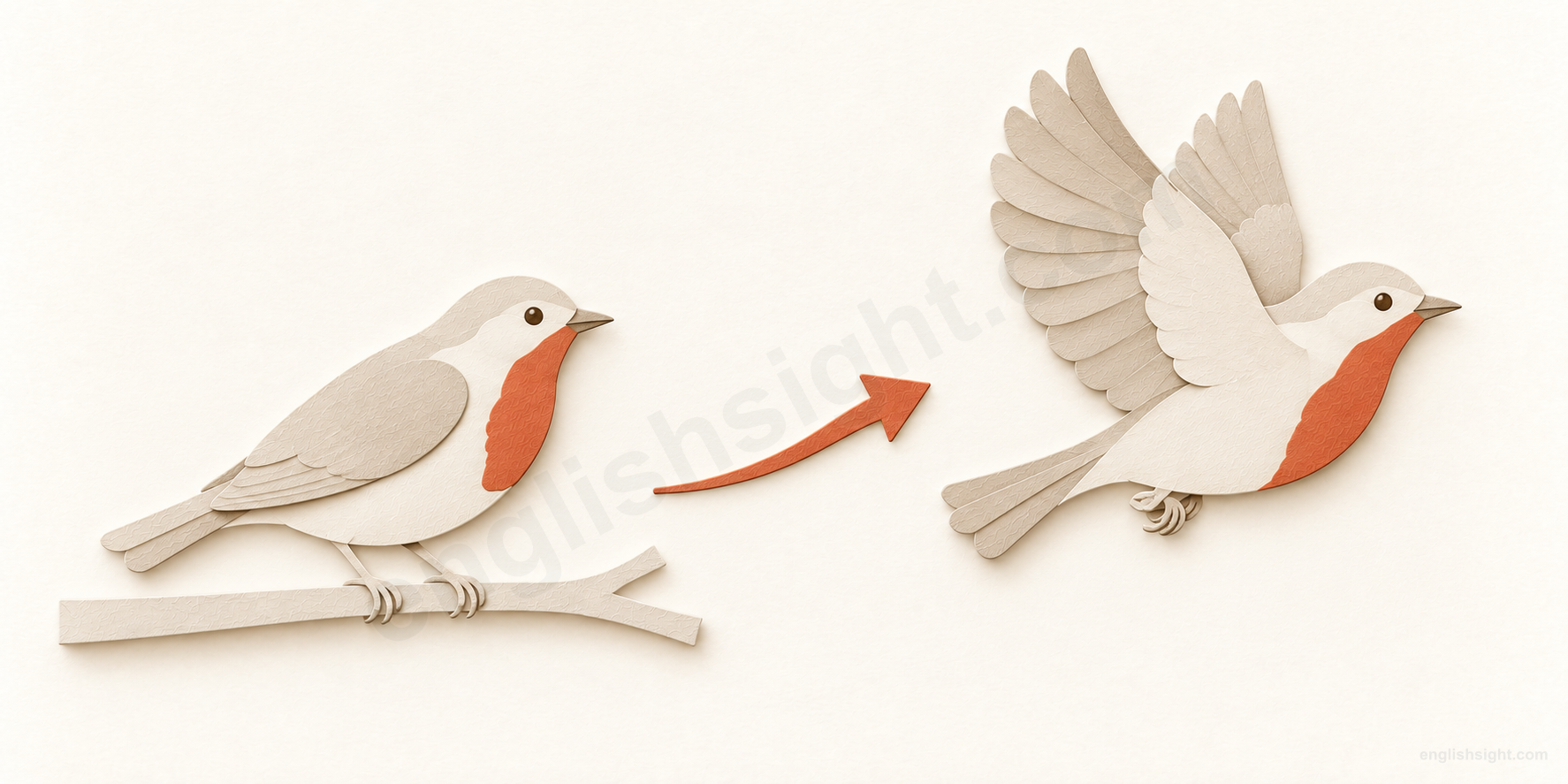
Distinguish flying, a scheduled journey, escape, and the fixed expressions around flight.
From a perch into the air
From a perch into the air
Resting on a branch
flight
The bird is in flight
The bird lifts off and moves through the air.
Take flight marks the start; in flight describes the bird while airborne.
Flight can name movement through the air or space, or the ability to fly; a flight can be a particular journey made that way.
The bird illustrates the flying branch. Escape, stair sections, tasting sets, and ranking expressions are treated separately; the picture is not a claim about a single origin for every modern use.
A bird in flight gives us a useful starting scene: it is moving through the air. At an airport, a flight is a journey or scheduled service that you can book and take.
Other familiar uses need context. A family’s flight from war is escape; a flight of stairs is a section of steps. The air picture helps with one family of meanings, not every expression.
01
Moving through the air
Start with flying itself, then distinguish a moving object, the start of flight, and a group flying together.
01
in flight; during flight; be capable of flight
in flight; capable of flight
flying, or having the ability to fly
Situation
A bird rests on a branch.
What is being described?
It leaves the branch and moves through the air.
Flight names the activity or ability; fly is the ordinary verb.
Look at the bird while it is airborne: it is in flight. When we talk about flight in general, we normally use no article: Flight requires energy. Capable of flight describes ability, even while the animal is resting.
The picture moves from a supported position to an airborne one. It illustrates one clear instance of flight, not a rule that everything in flight must have wings. A rocket can also be in flight, including while traveling through space beyond the atmosphere.
Compare Birds fly with the noun phrase the flight of birds. Use fly, flew, flown for the everyday verb; flight is not its past tense.
Example
The bird looks much larger in flight.
Watch the difference For a particular journey, use a flight; for flying as an activity, use flight without a.
02
the flight of + object; flight path; line of flight
the flight of a ball; flight path
the movement or route of an airborne object
Situation
A player hits a ball high above the field.
What is being described?
You follow its curved movement until it lands.
An object need not fly under its own power.
The flight of the ball draws attention to its travel through the air, including its direction and curve. The ball is not a passenger and does not need an engine.
A flight path is the route of an aircraft or another flying object. Flight describes the kind of path; path is the main noun. The line of flight similarly refers to the direction of travel.
Example
We followed the flight of the ball until it disappeared behind the wall.
Watch the difference A flight path is a route, not a flight ticket or the aircraft itself.
03
bird / flying creature + take flight
take flight
leave a surface and begin flying
Situation
A bird is perched.
What is being described?
It spreads its wings and lifts into the air.
Take flight describes the start; in flight describes the airborne state.
With a bird or other flying creature, take flight can mean become airborne. The whole phrase supplies the beginning: The birds took flight. Take is followed by the noun flight, not a verb particle.
The same words can mean run away, as the escape section explains. A bird may do both at once, but a person who takes flight need not fly. Let the subject and situation decide.
Example
The heron took flight as our boat approached.
Watch the difference Take a flight usually means travel on an air service; take flight has no a and can mean start flying or flee.
04
a flight of + plural birds / aircraft
a flight of birds
a group flying together
Situation
Several geese are moving as a group.
What is being described?
You describe the group as one flight.
One flight can contain several birds or aircraft.
A flight of geese names a group in the air, not a ticket for one goose. The of-phrase says what the group contains. A flock of geese is a more general group description and does not itself say that the birds are flying.
Aircraft can also fly in a flight. Military flight has additional organizational meanings; ordinary travel questions do not require those technical definitions.
Example
A flight of geese passed above the lake.
Watch the difference Do not assume that three flights always means three aircraft; it may mean three journeys or groups.
02
Planning and taking an air journey
At an airport, flight can name both a journey and the scheduled service that makes it. The surrounding words tell you what to do.
05
a flight (from + place) (to + place); a smooth / bumpy flight
a flight from … to …
one journey by air
Situation
You leave one city by plane.
What is being described?
You arrive in another after a period of travel.
From marks the origin; to marks the destination.
A flight is one air journey: a short flight, two flights, or our flight. Describe where it starts with from and where it ends with to. In a question such as How was your flight?, the speaker asks about the journey experience.
A smooth flight feels relatively steady; a bumpy flight involves noticeable jolts. These adjectives describe the ride. The broader word trip can cover your hotel stay and other activities as well as the flight.
Example
How was your flight from Lisbon to Madrid?
Watch the difference Flight is countable here: We had a good flight, not We had good flight.
06
book a flight for + day; take a flight to + place
book / take a flight
reserve an air journey or travel on it
Situation
You choose a service for next week.
What is being described?
You reserve a seat, then later travel.
Book arranges the journey; take describes using it.
Book a flight means make a reservation. Take a flight means use that air service to travel. Booking today does not mean you are flying today: I booked a flight for Friday separates the arrangement time from the travel date.
The noun can also name a scheduled service or the aircraft on that service: Our flight leaves at six. This is why a flight can be booked, boarded, or cancelled even though the focus is not always the time spent in the air.
Example
I booked a flight for Friday, but I may change it.
Watch the difference To describe traveling, use take a flight or fly, not flight as an ordinary travel verb.
07
catch / make / miss + a / the / my flight
catch / make / miss a flight
succeed or fail in reaching a departing service
Situation
Traffic delays your arrival at the airport.
What is being described?
You either reach boarding in time or lose that departure.
Catch and make focus on reaching the service in time.
Catch a flight means get onto the service you intend to use. Make your flight can emphasize succeeding despite a tight schedule. Miss your flight means fail to take it, often because you arrive too late.
If the airline cancels a flight, that is different from you missing it. In I missed my flight because the train was late, the flight may still depart normally.
Example
We left early so we would not miss our flight.
Watch the difference Catch here does not mean grab an aircraft; it is the established transport use of catch.
08
on / aboard a flight; in-flight + noun; be in flight
on a flight; in-flight
traveling on a particular air service; happening during it
Situation
Passengers board the aircraft.
What is being described?
During the journey they receive a meal.
On a flight identifies the journey; in-flight modifies a following noun.
Say I met her on the flight or aboard the flight. On is the usual preposition when identifying the air service you are traveling on; it does not mean on the outside of the plane.
In-flight is an adjective placed before a noun: in-flight entertainment or an in-flight meal. Contrast the separate phrase in flight, as in The plane was already in flight. The adjective describes something provided or occurring during the journey.
Example
The in-flight meal was served an hour after we took off.
Watch the difference For the usual journey expression, say on the flight; do not replace it mechanically with in the flight.
09
flight + number / attendant; Flight + service code
flight number; flight attendant
identify a service or the person helping passengers
Situation
You check the departure information and ask for help.
What is being described?
A number identifies the service; an attendant helps you onboard.
Flight can modify another noun without becoming the verb.
Your flight number identifies the scheduled service. An announcement can use Flight plus its code: Flight ES204 is boarding. The code is a label, not the number of people or hours.
A flight attendant works with passengers on the aircraft, helping and serving them. In these noun combinations the final noun tells you the kind of thing: a number is an identifier, and an attendant is a person.
Example
The flight attendant asked me to put my bag under the seat.
Watch the difference A flight attendant is not simply another word for the pilot.
10
a domestic / international / short-haul / long-haul flight; an outbound / return / one-way flight
domestic / international / return flight
specify a route’s geographical scope or direction
Situation
You compare services for a holiday.
What is being described?
You choose where you will fly and which leg you mean.
The adjective adds information; flight still names an air journey.
A domestic flight stays within one country; an international flight goes between countries. Short-haul and long-haul distinguish shorter and longer air routes, without giving an exact duration by themselves.
The outbound flight goes toward your destination; the return flight brings you back. A return flight can also refer to outward-and-back travel in British booking contexts. Check whether a price covers one leg or both. One-way explicitly describes travel in one direction.
Example
Our outbound flight is on Monday, and our return flight is on Saturday.
Watch the difference Return does not always tell you by itself whether a quoted fare covers one journey or a round trip.
11
a non-stop flight; a connecting flight; miss a connecting flight
non-stop / connecting flight
fly without an intermediate stop, or change to another air service
Situation
Your destination can be reached in one service or via another city.
What is being described?
Your itinerary tells you whether you must transfer.
A connecting flight is the next air service in a linked journey.
A non-stop flight has no intermediate landing on that route. A connecting flight is one you take as part of a journey involving a change of services. You may need time to get from the arrival gate to the departure gate.
If someone says I missed my connecting flight, they failed to take the onward service in a journey involving a transfer. Often their first flight arrived too late, but the phrase alone does not prove that they reached the transfer airport or took the first flight. Check the context and itinerary for what happened.
Example
Our first flight was late, so we missed our connecting flight.
Watch the difference A connection is a link between services, not merely two cities shown on the same ticket.
12
a flight is delayed / cancelled / diverted; cancel / delay / divert a flight
a flight is delayed / cancelled / diverted
a service runs late, does not operate, or goes elsewhere
Situation
Bad weather affects the planned journey.
What is being described?
The schedule or destination changes.
Different disruption words describe different outcomes.
A delayed flight runs later than planned. A cancelled flight will not operate as planned. A diverted flight is sent to a different destination, such as another airport. Read the notice to find out which problem has occurred.
The flight is the affected service, not the person causing the change. Passive patterns are natural here: The airline cancelled our flight becomes Our flight was cancelled. A delay alone does not tell you that a service has been cancelled.
Example
Our flight was diverted to another airport because of fog.
Watch the difference Was diverted is not the same as was cancelled: a diverted flight can already be in the air.
03
Getting away from danger
Flight can also mean fleeing. This branch does not require wings, a plane, or even travel by air.
13
(someone’s) flight from + threat; flight to + refuge; in flight from + difficulty
flight from danger; in flight from …
escape from a threatening or difficult situation
Situation
People face a threat.
What is being described?
They leave to get away from it.
In this branch, flight means fleeing, whatever the transport.
Flight from danger describes getting away. From identifies the threat or place left behind; to can identify a refuge: their flight to safety. In flight from persecution describes people escaping persecution, even if they travel on foot.
The same pattern can describe avoiding a difficult personal reality. A character in flight from responsibility may be trying to escape obligations, rather than physically leaving a country. The larger context supplies the threat or burden.
Example
The novel follows a family’s flight from the war.
Watch the difference A flight from Rome is often an airline journey; flight from persecution describes escape. Read what follows from.
14
take (to) flight; put + someone / something + to flight
take (to) flight; put someone to flight
flee, or cause someone else to flee
Situation
A dog approaches animals in a field.
What is being described?
They run away from it.
Taking flight does not necessarily involve leaving the ground.
A frightened person or animal can take flight or take to flight: they run away. This can sound more narrative than the plain run away. The no-article phrase differs from take a flight, which normally means travel by air.
Put someone to flight means force them to flee. It is old-fashioned and often appears in stories or historical writing. Compare The foxes took flight with The dog put the foxes to flight: the second sentence names the cause as its subject.
Example
The deer took flight when the dog barked.
Watch the difference People who take flight may leave on foot; the phrase alone does not specify air travel.
15
fight or flight; a fight-or-flight response / reaction
fight or flight; fight-or-flight response
confront a threat or get away from it
Situation
A threatening situation is perceived.
What is being described?
The body prepares for defensive action or escape.
Flight is the escape side of the pair, not flying.
Fight or flight contrasts confronting danger with escaping it. The adjective fight-or-flight commonly comes before response or reaction in discussions of stress.
This is a set expression. It does not claim that a person always consciously chooses between exactly two behaviors, and it is not a description of an airline emergency.
Example
The sudden noise triggered a fight-or-flight response.
Watch the difference Fight /faɪt/ and flight /flaɪt/ are different words; keep the l sound in flight.
04
Stairs, imagination, rank, and tasting
These established uses need their own contexts. Learn the whole expression rather than forcing each one into the flying picture.
16
a flight of stairs / steps; two flights up; up / down a flight
a flight of stairs / steps
one continuous section of a staircase
Situation
You stand at the bottom of a staircase.
What is being described?
You climb one section to a landing.
Count sections of stairs, not individual steps.
A flight of stairs is a continuous run of steps between levels or landings. A single flight contains several steps. A staircase can have more than one flight, so two flights do not necessarily mean two floors.
Her flat is three flights up tells you how many such sections you climb. Flight here is a countable noun for a set, not movement through the air. Learn the unit flight of stairs or flight of steps together.
Example
There are two flights of stairs between the entrance and our office.
Watch the difference Two flights of stairs does not mean only two steps.
17
a flight of fancy / imagination; flights of fancy
a flight of fancy / imagination
an imaginative idea that goes beyond practical reality
Situation
Someone proposes a fanciful plan.
What is being described?
You question whether it is realistic.
The mental journey is a metaphor, not a literal flight.
Calling a plan a flight of fancy suggests that imagination has carried it away from what is sensible or workable. For example, a plan to move a small café to the Moon could be a flight of fancy.
Flight of imagination is a related expression. Fancy here means imagination, not elegant or expensive. The phrase may be playful or critical; it does not automatically praise the idea.
Example
Turning the old shed into a space station was a flight of fancy.
Watch the difference Do not use flight of fancy as a neutral synonym for any sensible new idea.
18
in the top / first flight; top-flight + noun
in the top flight; top-flight
among the leading members or at the highest level
Situation
A team advances to the highest league.
What is being described?
It competes among the strongest teams.
Flight can name a level or class in this established expression.
The top flight often means the highest division in a sport. In the first flight or in the top flight can also place someone among the best in a field. This is ranking, not the earliest plane of the day.
The adjective top-flight means of a very high standard or rank: a top-flight musician. Keep the hyphen in this adjective. Compare a team in the top flight with a top-flight team.
Example
The club returned to the top flight after a strong season.
Watch the difference A top-flight coach is an excellent or high-ranking coach, not a coach on an aircraft.
19
a flight of + wines / beers; a wine / beer flight
a flight of wines / beers
a selection of small drinks to taste and compare
Situation
You want to compare several drinks.
What is being described?
Several small samples arrive as one tasting selection.
Here flight groups samples; it does not describe transport.
On a tasting menu, a wine flight or a flight of beers is a selection served for comparison. Each sample can differ, so this is not simply several identical full-size drinks.
This is a food-and-drink context, separate from airline travel. Use the menu and setting to choose the meaning: We ordered a flight in a tasting room is different from We booked a flight online.
Example
We shared a flight of three local beers.
Watch the difference A wine flight on a menu does not mean a plane carrying wine.
Choose the sense from the whole expression
Noun and verb
Flight /flaɪt/ is usually a noun in everyday conversation; its plural is flights. The everyday verb is fly, with flew and flown. Specialist verb uses of flight exist, but they are not substitutes for fly in I fly to work.
Countable and uncountable
Use a flight or several flights for journeys, scheduled services, groups, stair sections, and tasting selections. Use flight without an article for flying in general or ability: capable of flight. Escape is often uncountable, but their flight from danger names a particular escape.
A useful picture has limits
The bird helps you connect take flight, in flight, and flying movement. It does not mean that refugees must travel by plane, that a staircase flies, or that all other uses can be guessed from an arrow.
Common uses, with specialist edges
Military units, competition groups, dart parts, technical sporting verbs, and other specialist senses are outside this introductory course. Put someone to flight is retained as a marked recognition phrase, not a model for ordinary travel conversation.
Read the situation, then choose
Notice articles, surrounding nouns, and the speaker’s purpose.
1. You are describing an owl while it is flying. Which phrase fits?
2. Yesterday you reserved air travel for next month. Which sentence states that arrangement?
3. In a story, a thief took flight when a guard shouted. What does the expression tell you?
4. A sign says the office is two flights up. What should you expect?
5. Your plane is sent to a different airport while you are traveling. Which notice fits?
6. A friend calls your plan for a floating city a flight of fancy. What are they suggesting?
Sources and teaching notes
The sources below support the meanings and expressions. Explanations and examples are original teaching material. The bird diagram illustrates the flying branch, rather than every meaning of flight.
The picture is a teaching aid; English speakers do not all imagine the same scene.