The surface beneath you—and the uses built around it.
Distinguish a room’s surface, a building level, a speaking turn, and expressive verb uses.
The surface beneath the objects
A lower inside surface that supports what is above it
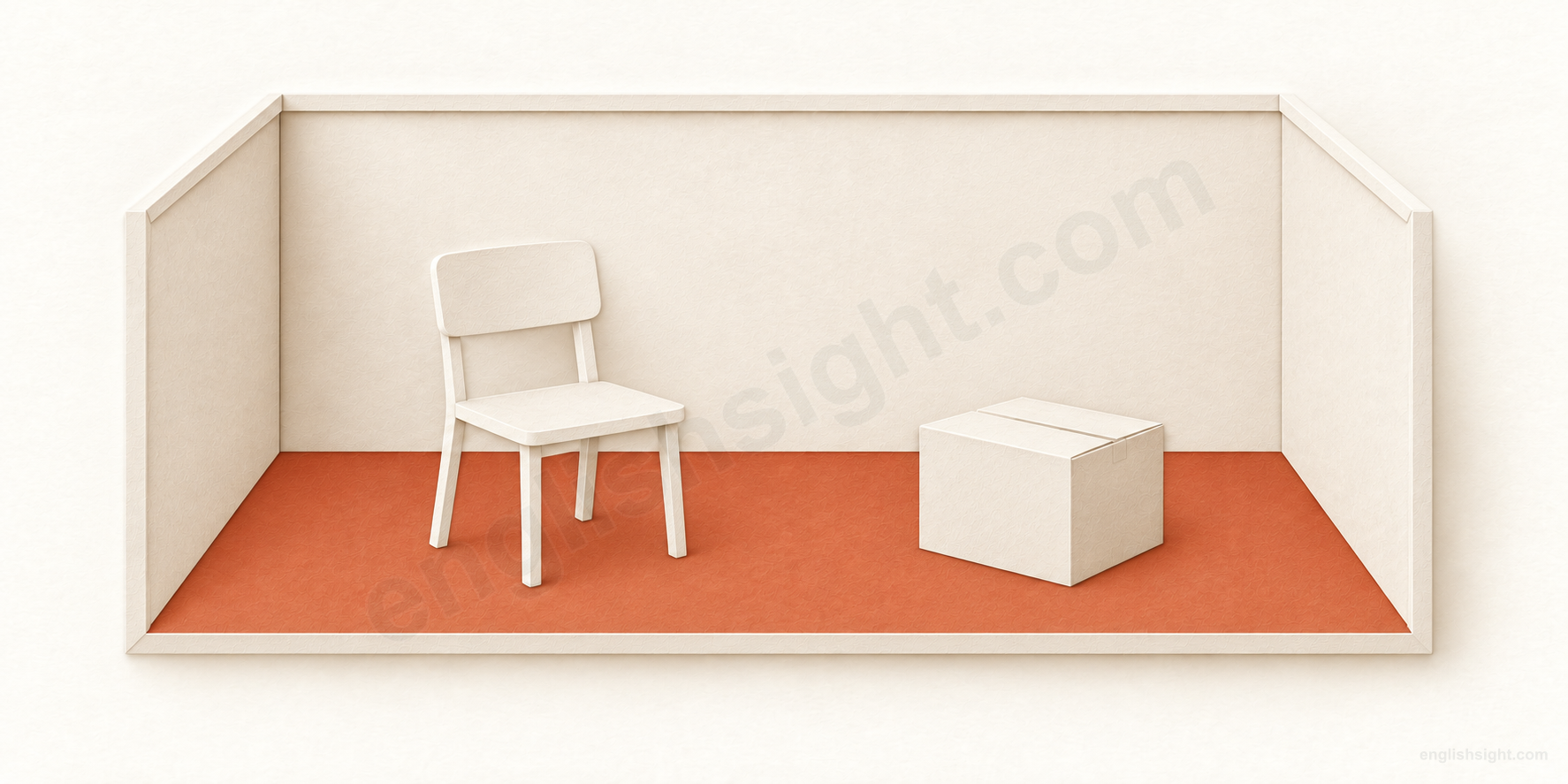
Inside a room, a chair and a closed box rest on the lower surface.
floor
The highlighted surface is the floor beneath the chair and box.
The terracotta floor supports both objects.
The floor is the room’s lower supporting surface. This is a static relationship, not a change.
A floor is the lower inside surface of a room or structure, on which people and objects can stand or rest.
The diagram shows a static support relationship. It does not show a change or claim that a floor must be at street level. Speaking rights and fixed idioms are separate extensions explained below.
Floor is first useful when you look down inside a room: it names the lower surface that supports people and objects. In a tall building, a floor can also mean an entire level of rooms.
Other uses concern an activity area, the people there, a speaking turn, or a lower limit. These connections help learning, but established idioms and verb senses need their own context; one picture cannot predict every expression.
01
Surfaces, rooms, and building levels
Start with the surface under your feet, then distinguish a whole building level, its numbering, and useful descriptions of a room.
01
on / to / under the floor; the floor of + room / vehicle
on the floor
on the lower inside surface of a room or vehicle
Situation / reference
A room has a walking surface beneath the furniture.
Meaning in context
A bag rests on that surface.
On describes contact or position; floor names the surface.
Use floor for the inside surface beneath people and furniture: a kitchen floor, a wooden floor, or the floor of a bus. Outdoors, the ordinary word is ground: We sat on the ground beside the tent.
A bag on the floor is resting there; a bag falling to the floor is moving toward it. Under the floor means beneath the floor structure, not simply somewhere low in the room. Sweep, mop, and clean the floor name ordinary household tasks.
In a sentence
Please leave your bag on the floor beside your chair.
Watch the difference Say on the floor for something resting on top; in the floor suggests something within its material.
02
on the + ordinal / top / ground + floor; number + floors
on the top floor
on a particular level of a building
Situation / reference
A building has rooms at several heights.
Meaning in context
You identify the level containing the flat.
A floor here includes a whole building level, not just its walking surface.
The top floor, the second floor, and the floor above identify levels containing rooms. The lift stops at every floor means every served level, not every individual room.
Use on for the location: Her office is on the third floor. For the total height of a building, storey (British) or story (American) is useful: a three-storey house or a three-story house. The house has three floors is also possible.
In a sentence
Our flat is on the top floor, two floors above the café.
Watch the difference Floor and storey can both count levels, but on the third storey is less usual than on the third floor for an address.
03
on the ground / first / second floor
ground floor / first floor
name building levels using the local numbering system
Situation / reference
You enter a building at street level.
Meaning in context
A local sign tells you which floor number to choose.
British and North American numbering often start differently.
In usual British naming, the ground floor is at street level and the first floor is one level above it. In usual North American naming, street level is the first floor and the next level is the second floor.
North American public buildings may also label street level ground floor while still calling the level above it second floor. Basement names, mezzanines, and local signs can vary. Check the lift directory rather than translating a floor number mechanically.
In a sentence
In this British hotel, reception is on the ground floor and our room is on the first floor.
Watch the difference First floor does not identify the same height in the two usual systems.
04
the ocean / sea / forest / valley floor; the floor of a cave
the ocean / forest / valley floor
the ground forming the bottom or base of a natural place
Situation / reference
You describe an ocean, forest, cave, or valley.
Meaning in context
Floor identifies its ground or bottom surface.
The lower-surface meaning extends beyond constructed rooms.
The ocean floor and sea floor are the seabed. The forest floor is the ground beneath the trees; the valley floor is the low ground between the sides of the valley. The floor of a cave is its bottom surface.
These are established combinations, not permission to replace every outdoor ground with floor. Say The children played on the ground in the park for an ordinary outdoor location.
In a sentence
Fallen leaves covered the forest floor.
Watch the difference A forest floor is natural ground; it does not imply wooden boards.
05
from floor to ceiling; floor-to-ceiling + noun
from floor to ceiling
over the full height of a room
Situation / reference
A wall has space from its bottom to its top.
Meaning in context
Shelves occupy that full height.
From and to establish the two endpoints.
From floor to ceiling describes a vertical extent. A room filled with boxes from floor to ceiling may be almost completely full; shelves extending that far reach from the room’s lower surface to its upper one.
Before a noun, the combined description is usually hyphenated: floor-to-ceiling windows. Floor tiles and floor space instead use floor as a noun modifier: tiles used on a floor and the usable area measured across it.
In a sentence
Bookshelves cover one wall from floor to ceiling.
Watch the difference Ceiling is the upper inside surface of the room; roof is the outside covering above a building.
06
a floor plan of + room / building; look at the floor plan
a floor plan
a drawing showing a room or building layout from above
Situation / reference
You need to understand how rooms connect.
Meaning in context
A drawing shows their positions and entrances.
Plan names the drawing; floor tells you the layout being represented.
A floor plan shows the arrangement as if viewed from above. It can show walls, doors, rooms, or furniture, helping you decide how to move through or use a space.
It is a view of layout rather than a photograph of the floor material. A building with several levels may have a separate floor plan for each one.
In a sentence
The floor plan shows a small kitchen beside the entrance.
Watch the difference Do not confuse a floor plan with a plan to clean or replace the floor.
02
Places for activities and turns to speak
A floor can be an area used by dancers, workers, traders, or a debating assembly. Some expressions then refer to the people or the right to speak.
07
on the shop / factory / trading floor; shop-floor + noun
on the shop / factory / trading floor
in the area where the main work is done
Situation / reference
A business has offices and areas for its main activity.
Meaning in context
Staff work where products are made, sold, or traded.
The activity identifies the area; floor can stand for more than its surface.
A factory floor is the production area. Shop floor can likewise mean the factory working area or its production workers, especially when contrasted with management. In retail, shop floor means the public sales area, rather than stockrooms or offices.
A trading floor is an area used for financial trading. In a store, staff on the floor are available in the customer-facing area. These expressions identify the kind of work or location, not a particular numbered storey.
In a sentence
The manager spent the morning talking to workers on the factory floor.
Watch the difference Shop floor does not always mean a retail shop: factory and worker uses are important.
08
take to the floor; take the floor; on the dance floor
take to the floor
start dancing in the dancing area
Situation / reference
The music starts while people sit around the room.
Meaning in context
Some guests begin dancing.
Here the floor is the dance floor.
A dance floor is an area intended for dancing. With that area understood, on the floor can simply mean dancing there. Take to the floor is an established way to say begin dancing.
Take the floor can also mean begin dancing, as well as begin speaking in a meeting. A band, couples, or a final dance points to the dancing interpretation; a chairperson or a debate points to speaking.
In a sentence
When the band began, several guests took to the floor.
Watch the difference Take to the floor in this use means dance, not sit down or fall over.
09
on the floor of the House; questions / comments from the floor
questions from the floor
questions from members of the audience or assembly
Situation / reference
A speaker finishes a presentation.
Meaning in context
People listening are invited to ask questions.
From the floor identifies the people participating, not a sound from below.
The floor of the House names the part of a legislative chamber where official discussion takes place. A speech on the floor of the House is part of those proceedings.
In questions or comments from the floor, the place stands for the people in the audience or assembly. The speaker may stay on a platform while others ask questions. This wording is natural in meetings and public discussions, not a name for every group of people.
In a sentence
After the talk, the scientist answered questions from the floor.
Watch the difference From the floor does not mean that the questioner must be physically sitting on the ground.
10
have / get / take the floor; give + person + the floor; be given the floor
have / give / take the floor
have, grant, or begin a turn to speak
Situation / reference
A meeting has an agreed order of speakers.
Meaning in context
The chair invites one participant to speak.
The floor means the right to address the group.
You have the floor tells someone it is their turn to speak. Give someone the floor grants that opportunity; get the floor means obtain it. Take the floor describes beginning to address the group.
This is established meeting language. Giving the floor changes who is entitled to speak, not who owns the room. The chairman gave Maya the floor and Maya was given the floor express the same allocation with different subjects.
In a sentence
The chair gave Maya the floor to explain her proposal.
Watch the difference Keep the in these expressions; have a floor normally refers to a physical floor or building level.
11
hold the floor + for + length of time
hold the floor
continue speaking while others wait
Situation / reference
One participant is already speaking.
Meaning in context
That participant keeps the speaking turn for some time.
Hold emphasizes retaining the turn rather than obtaining it.
Hold the floor describes remaining the speaker in a discussion, often for a long time. Depending on context, it can suggest that other people have little chance to contribute.
Compare take the floor, which marks the start of a turn, and have the floor, which states whose turn it is. Hold the floor adds duration or continued control; it is not a physical grip on a surface.
In a sentence
Leo held the floor for twenty minutes before inviting a response.
Watch the difference The expression can sound critical if someone is preventing other contributions.
03
Lower limits and established idioms
A physical base provides a useful comparison for a minimum level. Other expressions have established meanings that you must learn as whole phrases.
12
a price / wage floor; set / put a floor on + value
a floor on prices
a lower limit below which a value is not allowed or expected to fall
Situation / reference
An organization sets a minimum acceptable value.
Meaning in context
The stated value acts as a lower boundary.
A floor is a minimum; a ceiling is a maximum.
A price floor or wage floor is a minimum level. Set a floor on something identifies the value being limited. The comparison is with a base beneath a quantity, not a room at a numbered height.
The surrounding context matters: a legal floor is an imposed minimum, whereas a market floor may be an observed level below which prices seem unlikely to fall. The word alone does not guarantee that a market value cannot fall further.
In a sentence
The agreement sets a floor on hourly pay.
Watch the difference A price ceiling limits how high a price may go; a price floor limits how low it may go.
13
prices / sales + go / fall / drop through the floor
go / fall through the floor
decrease suddenly to a very low level
Situation / reference
Sales were much higher before a change.
Meaning in context
They fall sharply.
The downward movement is figurative when the subject is sales or prices.
When prices, sales, or confidence go, drop, or fall through the floor, they decrease dramatically. The complete expression supplies the exaggeration: an imagined supporting surface gives way.
The phrase does not specify a numerical minimum, zero, or a legal price floor. With a person or object in a damaged building, fall through the floor can instead describe an actual fall through a broken surface.
In a sentence
Sales fell through the floor after the shop lost its main customer.
Watch the difference Read the subject and situation before choosing a literal or figurative interpretation.
14
get / be in on the ground floor of + project / business
get in on the ground floor
join a project at an early stage, often hoping to benefit
Situation / reference
A new business is just starting.
Meaning in context
Someone joins before it becomes established.
Ground floor stands for a beginning, not a required physical address.
Get in on the ground floor of a business or project means become involved early. It often suggests a chance to gain an advantage as the project grows. Be in on the ground floor describes already having that early involvement.
This idiom draws on a building’s starting level, but the full combination carries the meaning. Working on the ground floor of an office describes a location and does not itself say that you joined the business early.
In a sentence
Rina got in on the ground floor of the business and helped develop its first product.
Watch the difference Early involvement can offer an opportunity; the idiom does not promise success or profit.
15
wipe / mop the floor with + opponent
wipe / mop the floor with someone
defeat someone very decisively
Situation / reference
Two players compete.
Meaning in context
One wins by a large margin.
The whole informal idiom expresses overwhelming defeat.
Wipe the floor with someone and mop the floor with someone are informal, forceful descriptions of winning easily in a competition or argument. The person after with is the defeated opponent.
The expression can sound mocking or boastful, especially as a prediction. It does not report actual cleaning or require physical violence. A close win would not normally justify this description.
In a sentence
Our debate team wiped the floor with the visitors.
Watch the difference Do not say wipe someone with the floor for this idiom; learn the full word order.
04
What happens when something floors someone?
The verb has an object: a person knocked down or overwhelmed, a room given a surface, or an accelerator pressed hard. Context distinguishes these uses.
16
floor + person; be floored by + punch / opponent
floor an opponent
hit someone so that they fall down
Situation / reference
A boxer is standing.
Meaning in context
A punch knocks the boxer down.
The verb makes the person come down to the floor or ground.
Floor someone in a fight or sport means knock them down with a blow. The opponent is the direct object. The passive is common: The boxer was floored by a punch.
The floor need not be mentioned separately because the downward result is part of this verb sense. Someone who simply slips and falls is not necessarily floored by someone; that wording suggests an external blow or force.
In a sentence
A sudden punch floored the boxer in the second round.
Watch the difference Flooring an opponent does not by itself tell you the match’s final result.
17
something floors + person; be floored by + news / question / reply
be floored by the news
be so surprised or confused that you do not know how to respond
Situation / reference
Someone expects an ordinary announcement.
Meaning in context
Unexpected news leaves that person momentarily unable to respond.
A psychological impact replaces a physical knockdown.
News, a reply, or a difficult question can floor someone without making them fall. The person may be astonished, overwhelmed, or unable to think of an answer. A problem floored me emphasizes difficulty or confusion; an unexpected announcement may emphasize surprise.
The active and passive are both useful: Her reply floored me; I was floored by her reply. This is expressive wording, stronger than simply saying that something was a little surprising.
In a sentence
I was floored by the question and could not think of an answer.
Watch the difference Being floored does not necessarily mean being upset: welcome news can also overwhelm someone.
18
floor + room; be floored in / with + material
be floored with wood
have a floor installed or covered with a material
Situation / reference
A room needs a finished walking surface.
Meaning in context
A wooden surface is installed.
Here floor is a construction verb, not a blow or a reaction.
To floor a room is to provide it with a floor. Descriptions of completed interiors often use the passive: The room is floored with oak, or floored in oak.
The room is the object receiving the floor; the material follows with or in. Flooring can also be an uncountable noun naming material used for floors: We chose wooden flooring. That noun is distinct from the plural floors, which counts surfaces or building levels.
In a sentence
The hallway was floored with pale wood during the renovation.
Watch the difference Floored with wood describes a surface installation, not wood surprising the hallway.
19
floor the accelerator; floor it; floor + vehicle
floor it / floor the accelerator
press the accelerator hard to accelerate rapidly
Situation / reference
A vehicle is moving slowly.
Meaning in context
The driver presses the accelerator hard.
Floor evokes pressing the pedal down toward the vehicle’s floor.
Floor the accelerator means press the accelerator pedal hard, typically all the way down toward the vehicle’s floor. Informal floor it means accelerate very rapidly or use maximum power. A vehicle can also be the object: The driver floored the van to pull ahead.
It is not a general pattern in which it can be replaced by any object. Compare floor the room, which means install a floor, and floor the driver, which would normally mean knock down or overwhelm the person.
In a sentence
In the film, the driver floored it as soon as the road cleared.
Watch the difference This describes forceful acceleration; it is not a neutral synonym for drive.
Keep the referent and the construction clear
Floor, ground, and a building level
Use floor for a room’s or vehicle’s lower inside surface, and normally ground for the ordinary outdoor surface. Natural combinations such as forest floor and ocean floor are established exceptions to that quick guide. On the third floor identifies a whole level of a building.
Articles and modifiers
The noun is countable: a floor, two floors. Use the when the relevant surface, level, or speaking right is identified: on the floor, have the floor. Before another noun, singular floor often describes purpose or location: floor tiles, floor space, floor plan.
Verb forms and objects
The verb forms are floor, floors, floored, flooring. The main senses are transitive, and the passive is especially natural for being knocked down or for a room provided with a surface. A room being floored describes ongoing construction; someone being floored by news describes the impact on that person. There is no productive family of floor + particle phrasal verbs to memorize here.
The picture has a boundary
The lower-surface model is a teaching connection. It cannot tell you that take the floor means speak or dance, or that wipe the floor with someone means win decisively. Learn those combinations with their situations; English speakers do not all share one mental picture.
Choose the meaning that fits
Use the setting, the subject, and the whole expression.
1. You sat beside a tree in an ordinary city park. Which wording fits that outdoor surface?
2. A British hotel uses the usual British numbering. Which level is immediately above the ground floor?
3. The chair says, “Maya, you have the floor.” What should Maya understand?
4. An agreement puts a floor on hourly pay. What does that establish?
5. A difficult question floored Ana, although nobody touched her. What happened?
6. A band starts playing at a wedding, and guests take to the floor. What do they do?
Sources and teaching notes
Dictionary entries were used to check the senses, constructions, and idioms. Explanations, examples, and the support diagram are original teaching material; connections between meanings are learning aids.
The diagram illustrates the supporting surface inside a room. Other meanings need their own context.