See how flower names a blossom, a garden plant, or a gift—and how flowering becomes an image of development.
From bud to open flower
From bud to open flower
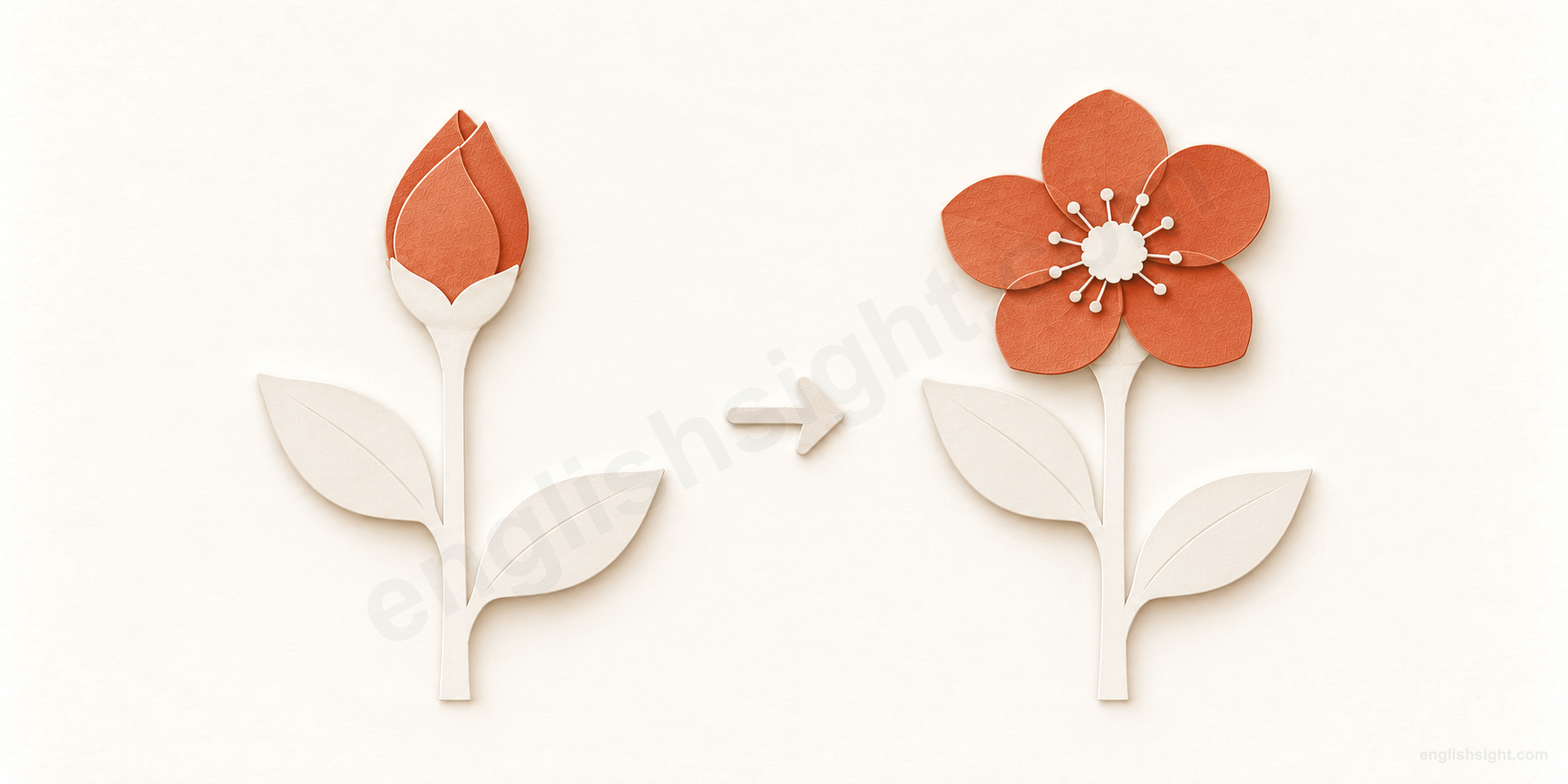
A closed bud sits on a stem with two leaves.
flower
An open flower stands on the same plant.
The bud develops and opens.
The bud opens into a flower. The noun names the blossom; the verb describes the plant producing flowers.
A flower is a plant’s blossom; when a plant flowers, it produces blossoms that develop and open.
The image follows one bud opening. It supports the literal noun and verb and offers a comparison for development; gift meanings and literary expressions still need their own context.
A flower can be the blossom on a plant, a plant grown for its blossoms, or a picked flowering stem. Notice what the speaker sees, grows, or gives before choosing an interpretation.
The verb flower describes producing flowers. More literary uses connect flowering with successful development, a prime period, or the finest part of a group. These connections help memory without making every expression predictable.
01
Flowers we see, grow, and give
Flower can name a part of a plant, a garden plant, or a picked stem. The surrounding words tell you what is being counted or handled.
01
a / one + flower; plural flowers; flower bud / petal
a flower / flowers
the blossom on a plant
Situation / starting point
You look at a leafy plant.
Meaning / resulting state
You identify one blossom among its leaves.
A flower is a plant part; it is not simply another word for a leaf or the whole plant.
In its central concrete use, a flower is the part of a flowering plant involved in producing seeds. Many familiar flowers have noticeable petals, but bright colour and a strong smell are not requirements.
This noun is countable: one flower, two flowers, some flowers. A plant can have several flowers, so counting flowers need not tell you how many plants there are.
A flower bud is a flower before it opens; a petal is one of its often colourful parts. The diagram follows a bud opening, rather than suggesting that a flower appears from nothing.
In a sentence
This plant has three small white flowers.
Watch the difference Say a flower or some flowers when referring to individual blossoms. A single petal is not a whole flower.
02
grow / plant / water + flowers; wild flowers
grow / plant flowers
cultivate plants for their blossoms
Situation / starting point
You choose what to grow beside the path.
Meaning / resulting state
You grow flowering plants there.
In gardening, flowers can refer to whole plants valued for their blossoms.
We grow flowers and vegetables describes two kinds of garden planting. Here flowers includes the plants, not just detached blossoms. Plant flowers can mean putting young flowering plants into soil; plant flower seeds names the seeds explicitly.
In The flowers need watering, the context may make the whole plants the intended reference. Compare The plant has yellow flowers, where flowers names parts of one plant.
Wild flowers grow without being planted by people in that place; the spelling wildflowers is also used. A carpet of flowers describes a wide covering that looks like a carpet, not something made for walking on.
In a sentence
We grow flowers along the path and vegetables behind the house.
Watch the difference Do not infer that every flower is a separate plant or that every plant is a flower.
remove flowers, often with stems, for use or display
Situation / starting point
The blossoms are growing in the garden.
Meaning / resulting state
Some stems are gathered for a vase.
Flowers can mean the picked blossoms together with their stems.
Pick flowers means take them from where they are growing. Cut flowers highlights cutting their stems; as a noun phrase, cut flowers are flowers sold or kept after being cut from the plant.
Put the flowers in a vase normally refers to cut stems placed in water. A flowerpot usually holds soil and a growing plant instead. The container and situation help distinguish picked flowers from garden plants.
Fresh flowers contrasts with dried flowers or artificial flowers. Artificial flowers imitate the appearance of real flowers; the word flower does not make them living plant parts.
In a sentence
I cut a few flowers and put them in a vase.
Watch the difference Pick a flower does not normally mean dig up the entire plant, roots included.
04
a bunch / bouquet of flowers; give / send + person + flowers; give / send flowers to + person
a bunch of flowers / send someone flowers
give or deliver flowers as a present
Situation / starting point
You want to thank someone after a visit.
Meaning / resulting state
A group of flowers arrives as a gift.
The gift meaning comes from the action and occasion, not from flower alone.
A bunch of flowers is a group gathered together, often held or tied by the stems. A bouquet of flowers commonly suggests flowers arranged for presentation. These are useful choices in a shop or when describing a gift.
You can give someone flowers, give flowers to someone, send someone flowers, or send flowers to someone. The person is the recipient; the flowers are the gift. Send adds delivery or dispatch, which flower itself does not express.
Occasions can include thanks, congratulations, sympathy, or romance. Do not assume that flowers always imply romantic interest. With a bunch of flowers as subject, the head noun is singular: The bunch is on the table.
In a sentence
We sent our neighbour a bunch of flowers to thank her for her help.
Watch the difference Use a bunch of flowers, not a bunch flowers. With a bouquet, keep flowers plural when there is more than one.
name a place, container, or display associated with flowers
Situation / starting point
You discuss where plants grow and how cut flowers are displayed.
Meaning / resulting state
You choose the noun for the place, container, or display.
In these compounds, the final noun names the thing; flower tells you its connection with flowers.
A flower bed is an area of garden soil used for growing flowers, not a bed for sleeping. A flowerpot is a container for growing a plant. It can hold a plant that is not currently in flower.
A flower garden is a garden devoted to flowers. A flower arrangement is a display made by placing flowers together, and flower arranging names the activity. These expressions name different things rather than new meanings of the verb flower.
The first noun normally stays singular in these familiar forms: flower beds, flower arrangements. Pluralise the final count noun. Flowerpot is commonly written as one word; flower bed as two.
In a sentence
There are two flower beds beside the gate.
Watch the difference A flowerpot is for a growing plant; a vase usually holds cut flowers. Flowers bed is not the standard compound.
02
Having flowers and producing them
Distinguish a flowering state, the start of that state, and the verb that describes producing flowers.
06
be + in (full) flower
be in flower
have flowers that have appeared and opened
Situation / starting point
You check the roses during their flowering season.
Meaning / resulting state
You report their current state.
In flower describes the plant’s flowering state, rather than a physical location.
The roses are in flower means that the plants have open flowers now. In is part of this established expression, not a claim that the roses are inside another flower.
In full flower intensifies the picture: flowering is at its fullest or most abundant stage. The form stays flower even with a plural subject: The trees are in flower.
Compare There are flowers in the vase. That sentence locates cut flowers in a container. The garden is full of flowers describes its contents; in full flower describes a flowering state.
In a sentence
The roses are in flower, but the lilies are still in bud.
Watch the difference Keep this expression singular and article-free: in flower, not in a flower or in flowers for this meaning.
07
come / comes / came / has come + into flower
come into flower
begin to have open flowers
Situation / starting point
The plant has not yet opened its buds.
Meaning / resulting state
Its flowering period begins.
Come into marks the beginning of the state described by in flower.
The bush has come into flower presents a change: it has started flowering. The bush is in flower reports the state once flowering is happening. The contrast is between beginning and being, not between arriving at two places.
You can add a time: These plants come into flower in May. In come into flower, into belongs to the state-change expression; in May supplies the time.
Come into flower is a useful established expression, not evidence that flower has a general family of separable phrasal verbs. Learn the whole pattern without inserting an object between come and into.
In a sentence
The apple trees have just come into flower.
Watch the difference Is in flower describes a state; has come into flower highlights its recent beginning.
08
plant / tree + flower(s); be flowering; flowered
plants flower
plants produce flowers
Situation / starting point
The plants grow leaves and buds.
Meaning / resulting state
They produce and open their flowers.
As a verb, flower describes what the plant does, with no direct object.
These plants flower in June uses flower as an intransitive verb. The plants are the subject; in June supplies time. The noun version is These plants produce flowers, where flowers is the object of produce.
The forms are flower, flowers, flowered, flowered, flowering. The plant is flowering now is natural for an ongoing flowering period. A flowering plant is a plant that produces flowers; early-flowering plants flower early in the season.
Bloom is often a close alternative in this literal use. Blossom also describes producing flowers, especially in talk about trees. These are useful overlaps, but do not assume that every fixed expression containing one word allows the others.
In a sentence
These plants flower twice a year.
Watch the difference Say The plants flower or The plants produce flowers. In ordinary gardening English, do not use I flower the plants to mean I make them bloom.
03
Development, a peak, and the best
More literary uses draw on growth and flowering. Learn their full expressions and register rather than using them as everyday replacements for good or grow.
09
talent / relationship / movement + flower; flower into + noun phrase
talent / a relationship flowers
develop strongly and successfully
Situation / starting point
Someone has an ability that is not yet fully expressed.
Meaning / resulting state
That ability develops and becomes evident.
The plant’s growth supplies a metaphor for development, not a literal change into petals.
Her talent flowered describes successful development. A relationship or a cultural movement can also flower. This use is more literary than develop or grow and is useful for reading as well as expressive writing.
Flower into something names the developed result: Their friendship flowered into a lasting partnership. Into introduces that result; it does not turn flower into a separable verb or give it a direct object.
The diagram helps you connect opening and development, but it is a teaching comparison. It cannot predict whether every abstract noun will sound natural with flower.
In a sentence
Her talent flowered when she joined the drama group.
Watch the difference For neutral everyday wording, Her talent developed is often easier. Flower here does not mean merely appear suddenly.
10
in the flower of + youth; in (full) flower
in the flower of youth / in full flower
at a period of greatest vigour or development
Situation / starting point
A writer describes a person’s most vigorous years.
Meaning / resulting state
The person is presented at a peak stage of life.
Some literary noun expressions treat flowering as a peak period, not a single blossom.
In the flower of her youth means in the prime of her youth, when she is young and vigorous. It is a literary description, often encountered in accounts looking back on someone’s life.
Abstract things can also be described as in flower or in full flower when flourishing or fully developed. Here full emphasises the developed state, as it does with a plant in full flower.
The time-of-life meaning is different from selecting the best members of a group. In the flower of youth concerns a period; the flower of a generation can refer to people judged to be its finest members.
In a sentence
The portrait shows her in the flower of her youth.
Watch the difference These are literary expressions. In her youth simply says when; in the flower of her youth adds the idea of a prime period.
11
the flower of + group / community / generation / art form
the flower of something
the finest part or members, or the best example of something
Situation / starting point
A historian looks back at a generation of writers.
Meaning / resulting state
The most admired members are described collectively.
The flower of can identify the finest part of a whole or an outstanding example of something.
The flower of a generation refers to the people regarded as its best or most promising members. This literary expression often appears in historical writing, including accounts of people lost in war. It can also describe a thing as the finest example of something: a palace might be praised as the flower of European architecture.
The flower is singular even when it refers collectively to several people. The following of phrase names the larger group, whole, or category in relation to which someone or something is judged to be the finest.
The judgment of excellence belongs to this established expression. Do not call an individual person a flower merely to mean that they are good at their job; an ordinary compliment needs different wording.
In a sentence
The exhibition celebrates the flower of a generation of local artists.
Watch the difference This is literary praise, not a neutral classification. Use the best artists for a plain everyday description.
Choose the sense from the whole expression
A noun and a verb can look identical
The flowers are open uses the plural noun. The plant flowers in May uses the third-person singular verb. The sentence structure shows which job the word is doing.
Flower and flour sound alike
Flower and flour are homophones in the standard British and American pronunciations shown by the dictionaries. Flour is the powder used in baking. Write a bag of flour and a bunch of flowers.
Bloom, blossom, and register
Bloom and blossom overlap with the literal noun and verb. Flower is useful for the everyday objects and gardening expressions here. The abstract development, prime-of-life, and finest-part uses are more literary; plain develop, prime, or best often fits conversation better.
Scope of this lesson
This lesson focuses on the ordinary intransitive verb: plants flower. Transitive uses for causing a plant to flower or decorating with flowers, specialist botanical detail, printing ornaments, chemical flowers such as flowers of sulphur, and separate derivatives such as flowery are outside this lesson. The diagram is a teaching aid, not a shared mental picture attributed to all English speakers.
Read the whole expression
Choose the sentence that matches the situation, then check the explanation.
1. One plant has four separate blossoms. What are you counting?
2. The buds were closed yesterday. Today the tree has its first open blossoms. Which expression highlights the beginning?
3. You want a group of cut flowers for a thank-you gift. What would you ask for?
4. The plants produce blossoms every summer. Which sentence uses flower as the ordinary gardening verb?
5. A biography says her talent flowered after she joined a theatre company. What developed?
Sources and teaching notes
Noun senses, verb patterns, and expressions were checked against Oxford, Collins, and Merriam-Webster. The explanations, examples, and diagram are original teaching material; the visual connection is a teaching interpretation.
The diagram connects a bud with an open flower. It is a learning aid, not a mental picture shared by every English speaker.