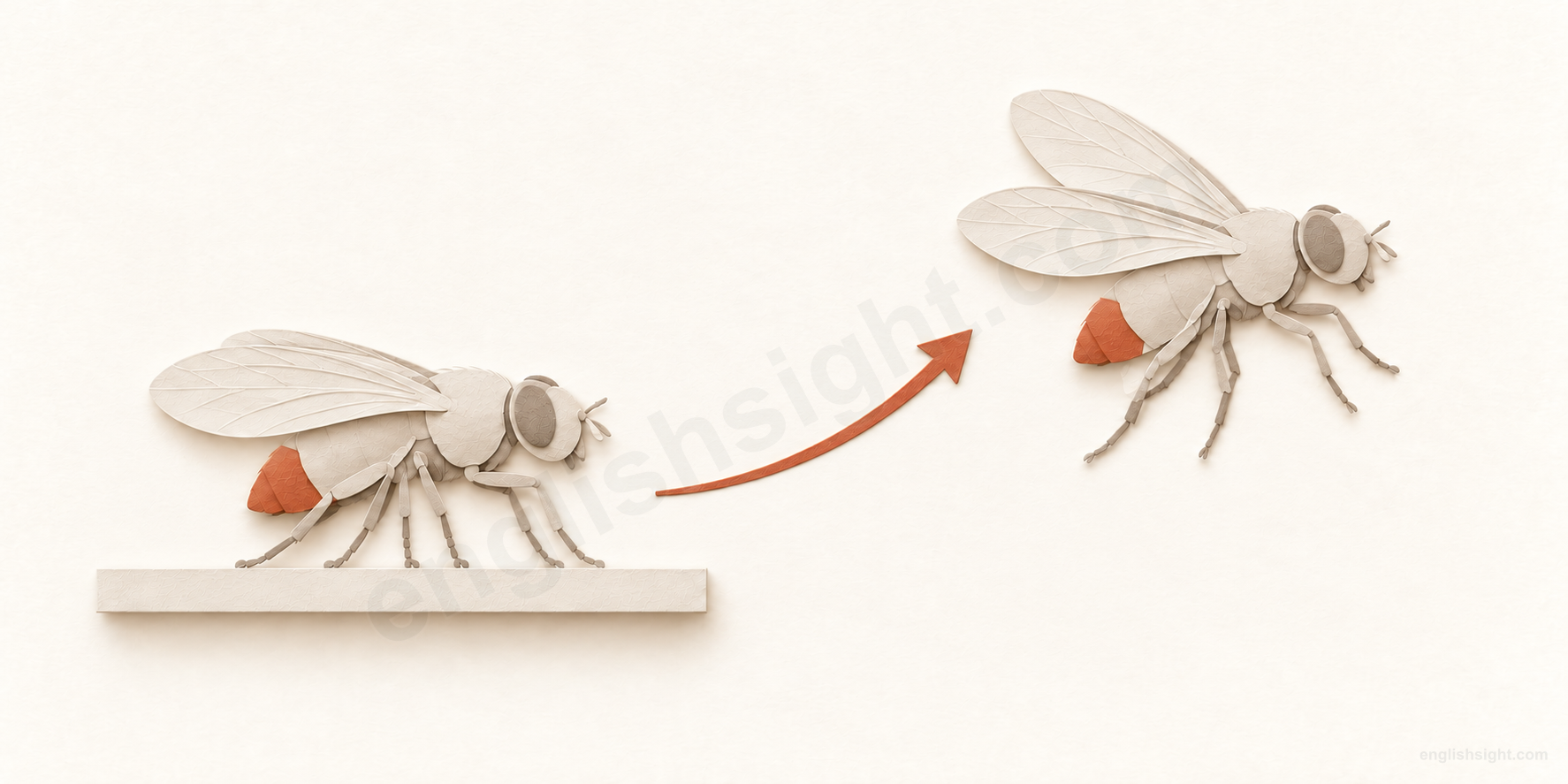
Recognize the insect, then follow movement, grammar, and fixed expressions.
An insect, and movement through the air
An insect, and movement through the air
A fly rests on a short ledge.
fly
The same fly is airborne beyond the ledge.
Its wings carry it up and to the right.
It is a fly in both moments; in the second, it is flying.
In its literal verb use, fly means to move through the air. A fly is one kind of insect; it remains a fly when it lands. Grammar distinguishes the moving thing, the traveler, the controller, and what is transported.
The picture links the insect noun with literal flight. It is a teaching model for this connection; rapid change and fixed expressions need the explanations below.
In There is a fly on the window, fly names an insect. In A bird can fly, it describes movement through the air. Start by asking whether the word names something or tells you what happens.
The literal movement helps explain air travel, controlling a kite, and some images of speed. It does not mechanically explain every noun meaning or idiom. Learn those with their own situations and constructions.
01
A small insect, and other noun meanings
A fly names something. Start with the insect; clothes, fishing, and baseball supply different noun meanings. These are not interchangeable.
01
a / the + fly; number + flies
a fly / flies
a small insect, such as a housefly
Situation before / context
A small insect is near the fruit.
What happens / what is meant
You identify it as a fly.
The noun identifies the insect, whether it is flying or resting.
A fly is a countable insect noun: one fly, two flies. Around food or windows it often means a housefly; fruit fly names another kind. A fly can land, walk, or rest and still be a fly.
Compare A fly is on the glass with The bird can fly. In the first sentence fly names a creature; in the second it tells us what the bird can do. Not every flying creature is called a fly.
In a sentence
Two flies landed beside the fruit bowl.
Watch the difference Use flies for the plural, not flys. The form flies can also be a verb: The bird flies.
02
someone’s fly + is open / undone; BrE flies + are undone
Your fly is open.
the fastened opening at the front of trousers
Situation before / context
The front fastening of a pair of trousers has not been closed.
What happens / what is meant
Someone quietly points out the open front fastening.
The clothing noun refers to an opening, not an insect.
The fly is the front opening of trousers or pants, usually fastened with a zip or buttons and covered by a flap. Your fly is open or Your fly is undone is a discreet warning.
British English also uses the plural form flies for this opening: Your flies are undone. Match the verb to the form you choose. This clothing use needs its own context; do not try to explain it as an insect in motion.
In a sentence
He checked that his fly was done up before leaving.
Watch the difference Say Your fly is open, but Your flies are open. Fly is not the name for every zip on a garment.
03
a fly; fish with a fly; fly fishing
a fishing fly
an insect or an imitation used to catch fish
Situation before / context
A fisher chooses something for the end of the line.
What happens / what is meant
A small insect-like lure is attached.
The fishing noun names bait or a lure rather than an action.
In fishing, a fly can be an insect used as bait or an artificial lure made to suggest one. The artificial object is called a fly even though it has no life and cannot fly by itself.
Fly fishing names the activity. You can recognize the noun without learning specialist dry-fly and wet-fly techniques here. It is a separate practical use of the insect image.
In a sentence
She tied a tiny artificial fly to the line.
Watch the difference A fishing fly is not necessarily a real insect. Fishing is not what the ordinary verb fly means.
04
hit / catch a fly (ball); fly out; flied out
a fly ball / flied out
a high hit, and the related baseball verb
Situation before / context
A batter hits the ball high.
What happens / what is meant
A fielder catches it and the batter is out.
Baseball has a specialist noun and an exceptional verb form.
A fly or fly ball is a baseball hit that goes high into the air. Fly out describes being put out when that kind of hit is caught; a pop fly is a particularly high, short hit.
The baseball verb uses flied in the past and past participle: She flied out. This exception does not change ordinary flew and flown for birds, journeys, or aircraft.
In a sentence
The batter flied out to center field.
Watch the difference Sports flied out and The bird flew out describe different events. Do not replace flew with flied in ordinary travel.
02
Move, travel, or make something move in the air
Check the subject and any object: is a bird moving, a passenger traveling, a pilot controlling, or someone arranging transport? Direction words add the route.
05
fly + direction / place; fly away / in / out / over / through
fly away / over / through
move through the air
Situation before / context
A bird is on a branch.
What happens / what is meant
It moves away through the air.
The subject itself is moving in the air.
Birds and many insects fly using wings; aircraft fly using their equipment. Fly does not mean that the subject has to be moving upward or very fast. A bird can fly low, circle, or glide.
In The bird flew away, away gives departure. In A bee flew into the room, into gives the direction and endpoint. Fly over the roof and fly through the opening describe different routes. These ordinary direction combinations do not all need separate idiom meanings.
In a sentence
A swallow flew over the shed and out of sight.
Watch the difference A jump is a leap from a surface; a bird flying normally uses its wings to move through the air. Fly can also describe an object thrown through the air, as explained below. A fly resting on a wall is not flying.
06
fly (from A) to B; fly home / back / in / out; fly economy; fly + airline / route
fly to a city / fly home
travel as a passenger by air
Situation before / context
You choose air travel for a visit.
What happens / what is meant
You make the journey in an aircraft.
A person who flies somewhere need not be the pilot.
I flew to Oslo tells you how I traveled. It normally says nothing about my ability to control an aircraft. Fly from A to B supplies the departure point and destination; fly in and fly out can describe arriving and departing by air.
Home takes no to: fly home. Fly back adds return. Fly economy / business class specifies the travel class; fly with an airline or fly followed by an airline name specifies the carrier. In fly the Atlantic, the object names an area crossed, not a machine being controlled.
In a sentence
My sister flew to Oslo to visit a friend.
Watch the difference Use fly to Oslo, not fly Oslo for an ordinary destination. A route, distance, ocean, or airline name can follow fly in other constructions.
07
fly + aircraft; learn to fly; fly solo; aircraft + be flown by + pilot
fly a plane
control an aircraft in flight
Situation before / context
A pilot is at the controls.
What happens / what is meant
The pilot operates the aircraft in the air.
With an aircraft as object, fly often describes control.
She flies a helicopter means she operates it. She flies to the island normally means she travels there by air. The object and context distinguish pilot from passenger.
Learn to fly can mean learn to pilot, with the aircraft understood. Fly a drone is another control use. A passive is possible when discussing the aircraft: The plane was flown by an instructor.
Solo adds the idea of being alone. In pilot training, fly solo means pilot with no other person aboard: After weeks of lessons, she finally flew solo. In a passenger’s travel plans, flying solo can instead mean traveling unaccompanied. The context still tells you whether the person is pilot or passenger.
In a sentence
The instructor flew the small plane while I watched.
Watch the difference Do not use drive a plane as the usual expression for operating it in flight. Fly a passenger somewhere has a different object relationship.
08
fly + person / goods + to / from / in / out; be flown; have something flown in
fly someone / something in or out
carry or send people or goods by air
Situation before / context
A team needs equipment at a remote site.
What happens / what is meant
Someone arranges an aircraft to bring it.
The object is transported; it is not the aircraft being piloted.
They flew the engineers in means they brought the engineers by air. The subject may be a company or an organizer, not the individual pilot. Out often adds removal from a place: They flew the tourists out.
The passive is useful when the transported person or goods matter most: The equipment was flown in yesterday. Have something flown in describes arranging that transport. With a pronoun say fly them out; do not put the pronoun after out in this transport pattern.
In a sentence
The rescue team flew the injured climber to a city hospital.
Watch the difference The climber was flown to hospital does not mean the climber controlled the aircraft. Compare the simple past They flew the climber out, the passive The climber was flown out, and the perfect They have flown the climber out. Was flying is a different, progressive form.
09
fly + a kite; go fly a kite
fly a kite
keep a kite moving in the air
Situation before / context
A kite is attached to a line.
What happens / what is meant
A person handles the line while the kite stays aloft.
Fly can take an object whose flight someone enables or controls.
In fly a kite, the kite is the thing in the air; the person remains on the ground. The wind and the line matter to this situation. The verb does not mean the person carries the kite in a plane.
In mainly British discussion of ideas, fly a kite can instead mean put an idea forward to test reactions: The council may be flying a kite with its parking proposal. Collins notes that this can sound critical. The dismissive Go fly a kite! means go away in informal North American English; it is not a literal invitation.
In a sentence
We flew our kite above the empty field.
Watch the difference The literal activity, the trial-idea expression, and the dismissive command are different uses. Learn the context rather than applying a single translation.
10
fly a flag; a flag flies; fly the flag for + group / cause
fly a flag / fly the flag for
display a flag; represent or support a group
Situation before / context
A building has a flagpole.
What happens / what is meant
A flag is displayed there.
The literal object is displayed in the air; the idiom makes support central.
The hotel flies a flag and A flag is flying above the hotel describe the same display from different viewpoints. A flag flying at half-mast is lowered on its pole, usually as a sign of mourning; American English also uses half-staff.
Fly the flag for a country, group, or cause can be figurative: Our local band will fly the flag for the town at the festival. They represent or support the town; carrying a real flag is not required. Keep the flag flying similarly emphasizes continued representation.
In a sentence
The school flies a flag above its main entrance.
Watch the difference Do not assume fly the flag for always refers to cloth on a pole. In the literal use, the flag does not have to detach and travel away.
11
hair / fabric + fly; with + hair + flying
hair flying in the wind
move freely or loosely in the air
Situation before / context
A cyclist moves into the breeze.
What happens / what is meant
Loose hair streams behind the cyclist.
Part of something can move in the air without leaving it.
Her hair was flying describes loose movement, often caused by wind or speed. The hair is still attached. A scarf or loose fabric can also fly in the wind.
This use connects with moving freely in air, not necessarily with a journey from one place to another. Compare The scarf flew out of the window: that describes the whole scarf traveling away.
In a sentence
She cycled past, her hair flying behind her.
Watch the difference Hair flying does not normally mean hair falling out. The surrounding words show whether something merely flutters or moves away.
03
Quick movement, sudden change, and rapid spread
Fly can highlight speed or force even when nobody is airborne. The subject and the words after fly tell you what moves, changes, passes, or circulates.
12
fly + direction; must / have to + fly
fly downstairs / I must fly
move or leave very quickly
Situation before / context
A person notices the time and hears a taxi.
What happens / what is meant
They hurry down the stairs and leave.
Fly emphasizes haste without requiring literal flight.
He flew downstairs describes very fast movement, usually on foot. A train can fly along too. The speed is expressive; the speaker is not claiming wings or movement above the rails.
I must fly is an informal way to say I have to leave now. You might say it before walking to a bus stop, so it does not announce an airline journey. The direction or conversation supplies the situation.
In a sentence
I must fly—the last bus leaves in five minutes.
Watch the difference Fly to Madrid normally suggests air travel; fly downstairs normally suggests haste. The same verb receives different readings from the route and context.
13
go / come flying; send + object + flying
go flying / send something flying
be thrown or knocked through the air
Situation before / context
A backpack catches the edge of a tray.
What happens / what is meant
The tray is knocked away and falls.
The moving object is propelled, rather than controlling flight.
The tray went flying presents sudden movement and often a fall. My bag sent the tray flying names the cause: the bag hit it and made it move. Send + object + flying is a result construction, not a new past tense of fly.
A person can go flying after tripping. Flying glass means pieces moving through the air, often after a breakage. These descriptions do not suggest controlled travel like a bird’s flight.
In a sentence
His backpack knocked the tray and sent it flying.
Watch the difference Use sent it flying, not sent it flown. Flying describes the resulting movement after send.
14
fly + open / apart / off
fly open / fly apart
change position or come apart suddenly
Situation before / context
A gust catches an unlatched gate.
What happens / what is meant
The gate suddenly swings open.
The word after fly supplies the resulting position or condition.
Fly open combines sudden movement with the result open. The gate flew open does not mean it left its hinges or traveled across the garden.
Fly apart describes pieces separating abruptly: The model flew apart when it hit the floor. A lid that flies off moves away from its container. Open, apart, and off are not interchangeable results.
In a sentence
A gust caught the gate, and it flew open.
Watch the difference Use the adjective open in flew open, not the past participle opened. Fly does not itself tell you which result occurred.
15
time flies; a period + fly by / past
time flies / fly by
time seems to pass quickly
Situation before / context
You begin an absorbing activity.
What happens / what is meant
The afternoon ends sooner than you expected.
This is a judgment about experienced time, not physical flight.
Time flies describes the feeling that time passes quickly. The afternoon flew by and The weeks have flown past express that feeling with a particular period as subject.
By and past add the image of something passing the observer. Fly by can also describe literal motion, as in A bird flew by; the time noun selects the figurative reading.
In a sentence
The afternoon flew by while we repaired the bikes.
Watch the difference Time flies has singular time and the verb flies. It does not refer to several insects called time flies.
16
rumours / accusations + fly (around / about)
rumours / accusations fly
circulate quickly or be exchanged energetically
Situation before / context
An unconfirmed report reaches a few colleagues.
What happens / what is meant
Many people discuss it in a short time.
Information is presented as moving rapidly between people.
Rumours were flying around means they were circulating widely and quickly. Around identifies circulation in a community or place; no physical object is airborne.
Accusations were flying describes people making accusations in an active, often heated exchange. Fly does not verify the rumours or accusations. Their truth remains a separate question.
In a sentence
Rumours were flying around the office before the announcement.
Watch the difference Do not infer that a flying rumour is true. About may introduce a topic too: rumours about a merger were flying.
17
a product + fly off the shelves
fly off the shelves
sell very quickly
Situation before / context
A shop stocks a new puzzle.
What happens / what is meant
Customers buy the stock rapidly.
Rapid removal from shelves stands for sales.
Goods that are flying off the shelves are selling fast. The subject is the product: The new puzzles are flying off the shelves. The phrase describes demand, not shop staff throwing products.
The same words can be literal in a different scene: During the earthquake, books flew off the shelves. Shopping and sales information select the established commercial meaning.
In a sentence
The new puzzle is flying off the shelves this week.
Watch the difference The phrase says sales are fast; it does not state an exact number sold or guarantee the shop is already sold out.
04
Plans, success, and strong reactions
Some extensions describe a plan working, a career doing well, or an emotional outburst. Several are fixed expressions rather than a general rule for fly.
18
plan / idea / explanation + (not) fly; that won’t fly
That won’t fly.
a plan or explanation will not work or be accepted
Situation before / context
You suggest an excuse to a colleague.
What happens / what is meant
The colleague thinks nobody will accept it.
A proposal is judged for viability, not for speed or altitude.
That excuse won’t fly means it will not be accepted or believed. A plan that might fly may succeed or gain acceptance. This informal use is especially associated with North American English.
In That won’t fly, that refers to the idea or explanation already mentioned. A plan can also be stated directly as the subject. This is not a rule that every abstract noun can replace plan or excuse naturally.
In a sentence
Blaming the printer won’t fly when the report was never written.
Watch the difference Won’t fly here does not mean the idea is too slow. Compare a literal aircraft that won’t fly because it is damaged.
19
person / team / business + be flying high
be flying high
be very successful or feel elated
Situation before / context
A designer wins an important award.
What happens / what is meant
Her business does well and she feels delighted.
Height supplies a positive image; no actual ascent is required.
A business or career flying high is doing very well. With a person, the expression may also emphasize happiness or confidence after success.
Context separates this idiom from a bird flying high in the sky. A report about awards, sales, or results invites the success reading; a description of clouds invites literal height.
In a sentence
Her design studio is flying high after its first major award.
Watch the difference Flying high does not by itself mean taking an aircraft trip, and it is not a guarantee of permanent success.
20
fly at + person; fly at someone for + -ing
fly at someone
attack someone suddenly, physically or verbally
Situation before / context
A sharp criticism upsets one speaker.
What happens / what is meant
They suddenly attack the other speaker with words.
At marks the target of a sudden attack in this established use.
She flew at him can describe a physical attack or an angry verbal attack. In a discussion, words such as accusing or shouting help establish that the attack is verbal.
Keep the target after at, including pronouns: fly at him, not fly him at. In A bird flew at the window, at can instead name a literal direction; context matters.
In a sentence
He flew at his colleague for questioning the figures, shouting insults across the table.
Watch the difference Fly at someone is stronger than merely disagreeing. It is not the transport pattern fly someone to a place.
21
fly into a rage / temper / panic; fly off the handle
fly into a rage / fly off the handle
suddenly become very angry
Situation before / context
A relatively small problem occurs.
What happens / what is meant
Someone reacts with a sudden angry outburst.
The sudden change of emotion is central; nobody has to move through air.
Fly into a rage or a temper describes an abrupt emotional change. Fly into a panic similarly describes becoming very anxious. Into introduces the new state, not a physical room.
Fly off the handle is an informal fixed expression for suddenly losing your temper: She flew off the handle when she saw the extra charge. Learn off the handle as a whole; replacing handle with another object loses the idiom.
In a sentence
He flew into a rage when he saw the broken camera.
Watch the difference Say flew into a rage, with a. The emotional expression does not mean every fly into + noun names an emotion.
22
fly in the face of + evidence / expectation / rule
fly in the face of something
go against evidence, expectations, or an accepted rule
Situation before / context
The evidence points in one direction.
What happens / what is meant
A claim directly contradicts it.
The object after of names what is contradicted or defied.
A claim can fly in the face of the evidence; a decision can fly in the face of common sense or established practice. The phrase expresses a strong conflict, not a small difference.
The subject need not be a person deliberately rebelling. Results can fly in the face of predictions simply because they contradict them. This is an established expression, not literal movement toward somebody’s face.
In a sentence
That claim flies in the face of the measurements we collected.
Watch the difference Keep in the face of together. Fly at a person describes attack; fly in the face of evidence describes contradiction.
23
let fly (at + target) (with + words / object)
let fly at / with
release an attack, object, or forceful words
Situation before / context
A person has been holding back criticism.
What happens / what is meant
They release it in an angry burst.
Let fly presents a forceful release in a fixed expression.
Let fly at someone often means attack them physically or verbally. Let fly with a stream of insults names what is released: He let fly at the editor with a furious complaint.
Let fly can also describe throwing an object. The object or situation tells you whether the release is physical or verbal. This is different from literal permission in She let the bird fly away.
In a sentence
After another interruption, she let fly with an angry complaint.
Watch the difference After let use fly, not to fly. Let fly with criticism is an outburst, not a neutral way to say give feedback.
24
sparks fly (between + people / when + clause)
sparks fly
an interaction becomes heated or excited
Situation before / context
Two people begin discussing a contentious decision.
What happens / what is meant
Their exchange becomes energetic and angry.
The phrase describes the energy of an interaction.
Sparks flew during the meeting often means there was an angry or excited exchange. It borrows the image of hot sparks thrown out by contact, rather than describing insects or air travel.
Sparks flying between people can also suggest an exciting interaction. The expression alone does not settle whether the excitement is welcome; surrounding details show the kind of relationship. Literal sparks can fly from a fire too.
In a sentence
Sparks flew when the two managers discussed the missing money.
Watch the difference In this idiom sparks is a plural noun and fly is its verb. Do not treat sparks fly as a separable phrasal verb.
05
Leaving, distance, attention, and improvisation
Learn the whole expression. The words around fly carry essential meaning; literal flight alone does not predict these uses.
25
fly the nest; have / has flown the nest
fly the nest
leave the family home to live independently
Situation before / context
An adult child lives with their parents.
What happens / what is meant
They move out to establish their own home.
The bird image supports a conventional expression for independence.
For young birds, flying the nest is literal. For children who have grown up, it means leaving their parents’ home to live elsewhere. It does not mean simply stepping out for the afternoon.
The past participle is flown: Both children have flown the nest. The figurative expression does not tell you whether they leave by plane, car, or train.
In a sentence
Both their children have flown the nest and rented flats nearby.
Watch the difference Fly to the nest would describe a direction toward it, the opposite of leaving home in the idiom.
26
fly the coop; have flown the coop
fly the coop
leave or escape from a limiting place or situation
Situation before / context
Someone is expected to remain in a restrictive situation.
What happens / what is meant
They leave it and gain freedom.
The coop is an image of confinement, not a required destination.
Fly the coop informally means leave or escape, especially from somewhere limiting. A coop is a place for keeping birds, but the expression is used for people too.
It can overlap with leaving the family home, but it also works for other departures. Fly the nest emphasizes growing independence; fly the coop emphasizes getting away. Neither requires an aircraft.
In a sentence
By the time the guard returned, the prisoner had flown the coop.
Watch the difference The expression is informal, often playful. It is not the usual neutral wording for a routine scheduled departure.
27
distance + as the crow flies
as the crow flies
measured in a straight line
Situation before / context
A road winds around a hill.
What happens / what is meant
You compare that route with the direct distance.
The expression specifies a way of measuring, not a planned journey.
Five kilometres as the crow flies means five kilometres along a straight line between the two points. The road or walking route may be much longer.
The bird supplies a simple direct-route image. This is an idiomatic measurement phrase, not a claim that real crows always travel in straight lines.
In a sentence
The village is four kilometres away as the crow flies, but nine by road.
Watch the difference Do not use this distance as the expected driving distance. The phrase says nothing about accessible roads.
28
person / activity + fly under the radar
fly under the radar
receive little attention or avoid being noticed
Situation before / context
A small project is active without publicity.
What happens / what is meant
Few people notice it.
The expression concerns attention, not whether work is happening.
Fly under the radar borrows the idea of an aircraft avoiding detection. In ordinary conversation, a person, product, or activity can receive little attention, deliberately or simply because people overlook it.
Under the radar is the central expression: stay under the radar and be under the radar have related uses. Replacing under with on changes the image toward awareness or attention.
In a sentence
The small music festival flew under the radar for years.
Watch the difference The phrase does not necessarily imply wrongdoing or a deliberate secret. Unnoticed is the key idea.
29
verb + on the fly
do something on the fly
do or adjust it while activity continues
Situation before / context
A speaker notices that the audience needs a different example.
What happens / what is meant
They change the explanation during the talk.
The change is made during an ongoing activity rather than fully prepared beforehand.
On the fly commonly means quickly, as you go along, without much advance planning. We changed the route on the fly means we adjusted it during the journey. It can also describe doing something hurriedly between other activities: We grabbed lunch on the fly between appointments.
In computing, a program may make a change on the fly while it is running, without a full restart: The app can change the layout on the fly. This established technical use emphasizes continued operation; it does not always imply careless improvisation.
In a sentence
I changed the final slide on the fly during the presentation.
Watch the difference Use on the fly, not on a fly. It is an adverbial expression, not an instruction to act while traveling by plane.
30
fly by the seat of + possessive + pants
fly by the seat of your pants
act using instinct rather than a prepared plan
Situation before / context
You face unfamiliar problems without a detailed procedure.
What happens / what is meant
You decide what to do moment by moment.
The whole idiom emphasizes instinct and improvisation.
Fly by the seat of your pants means rely on judgment or instinct because you lack a settled plan or all the information you would like. The possessive changes with the person: I flew by the seat of my pants.
On the fly emphasizes doing something while another activity continues. By the seat of your pants emphasizes the way decisions are made. The expressions can overlap, but are not automatically identical.
In a sentence
With no rehearsal time, we flew by the seat of our pants.
Watch the difference Keep by the seat of together. The idiom does not simply mean act quickly or wear particular trousers.
31
fly blind; be flying blind
fly blind
proceed without enough information or guidance
Situation before / context
A decision is needed, but reliable data is missing.
What happens / what is meant
People proceed without knowing enough.
The everyday metaphor concerns missing guidance.
We are flying blind means we are operating without the information or guidance we need. It draws attention to uncertainty rather than praising instinct.
The literal aviation expression has a different practical detail: it can mean flying using instruments rather than an outside view. It does not mean a pilot is using no information at all. Keep the literal technical use distinct from the everyday metaphor.
In a sentence
Without last month’s sales figures, we are flying blind.
Watch the difference Fly blind differs from fly under the radar: one concerns the actor lacking guidance; the other concerns other people not noticing.
32
when pigs fly; (and) pigs might fly
when pigs fly / pigs might fly
express disbelief that something will happen
Situation before / context
Someone makes a prediction you find extremely unlikely.
What happens / what is meant
You respond with humorous or sarcastic disbelief.
An impossible image conveys the speaker’s attitude.
When pigs fly is a familiar informal response meaning effectively never. British English also uses Pigs might fly! or And pigs might fly! after an unlikely suggestion.
The expression can sound sarcastic or dismissive. It communicates disbelief, not a literal conditional plan involving animals. In a fairy tale, of course, pigs could fly literally; context still decides.
In a sentence
“Will he volunteer to wash every dish?” “When pigs fly.”
Watch the difference This is a fixed saying. Replacing pigs with any other animal does not automatically preserve the familiar idiom.
06
Expressions built around the insect
Here a fly supplies an image of something tiny, unnoticed, or unwelcome. The full expression tells us what the speaker means.
33
be / wish to be a fly on the wall; fly-on-the-wall + noun
be a fly on the wall
observe events without being noticed
Situation before / context
A conversation will take place without you.
What happens / what is meant
You imagine hearing it as an unnoticed observer.
The insect’s small size supplies an image of invisible observation.
I would love to be a fly on the wall means I would like to see or hear what happens without becoming a visible participant. The imagined observer is not supposed to interrupt the interaction.
A fly-on-the-wall documentary aims to show people going about their lives as though the camera were not there. The hyphens join the words when they describe documentary.
In a sentence
I would love to be a fly on the wall at their first planning meeting.
Watch the difference The phrase means more than being quiet in a meeting you openly attend. The unnoticed viewpoint is central.
34
a / the / the only fly in the ointment
a fly in the ointment
a drawback in an otherwise good situation
Situation before / context
You find an attractive flat at a good rent.
What happens / what is meant
One problem makes the opportunity less satisfactory.
A small unwelcome element spoils some of the benefit.
A fly in the ointment is a person, problem, or detail that makes a promising situation less pleasant or successful. It often introduces the one drawback after good news.
In The only fly in the ointment is the long commute, the commute is not an insect. Learn the full noun phrase; the image is a memory aid, not a productive rule for all containers or insects.
In a sentence
The flat is lovely; the only fly in the ointment is the long commute.
Watch the difference The expression does not require the whole plan to fail. A drawback may reduce its appeal without destroying it.
35
would not / wouldn’t hurt / harm a fly
wouldn’t hurt a fly
be very gentle and unwilling to harm anyone
Situation before / context
A person’s size or appearance seems intimidating.
What happens / what is meant
Someone explains that the person is actually gentle.
Not hurting even a tiny insect emphasizes gentleness.
He wouldn’t hurt a fly describes someone as kind or harmless. Wouldn’t harm a fly is a common variant. The point is the person’s character, not a measured record of every insect they have met.
The expression often corrects an intimidating first impression. It is not the same as can’t hurt a fly, which could describe inability rather than unwillingness.
In a sentence
He looks fierce, but he wouldn’t hurt a fly.
Watch the difference Do not infer that the statement is only about the person’s attitude to insects. It is normally figurative reassurance about character.
36
people + drop / fall / die like flies
drop / die like flies
become ill, collapse, or die in large numbers
Situation before / context
A group faces illness or severe heat.
What happens / what is meant
Many people are affected in a short time.
The comparison emphasizes numbers and repeated losses.
People dropping like flies may be becoming ill or collapsing in large numbers. Dying like flies explicitly refers to death. Read the main verb and the situation before deciding how severe the statement is.
This is an informal and vivid comparison. It can sound insensitive when used about serious suffering. It is not simply a synonym for being tired, nor a statement that people are turning into insects.
In a sentence
During the flu outbreak, staff were dropping like flies.
Watch the difference Dropping like flies does not always mean dying. Dying like flies does.
07
Three useful expressions with flying
Flying is not always a verb in progress. In these expressions it belongs to a fixed noun phrase, so read the whole phrase.
37
pass + test + with flying colours / colors
pass with flying colours
succeed in a test or challenge very well
Situation before / context
A learner takes a difficult assessment.
What happens / what is meant
They achieve an excellent result.
The phrase describes the quality of success, not literal flight.
Pass with flying colours means pass very successfully. The phrase can also describe coming through a challenge with an excellent result.
British English writes colours; American English writes colors. The meaning is the same. Flying belongs to the fixed phrase, so there is no requirement to imagine a learner moving in the air.
In a sentence
Lena passed her driving test with flying colours.
Watch the difference With flying colours is stronger than merely passing by the minimum required amount. Keep with in this expression.
38
get off to / make + a flying start
get off to a flying start
begin very successfully or with strong momentum
Situation before / context
A team begins a new season.
What happens / what is meant
It performs strongly in the first matches.
The expression evaluates the beginning, not the eventual outcome.
Get off to a flying start means start very well. A team, business, or new project can do this. Flying suggests a fast or strong beginning.
A flying start can also be a fast start in a race. In everyday evaluation the key point is a good beginning, not a promise that the whole activity will finish successfully.
In a sentence
The new café got off to a flying start with a busy first weekend.
Watch the difference Say get off to a flying start, including to a. A strong start does not itself guarantee a strong finish.
39
pay / make + a flying visit + to + person / place
pay a flying visit
make a very brief visit
Situation before / context
A traveler has a little time before continuing elsewhere.
What happens / what is meant
They stop to see a friend briefly.
Flying describes the short duration of the visit.
A flying visit is a very short visit, especially in British English. You can pay or make a flying visit to someone or somewhere.
It does not specify your transport. You could make a flying visit to a neighbour on foot. Compare a flight to Paris, which names an air journey and says nothing about how long the visit lasts.
In a sentence
We paid a flying visit to my aunt before catching the train.
Watch the difference A flying visit need not involve a plane. For the journey itself, use flight or fly in an appropriate sentence.
Check the role, the form, and the whole expression
Forms and pronunciation
The noun and verb are pronounced /flaɪ/. Ordinary verb forms are fly, flies, flew /fluː/, flown, and flying. Use I flew yesterday but I have flown before. The insect plural is flies. In the specialist baseball verb, the past and participle are flied.
Passenger, pilot, and transported person
She flew to the island usually makes her a traveler. She flew the helicopter makes her the controller. They flew her to the island makes her the transported person. Check the object and the route, rather than translating every sentence the same way.
Progressive, passive, and causing movement
They are flying home is a normal progressive for a journey in progress or an arranged future trip. People or goods can be flown somewhere, and an aircraft can be flown by a pilot. A bird flying away has no object to make passive. Fly a kite and fly supplies in can cause or arrange movement; send a tray flying is a different result construction, and have equipment flown in means arrange its transport.
Direction words are not all idioms
A bee flew into the room describes direction. He flew into a rage names a sudden emotional state. Fly at someone is an established attack expression. Ordinary place phrases and fixed idioms contribute different kinds of meaning. With transported pronouns use fly them in / out; with attack targets use fly at them.
Fly, flee, and flight
Flee means escape from danger; its forms are flee, fled, fled. A person can flee on foot without flying. Formal fly meaning escape, as in flown the country, survives but is not a general substitute for flee in everyday writing. Flight is the usual noun for an air journey; I booked a flight, not I booked a fly.
Boundaries and recognition
Fishing and baseball are recognition branches, not specialist courses. Tent coverings, theatre machinery, printing, historical transport, and detailed insect classification are outside this selection. The adjective fly meaning stylish is slang, especially associated with African American English; chiefly British fly meaning shrewd belongs to another register. Neither is the neutral general meaning of the verb.
A connection helps; it does not predict everything
Use the flight image to remember some relationships. Acceptance, emotional idioms, clothing, and fixed noun phrases still have to be learned in context. This lesson describes common expressions and useful recognition items; it does not claim a frequency ranking or a single mental picture shared by all English speakers.
Choose the meaning in context
Use the subject, object, and full expression to decide.
1. In Two flies landed on the plate, what does flies do?
2. A friend traveled to an island by air. Which sentence describes the journey without saying she piloted the aircraft?
3. An aircraft brought the equipment yesterday. Complete: The equipment was ___ in yesterday.
4. An enjoyable afternoon seemed to end quickly. Which expression fits?
5. Your colleague says That excuse won’t fly. What is the intended meaning?
6. You are making decisions without enough data. Which expression describes the missing information?
7. A British friend says I paid a flying visit to my aunt. What does this establish?
Sources and teaching notes
Usage, constructions, and expression boundaries were checked against the publisher pages below. The explanations and example sentences were written for this lesson. The diagram is a teaching connection between the insect noun and literal flight.
The picture helps explain a connection; English speakers do not all share one identical mental image.