From a bent sheet to compact shapes, gentle mixing, and established expressions.
One connected object, a different arrangement
A connected object changes arrangement
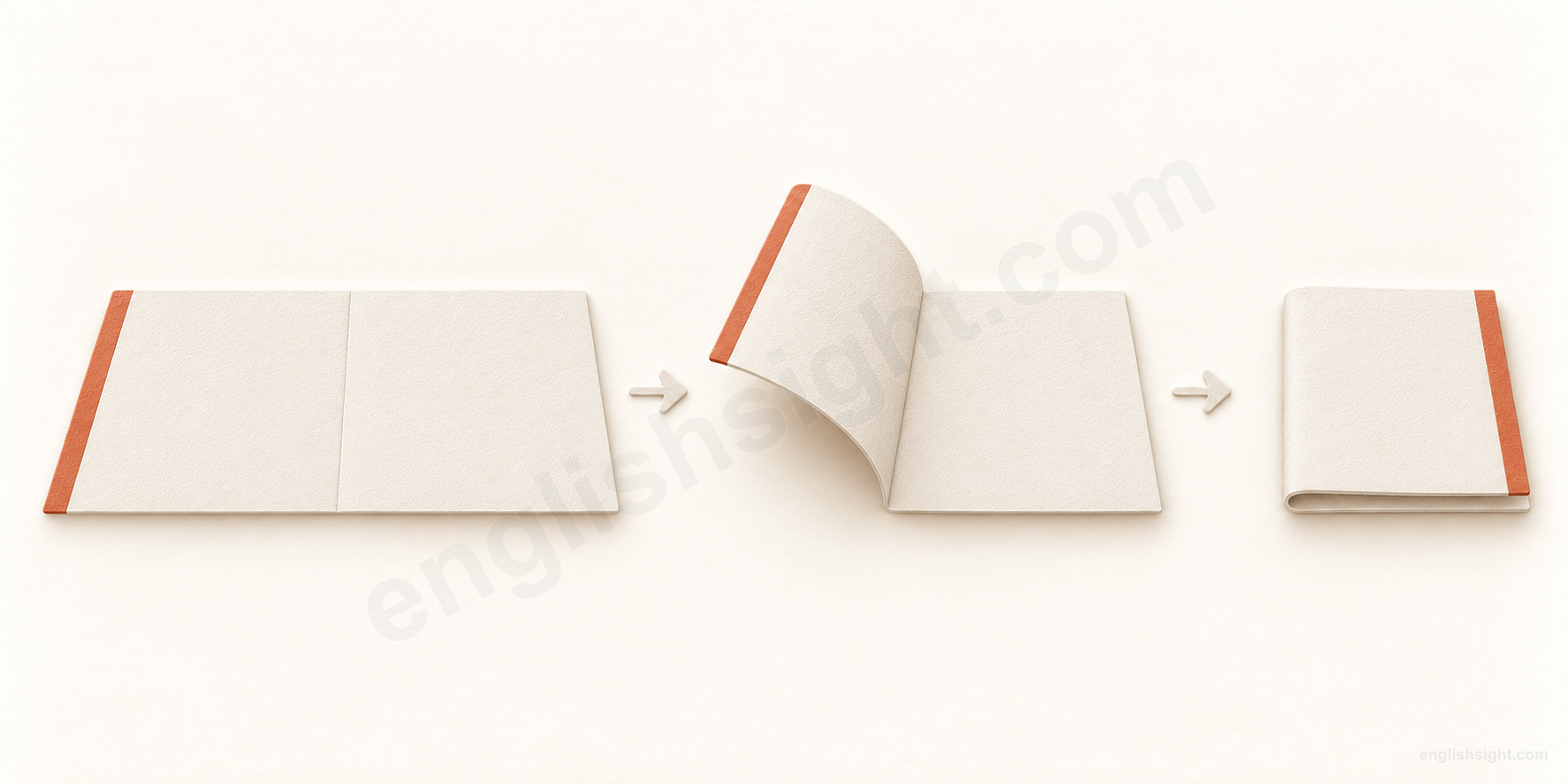
One connected sheet lies open.
fold
The same sheet forms two overlapping layers.
The left half bends over toward the right half.
One half bends over the other without cutting the sheet. The arrangement changes and the footprint becomes smaller.
Bend one part over or toward another part of the same thing, often bringing spread-out parts into a closer arrangement.
This is a teaching model for the physical verb. Fold out can open an arrangement, and the group noun and numerical suffix need separate explanations.
Start with an open sheet. Bend part of it over another part, and you have folded it. The material remains connected while its arrangement changes.
This model helps with cloth, wings, and folding furniture. Cooking, business, card games, and group membership require their own conventions. A picture helps you remember a connection; it cannot predict every use.
01
Change a shape or store something
Start with paper and cloth, then notice how direction words and result descriptions change the instructions.
01
fold + object; fold something in half / in two / into thirds
fold paper / fold in half
bend one part over another
Starting situation
A sheet lies open on the desk.
Result or interpretation
One half lies on top of the other.
One connected sheet changes arrangement without being cut.
To make a card, bring one side of the sheet over the other. Fold names that action; press the edge if you want a sharp crease. Cloth can be folded without acquiring a permanent line.
In half or in two specifies two equal parts. Into thirds specifies three parts; into a narrow strip describes the resulting shape. These phrases add information to fold, rather than create unrelated verb meanings.
In a sentence
Fold the card in half before you draw on the front.
Watch the difference Bend is broader: bending a wire need not put one part over another. Cut in half separates the material.
02
fold + object + back / down / over
fold back / down / over
specify where a part turns
Starting situation
A blanket covers the whole bed.
Result or interpretation
Its top edge is turned back to uncover the pillow.
The added word describes the direction or position of the folded part.
Fold the blanket back turns a portion away and exposes what was covered. Fold the top down turns that portion downward. Fold the edge over places it across another part.
These words specify physical directions. The purpose depends on the object: a ceiling screen can fold down for viewing, while a seat can fold down to make space. Down therefore does not always mean closing something for storage.
In a sentence
Fold the top of the blanket back to uncover the pillow.
Watch the difference Fold back does not mean restore an object to its original state. To open a folded sheet, unfold it.
03
fold something up / fold up something; fold it up; fold (something) away
fold up / fold away
make compact for carrying or storage
Starting situation
The map is spread out.
Result or interpretation
The map fits in a small pocket.
Up emphasizes a compact arrangement; away adds a storage purpose.
Fold up a map or fold a map up focuses on reducing its spread. With a pronoun, say fold it up. Up here does not require upward movement.
A folding bed can fold away, or you can fold it away. It is designed to become compact and be stored out of the way. Folding a map up does not itself say where you put it.
In a sentence
Fold the map up and put it in your pocket.
Watch the difference Say fold it up, not fold up it. Putting something away without changing its shape is not necessarily folding it away.
The person can fold the chair; the chair can also be the grammatical subject.
I fold the chair describes an action on an object. The chair folds describes its behavior or capability. The chair is folded by an attendant is passive; folds by itself is not a passive form.
Flat describes the result: This chair folds flat. Folding chair and fold-up chair describe a design that allows folding. A folded chair is already in the closed arrangement.
In a sentence
These chairs fold flat, so we can store them behind the door.
Watch the difference Folded and folding are different: a folding chair can currently be open. Not every rigid chair can fold.
05
fold out; fold out into + noun; fold-out + noun
fold out / a fold-out bed
open folded sections for use
Starting situation
A sofa has a bed stored inside it.
Result or interpretation
The bed extends into the room.
Out can describe opening into a larger usable arrangement.
In The sofa folds out into a bed, sections open and extend. The object becomes usable in another form. This is why fold does not always mean make smaller.
A fold-out map opens beyond the surrounding page; a fold-out bed opens for sleeping. Write fold out as two words for the verb and fold-out with a hyphen before a noun.
In a sentence
The sofa folds out into a bed for our guests.
Watch the difference Do not assume up and out are interchangeable. A bed may fold out for use and fold up for storage.
02
Bring body parts or a covering together
Arms, hands, wings, and blankets have different arrangements. Learn the objects and the relationship each expression describes.
The expression concerns hands held together, not arms crossed over the chest.
Fold your hands describes bringing them together, often with the fingers linked or one hand resting over the other. In your lap tells us their location.
Hands folded and arms folded name different arrangements. Neither phrase automatically says that someone is praying or upset.
In a sentence
He listened with his hands folded in his lap.
Watch the difference Fold your hands is not an instruction to cross your whole arms over your chest.
08
bird / insect + fold + its wings
fold its wings
draw extended wings close to the body
Starting situation
A bird has its wings spread.
Result or interpretation
The wings rest against its sides.
Jointed body parts move from spread to tucked together.
The bird folds its wings after landing. The wings remain attached and bend at their joints; no flat sheet is required.
This use connects with the compacting model. It tells us about the wing position, not necessarily whether the bird is asleep or unable to fly.
In a sentence
The bird landed on the wall and folded its wings.
Watch the difference Close a door and fold a wing describe different movements. Do not replace every instance of close with fold.
09
fold A in B; fold B around / round / over A
fold a blanket around someone
bring material around a person or object
Starting situation
A child is cold and a blanket lies open.
Result or interpretation
The blanket surrounds the child.
The covering bends around what it encloses.
Fold a blanket around the child names the covering first. Fold the child in a blanket names the person first. Around and in assign different roles to the nouns.
The image connects through material brought together around something. Wrap the child in a blanket is a more neutral everyday alternative; fold in this use can sound descriptive.
In a sentence
She folded a blanket around the sleepy child.
Watch the difference In fold the child in a blanket, the child is enclosed; you are not bending the child like paper.
10
fold + person + in + possessive + arms
fold someone in your arms
hold someone in an embrace
Starting situation
A child runs toward a parent.
Result or interpretation
The parent holds the child close.
The arms surround a person; the person is not being creased.
Fold someone in your arms is a literary or descriptive way to say embrace. The direct object is the person held; in your arms identifies the enclosing hold.
Compare fold your arms: that describes crossing your own arms and need not involve another person. The longer expression is not simply the same posture with an extra noun.
In a sentence
She folded her son in her arms when he came home.
Watch the difference For an ordinary conversational request, Give me a hug is more usual than Fold me in your arms.
03
Mix, combine, stop, or withdraw
These established uses need their own context. The paper model offers a connection for some of them, but cannot supply their full meanings.
11
fold in + ingredient; fold + ingredient + in; fold + ingredient + into + mixture
fold in / fold into a mixture
combine ingredients with gentle turning
Starting situation
Beaten egg whites and batter are separate.
Result or interpretation
They combine with gentle lifting and turning.
Folding is a mixing technique, not vigorous stirring.
In a recipe, fold in the egg whites tells you to lift and turn the mixture gently. This can help preserve air already beaten into an ingredient. You are not making a paper-like crease.
You can fold the egg whites in or fold them in. Fold the egg whites into the batter explicitly names the receiving mixture. Into must come before that mixture.
In a sentence
Gently fold the beaten egg whites into the batter.
Watch the difference Fold them in, not fold in them. Do not replace fold with beat when the recipe requires a gentle technique.
12
fold + thing / unit + into + larger whole; be folded into
fold something into a larger whole
include it as a part of a combined whole
Starting situation
Two reports are separate documents.
Result or interpretation
Their information becomes part of one report.
Separate material is integrated rather than physically bent.
Workplace and news writing use fold something into something for incorporation. We can fold the survey results into the final report or fold a small unit into a larger organization.
The folding connection is a teaching comparison: parts are brought into one arrangement. The actual operation may be editing, combining teams, or restructuring; the context supplies it.
In a sentence
We folded the survey results into the final report.
Watch the difference This is incorporation, not the recipe technique. You cannot infer gentle mixing from fold into when the objects are reports.
13
business / organization + fold; fold + business; fold up
a business folds
stop operating after failure
Starting situation
A magazine is losing money.
Result or interpretation
It stops publishing.
The organization closes; nothing needs to be physically folded.
In informal reporting, a business, club, or show can fold when it cannot continue successfully. The subject names the undertaking, and no object is needed.
The owners folded the business uses fold transitively for ending it, especially in American usage. Fold up can also mean fail or close. Learn these as established extensions, not predictions from a paper diagram.
In a sentence
The small magazine folded after losing its main advertiser.
Watch the difference The café is closed today may describe a day off. The café folded normally means it ceased operating.
14
person / team + fold (under pressure); legs + fold under + person
fold under pressure
give way or stop resisting
Starting situation
A team faces strong opposition.
Result or interpretation
It can no longer keep resisting.
An established figurative use presents resistance as giving way.
A team or person may fold under pressure: they give in or fail to keep going. It does not mean their body literally folds. Under pressure states the circumstances, rather than forming a separable particle verb.
A different physical use appears in Her legs folded under her: her legs buckled and she fell. Someone who folds up with pain or laughter bends or collapses. Keep physical collapse distinct from abandoning resistance.
In a sentence
Our team refused to fold under pressure in the final minutes.
Watch the difference Refused to fold means kept resisting here; it does not refer to putting away sports equipment.
15
player + fold; fold + possessive + hand / cards
fold / fold your hand
withdraw from the current poker hand
Starting situation
A player must decide whether to continue.
Result or interpretation
The player gives up participation in this hand.
In card play, fold names withdrawal, not a bend in a card.
At a poker table, I fold announces that you will not continue competing for this hand. Fold your hand or fold your cards expresses the same decision with an object.
Hand here means the cards held or the round of play, not a body part. The player may play again in the next hand; folding does not necessarily mean leaving the entire game.
In a sentence
I folded when the next player raised the bet.
Watch the difference Do not bend the cards. This conventional game expression describes a decision to withdraw.
04
Lines, layers, groups, and related forms
A fold can be a physical feature or a group. The suffix -fold is a separate grammatical form used with numbers.
16
a fold in + material; along / on the fold
a fold / along the fold
a line or bend made by folding
Starting situation
A sheet has been doubled over and reopened.
Result or interpretation
A line marks where it bent.
The countable noun can name the trace of the action.
A fold can be the line where material bends, or a line indicating where it should bend. Along the fold follows that line; on the fold locates something at it.
A crease especially names a distinct pressed or wrinkled line. Fold is broader and can also refer to the doubled part itself. An accidental wrinkle and a planned fold are not always interchangeable descriptions.
In a sentence
Cut along the fold after you open the paper.
Watch the difference Fold is countable here: a fold, two folds. Do not confuse the action fold the paper with the line in the paper.
17
folds of + material / skin; in a fold of / in the folds of
folds of cloth / skin
bent, hanging, or doubled parts
Starting situation
A curtain hangs loosely.
Result or interpretation
Its material forms soft curved layers.
Folds can be rounded shapes, without a sharply pressed line.
The folds of a curtain are the hanging portions where the cloth bends and gathers. Something hidden in a fold lies between or within those portions.
Folds of skin similarly describes doubled or overlapping skin. It does not mean somebody deliberately performed a folding action. The noun often appears in the plural for repeated features.
In a sentence
The kitten hid in the folds of the curtain.
Watch the difference Do not picture every fold as a sharp crease. Soft fabric can hang in folds without being pressed.
18
a fold / sheepfold; sheep + in the fold
a sheepfold / a fold
an enclosure for keeping sheep
Starting situation
The sheep are outside a fenced pen.
Result or interpretation
They are gathered in the enclosure.
This noun names a place, not a bend in the animals.
A fold is a fenced or walled enclosure used for sheep. Sheepfold makes that meaning explicit. You are more likely to meet fold alone in farming or descriptive writing than in general household conversation.
This is a separate noun family from fold meaning bend. Dictionaries also record fold for the flock itself; context distinguishes the animals from their enclosure. The group expression the fold belongs with this family, not with folding paper.
In a sentence
The shepherd led the sheep into the fold before nightfall.
Watch the difference A fold can contain sheep; it is not a folded piece of sheep. Use a pen if that is clearer in everyday conversation.
19
return to the fold; come back into the fold; welcome + person + into the fold
return to / welcome into the fold
belong to a group with shared connections
Starting situation
A former member is outside a group.
Result or interpretation
The group accepts the person again.
The fold presents the group as a community of belonging.
Return to the fold, come back into the fold, and welcome someone into the fold concern membership or renewed acceptance. The group may be a family, party, religious community, or organization.
The ordinary pattern uses the fold, sometimes expanded to the family fold. It is connected with the enclosure/group noun, not with literally bending people into a compact shape.
In a sentence
After a year away, Leo was welcomed back into the fold.
Watch the difference Fold here does not name a paper crease. The context must tell us which group is involved.
20
above / below the fold; above-the-fold / below-the-fold + noun
above / below the fold
visible first or farther down a page
Starting situation
A reader opens a page.
Result or interpretation
Some content is visible immediately; the rest requires opening or scrolling.
The fold is a conventional boundary for initial visibility.
For a newspaper, above the fold refers to the upper part visible when the paper is folded. On a web page, it refers to the area initially visible before scrolling; below the fold is farther down.
The web boundary depends on the screen and layout, so it is not a universal pixel height. Before a noun, use hyphens: an above-the-fold image.
In a sentence
Keep the main heading above the fold on the mobile page.
Watch the difference A web page need not contain a physical crease. This is an established publishing and design expression.
21
number + -fold; grow threefold; a twofold aim
twofold / threefold / tenfold
express a multiple or a number of parts
Starting situation
A quantity is 10 and later becomes 30.
Result or interpretation
The new quantity is three times the original.
The bound suffix -fold attaches to a number; it is not the standalone verb.
The total grew threefold means it became three times as large: from 10 to 30, for example. A threefold increase uses the same multiplier in an adjective before a noun.
A twofold aim has two parts, rather than being twice the size of an earlier aim. This second suffix use counts aspects. The grammar and context distinguish multiplication from a number of parts.
In a sentence
The purpose is twofold: save time and reduce waste.
Watch the difference Threefold growth from 10 gives a total of 30, not 40. Write threefold as one word, not three fold.
Keep the object and construction in view
Forms and grammar
Forms are fold, folds, folded, folding. Physical actions can be progressive or passive: She is folding the sheets; the sheets were folded. You can have the sheets folded by someone, but fold does not itself mean arrange for another person to act.
Fold, bend, roll, and unfold
Bend describes changing an angle or curve. Fold typically brings parts over or toward each other. Roll forms something into a cylinder or coil. Unfold opens what was folded. The right choice depends on the movement, not merely on the final size.
Particles, prepositions, and fixed uses
Fold it up and fold them in place a pronoun before the particle. Fold it into the mixture keeps into before its following noun phrase. In half gives a division; under pressure gives a circumstance. Not every word after fold creates a new phrasal verb.
The picture has limits
Closing a business, withdrawing from a hand, and entering the fold are established uses. The enclosure/group noun has a different history from the bending verb. The sheet sketch is a limited teaching aid, not a universal mental image or an account of every meaning.
Choose the meaning and the form
Use the object, the context, and the whole construction.
1. You want the map to fit in a pocket. Which instruction has the correct pronoun position?
2. A recipe says to fold the egg whites into the batter. What should you do?
3. A chair is open for use but can be made compact. Which description tells us about its design?
4. The newspaper folded after losing its funding. What does this normally mean?
5. A former member was welcomed back into the fold. What changed?
6. An amount of 10 grows threefold. What is the new total?
Sources and teaching notes
Dictionary entries support the uses and constructions below. The explanations, examples, and limited visual model were created for this lesson.
The diagram illustrates one physical relationship; individual speakers need not picture the word in the same way.