Use food for what is eaten, foods for kinds, and familiar compounds for more specific ideas.
What is eaten, and by whom?
Things eaten as nourishment
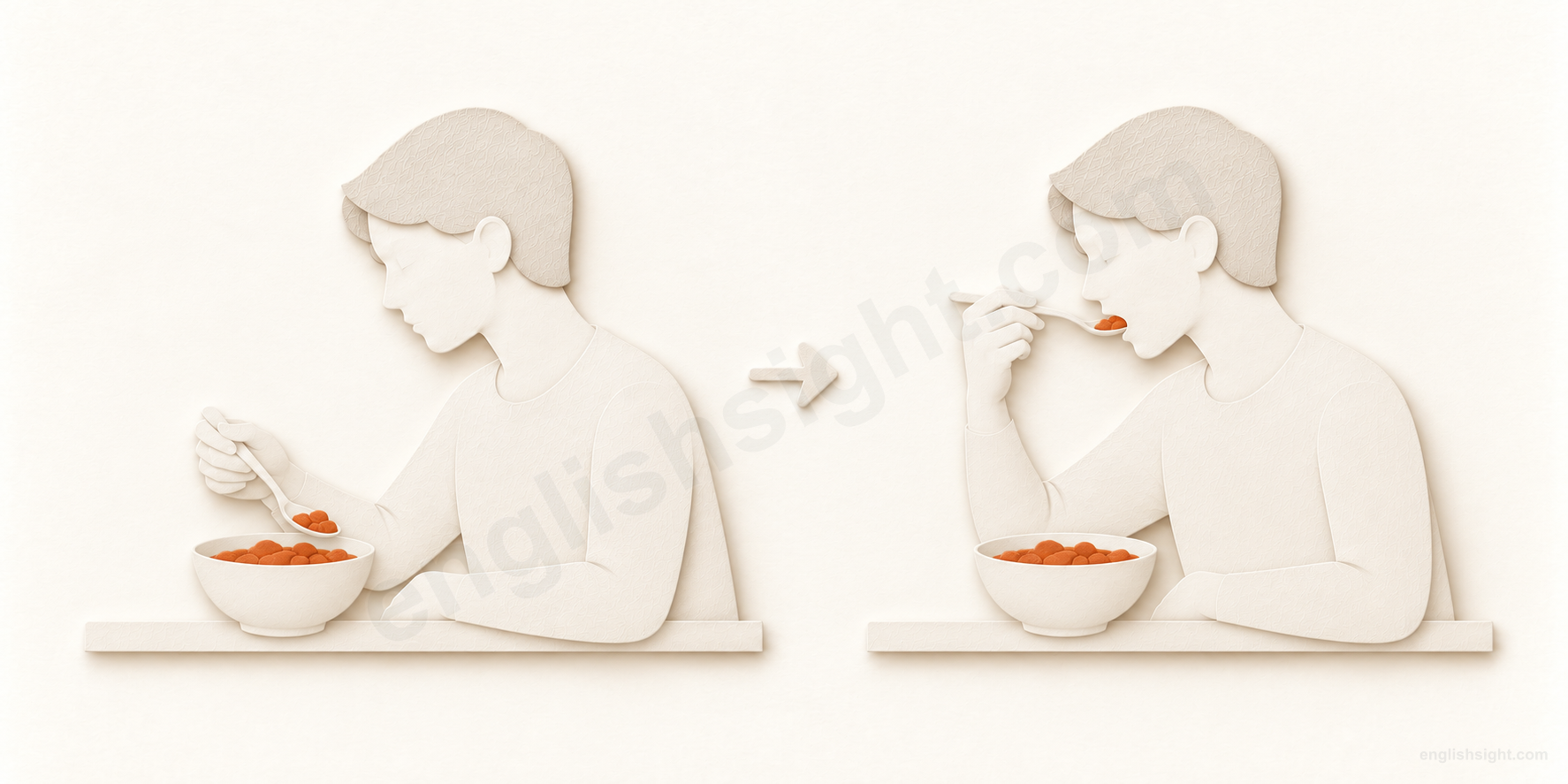
A spoonful of food is held just above the bowl.
food
The food reaches the mouth as the person begins eating.
The same person lifts the spoonful from the bowl to the mouth.
Food is what is eaten as nourishment; this scene shows one example.
Food is what people or animals eat to sustain life; it can be discussed as a supply or as particular kinds.
The eating scene illustrates the physical sense. Food names what is eaten, not the act of feeding. Mental nourishment is a figurative extension, while compounds and idioms add meanings that the picture alone cannot predict.
Food connects an eater with things taken in as nourishment. In daily conversation it can mean the food on a plate, a supply to share, or a kind that someone likes. Grammar tells you which view is intended.
This lesson covers the modern noun and useful constructions, compounds, and idioms. The diagram is a teaching model; it does not claim that every English speaker imagines the same picture.
01
Amounts, kinds, and eating
Start with food as nourishment, then choose between an amount, a type, a meal, and a dish.
01
food + singular verb; some / any / enough food; the food + identifying detail
food / the food
things eaten as nourishment
Situation
You need something to eat.
What you express
You refer to the supply or the food available.
Food names what is eaten, rather than the act of eating.
Food is a noun, pronounced /fuːd/, with the vowel in moon. It usually treats things to eat as a mass: Food is ready, We need some food, or Is there enough food? Use singular agreement with this mass meaning.
No article is needed for food in general: Food costs money. The food identifies particular food already understood, as in The food at this café is excellent. Your food can mean the food on your plate, not a special kind belonging only to you.
The nourishment model connects people and animals with what they eat. It does not guarantee that everything called food is safe, nutritious, cooked, or part of a full meal.
Example
The food in this little café is excellent.
Watch the difference For an ordinary quantity, say some food, not a food or several foods. Countable food has a different focus: a kind of food.
02
a portion / plate / piece of food; much / little food
a portion of food
measure an amount to eat
Situation
You want a serving, not a new category.
What you express
You specify a quantity or container.
Count the portion or plate when the focus is quantity.
A little food, a lot of food, and too much food refer to amounts. A portion of food or two plates of food makes the unit countable while food remains a mass noun.
A piece of food is an individual bit, not necessarily a full serving. There is some food left describes remaining food; it does not mean one whole meal is left.
Example
There is enough food for six people, but only five plates.
Watch the difference Use How much food? for an amount; How many foods? asks about kinds, not how many people can eat.
03
a + describing word + food; different / various foods; types of food
a food / different foods
identify a kind or several kinds
Situation
You compare categories of things to eat.
What you express
You name a particular type or a range.
Foods counts kinds, not individual mouthfuls.
The countable use classifies something: Rice is a staple food means it is a basic food eaten regularly. Different foods and foods rich in protein describe different types, not simply a large quantity.
What is your favourite food? normally asks which kind you like best. My favourite food is pasta is natural. A food can therefore be correct when its category is the point, even though I bought a food is an odd way to report buying lunch.
Example
The stall sells several foods that I have never tried.
Watch the difference Foods is a real plural, but do not add -s whenever you see many items on a plate.
04
country / region adjective + food; a meal; a dish; someone’s diet
Italian food / a meal / a dish
distinguish a style of food from a meal or prepared dish
Situation
You describe what you like or what a restaurant serves.
What you express
You choose the noun that fits your focus.
Food is the broad material or category; meal and dish organize it differently.
Italian food and local food describe a culinary tradition or source. They usually remain uncountable: I like Italian food. Italian foods can emphasize distinct products or kinds instead.
A meal is an eating occasion or the food eaten on it: We had a meal at noon. A dish is food prepared in a particular way: We shared two rice dishes. A meal can contain several dishes.
Your diet is what you habitually eat and drink, and does not necessarily mean a plan to lose weight. These words overlap in context, but they are not interchangeable counting units.
Example
We ordered two local dishes for our evening meal.
Watch the difference Two dishes need not mean two meals; some local food does not specify a number of either.
05
baby / dog / cat + food; food for + eater; for food
baby food / dog food / food for birds
identify who or what the food is intended for
Situation
You choose food for a particular eater.
What you express
The modifier or for-phrase identifies the eater.
The intended eater need not be an adult human.
Baby food is prepared for babies; dog food and cat food are for those animals. The first noun describes the intended consumer, not an ingredient. Dog food does not mean food made from dogs.
Food for the birds names the recipients in a for-phrase. For food in raise animals for food instead expresses purpose: the animals are raised to be eaten.
Plant food is also an established gardening label for material supplied to plants. Learn that label in context; it does not mean human food made from plants. This course does not use it as a scientific account of plant nutrition.
Example
We left some food for the birds beside the tree.
Watch the difference Read the relationship, not just the word order: baby food is for babies; food for babies can express the same purpose.
06
food and drink / drinks; food and water
food and drink
mention things to eat separately from beverages
Situation
You plan refreshments for an event.
What you express
You distinguish eating supplies from drinks.
The boundary depends on the context, not a strict solid-versus-liquid test.
In everyday food and drink, food usually means the things to eat and drink covers beverages. Food and water similarly lists two needs separately.
The broader nourishment sense can include substances taken into the body in liquid form. Soup can be food; being liquid does not automatically prevent that. Food and drinks is also possible when drinks means separate servings or kinds.
Example
The ticket includes food and drink.
Watch the difference Do not infer that food can never include a liquid merely because food and drink contrasts the two.
07
prepare / cook / serve / eat / have + food; food is ready
prepare / cook / serve food
describe different jobs around eating
Situation
Ingredients or prepared food are available.
What you express
Someone gets it ready, heats it, or offers it.
The verb supplies the action; food remains the thing involved.
Prepare food means get it ready; this can include washing or cutting without cooking. Cook food involves preparing it with heat. Serve food means provide it for someone to eat.
Food is ready announces that people can eat. Enjoy your food and Enjoy your meal are both possible, with meal focusing on the eating occasion. Have some food can be an invitation to eat, not just a statement about ownership.
Example
We prepared the food at home and served it at the picnic.
Watch the difference Cooking is one way of preparing food; the words do not mean exactly the same action. Food itself is not the ordinary verb for feeding someone.
02
Describing and choosing food
Modifiers may describe preparation, service, emotional value, or an established food category. They do different jobs.
08
fresh / frozen / raw / cooked / processed + food
fresh / frozen / processed food
describe the condition or treatment of food
Situation
You compare products in a shop.
What you express
An adjective identifies how the food is kept or prepared.
The modifier narrows food without creating a new meaning of the noun.
Fresh food, frozen food, raw food, cooked food, and processed food describe different conditions or treatments. These labels answer different questions: frozen concerns storage, while raw contrasts with cooked.
Food can be both frozen and cooked. Processed food has undergone preparation or industrial treatment; the phrase alone does not tell you exactly what was done. Learn the modifier rather than treating all these expressions as idioms.
Example
This shop sells both fresh food and frozen foods.
Watch the difference The -s in frozen foods highlights products or kinds; frozen food can describe the category as a whole.
09
healthy / nutritious food; health food; a health food shop
healthy food / health food
distinguish a description from an established product category
Situation
You describe food or look for a kind of shop.
What you express
You select healthy or the compound health food.
Healthy evaluates food; health food names a familiar category.
Healthy food describes food considered good for health. Nutritious food emphasizes nourishment, while fatty foods or low-fat food describe composition. These phrases retain the ordinary food meaning.
Health food is an established term for food considered beneficial, often associated with natural ingredients and the absence of artificial substances. A health food shop sells that category. Healthy food is broader and need not come from a specialist shop.
Example
The health food shop sells oats, nuts, and dried fruit.
Watch the difference A health food label expresses a category or reputation, not proof of any particular health benefit.
10
some fast food; a fast-food restaurant / chain
fast food
food prepared and served quickly by an outlet
Situation
You need something to eat during a short break.
What you express
You choose a quick-service outlet.
Fast describes the service category, not how quickly you chew.
Fast food commonly includes things such as burgers and chips served quickly, often to take away. It names an established kind of food service, not every dish that happens to take little time to make.
Fast food is normally uncountable: We bought some fast food. In a fast-food restaurant, the compound modifies restaurant. A fast-food chain is a group of outlets, not the ecological food chain.
Example
We stopped for fast food before catching the coach.
Watch the difference Fast food, convenience food, and junk food can overlap, but each highlights something different.
11
convenience food; convenience foods
convenience food
food sold ready or partly ready for easy preparation
Situation
You have little time to prepare dinner.
What you express
You use a product that saves preparation.
Convenience concerns the work saved before eating.
Convenience food is sold in a form that makes preparation quick and easy, for example frozen ready meals or prepared food in cans. Convenience foods can refer to different products.
The focus is saving work, often at home. Fast food focuses on quick service from an outlet. A convenience store is a kind of shop; food bought there is not automatically convenience food.
Example
On busy evenings, we sometimes rely on convenience food.
Watch the difference This category does not by itself tell you whether a product is nutritious or poor in nutrients.
12
eat / cut down on + junk food
junk food
food spoken of disapprovingly as unhealthy
Situation
Someone criticizes a pattern of eating.
What you express
They use an informal negative label.
Junk adds an evaluation, not a literal instruction to throw it away.
Junk food is an informal, disapproving expression for food considered bad for health, often quick, easy food or snacks. The expression evaluates what is eaten rather than identifying an exact scientific category.
It is normally uncountable, though junk foods can distinguish kinds. Fast food describes quick service; junk food adds criticism. Do not assume the two phrases are exact synonyms in every discussion.
Example
He calls those snacks junk food, but she disagrees.
Watch the difference Because it is disapproving, the label can sound critical of someone else’s choices.
13
some comfort food; a comfort food; someone’s comfort food
comfort food
food that gives emotional comfort
Situation
You want something familiar after a difficult day.
What you express
A favourite food makes you feel better.
Comfort is emotional, not necessarily a nutritional judgment.
Comfort food is food that feels reassuring or makes someone feel better, often because of familiar flavours or memories of home. The choice varies from person to person.
It can be uncountable, as in I need some comfort food, or countable for a particular kind: This soup is a comfort food for me. It need not be identical to what another person finds comforting.
Example
My grandmother’s noodle soup is my comfort food.
Watch the difference The phrase does not mean food that treats an illness or is comfortable to sit on.
14
serve / offer finger food; finger foods
finger food
food in pieces easily eaten with the fingers
Situation
You plan a gathering where people will stand.
What you express
You choose food that needs no knife and fork.
Finger identifies the way of eating, not an ingredient.
Finger food consists of pieces that people can easily pick up and eat with their fingers. Small sandwiches are one possible example; the term does not specify one recipe.
We served finger food treats it as a category. Finger foods can identify different types. This is an established compound, not a phrasal verb or a description of food shaped like fingers.
Example
We served finger food so guests could eat while standing.
Watch the difference Food eaten with the fingers need not be fast food, street food, or junk food.
15
try / buy / sell street food; local street foods
street food
prepared food sold for immediate eating in a public place
Situation
You visit a market or street stall.
What you express
You buy something ready to eat there.
Street identifies a selling setting and style.
Street food is prepared or cooked food sold in a street or another public place for eating straight away. It may include many different local dishes.
The term is usually a broad category; street foods highlights varieties. Food you bring from home and eat outside is not automatically street food: where and how it is sold matters.
Example
We tried the street food at the evening market.
Watch the difference The name does not say that the food is unsafe or that it has been dropped on the street.
03
Food in society and nature
Noun groups connect food with prices, support, safety, and linked systems. Some have distinct literal and figurative meanings.
You discuss buying, producing, or distributing food.
What you express
Food specifies what another noun concerns.
In these noun groups, the second noun is the main one.
Food prices are prices for food; the food industry produces or sells it. Food safety concerns whether food is safe to eat. Food supplies are stocks available for use, while a food shortage means not enough is available.
Food normally stays singular before another noun: food prices, not foods prices. Compare Food is expensive with Food prices are rising: agreement follows food in the first sentence and prices in the second.
Food waste can refer to food discarded or the wasting of it. This is the same productive pattern, not a separate action meaning of food.
Example
Food prices rose, so the school changed its menu.
Watch the difference Do not use the plural of the first noun simply because the whole noun group is plural.
17
donate food to / volunteer at + a food bank
a food bank
an organization or place supplying free food to people in need
Situation
People need help obtaining enough to eat.
What you express
Food is collected, stored, and distributed.
Bank refers to organized provision, not an ordinary money account.
A food bank helps supply food to people in need. In British use it commonly means a place people visit for free food. In American use it can mean a larger organization distributing supplies through local food pantries.
The compound is countable: a food bank, two food banks. The exact arrangement varies, so do not assume that every food bank hands food directly to visitors.
Example
Our class collected tins of beans for a food bank.
Watch the difference A food bank is not a restaurant, and the compound does not normally mean a bank lending money for food.
18
have / get food poisoning; a case of food poisoning
food poisoning
illness caused by eating contaminated food
Situation
You discuss an illness linked to something eaten.
What you express
You name the illness rather than the food’s taste.
The whole compound names an illness, not deliberate poisoning by a person.
Food poisoning refers to illness from contaminated food, such as food containing harmful bacteria. It is normally uncountable: have food poisoning or a case of food poisoning.
Food safety names the issue of keeping food safe, whereas food poisoning names an illness. Neither phrase simply means food that tastes unpleasant.
Example
The report said that several guests had food poisoning.
Watch the difference Use a case of food poisoning rather than a food poisoning when counting cases. The phrase alone does not establish the cause of someone’s symptoms.
19
in / at the top of + the food chain; through the food chain
the food chain
feeding relationships or the route from production to eating
Situation
You trace where nourishment or food products come from.
What you express
You describe a linked series.
Context determines whether the chain is ecological or a supply process.
In ecology, a food chain connects organisms through who eats what. A small fish eaten by a larger fish is one link. At the top of the food chain describes a high feeding position in the chain being discussed.
Food chain also describes the stages from producing food through selling and eating it. Tracking vegetables through the food chain concerns supply and handling, not vegetables eating one another. These are distinct uses of the compound.
Example
The team traced the vegetables through the food chain from farm to shop.
Watch the difference A fast-food chain means a network of outlets. It is a different grouping from either sense of food chain here.
20
at the top / bottom of the food chain
at the bottom of the food chain
have little power or importance in a hierarchy
Situation
You compare people’s positions in an organization.
What you express
You informally describe a ranking.
The feeding hierarchy supplies a metaphor for unequal power.
Informally, the food chain can mean a system of people or organizations ranked by importance or success. At the bottom suggests little influence; at the top suggests greater influence.
This is an established figurative use. It does not claim that colleagues literally eat one another, and its competitive tone may not suit a neutral description of a team.
Example
As a new assistant, I was near the bottom of the office food chain.
Watch the difference Read the context: in a wildlife article the same phrase may refer to actual feeding relationships.
04
Appetite and mental nourishment
Two familiar expressions keep useful connections with eating, but their full meanings must be learned as expressions.
21
give someone / provide / offer + food for thought
food for thought
something that prompts careful thinking
Situation
New information challenges a plan.
What you express
You have something worth considering.
Ideas nourish thought in this established metaphor.
Food for thought means material that makes someone consider something seriously. A suggestion, question, or report can give someone food for thought. It need not be pleasant or provide a final answer.
Food keeps its mass-noun pattern: some food for thought, plenty of food for thought. For thought names what is being stimulated, unlike food for birds, where birds names literal eaters. The metaphor is useful, but it does not make every new food for… combination an idiom.
Example
Your question has given me plenty of food for thought.
Watch the difference Say food for thought, without a or a plural thoughts in the fixed expression.
22
be + off + my / your / his / her / its / our / their + food
be off your food
have little or no desire to eat
Situation
Someone is eating less because they lack appetite.
What you express
You describe the loss of appetite.
Off marks an established appetite expression, not physical distance from food.
Be off your food means not feel like eating, often because you are unwell. Change the possessive to match the subject: I’m off my food; she’s off her food; the dog is off its food.
A neutral alternative is She has lost her appetite. Be out of food instead means have no food left: the problem is the supply, not the desire to eat.
In British English, The food has gone off means it has spoiled, while I’ve gone off that food can mean I no longer like it. Compare the subjects and complements: food goes off, a person goes off a particular food, and a person is off their food. These expressions do not have the same meaning.
Example
He has been off his food since Monday.
Watch the difference Off his food describes appetite, not a shortage of supplies or necessarily a deliberate diet.
Keep the noun and the whole expression in view
Food is not always plural
Food is usually a mass noun; foods is useful for kinds. A food is possible in classification. For ordinary servings, count meals, dishes, portions, or items rather than automatically counting foods.
Noun, not a general feeding verb
Modern everyday English normally uses eat for taking food in and feed for giving it to someone. Food before another noun is commonly analyzed as an attributive noun; some dictionaries label this function adjective. Neither analysis makes food prices a new action sense. Verb tense, passive, causative, and separable-particle patterns do not apply to the noun itself.
Compounds do not form a nutritional scale
Fast food concerns service, convenience food concerns preparation, comfort food concerns emotional value, and junk food expresses disapproval. One product may fit more than one description.
Scope and the picture
The diagram shows literal eating. It does not predict all compounds, prove a food is beneficial, or explain every literary use of mental nourishment. Further specialized compounds and detailed scientific classifications are outside this introductory lesson.
Choose the expression that fits
Check whether you mean an amount, a kind, a serving, or an established expression.
1. You want to know whether there is enough for ten guests. Which question fits?
2. You mean several different kinds, not several spoonfuls. Which sentence says that?
3. Two prepared rice dishes are shared as part of one dinner. Which description fits?
4. A colleague’s question makes you reconsider your plan. What can you say?
5. A British speaker says the dog is off its food. What is the usual meaning?
6. You mean a product sold partly prepared to save cooking work at home. Which term is most specific?
Sources and teaching notes
Usage was checked against the dictionary entries below. Explanations and examples are original; the diagram is a teaching interpretation of literal nourishment.
The diagram helps explain a connection; it is not a picture shared by every native speaker.