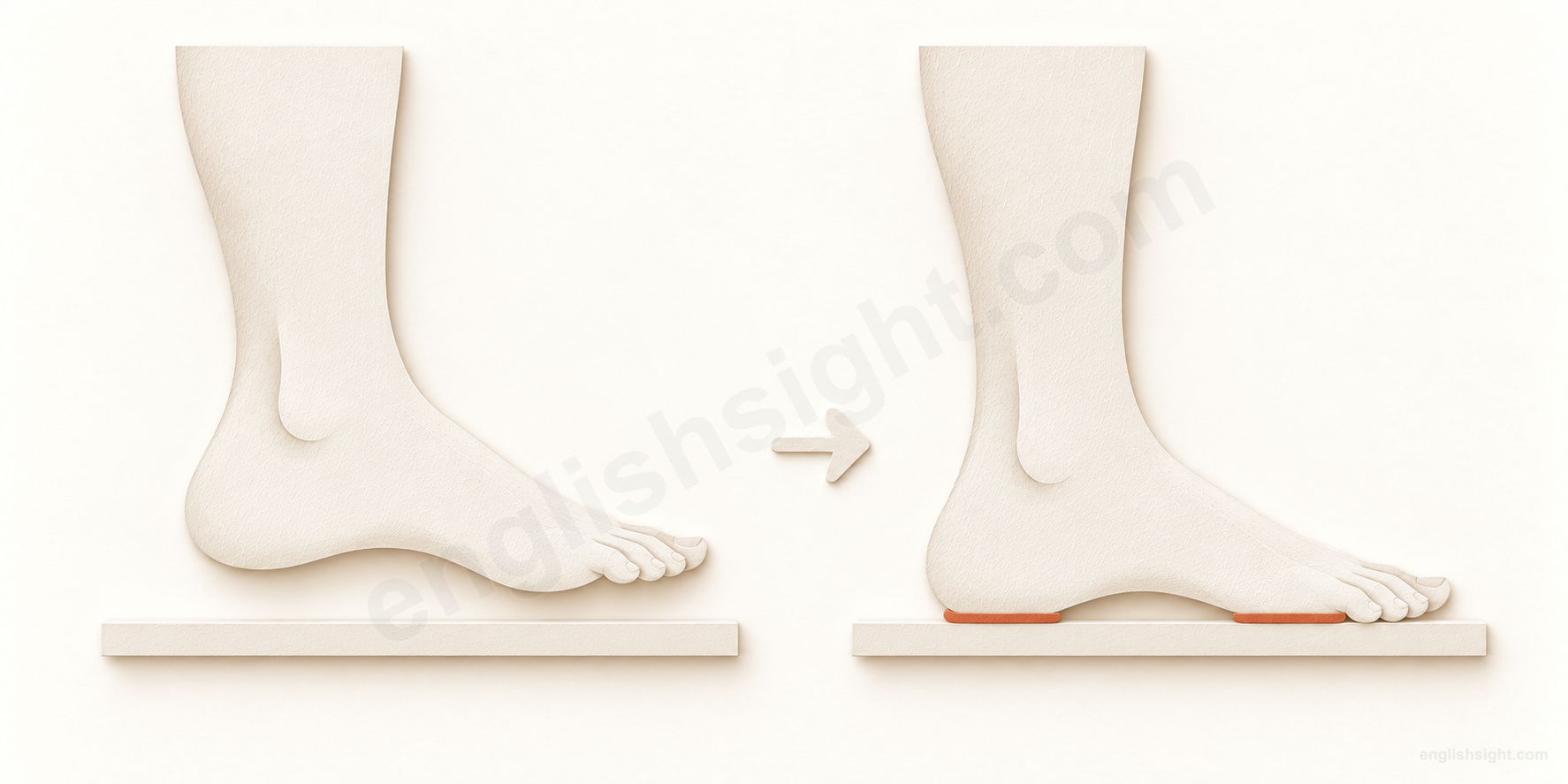
From the part below the ankle to lower ends, measurements, and expressions about daily life.
A supporting part below the ankle
The end of the leg, in contact with the ground
The foot is held just above the ground.
foot
The foot now helps support the body through contact with the ground.
The foot lowers until the heel and forefoot meet the ground.
Below the ankle, the foot meets the ground to support the body.
The leg ends in a foot. Its heel, sole, and toes help support the body against the ground and take part in movement.
Lower ends and standing provide useful connections. The unit of length and fixed idioms have their own conventions; they cannot all be worked out from this picture.
A foot is the end part of a leg that meets the ground to support the body and help it move. This concrete relationship helps you understand walking and standing, and offers a useful comparison for some lower parts and ideas of stability.
English also uses foot as a fixed unit of length and in established expressions. Learn each whole pattern: a body diagram cannot predict that foot the bill means pay. The connections here are teaching aids, not a claim about a picture shared by all English speakers.
01
The body, lower ends, and measurement
Begin with a foot below the ankle. Then distinguish related object parts, uses before another noun, and the fixed unit of length.
01
a / one + foot; two / both + feet; my / your / their + foot or feet
one foot, two feet
the body part below the ankle
Situation
A pebble gets inside your shoe.
What the expression conveys
You point to the part of your body that hurts.
The foot is the lower end of the leg that supports the body against the ground.
Foot /fʊt/ is countable; its body-part plural is feet /fiːt/. A toe is one small part at the front of a foot, and the ankle joins the foot to the leg. Say My left foot hurts or Both my feet hurt.
Bare feet have no shoes or socks on them; in your stocking feet means wearing socks or stockings without shoes. The foot of a sock is the portion that covers this body part. In wipe your feet, ordinary context can make feet refer to the shoes you are wearing.
From head to foot, also from head to toe, covers the whole body: We were muddy from head to foot. The fixed phrase keeps singular foot. Adjectives such as left-footed describe the foot used; they are not past-tense verbs in a left-footed kick.
In a sentence
I took off my shoe because my right foot hurt.
Watch the difference Use two feet for body parts, never two foot or two foots. Foot and leg are not interchangeable.
02
foot + equipment noun
a foot pump / a foot brake
equipment worked with the foot
Situation
Your hands hold the object being inflated.
What the expression conveys
You press a pump with your foot.
Before a noun, foot can identify the body part that operates a device.
A foot pump is pressed with a foot; a foot brake is a brake controlled with a foot. The following noun names the device. Foot explains how it is operated, rather than naming a measurement.
Collins labels this use an adjective; it can also be described as foot used before another noun. Either description should help you read the combination. A foot injury instead concerns the foot itself, so the relationship depends on the following noun.
In a sentence
Use the foot pump to inflate the mattress.
Watch the difference Foot does not have the same relationship to every following noun: a foot injury is not an injury operated by a foot.
03
foot + traffic / patrol / passenger
foot traffic / a foot passenger
people moving without vehicles, or a ferry traveler without a vehicle
Situation
A shop measures how many people walk past.
What the expression conveys
Its owner describes the flow of pedestrians.
Foot can mark walking as opposed to vehicle use.
Foot traffic commonly means pedestrians moving through an area, including potential customers passing a shop. In a description of flooring, it can also mean the wear caused by people walking over the surface. Foot patrol similarly indicates patrol on foot.
A foot passenger, especially on a ferry, travels without taking a vehicle aboard. The passenger still travels on the boat; the expression does not mean walking across the water. The noun determines which practical contrast matters.
In a sentence
The new entrance brings more foot traffic past the bakery.
Watch the difference A foot passenger can sit during the crossing. The expression concerns traveling without a vehicle, not standing throughout.
04
at / near + the foot of + thing
at the foot of the hill
at the bottom or base of something
Situation
A path begins where the hillside meets level ground.
What the expression conveys
You identify the path’s starting point.
A body’s lower supporting part provides a useful comparison for a lower location.
The foot of a hill, a mountain, or the stairs is its lower part. At the foot of a page means at the bottom of the page. A foot on a piece of furniture can be a supporting part at the end of a leg.
This extension concerns position or support, not a human body part hidden in the object. In British sports reporting, a team at the foot of the table is last in the league standings: table means the ranked list there.
In a sentence
There is a small car park at the foot of the hill.
Watch the difference Use the foot of the hill for its base. A hill does not have toes, and foot cannot replace bottom in every expression.
05
at / on + the foot of the bed; the head of the bed
the foot of the bed
the end where a person’s feet normally lie
Situation
You need to leave a blanket away from the pillows.
What the expression conveys
You choose the opposite end of the bed.
Here foot contrasts with head rather than meaning underneath.
The foot of a bed is the end opposite the pillows, where the sleeper’s feet normally are. The blanket can be on top of the mattress at that end. It does not need to be below the bed or on the floor.
The foot of a table can likewise mean the end opposite its head; the feet of a table can mean the supports at the bottoms of its legs. Singular end and plural supports describe different parts, so use context.
In a sentence
Please leave the folded blanket at the foot of the bed.
Watch the difference At the foot of the bed does not mean under the bed. Keep the end and the supporting legs distinct.
06
number + feet; a + number-foot + noun; number + square feet
six feet tall / a six-foot wall
a standard length unit and its form before a noun
Situation
You need to report a wall’s height.
What the expression conveys
You give a measurement rather than count body parts.
The modern unit has a fixed size, independent of anyone’s actual foot.
One foot equals twelve inches, or 30.48 centimetres; the abbreviation is ft. Use feet as the ordinary plural in measurements: The wall is six feet high. Square feet measure area, so a room of 120 square feet describes floor area, not a length of 120 feet.
Before a noun, a number-and-unit modifier uses foot: a six-foot wall, not a six-feet wall. Compare a wall six feet high. A spoken height such as five foot nine means five feet and nine inches; foot after a number is also accepted in some other measurement expressions.
For a clear beginner default, use feet after a number when giving a length and foot inside a modifier before a noun. The body-part plural still has to be feet. The measurement branch is conventional; the sketch is not a measuring device.
In a sentence
The wall is six feet high, so we need a ladder for this six-foot wall.
Watch the difference Write a six-foot wall, not a six-feet wall. Do not measure a modern foot by the length of your own foot.
02
Walking, standing, resting, and entering
The whole phrase tells you whether someone travels, stands, rises, rests, gets in the way, or enters a place.
07
go / come / travel / explore + on foot
on foot
by walking rather than using a vehicle
Situation
The station is nearby and you leave the car at home.
What the expression conveys
You walk to the station.
On foot identifies a way of traveling.
Go, come, travel, and explore can all be followed by on foot. The normal everyday contrast is with traveling by bus, by car, or by bike. Foot is singular with no possessive or article in this fixed expression.
Compare on my feet, which describes standing or being active on your feet. I came on foot answers How did you travel? I was on my feet answers What position or activity were you in?
In a sentence
We went to the station on foot because it was only ten minutes away.
Watch the difference Use on foot, not by foot or on feet, as the standard travel expression.
08
be + on + my / your / her / their + feet
be on your feet
be standing or moving around on foot
Situation
Your shift involves serving customers without sitting down.
What the expression conveys
You describe the physical demand of the day.
The possessive belongs to the person who is standing.
Be on your feet can describe standing at a particular moment or spending a long period standing and walking around. I have been on my feet all morning emphasizes time without a proper sit-down.
Match the possessive to the subject: She is on her feet; they are on their feet. Compare be back on your feet after trouble, which has a recovery meaning. The physical and figurative readings need context.
In a sentence
By lunchtime I had been on my feet for five hours.
Watch the difference On foot describes travel; on your feet normally describes standing or activity, and sometimes recovery.
09
get / rise / jump / struggle + to + possessive + feet
get / rise to your feet
move into a standing position
Situation
The audience is sitting when the musician returns.
What the expression conveys
People stand to applaud.
To marks the position reached, while on names an existing position.
Get to your feet means stand up. Rise to your feet is a somewhat more formal alternative, often used for an audience. Jump or spring to your feet adds speed; struggle to your feet adds difficulty.
Contrast She was on her feet, a state, with She got to her feet, a change. The verb carries the manner of rising. Feet remains a noun inside a prepositional phrase, not a verb meaning stand.
In a sentence
The audience rose to their feet when the violinist returned.
Watch the difference Get to your feet means stand up; get on your feet can instead refer to recovery, depending on context.
10
put + possessive + feet + up; take the weight off + possessive + feet
put your feet up
sit or lie down and relax
Situation
You finish carrying boxes all afternoon.
What the expression conveys
You sit down for a break.
Taking weight off your feet provides the physical link to resting.
Put your feet up offers or describes a rest, especially sitting with your feet raised and supported. In conversation, Have a cup of tea and put your feet up invites relaxation rather than prescribing an exact pose.
Take the weight off your feet also means sit down and rest. Compare get to your feet, which moves in the opposite practical direction: from sitting to standing. Keep the possessive: put your feet up, put her feet up.
In a sentence
You have carried enough boxes; put your feet up for a while.
Watch the difference Put your feet up invites a rest; get to your feet asks for or describes standing up instead.
11
be / get + under + someone’s + feet
be under someone’s feet
be nearby and in the way
Situation
You are moving hot dishes in a crowded kitchen.
What the expression conveys
You ask others to leave enough space to work.
The figurative expression is about obstruction, not being stood on.
A person under your feet is so close that they interfere with what you are doing. The expression often carries annoyance. They need not be on the floor; standing in your path can be enough.
In literal use, The grass was wet under my feet describes what is below them. In Please don’t get under my feet while I cook, the same spatial wording has the established meaning get in my way. Underfoot is also written as one word.
In a sentence
Please keep the dog out of the kitchen so he is not under my feet.
Watch the difference Calling a person under your feet does not mean that you have physically stepped on them.
12
set foot + in / on + place; never set foot + there
set foot in / on a place
enter, reach, or visit a place
Situation
You visit an unfamiliar country for the first time.
What the expression conveys
You emphasize arriving there.
The first contact of a foot can stand for entering the whole place.
Set foot emphasizes the act of entering or arriving, often with first, ever, or never. I will never set foot in that shop again is a strong refusal to return; it is not a promise to keep one foot raised.
Choose in for a place treated as an area or interior, and on for a surface or land: set foot in the building; set foot on the island. Foot stays singular without a possessive in this expression.
In a sentence
This is the first time I have set foot in a recording studio.
Watch the difference The usual expression is set foot in, not set my feet in. Use the preposition that fits the place.
03
Recovery, confidence, and a first opportunity
Some expressions compare managing life with standing securely. Others describe an opening or a first experience; learn those meanings with the complete expression.
13
be / get + back on + possessive + feet; get / put + someone + back on their feet; set + someone / something + on their / its feet
get back on your feet
recover after illness or a difficult period
Situation
An illness or a financial setback disrupts normal life.
What the expression conveys
You become able to manage normally again.
Standing securely is a teaching comparison for restored health or stability.
Back on your feet can mean well again after illness, or functioning normally after trouble. A person may be able to stand physically while still needing time to get back on their feet financially.
Get back on your feet emphasizes recovery; be back on your feet describes the recovered state. Help someone get back on their feet, or put a business back on its feet, describes helping restore its ability to function. The phrase is not a literal promise about someone’s legs.
Set someone or something on their or its feet can also mean make them independent or successful, even without an earlier setback: The start-up loan set her business on its feet. Back or again adds the idea of returning to an earlier state.
In a sentence
The emergency grant helped the small theatre get back on its feet.
Watch the difference With a business as subject, this is recovery or renewed stability, not a bodily action.
14
find + possessive + feet; be still finding + possessive + feet
find your feet
become confident in a new situation
Situation
You have just joined a team and do not know its routines.
What the expression conveys
You gradually learn to work confidently.
The expression concerns adjustment, not locating a missing body part.
Find your feet describes becoming comfortable and capable in a new job, place, or role. Still finding my feet is a useful way to explain that you need time to learn how things work.
Compare get back on your feet: that normally follows illness or trouble. You can find your feet in a new role without having suffered any setback. The connection to balance is a memory aid; the whole phrase supplies this social meaning.
In a sentence
I am still finding my feet in the new team, so please give me another week.
Watch the difference Use the possessive that matches the person adapting: she found her feet, not she found your feet.
15
stand + on + possessive + own (two) feet
stand on your own two feet
manage without depending on others
Situation
A young adult has relied on family for money and decisions.
What the expression conveys
They begin managing their own affairs.
Own emphasizes independence; two is optional in the established expression.
Stand on your own feet or stand on your own two feet describes practical or financial independence. It can be encouragement, but telling someone to do it can also sound demanding.
Compare find your feet, which is about growing comfortable in a new situation. Someone can already be independent and still be finding their feet in a new workplace. This figurative expression says nothing about a person’s actual mobility.
In a sentence
Her first steady job allowed her to stand on her own two feet.
Watch the difference Do not take the phrase as a claim that physical standing is necessary for independence.
16
have / keep + possessive + feet + on the ground
keep your feet on the ground
stay sensible and realistic
Situation
A successful launch leads to ambitious predictions.
What the expression conveys
You check the costs before expanding.
Contact with the ground is a helpful metaphor for staying connected to practical facts.
Have your feet on the ground describes a practical attitude; keep your feet on the ground means maintain it. The expression usually approves of someone who avoids unrealistic expectations.
You can keep your feet on the ground and still have ambitious goals. The point is how realistically you assess them. Unlike stand on your own two feet, this does not specifically mean paying your own bills or refusing help.
In a sentence
The early sales are encouraging, but we need to keep our feet on the ground.
Watch the difference The expression recommends realistic judgment; it does not tell you to abandon every ambitious plan.
17
land / fall + on + possessive + feet
land / fall on your feet
end up in a good situation, often through good luck
Situation
A contract ends unexpectedly.
What the expression conveys
A better opportunity appears almost immediately.
A safe landing is a memory image for a fortunate outcome.
Land on your feet and fall on your feet describe doing well despite difficulty or uncertainty. The speaker often highlights luck or a surprisingly good result, rather than a carefully earned achievement.
Get back on your feet emphasizes recovery; land on your feet highlights where you end up and how fortunate it is. Literal land on your feet is also possible in sport or movement, so read the situation before choosing the figurative meaning.
In a sentence
When the café closed, Leo landed on his feet with a better job next door.
Watch the difference This idiom does not claim that success always comes without effort; it highlights a fortunate outcome.
18
get / have + a / possessive + foot + in the door
get a foot in the door
gain an initial opportunity in a field or organization
Situation
A beginner cannot yet secure a full-time role.
What the expression conveys
A short placement gives them a first opening.
The door is a figurative barrier to entry; the opportunity is only a beginning.
Get a foot in the door or get your foot in the door means obtain an initial chance to enter a field, business, or organization. Have a foot in the door describes already having that opening.
A small opportunity can lead to something larger, but the phrase does not guarantee later success. Compare set foot in the office, which simply says enter the physical place. This idiom needs its conventional doorway image, not a literal foot wedged in a door.
In a sentence
The summer placement gave Nina a foot in the door at the design studio.
Watch the difference Getting a foot in the door does not mean you have already secured a permanent job.
19
get + possessive + feet + wet; get your feet wet + in / with + activity
get your feet wet
start gaining practical experience
Situation
You have read about editing but have not tried it.
What the expression conveys
You begin with a small real project.
The expression marks first involvement rather than full mastery.
Get your feet wet is an informal expression, especially familiar in North American English, for trying an activity and gaining early experience. A small task can let you start before taking on a larger responsibility.
Compare find your feet, which focuses on becoming comfortable and confident. Getting your feet wet can be the first step toward that. Water is unnecessary in the figurative use; actual wet shoes would be a literal reading.
In a sentence
I edited a short interview to get my feet wet before tackling the full film.
Watch the difference Getting your feet wet does not by itself mean you are already skilled or fully confident.
04
Nerves, restlessness, and attraction
These informal expressions describe feelings or coordination. Cold, itchy, and left are not literal descriptions in these uses.
20
get / have + cold feet + (about + noun / -ing)
get / have cold feet
become or be nervous about a planned action
Situation
You have agreed to speak at an event.
What the expression conveys
As the event approaches, you begin to hesitate.
The established meaning is apprehension, not foot temperature.
Get cold feet describes starting to feel nervous about something you planned to do. Have cold feet describes that hesitant state. About can introduce the plan, including an -ing form: cold feet about moving abroad.
The expression can suggest wanting to withdraw, but it does not say that you actually cancelled. Compare itchy feet, which expresses a desire for travel or change rather than fear of taking the step.
In a sentence
I signed up to give a speech, but now I am getting cold feet about speaking in public.
Watch the difference The idiom normally has plural feet with no possessive between get and cold feet.
21
have / get + itchy feet
have / get itchy feet
want to travel, move, or try a change
Situation
You have stayed in one town for several years.
What the expression conveys
You feel eager to go somewhere different.
Restless feet provide a memory image for wanting a change of place.
Have itchy feet commonly expresses a strong desire to travel or move elsewhere. Get itchy feet describes that desire developing. In a wider context it can concern wanting a different situation or activity.
The expression is informal. If you say My feet are itchy after taking off a pair of socks, you may be reporting a physical sensation instead. Context decides; the idiom is not an instruction to scratch your feet.
In a sentence
After three years in the same town, I am getting itchy feet and looking at jobs abroad.
Watch the difference Itchy feet expresses a desire for movement or change; cold feet expresses apprehension about a plan.
22
have + two left feet
have two left feet
be awkward at dancing or coordinated movement
Situation
Friends invite you to a dance class.
What the expression conveys
You jokingly explain that dancing is difficult for you.
Two left feet is a humorous description of coordination, not anatomy.
Have two left feet is often a lighthearted way to say that you dance clumsily. It can also describe awkward physical movement, including in sport. I have two left feet can soften an admission of poor dancing.
The phrase does not claim that left-handed or left-footed people are bad dancers. It is a fixed humorous exaggeration. Be careful applying it to someone else: a joke about coordination can still sound unkind.
In a sentence
I would love to join the dance class, even though I have two left feet.
Watch the difference Keep two left feet as a whole expression; two right feet is not its ordinary positive opposite.
23
sweep + someone + off + their feet; be swept off + possessive + feet
sweep someone off their feet
make someone fall in love quickly and deeply
Situation
Two people meet and one finds the other exceptionally charming.
What the expression conveys
A romance develops very quickly.
Losing one’s steady position is a metaphor for overwhelming attraction.
In its familiar romantic use, sweep someone off their feet means charm them so strongly that they fall in love quickly. The attracted person is the object of sweep: He swept her off her feet.
The passive is also natural: She was swept off her feet. Literal sweep someone off their feet can describe knocking a person down, but a romantic story normally has the figurative reading. The phrase alone does not prove that the relationship will last.
In a sentence
Mara said that Jo’s warmth and humor had swept her off her feet.
Watch the difference Match the possessive to the person affected: he swept her off her feet, not off his feet.
05
Choices, relationships, work, and costs
Read the verb and the whole combination. A firm refusal, an awkward remark, a delay, and paying a bill require different expressions.
24
get / start off + on the right / wrong foot + (with someone)
get off on the right / wrong foot
make a good or bad start, especially with someone
Situation
Your first conversation with a new colleague goes badly.
What the expression conveys
The relationship begins with tension.
The first step is a memory image for the beginning of an interaction.
Get off on the wrong foot with someone means start the relationship badly. Get off on the right foot and start off on the right foot express a good beginning. The phrase can also describe the start of a project or other situation.
The foot is singular and the article is the. Wrong does not mean that you used your left foot; it evaluates the start. A bad start does not make improvement impossible, so the expression can introduce an apology and a fresh attempt.
In a sentence
I got off on the wrong foot with my new neighbor by blocking her driveway.
Watch the difference Use with to name the person: off on the wrong foot with her, not to her.
25
put + possessive + best foot + forward
put your best foot forward
make a determined effort to do well
Situation
You face a demanding interview or task.
What the expression conveys
You make an energetic effort to handle it well.
Best evaluates the effort, not the quality of one anatomical foot.
Put your best foot forward encourages a positive, determined effort, especially when a task is difficult. In an interview context it naturally concerns doing your best and showing what you can offer.
The phrase can sound like traditional encouragement; Collins COBUILD marks it old-fashioned, while its idioms dictionary explains the energetic-effort meaning. It is useful to recognize, but Try your best is a plain everyday alternative. Unlike get off on the right foot, it emphasizes effort rather than the result of a beginning.
In a sentence
The task is difficult, but let’s put our best foot forward and offer a clear proposal.
Watch the difference The phrase does not guarantee success, and best foot is not a literal comparison between someone’s feet.
26
put + possessive + foot + down; put your foot down + about / over + issue
put your foot down
firmly oppose something or insist on a limit
Situation
Someone keeps making an unacceptable request.
What the expression conveys
You clearly refuse to allow it.
A firm stance is a useful image, but the phrase specifically conveys opposition.
Put your foot down means be firm about stopping or refusing something. It often suggests that earlier tolerance or discussion has ended. A parent, manager, or other person with control over a decision may put their foot down.
The whole expression supplies the refusal meaning. Simply putting a foot on the floor is not enough. Compare the British driving use, where put your foot down means accelerate; an argument about a rule and a description of a car produce different readings.
In a sentence
When they asked for a third extension, the manager put her foot down and said no.
Watch the difference This expression often sounds forceful; it is stronger than calmly stating a preference.
27
driver + put + possessive + foot + down
put your foot down (driving)
drive faster by pressing the accelerator
Situation
A driver is moving slowly on an open road.
What the expression conveys
The car accelerates.
The driving meaning comes from the foot pressing a pedal.
In British English, put your foot down can mean drive faster. The physical link is to pushing the accelerator pedal farther down; the object affected is the car’s speed, not another person’s decision.
This is a separate established use from firm refusal. She put her foot down and the car sped up is driving; She put her foot down and refused the request is opposition. Context makes the difference, so do not assign one meaning to every occurrence.
In a sentence
When the road opened out, the driver put his foot down and the engine grew louder.
Watch the difference The driving idiom is especially British. It does not mean pressing the brake.
28
put + possessive + foot + in it; put + possessive + foot + in + possessive + mouth
put your foot in it / in your mouth
accidentally say or do something embarrassing or offensive
Situation
You make a joke without knowing a sensitive fact.
What the expression conveys
Someone is embarrassed or offended.
This is a conventional expression for a social mistake.
Put your foot in it is especially British; put your foot in your mouth is familiar in North American English and is also used in Britain. The person making the mistake is the subject, and the possessive normally refers to that same person.
The mistake is typically accidental and socially awkward. It need not involve physical contact or a literal mouth. Compare shoot yourself in the foot, which emphasizes damaging your own interests and can concern a much wider range of decisions.
In a sentence
I put my foot in my mouth when I called the painting awful without realizing its artist was standing beside me.
Watch the difference Use my foot and my mouth when I make the mistake; do not switch to the listener’s foot.
29
shoot + myself / yourself / themselves + in the foot
shoot yourself in the foot
damage your own interests through your words or actions
Situation
You want support for a proposal.
What the expression conveys
Your own angry message makes supporters withdraw.
The idiom focuses on self-defeating consequences, not literal injury.
Shoot yourself in the foot means do something that harms your own position or chances. The person acting and the person harmed are the same, which is why yourself changes with the subject: I shot myself in the foot; they shot themselves in the foot.
The words or action may be intended to help you, but the result works against you. An embarrassing remark can do this, yet the idiom also covers poor decisions, bad strategy, or needless obstruction. Put your foot in your mouth focuses more narrowly on social embarrassment.
In a sentence
By insulting the committee in his email, he shot himself in the foot before the vote.
Watch the difference Keep the reflexive: he shot himself in the foot. In this figurative use, no weapon or bodily injury is involved.
30
drag + possessive + feet / heels + (on / over + issue)
drag your feet / heels
delay because you do not want to act
Situation
A team has agreed to a change but dislikes it.
What the expression conveys
It postpones the required work.
Reluctant movement is a memory image for reluctant action.
Drag your feet means act slowly or delay deliberately because you are unwilling. Drag your heels is a variant. A speaker using this expression usually criticizes the delay rather than neutrally reporting how long a task takes.
Use on or over to name the issue, or a phrase such as when it comes to making a decision. Literal dragging of tired feet is also possible, but in a discussion of approving a plan, the point is reluctance, not the way people walk.
In a sentence
The council is dragging its feet over approving the new crossing.
Watch the difference Slow work caused by a genuine technical problem is not automatically foot-dragging; the idiom suggests unwillingness.
31
be + rushed / run + off + possessive + feet; be dead on + possessive + feet
be rushed off your feet
be extremely busy
Situation
A small café receives many orders at once.
What the expression conveys
The staff have almost no time to pause.
The expression exaggerates constant activity; it does not describe falling over.
Be rushed off your feet, also be run off your feet, describes having a great deal to do. It is informal and often used about service work or a demanding day. The grammatical form is be plus rushed or run, not feet used as a verb.
Compare dead on your feet, which means extremely tired. A person can be rushed off their feet during the shift and dead on their feet afterward. Busy and exhausted are related possibilities, but the two expressions do not have identical meanings.
In a sentence
With two staff absent, we were rushed off our feet at the café all morning.
Watch the difference Rushed off your feet means very busy; dead on your feet emphasizes exhaustion.
32
think + on + possessive + feet; be able to think on your feet
think on your feet
respond effectively without time to prepare
Situation
An unexpected question interrupts your presentation.
What the expression conveys
You find a useful response immediately.
The idiom is about mental agility during action.
Think on your feet means think and react quickly and effectively as a situation develops. It is useful for interviews, customer service, teaching, and unexpected problems. You do not have to be physically standing.
The full phrase carries the meaning; on your feet alone does not mean intelligent. Compare find your feet, which describes becoming comfortable over time. Quick improvisation and gradual adjustment are different abilities.
In a sentence
When the projector failed, the teacher thought on her feet and used the board instead.
Watch the difference You can think on your feet while seated. The expression concerns a quick, effective response.
33
not / never / hardly + put a foot wrong
not put a foot wrong
make no mistakes
Situation
A performer completes a demanding show with exceptional accuracy.
What the expression conveys
You praise the lack of errors.
A wrong step is a memory image for a mistake in any activity.
Not put a foot wrong means perform without mistakes, even outside dancing or sport. It is especially familiar in British English. Hardly put a foot wrong means make almost no mistakes, not a guarantee of absolute perfection.
The phrase usually occurs with not, never, or hardly. Compare get off on the wrong foot, which concerns a bad beginning. A person can start badly and then hardly put a foot wrong for the rest of the task.
In a sentence
The young presenter hardly put a foot wrong during the live broadcast.
Watch the difference Hardly means almost not; it leaves room for a small error. Do not treat it as exactly the same as never.
34
vote + with + possessive + feet
vote with your feet
show your view by leaving, staying away, or choosing where to go
Situation
Customers dislike a shop’s new policy.
What the expression conveys
They stop going there.
The choice of where to go becomes an observable response.
Vote with your feet means express a preference or rejection through action, often by leaving an organization or avoiding a place. No formal ballot is required. Customer numbers can show a reaction even when nobody writes a complaint.
The feet image connects choice with going or not going somewhere. Oxford gives the broader going/not-going wording; Collins emphasizes leaving to show lack of support. The example here uses the shared rejection sense.
In a sentence
After the café removed its quiet seating area, regulars voted with their feet and went elsewhere.
Watch the difference The expression does not mean a legal election or a vote physically marked with a foot.
35
wait on + someone + hand and foot
wait on someone hand and foot
attend to someone’s every need
Situation
One person expects another to bring everything and handle every task.
What the expression conveys
The other person feels treated like a servant.
The fixed hand-and-foot phrase emphasizes comprehensive personal service.
Wait on someone means serve or attend to them here. Hand and foot strengthens this into doing everything for them. It often sounds disapproving, suggesting that the recipient expects excessive service.
The person receiving service follows on: wait on him hand and foot. This is not wait for him to arrive. Bound hand and foot is a different expression about restraint; sharing the words hand and foot does not make the meanings the same.
In a sentence
I can help with dinner, but I am not going to wait on everyone hand and foot.
Watch the difference Hand and foot stays singular and has no possessive in this idiom; do not change it to hands and feet.
36
the shoe / boot + be + on the other foot
the shoe / boot is on the other foot
the positions or advantages have been reversed
Situation
A person who once assessed you now needs your approval.
What the expression conveys
You hold the advantage they formerly held.
The whole expression signals a reversal between the same sides.
The shoe is on the other foot, or British the boot is on the other foot, means that a situation has reversed. A person who used to have power or an advantage may now be in the weaker position.
This can introduce a comparison between past and present treatment. It is not about someone wearing a shoe incorrectly. Keep the structure the shoe is on the other foot; changing other to another loses the familiar wording.
In a sentence
She used to approve my budgets; now I approve hers, so the shoe is on the other foot.
Watch the difference This means a reversal of positions, not simply any new or different situation.
37
be + on the back / front foot; put / catch + someone + on the back foot
on the back / front foot
at a disadvantage, at an advantage, or taking the initiative
Situation
Unexpected criticism forces an organization to defend itself.
What the expression conveys
It tries to regain the initiative with a clear plan.
These established stance metaphors describe advantage and response.
On the back foot means at a disadvantage or forced to respond defensively. Put someone on the back foot and catch someone on the back foot describe causing that situation. These expressions are common in British sports, political, and business discussion.
On the front foot means at an advantage or taking positive action rather than only reacting. The expressions need not describe actual foot positions. Compare on your feet, which describes standing or recovery without inherently saying who has the advantage.
For the advantage sense, The early goal put our team on the front foot says the team gained the stronger position. For proactive action, We need to get on the front foot and contact customers before they complain calls for initiative; it does not say success has already been achieved.
In a sentence
The unexpected complaint put the company on the back foot, but its clear response helped it regain the initiative.
Watch the difference Front foot is not a general synonym for success; it can describe a proactive approach before an outcome is known.
38
foot + the bill + (for + expense); the bill + be footed + by + payer
foot the bill
pay, or be responsible for paying, the cost
Situation
A pipe breaks and a repair is needed.
What the expression conveys
Someone has to cover the expense.
Foot is a verb in this established expression; the bodily sketch does not predict its meaning.
Foot the bill means pay the cost of something, often a substantial or unwelcome expense. The person or organization paying is the subject, and the bill is the object. For can identify the expense: foot the bill for repairs.
The verb has regular forms: foots, footed, footing. The passive is possible too: The bill will be footed by the owner. It is an informal alternative to pay or cover the cost. Learn the whole expression; do not infer that foot can replace pay with any object.
In a sentence
The landlord agreed to foot the bill for repairing the broken pipe.
Watch the difference Say foot the bill or pay the rent, not foot the rent as a general substitution for pay.
Read the complete expression
Feet as a noun, foots as a verb
The body-part plural is feet. The verb in foot the bill has regular forms: foot, foots, footed, footing. -Footed in left-footed describes a characteristic or manner of use; it is not automatically a passive verb.
Measure and modifier
Six feet is an ordinary measurement; six-foot modifies a following noun. Foot after a number is also possible in measurements, especially in spoken heights. These measurement forms do not license two foot for someone’s body parts.
The possessive and the small words matter
Compare on foot, on your feet, to your feet, and off your feet. Their whole patterns have different meanings. Most expressions in this lesson contain the noun foot or feet; they are not all phrasal verbs with foot as the verb.
Literal and figurative readings can coexist
Cold feet can be physically cold; land on your feet can describe a landing; put your foot down can describe a bodily action, a firm refusal, or British driving. Decide from the situation and the rest of the sentence.
Scope of this lesson
The lesson covers everyday body, location, measurement, and selected established expressions. Poetry’s rhythmic foot, anatomical specialisms, technical equipment parts, and older senses of the verb belong to separate lessons. Familiar idioms beyond this selection are listed in the coverage notes rather than presented as predictable new meanings.
Choose the meaning and the pattern
Read the situation, then choose the sentence that expresses it. Some alternatives are grammatical but describe something different.
1. You walk to the museum rather than taking a bus. Which sentence fits?
2. Choose the standard form for a wall whose height is six feet.
3. A folded blanket is at the foot of the bed. Where is it?
4. You are new to a team and gradually becoming confident in its routines. Which expression fits?
5. A parent says no firmly after repeated requests. What does put her foot down mean here?
6. A grant helped a theatre recover after financial trouble. Choose the fitting expression.
7. An applicant insults the people deciding on her application and damages her own chances. Which phrase fits?
8. The owner will pay the repair costs. Which sentence expresses that responsibility?
Sources and teaching notes
The dictionary pages below support the uses and patterns. Explanations, situations, examples, and the diagram were created for this lesson. Visual connections are teaching interpretations, not evidence that every idiom has one literal meaning.
The diagram explains a concrete relationship; it does not predict every fixed expression.