Recognize a tool, a divided route, and the fixed expressions for paying.
Connected at the base, separate at the ends
Connected at the base, separate at the ends
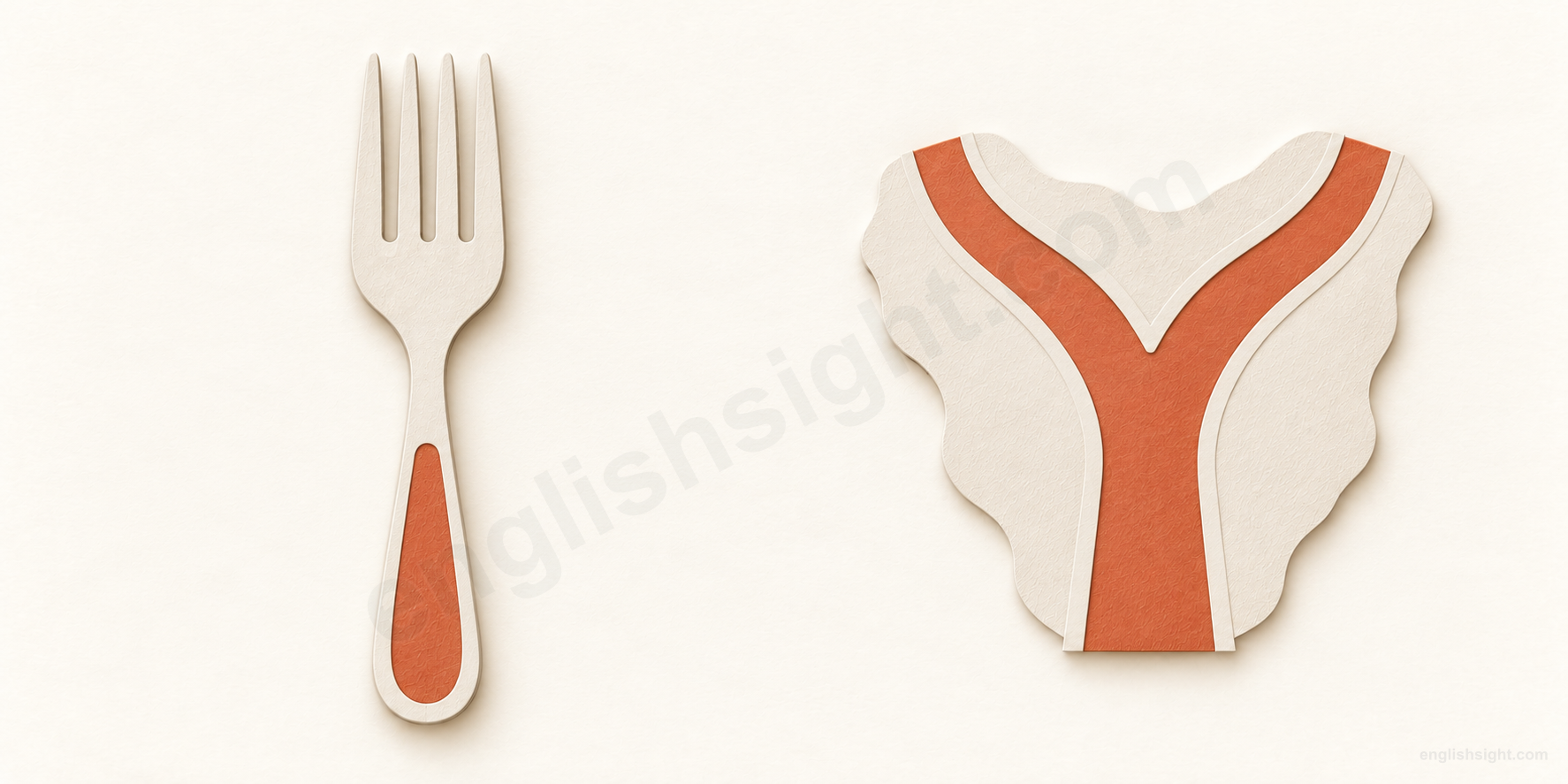
A table fork has four prongs joined to one handle.
fork
A path has one approach that divides into two branches.
Compare the connected base and separate ends.
The shared shape links a pronged tool with a branching route; neither object turns into the other.
A fork-shaped thing has a shared base with separate prongs or branches; a route forks when it divides into separate continuations.
The comparison links tools and branching shapes. It does not explain every specialized use or derive the payment expressions.
A fork can be the tool on your plate or the point where your path divides. A useful connection is a shared base with separate projecting parts or branches.
That shape is a teaching link between several senses, not a rule for inventing meanings. Fork out and fork over need their own explanations.
01
Eating, gardening, and using a fork
First identify the tool. As a verb, fork can say that this tool is used to move or work something.
01
a / the + fork; eat / pick something up + with a fork
a fork; with a knife and fork
a pointed utensil for holding or lifting food
Starting situation
You need something to pick up pieces of food.
Meaning in this situation
You use the points of a fork.
Fork names the tool; with introduces the instrument.
The noun is countable: a fork, two forks. Its points are called prongs or tines. A spoon has a bowl instead; a knife has a cutting blade.
At dinner you can ask, “Could I have a clean fork?” In with a knife and fork, the two utensils form a familiar pair; the phrase does not turn fork into a material or an uncountable noun.
In a sentence
Could you bring a fork for the salad?
Watch the difference Use with a fork for the instrument; on a fork describes food resting on it.
02
a garden fork; loosen / dig + soil + with a fork
a garden fork
a pronged tool for digging or lifting garden material
Starting situation
The bed contains compacted earth.
Meaning in this situation
A gardener loosens it with a strong fork.
Garden identifies a larger working tool, not a table utensil.
A garden fork has sturdy metal prongs and a handle. The shared shape connects it to the eating utensil, but its scale and job differ.
Say a garden fork when the context might otherwise suggest cutlery. A pitchfork is a related tool used for lifting loose material such as hay; the names should not be treated as interchangeable for every job.
In a sentence
We loosened the soil with a garden fork.
Watch the difference A spade has a broad blade; a fork has separate prongs.
03
fork + food + into / onto + destination
fork food onto a plate
move food by using a fork
Starting situation
A piece of potato is in the serving dish.
Meaning in this situation
Someone transfers it to a plate with a fork.
The food is the object; onto supplies its destination.
Fork can be a transitive verb: the person does the action, and the food is moved. The noun becomes a verb naming use of the tool.
Into and onto tell you where the food goes: fork a bite into your mouth; fork vegetables onto a plate. Fork does not itself mean eat, since you can transfer food without eating it.
In a sentence
Maya forked a piece of potato onto her plate.
Watch the difference Fork describes how food is moved; it does not by itself mean swallowing.
04
fork + material + into + soil; fork in + material; fork over + ground
fork compost in; fork over the soil
work or move material with a garden fork
Starting situation
Compost lies on the surface of a bed.
Meaning in this situation
Someone mixes it into the soil with a fork.
In indicates incorporation; over can indicate turning the earth.
Fork compost into the soil names the material and destination. Fork in some compost and fork some compost in describe working it into the bed; with a pronoun, say fork it in. The same tool-use verb can describe lifting loose material: They forked hay onto the wagon. Here onto gives the destination, rather than mixing the material into soil.
Fork over the soil means turn or loosen the soil with a fork. Here over concerns working the ground. In fork over the money, the same written combination has a different, established payment meaning.
The tool action can be ongoing or passive: We are forking compost into the bed; the compost was forked into the soil. These patterns do not apply in the same way to the intransitive road sense.
In a sentence
We forked the compost into the vegetable bed.
Watch the difference Read the object: soil suggests gardening; money suggests the informal payment expression.
02
Branches, directions, and choices
A route can have a fork, can fork, or can lead you to fork left. The subject and the construction tell you which relation is meant.
05
a fork in + road / path / river; at the fork; take the left / right fork
a fork in the road; take the left fork
the branching point or one branch of a route
Starting situation
A single path leads toward two onward paths.
Meaning in this situation
A traveler reaches the junction and chooses a branch.
At the fork locates the junction; the left fork names a branch.
The noun can identify the place of division or one of the resulting routes. Compare Wait at the fork with Take the left fork.
In a fork in the road, in identifies the route containing the junction. A river can also have forks; travel verbs such as take depend on whether someone is actually following a route.
In a sentence
At the fork, take the left fork toward the lake.
Watch the difference A fork is a branching layout; not every crossroads or street corner is a fork.
06
road / path / river + forks + place or direction
the path forks
a route divides into branches
Starting situation
The path continues as one route.
Meaning in this situation
Farther along, it has two separate continuations.
The path is the subject; nobody needs to split it deliberately.
The intransitive verb describes the layout: The path forks beyond the gate. It does not need an object or a person making the division.
Use a simple tense for this geographical description, normally not The path is forking. Forked in The path forked near the village describes the route in a past narrative, without necessarily saying that workers altered it then.
In a sentence
The path forks just beyond the wooden gate.
Watch the difference Distinguish The path forks from We fork left: the first describes the route, the second our choice.
07
fork left / right + at / after + landmark; fork left / right onto + road
fork left / right
follow a particular branch at a junction
Starting situation
You are approaching a divided road.
Meaning in this situation
You continue along its right branch.
The traveler is the understood subject of a direction.
In instructions, Fork right tells the listener which branch to follow. Right supplies the direction; fork indicates that the choice occurs where the route divides.
Turn right works in more situations, including an ordinary corner. Fork right specifically draws attention to a branching route. Left and right here are direction words, not objects being forked. For ordinary directions, use Fork right or We forked right, rather than a progressive form such as We were forking right.
In a sentence
Fork right after the stone bridge.
Watch the difference Do not use fork right for every right turn when there is no branching route.
08
be at / reach / face + a fork in the road
a fork in the road
a situation requiring a choice between different courses
Starting situation
You can continue your course or accept a full-time job.
Meaning in this situation
You must decide which direction your life will take.
A physical branching route becomes a comparison for a decision.
The figurative noun phrase frames a decision as choosing a route: continuing in one direction means following a different course from the alternative.
The expression does not guarantee that either option is better, or that every choice is permanent. The context must tell us what the options and consequences are.
In a sentence
After the job offer, Lena felt she was at a fork in the road.
Watch the difference A literal road is unnecessary in this figurative use; do not interpret it as a travel report automatically.
03
Recognizing a divided end
Some objects share the shape without being eating tools. Learn the object name and its function together.
09
a fork in + tree; a bicycle / front fork; forked + tail / end
a fork in a tree; a bicycle fork
a divided or pronged part of something
Starting situation
One tree trunk separates into two main limbs.
Meaning in this situation
The meeting place of the limbs forms a fork.
The shape connects the senses; the objects have different functions.
A fork in a tree is a branching part where limbs meet. A bicycle fork is the structure that holds the front wheel, with parts on either side of it; it is not an eating tool attached to a bicycle.
The adjective forked describes a divided shape: a forked tail or forked lightning. A snake’s forked tongue has a split tip. These are shape descriptions, whereas forked in She forked the hay is a past-tense verb describing tool use.
In a sentence
The bird rested in a fork in the tree.
Watch the difference A fork may name the branching part itself, not something that has broken off.
10
a tuning fork; strike / use + a tuning fork
a tuning fork
a two-pronged instrument that provides a reference note
Starting situation
A musician needs a note to tune to.
Meaning in this situation
A struck tuning fork gives a particular pitch.
The two-pronged shape explains fork; tuning identifies the purpose.
A tuning fork is a named instrument, not any fork used while playing music. Its two metal arms vibrate after it is struck, producing a reference note.
Learn the compound as a whole: tuning fork, plural tuning forks. The -ing form in this noun does not say that the object is currently tuning something by itself.
In a sentence
The teacher struck a tuning fork before the singing exercise.
Watch the difference A table fork is not normally a tuning fork; the name includes a specific function.
04
Informal expressions for paying
Fork out and fork over are established expressions. Their meanings need to be learned as whole combinations.
11
fork out (for + purchase); fork out + amount + for / on + purchase
fork out (for something)
spend money, often a large or unwelcome amount
Starting situation
Your laptop needs an expensive repair.
Meaning in this situation
You pay a bill you would rather have avoided.
The whole informal expression conveys spending, often with reluctance.
Fork out for a repair names what the payment buys. Fork out £180 for a repair also gives the amount. On can follow an amount too: fork out £180 on repairs.
The amount can be omitted when it is understood: I don’t want to fork out again. This is an established phrasal verb, not a prediction from the utensil picture. Pay is a more neutral choice for a formal message.
In a sentence
I had to fork out £180 for a laptop repair.
Watch the difference For introduces the thing paid for; the amount is direct: fork out £180, not fork out for £180 when naming the sum paid.
12
fork over + noun; fork + noun / pronoun + over (+ to + person)
fork over the money; fork it over
give or hand something over, especially money
Starting situation
A payment is due and someone asks for the money.
Meaning in this situation
The payer hands it over.
Over belongs to an informal transfer expression here.
Fork over often concerns money and can sound reluctant or demanding in context. Fork the money over to someone makes the recipient explicit. Compare the neutral hand over or pay.
This construction is separable: fork over the money or fork the money over. A personal pronoun goes between: fork it over, not fork over it. A command such as Fork it over! can sound abrupt; it is not a polite default request.
In a sentence
I finally forked it over to the mechanic.
Watch the difference Fork over the soil means work it with a garden fork; the object and context distinguish that literal use.
Let the object and construction guide you
Shape is a connection, not a universal definition
A table fork, a branching path, and a bicycle fork have a useful shape connection. A payment expression does not require any actual fork or division into branches.
Forms and grammar
The noun plural is forks. Verb forms are fork, forks, forked, forking; forked ends in /t/. Tool use permits an object, progressive forms, and a passive. Road-layout descriptions normally use a simple tense. Fork left is an intransitive direction, not a causative construction.
Coverage boundary
This lesson selects general tools, routes, shape expressions, music vocabulary, and informal payment expressions. Chess uses fork for a simultaneous attack on two pieces; that specialist sense is noted here without a tactics lesson. Computing forks, detailed machine parts, rare regional expressions, and the wider family of fork compounds are outside the taught scope.
Read the construction
Choose the expression that fits the situation and meaning.
1. The trail divides and you must follow its left branch. Which instruction fits?
2. You complain about an expensive repair. Which sentence expresses that payment?
3. You reluctantly hand over the money. Replace the money with it. Which word order fits?
4. Which sentence describes the layout of a path rather than a traveler’s choice?
Sources and teaching notes
Dictionary entries support the uses and constructions below. Explanations and examples are original; the shape comparison is a teaching aid.
The shared shape is a teaching connection, not an identical mental picture in every English speaker.