Connect form as a noun with form as a verb, then learn the branches that depend on context.
An identifiable arrangement
Parts acquire an identifiable arrangement
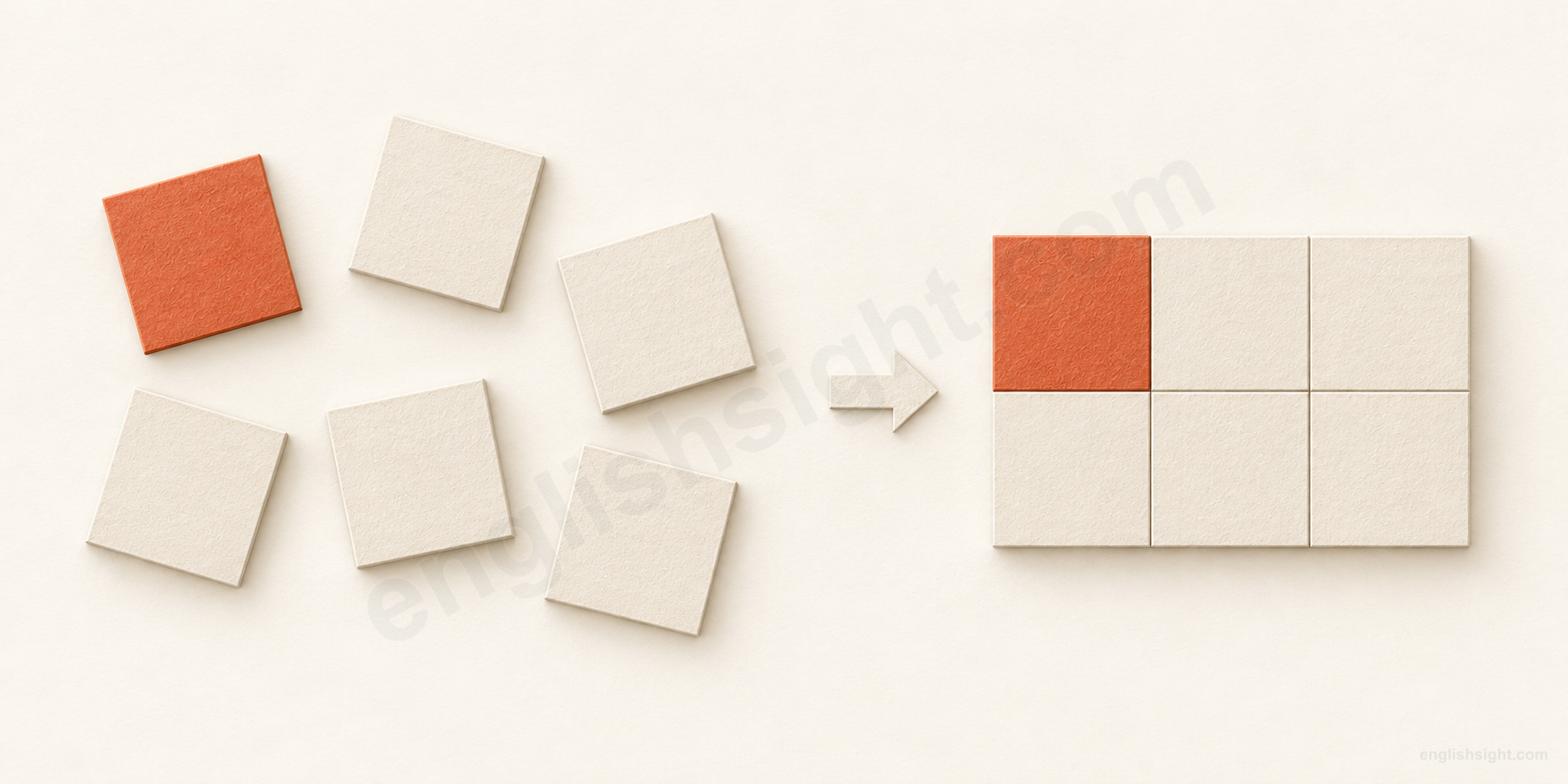
Six separate square tiles
form
Six tiles form one rectangle
The same tiles are arranged together.
The same six tiles form a rectangle through their arrangement.
Form is the shape or arrangement something has; to form can mean to make or come into an identifiable shape, structure, or existence.
The sketch illustrates arrangement and formation. Form can also describe what existing parts constitute. The document, school, and performance senses are learned branches, not literal rectangles.
A form may be an outline, a kind, or an organized way something exists. To form something often means to bring that shape or structure into being; something can also form without a deliberate maker.
This connection is a useful teaching model, not a rule that predicts every use. A form to complete, a school form, and being on form have established meanings that need their own contexts.
01
Shape, kind, and ways of presenting something
As a noun, form can name an outline, a variety, or the way something is expressed. Read the words around it to find the intended level.
01
the form of + noun; a shadowy / human form
the form of an object
its shape or recognizable outline
Situation / starting point
You notice a shape through fog.
Meaning / result
You describe the outline without identifying every detail.
Here form concerns visible shape, not the material or color.
Look first at the boundary: is the object long, round, narrow, or human-shaped? This use is close to shape. A shadowy form can name a person or object whose details you cannot make out.
The human form is a more descriptive or artistic way to talk about the shape of the body. For an ordinary question about a box, What shape is it? is usually simpler than What form does it have?
In a sentence
A dark form appeared between the trees.
Watch the difference A form here need not be a document. Context selects the outline sense.
02
a / one form of + noun; forms of + noun
a form of exercise
one type within a larger category
Situation / starting point
You compare ways of exercising.
Meaning / result
You classify walking as one kind of exercise.
The noun after of supplies the category.
A form of transport, entertainment, or treatment is one way that category occurs. Ask Is this a kind of it? rather than Does it have its outline? Walking is not shaped like exercise.
Use a form of for one variety and forms of for several. Some form of help leaves the exact kind open; it does not mean a partly completed application form. At a checkout, a form of payment is a payment method, such as cash or a card.
In a sentence
Walking is an inexpensive form of exercise.
Watch the difference Do not add a plural ending to an uncountable category: forms of transport, not necessarily forms of transports.
03
in + adjective / noun + form; in its + adjective + form
in written / digital form
in a particular medium, state, or version
Situation / starting point
You have information to send.
Meaning / result
You choose how it will be presented.
Form names how the information exists or is made available.
In written form contrasts with spoken delivery; in digital form contrasts with a physical copy. The information can stay similar while its presentation changes. In book form describes publication as a book.
In its present form and in its final form refer to the current or finished version of a proposal, law, or design. They need not concern a physical outline.
In a sentence
Please send the instructions in written form.
Watch the difference Ordinary medium expressions use no article: in digital form. Say in its final form when identifying a particular version.
04
in the form of + noun; take the form of + noun
in the form of… / take the form of…
as a particular manifestation or arrangement
Situation / starting point
An organization offers help.
Meaning / result
The help is provided as a travel pass.
The phrase identifies what the general thing amounts to in this case.
Help in the form of a travel pass means the pass is the actual help offered. It is not merely shaped like help. A meeting that takes the form of a discussion is conducted as a discussion.
Compare a cake in the form of a star, where a physical shape really is intended. Take the form of names the resulting type or structure; take form without of focuses on development.
In a sentence
The support came in the form of a free travel pass.
Watch the difference Keep the article in the established phrase in the form of; compare in digital form without the.
05
something takes form; give form to + noun
take form / give form to an idea
develop a definite structure or make an idea expressible
Situation / starting point
Your project begins as a vague possibility.
Meaning / result
Its structure becomes clearer during planning.
The result becomes more definite; no physical object has to be manufactured.
Take form describes something emerging or developing. Take shape is often a natural alternative. Take form can sound more formal, especially when describing an idea or plan.
Give form to an idea changes the viewpoint: someone turns it into an expression or structure that others can grasp. A drawing can give form to a design before anything is built.
In a sentence
The project began to take form during our discussion.
Watch the difference Take form is not the same as take a form from a desk: adding a changes the phrase and usually the meaning.
06
the + grammatical label + form of + word; form the plural / past tense; form letters / words / sentences
the past / plural form
a version of a word used in a grammatical setting
Situation / starting point
You need to talk about more than one child.
Meaning / result
You choose the word children.
A grammatical form belongs to a word and serves a grammatical purpose.
The plural form of child is children. The past form of go is went. These are not different topics or kinds of child and go; they are word forms used by grammar.
Form is also a verb in Form the plural by adding -s. The instruction tells you how to construct the required word. It does not say every plural follows that rule: child is an obvious exception.
Form can also mean produce the shapes or arrangement in writing: children learn to form letters, and words can be combined to form a sentence. In form letters neatly, form is a verb; in send a form letter, form letter is a noun compound for a standard message.
In a sentence
Children is the plural form of child.
Watch the difference Do not confuse a word’s form with its meaning: went and go share a lexical meaning but differ grammatically.
07
form and content; the form of + work; an art form
form and content / an art form
organization of a work, or a kind of artistic expression
Situation / starting point
You read a poem with a repeated pattern.
Meaning / result
You discuss its structure separately from its subject.
Form can concern how parts are organized; content concerns what is expressed.
In a poem, its lines, repetitions, and overall arrangement can matter to form; its events or ideas concern content. This comparison is useful even when there is no literal outline to trace.
An art form is a category of creative expression, such as dance or photography. Here the countable noun is closer to kind. In discussions of art, uncountable form often names the organizing aspect itself.
In a sentence
The poem’s form is simple, but its subject is difficult.
Watch the difference Do not assume form always means external appearance: internal arrangement matters in writing and music.
08
not / never + clause + in any (way,) shape or form
in any shape or form
in any variety or manifestation at all
Situation / starting point
You want a rule to include every kind of bullying.
Meaning / result
You reject exceptions based on how the bullying happens.
The full phrase emphasizes the breadth of a statement.
In any shape or form strengthens any: verbal, physical, online, or another kind all fall within the statement. It is often used with negatives or refusals.
In any way, shape or form is a longer variant. This is an established expression, not a claim about physical shapes. In some form or other instead leaves the particular variety unspecified.
In a sentence
We do not accept bullying in any shape or form.
Watch the difference Do not interpret shape and form as two separate physical requirements in this idiom.
02
Coming into being, arranging, and making up a whole
As a verb, form can describe a developing result, an action that produces it, or the existing contribution of parts to a whole.
09
form + material + into + result; be formed from / of / out of + material
form the dough into balls
give material a particular shape
Situation / starting point
You have one piece of dough.
Meaning / result
You shape it into several small balls.
The object is the material; into names the result.
In Form the dough into balls, someone acts on the dough. Form often directs attention to the resulting arrangement or outline. Shape the dough into balls would work too.
Reverse the viewpoint with Balls were formed from the dough. From or out of introduces source material; into introduces the result. Be formed of can describe the parts or material making up something. These prepositions do not create a family of separable particle verbs.
In a sentence
Form the dough into six small balls.
Watch the difference Say form it into balls, not form into it balls. The pronoun is the object of form, not of into.
10
form + line / queue / circle; form (people) into + group; form up
form a line / form into a circle
arrange people or things into a shape or group
Situation / starting point
People stand in different places.
Meaning / result
They arrange themselves in a circle.
People can do the arranging or become arranged themselves.
The children formed a circle makes the children the participants whose arrangement is circular. A circle formed describes the result appearing. Form the children into groups instead gives a separate organizer an object.
Everyone formed into a circle uses into to state the resulting arrangement. Form up means gather into an ordered group or line, often for an organized activity or drill: The teams formed up near the entrance. They formed themselves into teams makes the self-arrangement explicit with themselves.
In a sentence
The children formed a circle around the teacher.
Watch the difference A queue formed is active and intransitive; a queue was formed is passive. Both can be natural, with different emphasis.
11
something forms; something is formed by + cause
clouds form / be formed by…
come into existence through a process
Situation / starting point
Moisture is present in cooling air.
Meaning / result
Clouds begin to develop.
A result can emerge without a person deliberately making it.
Clouds are forming reports a process in progress. Form does not itself name the cause; surrounding words explain the conditions. Ice formed on the pond describes a result that came into being.
In The valley was formed by a river, the passive directs attention to the result and by supplies the cause. Do not insert be merely because the process happens without human control: Clouds formed is already grammatical.
In a sentence
Clouds are forming above the hills.
Watch the difference Has formed means the result has developed; has been formed is a passive construction and changes the viewpoint.
12
form + organization + (with somebody); an organization forms / is formed
form a team / company / government
establish an organized group
Situation / starting point
Neighbors want to organize a local event.
Meaning / result
They set up a team to run it.
Form concerns bringing the organization into existence, not simply joining it.
Someone can form a team, committee, band, or company with other people. The group may then continue for years. The band formed in April uses the group as subject without naming a separate founder.
A team was formed to organize the event is an ordinary passive. To organize expresses the team’s purpose, not a special form + person + to-infinitive construction. For causing someone to act, use an appropriate verb such as ask, get, or make.
In a sentence
The neighbors formed a team to organize the festival.
Watch the difference Join a team means become a member of an existing team; form a team means establish one.
13
form an opinion about / of something; form an impression of someone; form the view that + clause
form an opinion / impression / plan
develop a mental judgment or structure
Situation / starting point
You have heard only one person’s account.
Meaning / result
You wait for more information before deciding what to think.
Form describes a judgment coming together, not just being spoken aloud.
Form an opinion about an issue means arrive at a view of it. Form the view that the route is unsafe uses a that-clause to state the view’s content. The clause belongs with view; it is not an ordinary bare form that… pattern.
An idea formed in my mind describes mental development without an explicit maker. A fully formed plan is already worked out. The tile picture is only an analogy here: thoughts do not have to have a visible outline.
In a sentence
I need more evidence before I form an opinion about the proposal.
Watch the difference Form an opinion is not the same as express an opinion: you may develop a view privately and never state it.
14
form a habit (of + -ing); habits form
form a habit
develop a repeated way of behaving
Situation / starting point
You begin taking a short walk after lunch.
Meaning / result
Over time the action becomes a regular habit.
The repeated pattern develops; a single occurrence does not make a habit.
Form a habit and develop a habit both focus on a behavior becoming established. Habits form can describe the process without focusing on who starts it.
In form a habit of checking your calendar, of introduces what the habit consists of, and checking names an activity. Not every activity can replace habit directly after form: we normally say start exercising, not form exercising.
In a sentence
I am trying to form a habit of checking my calendar each morning.
Watch the difference The usual phrase is a habit of doing something. Do not transfer form a habit to unrelated actions without checking the collocation.
15
form a bond / relationship / friendship with + person
form a bond / friendship with…
develop an enduring connection
Situation / starting point
Two new colleagues work closely together.
Meaning / result
They develop trust and friendship.
The result is a relationship, not a visible group shape.
Form a bond with someone describes a connection developing. Form close friendships similarly concerns building relationships. The preposition with introduces the other participant.
Compare form a team with someone: that establishes an organization, whereas form a friendship with someone develops a personal relationship. The shared idea of something coming into being helps, but the object determines the actual result.
In a sentence
She formed a close friendship with her new neighbor.
Watch the difference Form is not a general substitute for meet: you can meet someone once without forming a bond.
16
something forms + character / attitudes; be formed by + influence
experiences form someone’s character
influence how a person or attitude develops
Situation / starting point
A child grows up caring for others.
Meaning / result
Those experiences influence the adult they become.
The subject shapes development rather than assembling physical pieces.
Experiences can form a person’s character; education can help form attitudes. This is a more abstract shaping use, close to mould or shape.
The passive her character was formed by these experiences changes the focus to the person’s development. Do not treat it as a claim that one experience controls everything about someone.
In a sentence
Years of caring for others helped form her character.
Watch the difference For an everyday account of influence, shape may sound more natural than form; neither normally takes a person plus an adjective as in make her happy.
17
X forms (a) part of Y; X forms the basis / core / bulk of Y; X forms Y
form part of / form the basis of…
make up a whole, a portion, or a functional element
Situation / starting point
A course includes several activities.
Meaning / result
You identify where the workshop fits.
Here form can describe an existing relationship, without an event of creation.
The workshop forms part of the course means it is included in the course. These reports form the basis of our decision means the decision relies on them. Form the core of names the central element.
Six tiles form a rectangle can describe their arrangement now, as well as suggest how it was made. Trees form a barrier describes what they collectively constitute. Compare The barrier formed overnight, which reports a change.
In a sentence
The workshop forms part of the training course.
Watch the difference Forms part of is correct without a. For a normal present relationship, use forms, not is forming, unless a developing process is intended.
18
form / present a united front (on / against + issue)
form a united front
act together to show a shared position
Situation / starting point
Members discuss an issue among themselves.
Meaning / result
They present a common position to others.
The front is a collective stance, not a line of bodies.
Form a united front means come together in support of a shared position. Present a united front emphasizes what outsiders see. The expression is useful in negotiations, family decisions, and workplace discussions.
This is a conventional metaphor involving the whole noun phrase. Form contributes bringing the united stance into being, but a literal drawing of tiles or a wall cannot explain the social meaning by itself.
In a sentence
The staff formed a united front against the proposed cuts.
Watch the difference A united front concerns shared outward action or opinion; it does not prove agreement about every private detail.
03
Forms to complete and forms at school
These established noun uses name a document, a standard message, or a school grouping. Learn their practical context rather than trying to draw them all from one picture.
19
fill in / out + a form; fill a form in / out; fill it in / out; complete / sign / submit a form
fill in / fill out a form
enter requested information in a structured document
Situation / starting point
A website asks for your application details.
Meaning / result
You enter your answers and submit the document.
A form provides fields to complete; it can be electronic or on paper.
An application form requests information for an application. Order, booking, and consent forms serve other purposes. Fill in a form is especially British; fill out a form is especially North American. Complete a form is a neutral alternative.
Both particle constructions can put a noun object before the particle: fill the form in or fill the form out. With a pronoun, use fill it in or fill it out. Sign and submit describe later actions; simply filling in a form does not necessarily send it.
In a sentence
Fill out the application form before you submit it.
Watch the difference Use a form or forms for documents. Do not use form a form to mean complete one: form is not the normal verb for entering answers.
20
send / receive a form letter
a form letter
a standard letter used for many recipients
Situation / starting point
You ask a company a specific question.
Meaning / result
Its reply repeats a standard message.
Form identifies a reusable pattern of wording, not a page of questions.
A form letter is a standard message sent to many people, sometimes with names or details changed. You may recognize that it does not answer your individual concern.
Contrast an application form, which you complete with answers. A form letter usually supplies the sender’s standard text. Learn this compound as a unit rather than assuming every form is something to fill in.
In a sentence
I asked for an explanation but received a form letter.
Watch the difference Do not tell a recipient to fill out a form letter unless you really mean a template with blanks to complete.
21
in a school form; a form teacher; in / join the sixth form
a school form / the sixth form
a school class, or a senior stage of secondary education
Situation / starting point
You read information from a British school.
Meaning / result
You interpret form as an educational grouping.
These school terms do not describe paperwork.
Form can mean a class at school, especially in older British terminology. A form teacher is responsible for a class or tutor group; the exact arrangement depends on the school.
The sixth form is an established term for the senior stage, commonly for students aged 16–18 studying courses such as A levels. It is not the same as American sixth grade. A sixth-form college provides this stage outside an ordinary school’s sixth form.
In a sentence
My sister will join the sixth form next year.
Watch the difference Do not translate sixth form as grade six. The age and qualification context matter.
04
Technique, performance, and familiar patterns
Form also concerns how someone performs or behaves. Fixed expressions distinguish skill, current condition, typical behavior, and social convention.
22
good / poor + activity + form; improve / maintain your form
good running / swimming form
the way a skilled movement is performed
Situation / starting point
A coach watches how you move.
Meaning / result
The coach comments on your posture and movement pattern.
Technique is about how you perform an action, not simply the result.
Good form in a physical activity concerns movement that meets the activity’s standards. Your arm position or balance may matter even if you are not winning.
Compare being in good form, which often concerns current fitness or performance, and bad form as a judgment of manners. Articles and surrounding words help keep these uses apart.
In a sentence
The coach helped me improve my running form.
Watch the difference Being physically fit does not automatically mean having good technique, so form can require more context.
23
be on / off form; be in top / good form; be out of form; return to form
on form / off form / in top form
performing well or below the usual level
Situation / starting point
A player has had several disappointing games.
Meaning / result
Today the player performs well again.
The expressions describe current performance or condition, not a physical shape.
On form means performing well; off form means below the usual level. These phrases are especially British. In top form and in good form describe a strong condition for performing. Out of form describes a poor condition or standard.
Back on form and a return to form mean a recovery of a good level. On current form judges what is likely from recent performance: On current form, they should reach the final. None of these predicts a guaranteed result.
In a sentence
After a slow start, the goalkeeper is back on form.
Watch the difference Form in this performance sense is uncountable: good form, not a good form. A good form can instead mean a good type or document.
24
be in good / great / fine form
in good form at a party
healthy, lively, or cheerful in company
Situation / starting point
You meet a friend at a celebration.
Meaning / result
The friend seems energetic and enjoys talking.
Good form can concern someone’s social energy rather than competitive performance.
In British conversation, She was in good form can mean she seemed well and cheerful. At a party, telling stories and laughing can make that meaning clear.
Without context, in good form might instead concern sport or fitness. It is not a medical judgment, and it does not mean the person filled in paperwork correctly.
In a sentence
Nina was in great form at dinner and kept us all laughing.
Watch the difference Do not confuse in good form with good form as polite behavior: the latter evaluates manners, not mood.
25
true to form, + clause; behave true to form
true to form
behaving as is typical or expected
Situation / starting point
A friend usually arrives early.
Meaning / result
The friend arrives early again.
Form refers to a familiar pattern, not necessarily a good standard.
True to form links the present event to a known tendency. The tendency may be admirable, annoying, or neutral. The phrase often introduces a whole sentence as a comment.
Compare on form, which praises the quality of someone’s current performance. A player can be true to form by playing badly if that is what people have come to expect.
In a sentence
True to form, Maya arrived early and helped set up the room.
Watch the difference True here means consistent with an expected pattern; it does not make form a synonym for factual truth.
26
it is / is considered good / bad form to + verb
It is bad form to…
judge behavior by social expectations
Situation / starting point
A guest shares someone else’s private news.
Meaning / result
Others judge that behavior impolite.
This is a judgment about manners, not athletic performance.
It is bad form to do something means the behavior is socially inappropriate. Good form expresses the opposite. The wording can sound old-fashioned, particularly as a British social judgment.
The to-infinitive names the behavior being judged: bad form to interrupt. In ordinary conversation, rude or impolite may communicate the same point more directly.
In a sentence
It is bad form to share a private message without asking.
Watch the difference Bad form is uncountable in this expression: do not add a. Compare a badly designed form, which is a document.
27
what is the form (for / when…)?; as a matter of form
What’s the form? / as a matter of form
an expected procedure or a conventional formality
Situation / starting point
You do not know the usual way to request something.
Meaning / result
You ask about the procedure or follow a required convention.
A customary pattern can be followed even when it adds little substance.
What’s the form? asks what people normally do in a situation. This use is especially British and less neutral internationally than What’s the procedure?
As a matter of form means because custom or procedure requires it. We asked again as a matter of form suggests the question was conventional rather than a genuine attempt to reopen the issue. It need not be a legal requirement.
In a sentence
They had already agreed, but we asked again as a matter of form.
Watch the difference A matter of form does not mean a question about document design. Read it as an established expression about convention.
Read the object, preposition, and context
Noun or verb?
A form and two forms are countable nouns when they name documents, varieties, or shapes. Form is often uncountable in discussions of performance, technique, or manners. Verb forms are form, forms, formed, forming; progressive and passive forms are natural when the meaning supports them.
Creation or composition?
A queue formed reports development. The six tiles form a rectangle can describe their present arrangement. Ask whether the sentence reports a change or explains what something consists of; form does not always mean a new event.
Form is more selective than make
Form works naturally with groups, structures, opinions, habits, and shapes. It is not a general replacement for make in make dinner, make a mistake, or make someone happy. Nor does it normally mean fill in when the object is an application form.
Patterns are not all phrasal verbs
In form dough into balls, into introduces the result. In form a bond with someone, with introduces the other participant. Form up is a particle use for assembling in order. Fill in and fill out are particle verbs headed by fill; form is their noun object.
Limits of the picture and selection
The arrangement picture supports several connections; it does not claim that every speaker imagines tiles. This lesson selects useful modern senses and recognizable expressions, without a frequency ranking. Specialist philosophy, taxonomy, printing, construction moulds, the old bench and hare-rest meanings, and British slang have form are not developed here.
Choose the meaning from the pattern
Decide whether form describes a document, a developing result, an existing structure, or a conventional expression.
1. A website asks you to enter your name and address. Which instruction fits?
2. A workshop is already included in a course. Which sentence describes that relationship?
3. You shape clay so that it becomes a bowl. Which pattern puts the material before the result?
4. A player who has been playing badly performs well again. Which comment fits?
5. You develop a view privately but do not tell anyone. Which sentence matches?
6. In British school information, what does join the sixth form normally mean?
Sources and teaching notes
Usage was checked against the dictionary pages below. The explanations, examples, and arrangement sketch are original teaching material; the visual model does not establish the history of every sense.
The diagram illustrates one connection in meaning, not a mental image shared by every English speaker.