Find the reference point, then let the construction tell you what moves ahead.
Direction depends on a reference
Direction depends on a reference
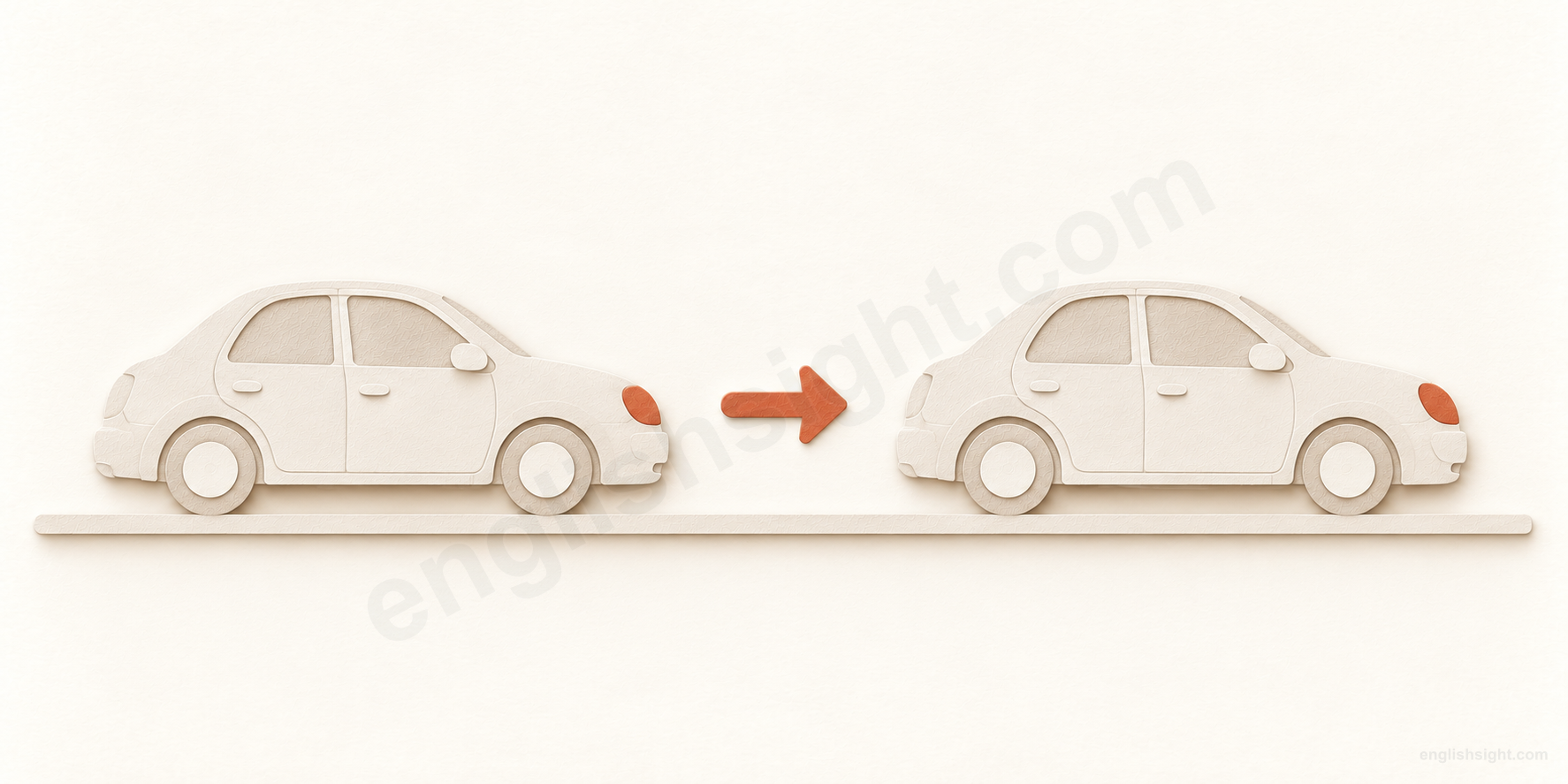
The car faces along the road.
forward
The same car is farther along, facing the same way.
It moves toward its own front.
The car moves toward its own front. Forward is relative to its orientation, not a fixed compass direction.
Forward points toward the front, or onward from a reference point; the surrounding construction determines which kind of direction or continuation is meant.
The sketch illustrates physical direction with the same car before and after moving. Progress and time can be understood through an ahead metaphor, but fixed expressions and social or sports senses must also be learned in context.
Forward often directs something toward the front or onward from a reference point. That point may belong to a vehicle, a process, a sequence of times, or a chain of communication.
This connection is a teaching model, not a claim that all meanings follow one rule or that every speaker sees the same mental picture. Calendar changes, social judgments, and fixed expressions need their own explanations.
01
The front and the direction ahead
First identify what counts as the front. Forward can describe movement, orientation, or a position; it does not always describe an action.
01
movement / orientation verb + forward(s)
move / face / lean forward
toward the front, or facing the front
Starting situation
A car is facing along a clear road.
Result or interpretation
It moves in the direction of its own front.
Forward gives a direction relative to an orientation.
In Drive forward a little, drive names the action and forward supplies its direction. Face forward describes orientation; Lean forward describes changing the angle of your body. Neither requires traveling to a new place.
The front may be a person’s facing direction or the front of a vehicle. Turning around changes the relevant orientation. Forward is not a compass direction and does not inherently mean right.
Forward and forwards are both adverbs of direction. Forwards is especially common in British English. Compare a forward movement: the adjective before a noun normally has no final -s.
In a sentence
Drive forward a little, then stop beside the gate.
Watch the difference Forward is an adverb here, not a preposition taking a destination directly: move forward to the line. Move can also take an object: move the chair forward.
02
be + further / farther forward; forward + noun; forward of + reference point
further forward / the forward cabin
in or near the front part
Starting situation
You compare seats in a long vehicle.
Result or interpretation
One seat is nearer the front.
A forward position can be stationary.
The seat is further forward locates it; nothing needs to move. Further or farther forward compares positions. In The forward cabin is quiet, forward is an adjective describing the cabin’s location.
Forward of the mast means in front of the mast. This compact expression is especially used for ships, aircraft, and technical descriptions; in front of is easier in ordinary conversation.
Forward movement describes movement toward the front, while a forward cabin describes where something is. Use the noun and context to distinguish direction from location.
In a sentence
Our seats are further forward, near the front of the bus.
Watch the difference Do not use forwards as the adjective: a forward cabin, not a forwards cabin.
03
move / rock / travel + backwards and forwards; know + something + backwards and forwards
backwards and forwards
repeatedly in opposite directions
Starting situation
A chair tilts one way.
Result or interpretation
It tilts back again, repeatedly.
The pair describes alternating directions, not steady progress.
Rock backwards and forwards describes repeated movement in opposite directions. Travel backwards and forwards between two towns describes repeated journeys, not necessarily traveling while facing backward.
The shorter back and forth is another natural way to describe this alternation. The complete paired expression supplies the repeated pattern.
Know something backwards and forwards is a separate idiom meaning know it thoroughly: After ten years here, I know the building’s layout backwards and forwards. No physical journey is implied.
In a sentence
The chair rocked backwards and forwards as he waited.
Watch the difference Do not interpret know it backwards and forwards as knowing a route in two travel directions only.
02
Continuing and making progress
A process can move forward without moving through space. Some expressions stress improvement, others determination or carrying a balance into the next record.
04
move / go forward (with a plan); a step forward (in something); a way forward
move forward / a step forward / the way forward
continue or make progress toward a result
Starting situation
A team is stuck on a problem.
Result or interpretation
It finds a useful next action.
Ahead in a process can mean progress rather than physical distance.
We need to move forward can ask people to continue instead of remaining stuck. Go forward as planned can mean proceed; a step forward highlights an improvement. The context decides whether actual success has occurred.
A way forward is a workable approach to the next stage: We need a way forward on the budget. Way is the approach, not a physical road.
Compare moving the chair forward, which changes its location. In a discussion, forward is often a metaphor for development, but continuing a bad plan does not guarantee improvement.
Carry a project forward means help it continue or advance: Her work carried the project forward. With a balance as the object, carry forward instead names the accounting transfer explained below.
In a sentence
Agreeing on a budget gives us a way forward.
Watch the difference Forward does not promise that a plan will succeed or that everyone approves of it.
The amount continues into the next record rather than disappearing.
Carry the balance forward transfers the total to the next page or column. Bring the balance forward looks at the same transfer from the new record. An account may label the amount brought forward.
The phrase is separable: carry it forward. It also occurs in accounting discussions of amounts transferred into a later period; detailed tax eligibility depends on rules outside this language lesson.
This use preserves an amount for the next record. It does not mean send money to another person or make the amount larger.
In a sentence
Carry the remaining balance forward to the next page.
Watch the difference A balance brought forward is an opening amount, not necessarily a new payment.
07
one step forward, two steps back
one step forward, two steps back
progress followed by setbacks that leave things worse
Starting situation
You solve a small problem.
Result or interpretation
A larger setback removes that gain and more.
The contrast expresses frustrating net loss.
The saying compares a gain with a bigger reversal. The numbers are usually figurative: fixing one fault and discovering several worse ones can feel like one step forward, two steps back.
A step forward by itself stresses progress. Adding two steps back reverses that positive evaluation; it is not a plan for literal footwork.
In a sentence
We fixed the leak but damaged the ceiling—one step forward, two steps back.
Watch the difference Use the whole saying for setbacks; forward alone does not carry the negative meaning.
03
The future, anticipation, and changing times
Time is often imagined as a sequence ahead of us. Learn the whole construction: a meeting brought forward becomes earlier, while a clock put forward shows a later time.
Looking ahead in time is different from feeling excited about an event.
Look forward can mean direct your attention to the future: We should look forward instead of arguing about last year. Forward planning means planning ahead. A forward-looking organization considers future needs and changes.
Compare Look forward to the trip, which means anticipate it with pleasure. Planning can involve unwelcome risks; it does not necessarily express excitement.
This is a time-based extension of ahead. The planning context, rather than the physical sketch alone, supplies the meaning.
In a sentence
A little forward planning will help us avoid a last-minute rush.
Watch the difference Use forward planning, not forwards planning. Forwards is an adverb variant, not the normal adjective form.
09
look forward to + noun / pronoun / -ing form
look forward to something / doing something
anticipate something with pleasure
Starting situation
You expect a visit that you will enjoy.
Result or interpretation
You feel pleased while waiting for it.
The full expression adds positive anticipation.
Look forward to the visit means feel pleased about the expected visit. In I’m looking forward to seeing you, to is a preposition, so the following verb takes -ing.
Do not separate this expression: look forward to it, not look it forward to. The progressive I’m looking forward to… is natural. The simple I look forward to hearing from you is also conventional in correspondence.
Compare I expect a reply, which can be neutral. I’m not looking forward to the exam expresses a lack of pleasure or dread, even though the exam is still expected.
In a sentence
I’m looking forward to meeting your family.
Watch the difference Say looking forward to meeting, not looking forward to meet.
10
from + time expression + forward
from that day forward
starting at a stated time and continuing afterward
Starting situation
A particular day marks a change.
Result or interpretation
The new situation continues after that day.
From fixes the starting point; forward extends the time range beyond it.
From that day forward can introduce a continuing habit or situation after a change. From now forward similarly starts at the present; from now on is an easy conversational alternative.
The construction can sound solemn or narrative, especially from this day forward. It does not mean that the situation happened only on the named day.
The start can be in the past. Forward here follows the sequence from that reference time, not necessarily from the present.
In a sentence
From that day forward, she kept a spare key with a neighbor.
Watch the difference Do not treat forward as a tense marker; the verb tense still locates the situation in time.
The phrase sets the time frame rather than describing literal walking.
Going forward often introduces a future policy or intention in business and formal discussion. Moving forward can serve the same function.
Compare We are moving forward with the project, which says we are continuing it. In Moving forward, we will meet weekly, the opening phrase means from now on.
In the future and from now on are plain alternatives. The expression by itself does not prove improvement.
In a sentence
Going forward, we will send one weekly update.
Watch the difference Read the whole sentence: future time and actual progress are related but distinct uses.
12
bring / put + event + forward (from old time to new time / by an interval)
bring / put a meeting forward
reschedule it for an earlier time
Starting situation
A meeting is scheduled for Friday.
Result or interpretation
It is rescheduled for Wednesday.
The appointment comes nearer in the schedule.
Bring the meeting forward from Friday to Wednesday makes it earlier. Put the meeting forward can also mean this, especially in British usage. A date after to tells you exactly when it will now happen.
These combinations are separable: bring it forward or put it forward. The passive is natural: The meeting has been brought forward.
By two days states the amount of change; to Wednesday states the new date. Bare move the meeting forward can be interpreted differently, so give both dates when precision matters.
Compare put a clock forward, where the displayed time becomes later. Scheduling and clock adjustment use different conventions; a single arrow cannot decide both.
In a sentence
We brought the meeting forward from Friday to Wednesday.
Watch the difference Do not assume that forward always means later in time. State the old and new times explicitly.
13
put / set + clock(s) + forward; the clocks go forward
put the clocks forward
adjust clocks to display a later time
Starting situation
The clock shows one o’clock before an official change.
Result or interpretation
It is adjusted to show two o’clock.
The clock display advances; an appointment is not being made earlier.
Put the clocks forward is familiar in British English when daylight saving time begins. In North American English, set the clocks ahead is a common equivalent.
The clocks go forward describes the change without naming who adjusts them. Put them forward names an action performed on the clocks.
Forward here makes the displayed time later, for example from one to two. Whether and when a country changes its clocks is a separate practical question.
In a sentence
We put the kitchen clock forward from one to two.
Watch the difference Compare a meeting brought forward: the meeting becomes earlier, but the clock display becomes later.
14
fast-forward + recording; fast-forward to + later point; press fast forward
fast-forward (to…)
skip ahead in a recording or story
Starting situation
A recording is at an unwanted introduction.
Result or interpretation
You reach a later point without watching the intervening part.
The compound adds rapid advancement or skipping.
Fast-forward the recording or fast-forward to the next scene moves to a later point without playing the intervening material normally. Press fast forward refers to the control.
In a story, Fast-forward ten years can jump directly to a later period: Fast-forward ten years, and the shop has become a museum. This does not claim that real time actually speeds up.
The compound verb is normally written fast-forward. Forward the recording to Maya instead means send it to Maya; that is a different verb use.
In a sentence
Fast-forward to the part where she explains the answer.
Watch the difference Forward a video to someone sends it; fast-forward a video skips ahead within it.
04
Bringing ideas and people into consideration
Ideas can be presented for discussion, people can be nominated, and witnesses can offer information. These are established verb combinations with different participants.
15
put / bring + idea / matter + forward; put forward + noun; put / bring it forward
put / bring a proposal forward
present an idea for consideration
Starting situation
An idea has not yet been discussed by the group.
Result or interpretation
The group has the idea before it for discussion.
An idea comes into attention rather than moving across the floor.
Put forward a suggestion, theory, or argument presents it for consideration. Bring a matter forward can introduce it for discussion too. Neither expression says the group accepts the idea.
With a noun, put forward a proposal and put a proposal forward are possible. With a pronoun, use put it forward. A passive is natural: Several alternatives were put forward.
Bring the proposal forward in a meeting can mean present it. Bring the meeting forward changes its date. The object and situation help select the meaning.
In a sentence
Maya put forward a cheaper alternative at the meeting.
Watch the difference A proposal put forward has been suggested, not necessarily approved.
16
put + person / person’s name + forward for / as + role; push yourself forward
put yourself / someone forward
suggest a person as a candidate
Starting situation
A role needs someone to fill it.
Result or interpretation
A person is proposed for selection.
Nomination brings a person into consideration; it is not appointment.
Put Nina forward for team leader proposes her as a candidate. Put yourself forward means offer your own name. Put someone’s name forward is another familiar form.
With a pronoun, put the person between put and forward: put her forward. With a noun phrase, both put Nina forward and put forward a candidate are possible. For introduces the role, and as can identify the proposed capacity.
Push yourself forward emphasizes making people notice you, sometimes with an unfavorable suggestion of self-promotion. It does not always involve a formal nomination.
In a sentence
I’d like to put Nina forward for team leader.
Watch the difference Being put forward does not mean being chosen. Use the reflexive yourself when the candidate and proposer are the same person.
17
come / step forward (with + information / to + verb / as + role)
come / step forward
offer help or information openly
Starting situation
Someone has useful information but has not offered it.
Result or interpretation
They make themselves available and share it.
The person offers a contribution; physical movement is optional.
A witness who comes forward offers information. A volunteer can come forward to help. Step forward can also mean offer help or information.
Come forward with information names what is offered. Come forward to help uses a to-infinitive to state the purpose. Neither means that someone else nominated the person.
Step forward two paces is literal movement. Come forward as a witness can be done by contacting the police remotely; it need not involve walking toward anyone.
In a sentence
Two neighbors came forward with useful information.
Watch the difference Come forward is intransitive in this use: come forward with information, not come information forward.
05
Sending on and helping something develop
As a verb, forward takes an object. It can send information or goods onward, redirect mail, or, in formal writing, help a cause or career develop.
18
forward + something + to + someone; forward + someone + something; be forwarded to
forward an email / a package
send information or goods onward to a recipient
Starting situation
You have received a message relevant to a colleague.
Result or interpretation
You send it on to that colleague.
As a verb, forward names the sending action and takes an object.
Forward this email to Sam asks you to pass the message on. Forward Sam this email is also possible. With a pronoun object, Forward it to Sam is a clear choice.
The verb can also describe sending goods, requests, or other information onward. It is common as an email command; some other administrative uses sound formal.
The request was forwarded to the accounts team is a normal passive. I’m forwarding the receipt now describes an action in progress. This is an ordinary verb, not a phrasal verb made from for and ward.
Collins also records the countable noun a forward for an email sent on to another recipient: That message is a forward from Jo. In this context it names the message, not a sports player.
In a sentence
Could you forward the booking email to Sam?
Watch the difference Forward the email to Sam sends the message. Fast-forward skips ahead in a recording.
19
forward + mail / calls + (from old destination) + to new destination; forwarding address
forward mail to a new address
send mail onward from an old or incorrect destination
Starting situation
A letter arrives at someone’s former home.
Result or interpretation
It is sent on to where they now live.
The intended person remains the same, but the delivery address changes.
Forward my mail to the new address asks someone to redirect letters arriving at the old address. A forwarding address is the address to which they should be sent.
The letter was forwarded from our old flat to our new house identifies both stages of delivery. This differs from forwarding an email to an additional reader.
Phone calls can also be forwarded to another number. In each case the communication is routed onward; forwarding does not itself mean writing a reply.
In a sentence
Please forward any letters for me to my new address.
Watch the difference A forwarding address is where mail should go next, not necessarily where it first arrived.
20
forward + abstract goal / cause / career
forward a cause / career
help something develop or advance
Starting situation
A cause needs practical support.
Result or interpretation
Someone’s work helps it advance.
This formal verb means further or advance, not send a file.
Forward a cause means help its development or success. Forward someone’s career similarly means help the career advance. This use is formal and especially familiar in writing.
The abstract object makes the meaning clear. In everyday speech, help the cause, advance her career, or move the project forward may be easier choices.
Forward the proposal to a manager describes sending it. Forward the cause of safer roads describes helping a goal; it does not require any message or address.
In a sentence
Her research helped to forward the cause of safer roads.
Watch the difference Do not interpret every forward + object as sending; a cause cannot be emailed in this sense.
06
Social judgments, sports, and fixed expressions
Keep these branches distinct. A forward player, a forward question, and paying it forward cannot be understood by replacing every forward with ahead.
21
be (too / rather) forward; be being forward
be too forward
behave with more confidence or familiarity than seems appropriate
Starting situation
You have only just met someone.
Result or interpretation
A personal question may cross a social boundary.
This adjective evaluates behavior, not direction of travel.
You are being rather forward can criticize someone for being too bold, personal, or familiar. I hope I’m not being too forward can soften a personal question or request.
Confident can praise self-assurance; forward in this social sense often suggests that the confidence goes too far. Direct means saying things plainly and need not imply this social criticism.
The spatial idea of coming to the front may help memory, but the judgment of appropriateness is conventional and depends on context. It is not the same as a forward-looking attitude.
In a sentence
I hope I’m not being too forward, but may I ask why you left?
Watch the difference Do not use He is forward as a neutral translation of He is confident; it can sound critical.
22
a forward; two forwards; play as a forward
a forward / play as a forward
a player in an attacking or front-position role
Starting situation
A coach assigns positions in a team.
Result or interpretation
One player takes a forward role.
The noun names a role, not the direction of a single movement.
A forward is a countable sports noun. In sports such as football, hockey, and basketball it names a position associated with the front or attacking part of a team; exact duties depend on the sport.
She plays as a forward identifies her role. Pass the ball forward uses the adverb to describe a direction. A forward pass uses the adjective before pass.
Plural forwards can therefore mean several players. It can also be the adverb variant or the verb form in She forwards messages; the sentence structure tells you which.
In a sentence
The coach selected two forwards for the match.
Watch the difference A player can be a forward while standing still or moving backward; the noun identifies a team role.
23
put + possessive + best foot forward
put your best foot forward
try hard or behave in a way that makes a good impression
Starting situation
You face a demanding task or an important first meeting.
Result or interpretation
You make an effort to do well or show yourself favorably.
The idiom concerns effort or self-presentation, not which foot moves first.
Put your best foot forward can encourage a determined effort at a difficult task. Merriam-Webster identifies this effort sense as British and distinguishes a US sense of behaving well to gain approval.
At an important first meeting, I tried to put my best foot forward can mean that you tried to show your best qualities and make a good impression. The context can emphasize self-presentation rather than the difficulty of the task.
Your changes with the person: she put her best foot forward; we put our best foot forward. Collins COBUILD marks its cheerful, determined use old-fashioned; that label should not be applied automatically to every use in every region.
Do your best is a plain alternative for effort; make a good impression emphasizes how others see you. Neither guarantees success.
In a sentence
We put our best foot forward when presenting the plan.
Watch the difference Do not translate it as an instruction about the left or right foot.
24
pay it forward
pay it forward
respond to kindness by helping another person
Starting situation
Someone helps you.
Result or interpretation
You help a different person in turn.
Kindness continues to another recipient instead of returning to the original helper.
Pay it forward means pass kindness on. After receiving help, you do something helpful for another person. The helpful act need not involve money.
Pay someone back can return money or repay a favor to the original person. Pay it forward directs the response toward somebody else.
Learn this fixed expression as a whole. It does not mean prepay a bill, forward an email, or literally push a payment toward the front.
In a sentence
A stranger helped me carry my bags, so I paid it forward by helping another traveler.
Watch the difference The new recipient matters: helping the original helper is paying them back rather than the central pay-it-forward pattern.
25
a forward slash; type / add a forward slash
a forward slash
the symbol /, especially in computer addresses
Starting situation
You are spelling out a website path.
Result or interpretation
You name the separator between its parts.
The compound is a name for a symbol.
A forward slash is /. It separates parts of an internet address or path. When reading an address aloud, people often simply say slash.
A backslash is the opposite-sloping symbol \. These names distinguish the marks; they do not describe text moving forward or backward.
Do not confuse forward with foreword, which names an introductory section of a book. The spellings identify different words.
In a sentence
Type a forward slash between “help” and “contact”.
Watch the difference Use / for the forward slash, not the backslash \.
Check the word class and the whole expression
Forward and forwards
Forward is the normal adjective and base verb. Forward and forwards can both be directional adverbs, especially in British English. Forwards also occurs as the plural sports noun and as a present-tense verb: two forwards; she forwards messages. Do not add -s to the adjective in forward planning.
Earlier meetings, later clock displays
Bring the meeting forward conventionally means make it earlier. Put the clock forward advances the time shown. Give the old and new dates or times if a scheduling instruction might be misunderstood.
An adjective can evaluate behavior
Being too forward means being more bold or familiar than the situation seems to allow. It is not a neutral synonym for confident and does not mean physically standing near the front.
Grammar belongs to the construction
Verb forms are forward, forwards, forwarded, forwarding. Forward a message permits a progressive and a passive. Put it forward is separable; look forward to it keeps its preposition before the object. Learn these patterns individually instead of treating every verb plus forward alike.
Scope of this lesson
This is a selection of modern uses and useful expressions, not a frequency ranking or every technical compound. Finance contracts, detailed tax rules, specialized sports positions, advanced-growth adjective uses, archaic eagerness, and bookbinding terminology are not expanded. The car explains direction; it does not prove those other meanings.
Choose the meaning and construction
Use the object, time expression, and situation to interpret forward.
1. The meeting was brought forward from Friday to Wednesday. What changed?
2. The kitchen clock was put forward from one to two. What happened?
3. You are pleased about a visit that has not happened yet. Which sentence is standard?
4. Nina has been put forward for team leader. What can you conclude?
5. A colleague needs an email you received. Which request asks you to send it onward?
6. A person says, “I hope I’m not being too forward,” before asking a personal question. What are they concerned about?
Sources and teaching notes
Dictionary headwords and expression entries were consulted for meanings and patterns. Explanations and examples are original. The visual connection is a teaching interpretation.
The sketch shows direction relative to the car’s front; other uses need their sentence context.