Recognize fowl as a bird category, a food word, and part of established names and an idiom.
Different birds, one category
Different birds, one category
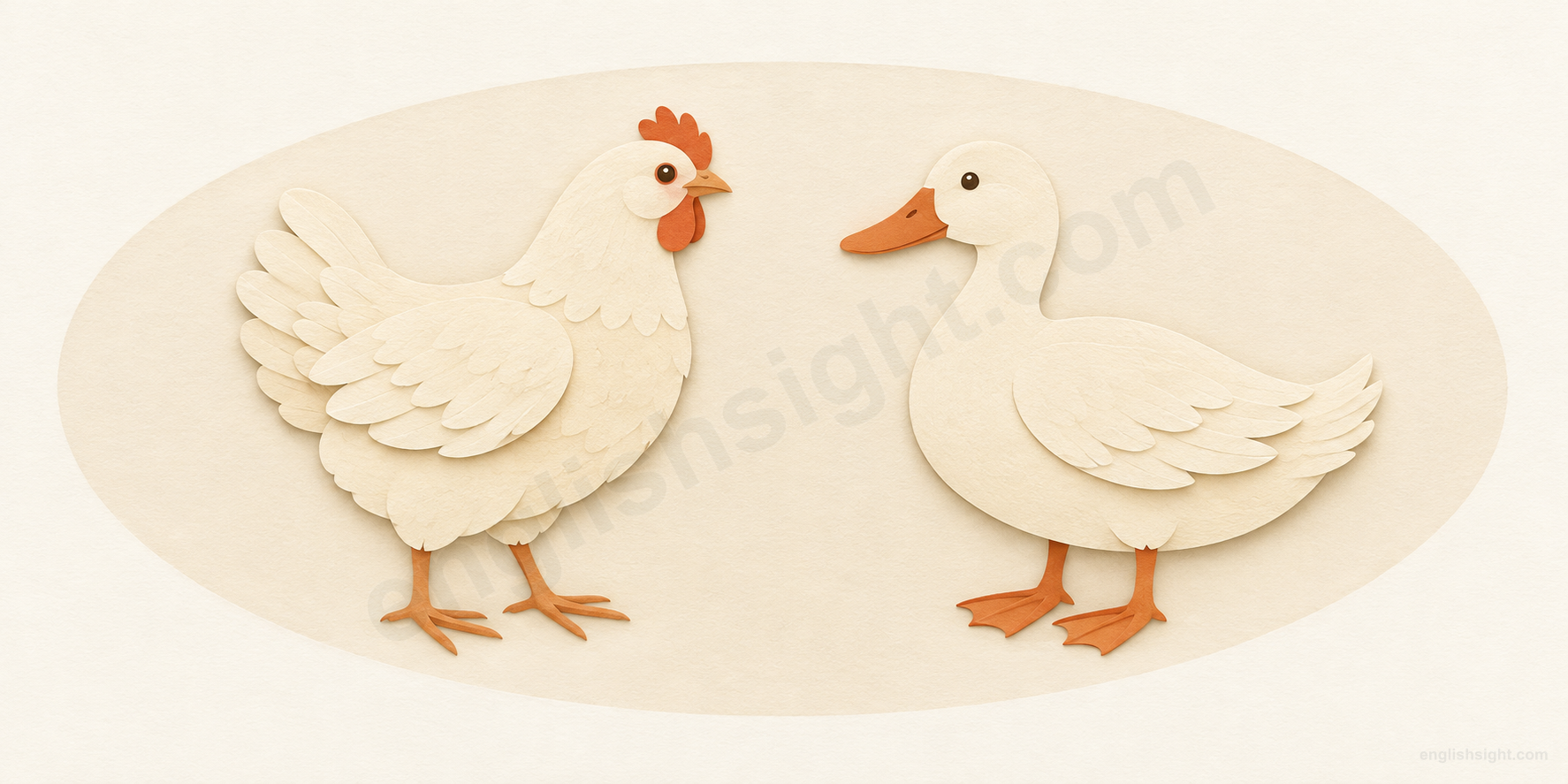
A chicken and a duck are different kinds of bird.
fowl
One category includes different kinds of bird.
Both can be grouped as fowl in a poultry context.
The shared oval groups a chicken and a duck as examples of fowl. It marks a category, not movement or a change of species.
Fowl names birds considered as poultry or game, and can also name their meat.
A chicken and a duck illustrate the poultry branch. Wild bird names and the classification idiom need their own context; the enclosure is not part of the definition.
You may meet fowl in a farm description, an older recipe, a bird name, or the phrase neither fish nor fowl. The surrounding words tell you whether you are looking at living birds, meat, or a figurative comparison.
Start with a chicken and a duck considered as members of a category. That provides a useful teaching picture, while the entries below show where the word narrows or extends beyond it.
01
Birds on a farm: category and counting
Start with the living birds. Choose a species name when you need precision, and notice whether fowl names one bird or several.
01
keep / raise + fowl; fowl such as + bird names
keep fowl
keep birds such as chickens or ducks as farm animals
Situation / context
A small farm has chickens and ducks.
What the expression tells us
The owner describes the birds as a group.
Fowl is a category label; it does not identify one species.
An owner can keep or raise fowl, then name the kinds separately: chickens, ducks, or turkeys. Keep describes looking after the birds; fowl supplies the animal category. The phrase does not itself say how many birds there are.
For ordinary birdwatching, use bird or the species name: a robin, for example. Fowl often directs attention to farm birds or game birds, so it is not a neutral replacement for bird in every sentence.
Poultry overlaps with the farm meaning: it groups birds kept for eggs or meat. Compare We keep poultry with We keep six fowl. The second counts individual birds; do not form a singular animal by saying a poultry.
In a sentence
They keep fowl, mainly chickens and ducks, behind the house.
Watch the difference If the species matters, say chicken, duck, or turkey rather than expecting fowl to identify it.
02
a domestic fowl; domestic fowl; barnyard fowl
domestic fowl
a domestic chicken, or poultry more broadly in some contexts
Situation / context
You read a label beside a chicken breed.
What the expression tells us
You understand which sense of the category is intended.
Domestic fowl has a narrower chicken sense as well as a broader use.
In a breed description, domestic fowl can name the domestic chicken, including both male and female birds. Domestic describes the kind of animal as domesticated; it does not mean that the bird lives inside a house.
You may also meet domestic fowl used more broadly for poultry. Read the surrounding list or description before deciding whether chickens alone are intended. Barnyard fowl is another expression used for domestic chickens.
Hen identifies a female chicken in this setting, while rooster identifies a male. Fowl alone does not always tell you the sex; a dictionary may also record a more restricted use for an adult hen.
In a sentence
The display describes this chicken breed as a variety of domestic fowl.
Watch the difference Do not assume every instance of domestic fowl includes ducks, or that every fowl is female.
03
a / one fowl + singular verb; several / number + fowl or fowls + plural verb
one fowl, several fowl
count individual birds with either accepted plural form
Situation / context
You count the birds in a pen.
What the expression tells us
You report one bird or a number of birds.
The plural can be fowl or fowls; agreement follows the number meant.
Fowl is countable when it names an individual: a fowl or one fowl. Both fowl and fowls are accepted plurals. Several fowl and several fowls can therefore describe more than one bird.
The form without -s does not force a singular verb. Compare One fowl is outside with Three fowl are outside. A number, determiner, and context reveal whether the noun is singular or plural.
A flock of fowl describes the birds as a group. In One flock is nearby, flock is the head of the subject; this is different from Several fowl are nearby.
In a sentence
One fowl is near the gate, and three fowl are beside the shed.
Watch the difference Do not change three fowl are to three fowl is just because fowl has no -s.
02
From the bird to the food
In a kitchen or on a menu, the same word can refer to the meat. Grammar distinguishes food in general from a whole bird.
04
serve / eat + fowl; roast + a / the whole fowl
roast fowl / a whole fowl
poultry meat, or one complete bird prepared as food
Situation / context
A recipe discusses meat and then a whole bird.
What the expression tells us
You distinguish the food category from a countable item.
The animal-to-food link is clear, but countability depends on the reference.
Without an article, fowl can mean meat: a sauce served with roast fowl is served with cooked poultry meat. A whole fowl, in contrast, counts one complete bird for cooking. The food use need not identify the species.
Compare We served fowl with We roasted a fowl. The first names what people ate; the second presents one bird as the item roasted. For a specific meal, chicken, duck, or turkey is usually more informative.
Some older market or cookery usage distinguishes a mature fowl from a young chicken. Do not apply that age distinction to every modern occurrence. Roast describes the preparation; it is not part of a special idiom.
In a sentence
We roasted a whole fowl and served it with rice.
Watch the difference Fowl as meat has no ordinary serving plural: say two portions of fowl when you mean servings.
03
Read the whole bird name
Waterfowl, wildfowl, and guinea fowl have their own established ranges. The extra element helps identify the birds; it does not create a new verb pattern.
05
a waterfowl; waterfowl + plural verb; migrating waterfowl
waterfowl
birds associated with water, especially swimming birds such as ducks and geese
Situation / context
You watch ducks and geese on a lake.
What the expression tells us
You describe them using an established group name.
Water narrows the bird category by habitat and way of life.
Waterfowl is written as one word. Ducks and geese are clear examples. A reference to migrating waterfowl can concern living birds in a nature reserve; it does not imply that anyone is keeping or cooking them.
The term is especially associated with swimming birds, rather than being a precise label for every bird seen beside water. A bird standing on a beach is not automatically a waterfowl.
The plural commonly has the same written form: These waterfowl are resting. Waterfowls is also recorded. Learn the compound as a noun, not as an action involving water.
In a sentence
Ducks and other waterfowl rested on the lake during their journey south.
Watch the difference Waterfowl can be wild or domesticated; the name alone does not settle that question.
A reserve describes the wild birds that visit its marsh.
What the expression tells us
You connect the name with wild game birds rather than farm birds.
Wildfowl and waterfowl overlap, but the emphasis differs.
Wildfowl is also one word. It is used for game birds, especially wild ducks and geese. Game here identifies a kind of bird hunted for food or sport; it does not mean a toy or a contest.
A reserve can protect wildfowl. Calling birds wildfowl does not mean they are being hunted in that particular place. Wild points away from domesticated stock; waterfowl instead emphasizes association with water.
Do not build the meaning by treating wild as badly behaved: a noisy chicken on a farm is not thereby a wildfowl. The established group name supplies a narrower interpretation.
In a sentence
The marsh provides a quiet place for wildfowl to feed.
Watch the difference Wildfowl is not the ordinary name for every wild bird; a wild sparrow is simply a wild bird.
07
a guinea fowl; keep / serve guinea fowl
guinea fowl
a named kind of bird, often recognized by spotted plumage
Situation / context
You see a rounded bird with spotted feathers on a farm.
What the expression tells us
You identify a particular kind rather than all poultry.
The complete name identifies the bird.
Guinea fowl names a kind of African bird also raised for food elsewhere. The familiar form has a small, largely bare head and pale spots across dark feathers. This is a specific bird name, unlike the broad category fowl.
The same name may appear on a menu, where it refers to that bird as food. Compare The farm keeps guinea fowl with We ordered guinea fowl: keeps and ordered provide the living-animal and meal contexts.
Learn the two words together. Fowl contributes the bird category, but the name is established vocabulary, not a rule that lets you invent any place name plus fowl.
In a sentence
A guinea fowl with spotted feathers walked past the henhouse.
Watch the difference Guinea fowl is not another name for an ordinary chicken, although both may be kept as poultry.
04
When ordinary categories do not fit
The familiar fish-and-fowl contrast also appears in an idiom about things that are difficult to classify.
08
something + be + neither fish nor fowl
neither fish nor fowl
difficult to classify as one recognizable kind or another
Situation / context
A course mixes a travel guide with a language textbook without a clear identity.
What the expression tells us
A reviewer says it fits neither category satisfactorily.
The whole expression transfers a contrast between animal categories to classification.
Use be neither fish nor fowl about something that does not fit a clear category. It can suggest an awkward mixture rather than praising versatility. The subject can be a book, course, policy, or other hard-to-classify thing.
Neither … nor … excludes both alternatives. In this established expression, fish and fowl stand for contrasting categories; the book or policy is not literally an animal. Fowl alone does not mean confusing or mixed.
Keep the conventional wording when using the idiom. If you only mean that a dish contains no fish or poultry, say that directly: the literal dietary statement and the figurative judgment answer different questions.
In a sentence
As a travel guide and a language course, the book is neither fish nor fowl.
Watch the difference This idiom does not simply mean both useful things at once; it often questions a clear identity or purpose.
Choose the right category and context
Bird, chicken, poultry, and fowl
Bird is the general everyday category. Chicken names a particular kind; poultry groups birds kept for eggs or meat. Fowl can count individual birds and also occurs in broader game-bird uses. These words overlap without being interchangeable everywhere.
Fowl and foul sound alike
Fowl /faʊl/ names birds or their meat. Foul has the same pronunciation but a different spelling and meaning: a foul smell is an unpleasant smell, and a foul in sport is an action that breaks a rule. Write fowl for the birds; sound alone will not distinguish the words.
Recognize the uncommon verb
Dictionaries also record an intransitive verb fowl, meaning hunt or catch wild game birds: fowled, fowling. Treat this as a recognition note rather than an everyday alternative to hunt. The noun lesson needs no passive, causative, or particle-verb family.
Older and narrower uses
Older writing may use fowl for a bird of any kind; that is not a reliable guide for present-day conversation. Adult-hen and mature cooking-bird uses are also narrower than the broad poultry category. Read the passage rather than imposing one definition on every occurrence.
A picture has a limited job
The diagram groups two farm birds. It does not show all birds that can be called fowl, explain the whole idiom, or represent a mental picture shared by every English speaker.
Read the category and grammar
Use the context, the number, and the complete expression to choose an interpretation.
1. You counted four live birds. Which sentence uses the unchanged plural correctly?
2. A menu says “fowl served with rice.” What does fowl most naturally refer to here?
3. A notice mentions waterfowl on the lake. Which group is a clear example?
4. A reviewer calls an app “neither fish nor fowl.” What is the reviewer most likely saying?
5. A breed label says “domestic fowl” beside a chicken. What should you infer?
Sources and teaching notes
Dictionary entries were consulted for senses, forms, names, and the idiom. The explanations, examples, and category sketch were created for this lesson.
The diagram is a teaching aid, not a picture shared by every native speaker.