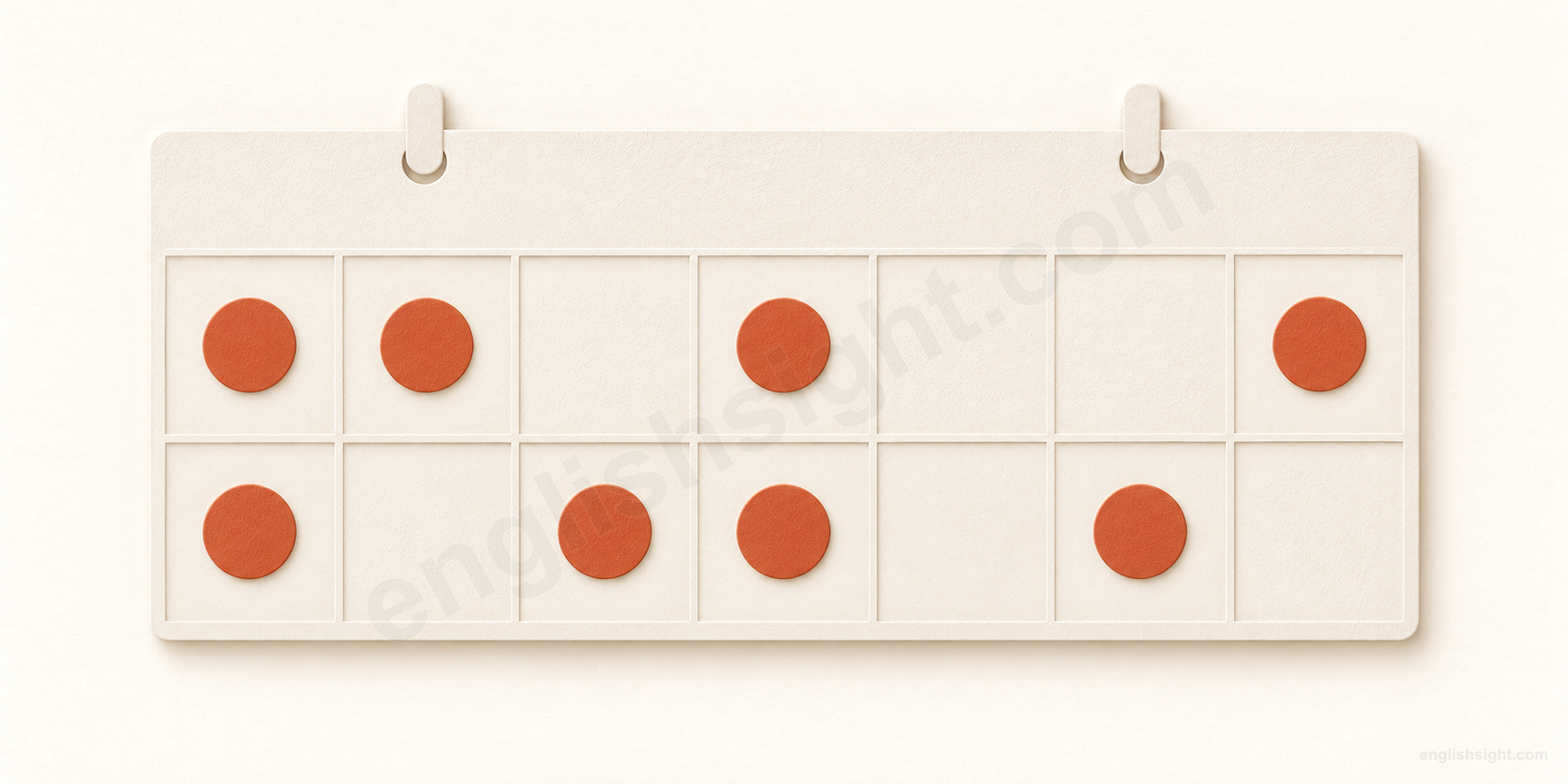
Use frequent for what happens often, and recognize the more formal verb for visiting a place often.
Repeated occurrences within a time span
Repeated occurrences, with room between them
A two-week period provides the time frame.
frequent
Eight event marks show repeated occurrences with unequal gaps.
The same kind of event recurs on separate days.
Similar events recur often; the gaps need not be equal.
Similar events occur many times within a relevant span of time; the gaps need not be equal.
The noun or verb construction tells us what recurs. A frequent visitor makes repeated visits; to frequent a place means to visit it often. The model does not set a universal rate or imply constant activity.
Frequent directs attention to recurrence: something happens again and again within the relevant period or setting. It does not give a fixed count, require equal gaps, or say each event lasts a long time.
The calendar below is a teaching model for repeated occurrences, not a claim that all English speakers imagine the same picture. The visiting verb shares the idea of repetition but has its own sentence structure.
01
Events, services, and people
Identify what happens often: an event, a service, or the activity associated with a person.
01
frequent + event / activity noun
frequent changes / interruptions
events that happen often
Situation
The schedule changes several times during the week.
What you can say
You describe the changes as frequent.
Frequent describes how often events occur, not how large or serious each one is.
In frequent changes, the noun identifies the recurring event. The same pattern works with calls, mistakes, headaches, visits, and breaks. Each occurrence can be brief or long; frequent does not measure its duration.
Compare one long interruption with frequent interruptions. The first expression describes length; the second describes recurrence. The calendar model marks separate occurrences, rather than one unbroken activity.
Frequent use of a tool means using it often. Use here is an activity noun, so it can be singular even though the activity recurs.
In a sentence
Frequent changes to the schedule make it hard to plan.
Watch the difference Frequent does not automatically mean bad: frequent breaks can be welcome, while frequent interruptions can be annoying.
02
a frequent + service; frequent + plural transport noun
a frequent bus service
a service with many departures or arrivals
Situation
Buses arrive many times during the hour.
What you can say
Passengers have frequent services to choose from.
The service is frequent because it operates often, not because each journey is fast.
A frequent service provides repeated opportunities to travel. Frequent trains and frequent flights similarly refer to how often they run, not the number of vehicles you can see at one moment.
Frequent stops describes repeated stopping during a journey. A route can have frequent departures and still be slow because its trains make many stops. Neither phrase promises punctuality.
In a sentence
There is a frequent bus service between the station and the beach.
Watch the difference A fast service concerns journey time; a frequent service concerns how often it runs.
03
a frequent + person noun (+ to / of + noun)
a frequent visitor / user
a person who does the named activity often
Situation
Mina visits the library many times.
What you can say
You call Mina a frequent visitor.
The activity comes from visitor, customer, traveller, or user; frequent says that it recurs.
A frequent visitor visits often, and a frequent user uses the relevant service or product often. The noun supplies the activity; frequent alone does not tell us what the person does.
A visitor to the library names the destination. A user of the library names what is used. These prepositions belong to the nouns, not to a general frequent to or frequent of construction.
Say Mina is a frequent visitor or Mina visits frequently. Mina is frequent does not normally express this meaning about a person.
In a sentence
Mina is a frequent visitor to the library.
Watch the difference Frequent visitors may arrive at irregular times. The expression does not require a fixed appointment.
02
Describe and compare frequency
Name the setting, compare rates, describe intervals, or use the related adverb with an action.
04
event + be / become + frequent (+ in / among + noun)
be frequent in / among…
occur often in a particular setting or group
Situation
You compare reports from different areas.
What you can say
You identify the setting where an event occurs often.
In names a setting; among names a group within which cases occur.
Frequent can follow be: Power cuts are frequent. It can also follow become: Power cuts have become frequent. These are adjective uses, not the visiting verb.
In this area limits the claim to a place. Among new learners limits it to a group: This mistake is frequent among new learners. These phrases describe the context in which occurrences are counted.
Common often overlaps here. A common mistake is widespread or often encountered; frequent highlights repeated occurrence. Neither word itself tells you how serious the mistake is.
In a sentence
Power cuts are frequent in this area during storms.
Watch the difference Use an event as the subject in this pattern. For a person’s habit, choose a frequent visitor or visits frequently.
05
more / less / most frequent; become + more / less frequent
more / less frequent
happening more or less often than a comparison point
Situation
You compare calls this month with calls last month.
What you can say
You describe a change in their frequency.
Compare occurrences over comparable periods or conditions.
More frequent calls means calls happen more often. Less frequent calls means they happen less often. Very frequent describes a high rate without naming a comparison; the most frequent compares one item with the others in a set.
The calls have become less frequent describes a change over time. It does not say they have stopped completely. How frequent are the updates? asks how often they happen.
Infrequent means not happening often. The prefix in- changes the adjective to its opposite; it does not mean happening inside something.
In a sentence
Her calls have become less frequent since she started the new job.
Watch the difference Use more frequent, not more frequently, after become when describing the calls. In She calls more frequently, the adverb describes calls.
06
verb + at frequent intervals
at frequent intervals
again and again with relatively short gaps
Situation
A notice appears several times during a broadcast.
What you can say
You describe the repeated appearances and their gaps.
An interval is a gap between occurrences; frequent says those gaps are relatively short.
At frequent intervals is a useful time expression for repeated checks, reminders, or announcements. The preposition is at in this established combination.
Regular intervals emphasizes a pattern, often equal spacing. Frequent intervals emphasizes recurrence with short gaps. The descriptions can overlap, but frequent does not by itself promise equal gaps.
What counts as frequent depends on the activity: several announcements during one hour and several visits during one year use different practical reference points. There is no universal number built into the word.
In a sentence
A reminder appears on the screen at frequent intervals during the lesson.
Watch the difference An annual event can be regular without being frequent in everyday conversation. Regular also has an often sense, so the two words are not strict opposites.
07
frequently + verb; verb + frequently; frequently + past participle
frequently; frequently asked questions
often, when describing an action or state
Situation
You want to describe how often people ask a question.
What you can say
You use the adverb with asked.
The related adverb modifies an action or description rather than naming a different visiting action.
Compare We make frequent visits with We visit frequently. Frequent describes the noun visits; frequently describes the verb visit. Frequently is close in meaning to often.
Frequently asked questions are questions that people ask often. FAQ is the familiar abbreviation. The adverb modifies asked, which describes questions; this is not the verb frequent.
Ordinary positions include We frequently check the page, We check it frequently, and The page is frequently updated. Word order follows the clause; the adjective cannot replace the adverb in these examples.
In a sentence
The help page answers frequently asked questions about opening an account.
Watch the difference Say We visit frequently or We make frequent visits, not We visit frequent.
03
A familiar travel expression
Frequent flyer is an established name for a person who often travels by air.
08
a frequent flyer / flier; a frequent-flyer programme / program
a frequent flyer / flier
someone who often travels by plane
Situation
A traveller takes many commercial flights.
What you can say
An airline may offer that traveller rewards.
The noun flyer supplies air travel; frequent describes repeated flying.
Frequent flyer and frequent flier are both established spellings. The expression describes a person who often travels on commercial flights, especially in connection with airline reward schemes.
A frequent-flyer programme or program is an airline reward scheme associated with repeated travel. In I joined the airline’s frequent-flyer programme, the compound describes the type of programme.
Membership alone does not prove how often someone currently flies. The reward scheme is an established travel use of the expression, not a separate meaning of frequent as free or discounted.
In a sentence
As a frequent flyer, Asha collects points on her work trips.
Watch the difference Frequent flyer is a person, not a plane that travels quickly. Flyer does not mean a paper advertisement in this expression.
04
The more formal verb
Frequent can also be a verb meaning to go to a place often. Its object and passive forms need their own grammar.
09
person / group + frequent + place
frequent a café / place
go to a particular place often
Situation
A group returns to the same café over time.
What you can say
A writer describes the café as a place they frequent.
The visitor is the subject and the place is the direct object.
The verb frequent means to visit or spend time in a place often. It is marked formal in learner’s dictionaries. In everyday conversation, often go to or visit often may fit more easily.
In Students frequent this café, students do the visiting and this café is the destination. No to is needed: frequent already takes the place directly as its object.
The forms are frequent, frequents, frequented, and frequenting. The adjective normally stresses the first syllable, FREE-kwuhnt; the verb commonly stresses the second, fri-KWENT. Some American dictionaries also record first-syllable stress for the verb.
In a sentence
After rehearsals, the musicians frequent a café near the theatre.
Watch the difference Do not say frequent to the café. This verb is about habitual visits, not simply making any action frequent.
10
place + be frequented by + visitors; place + frequented by + visitors
be frequented by…
be a place that particular visitors often go to
Situation
Tourists repeatedly visit a market.
What you can say
You describe the market by the people who often go there.
The place becomes the subject of the passive; by names the visitors.
The market is frequented by tourists describes habitual visiting from the place’s viewpoint. It does not report only one visit or say the visitors are there at this moment.
A market frequented by tourists is a shortened description with the same passive relationship. The place receives the visits, and by tourists identifies who makes them.
Less frequented paths are paths people use or visit less often. Here frequented is the verb’s participle; compare frequent visitors, where frequent is an adjective before a person noun.
In a sentence
The small market is frequented by visitors from nearby towns.
Watch the difference The market is frequent does not mean that people often visit it. Use is frequented, or say it has frequent visitors.
Keep frequency, grammar, and context distinct
Frequent, regular, and constant
Frequent focuses on recurrence. Regular can describe a repeating pattern or something done often, so it sometimes overlaps. Constant can suggest something continuing without a break, although constant interruptions can also mean very repeated interruptions. Check the whole phrase rather than treating these words as exact equivalents.
There is no fixed threshold
Frequent is relative to the activity and context. A statement about a symptom’s frequency is language description, not a medical diagnosis. The word itself says nothing about safety, severity, or an exact number of times.
Adjective, adverb, or verb?
Frequent visits uses the adjective; visits frequently uses the related adverb; frequents the café uses the formal verb. For comparison, use more frequent or less frequent. The related noun frequency names how often something happens; technical meanings of frequency are outside this lesson.
Scope and fixed combinations
Frequent has no everyday particle-verb family to learn here. The visiting verb allows ordinary active and passive forms; no special causative pattern is needed. Historical meanings such as crowded or familiar and the rare spatial sense of things positioned close together are outside this modern everyday selection.
Choose what happens often
Identify the word class, the recurring activity, and what the sentence actually claims.
1. A bus service is frequent. What does this tell you?
2. Mina visits the museum often. Which sentence naturally describes this habit?
3. Choose the correct formal verb pattern for people who often go to this café.
4. A market is frequented by tourists. What does this mean?
5. Choose the correct form when describing how often someone checks a page.
Sources and teaching notes
Dictionary entries were used to check meaning, grammar, and register. Explanations, examples, and the calendar model were created for this lesson; the model is a teaching interpretation.
The calendar illustrates recurrence; it does not represent a picture shared by every native speaker.